

If you're staring at an old corrugated roof in Gosford, Woy Woy, Terrigal or anywhere across the Central Coast and wondering whether it's asbestos, you're not alone. A lot of owners first notice the issue when they plan a reroof, a knockdown, solar removal, or repairs after weather damage. That's usually the point where a simple roofing job turns into a hazardous materials job.
The part many people miss is that asbestos roof removal isn't only about taking old sheets off safely. It affects who can enter the site, when waste leaves, when other trades can start, and whether your broader renovation keeps moving or grinds to a halt. If you understand that early, you'll make better decisions and avoid the usual mistakes.
Is It Asbestos and What Are My Options
A lot of older homes around the Central Coast, Sydney and Newcastle still have cement-based corrugated roof sheeting that owners casually call fibro. Some of it contains asbestos. Some of it doesn't. You cannot confirm it by eye alone.
You can, however, spot warning signs without disturbing it. Age of the home matters. So does the look of the sheeting, the profile, weathering, old fixings, and whether the material appears brittle or chalky. The key point is simple. If you suspect asbestos, don't drill it, pressure clean it, snap a corner off, or climb over it to “have a better look”.
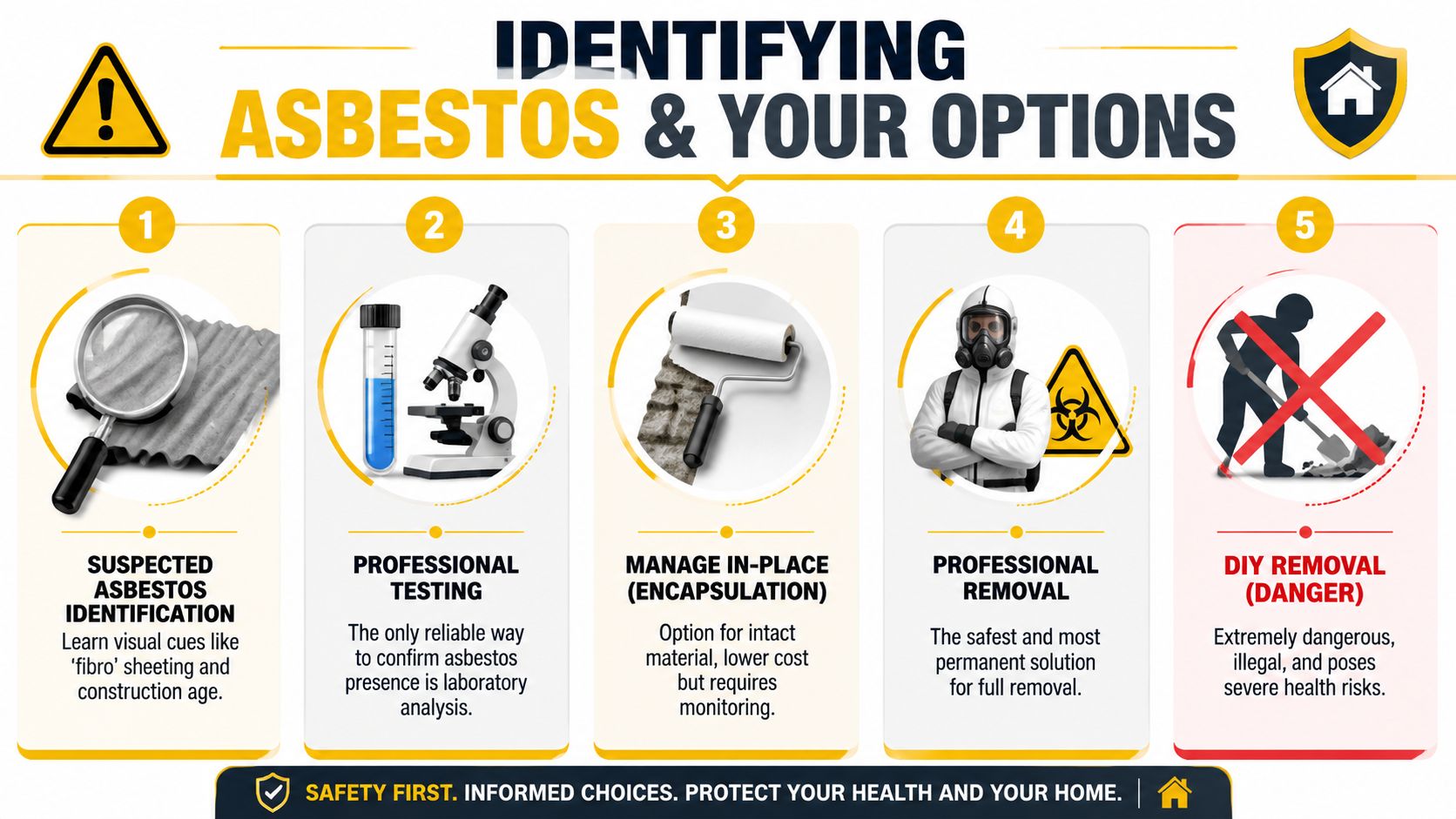
If you want a plain-English guide to early visual signs before you arrange testing, this article on how to identify asbestos sheeting is a useful starting point. It won't replace testing, but it helps you avoid the usual guesswork.
What you can check without touching it
Stand back and assess from ground level or from a safe position. Look for these practical clues:
- Older roof sheets: Homes and outbuildings from earlier eras are more likely to contain asbestos cement sheeting.
- Surface breakdown: If the sheet edges look furry, flaky or heavily weathered, that's a warning sign. Damage increases risk.
- Previous patch jobs: Sealants, mismatched screws, cracked ridge capping and patched penetrations often tell you the roof has already been disturbed.
- Future works planned: If you're about to reroof, demolish, install skylights, or replace framing, the risk changes because the roof won't stay untouched.
Practical rule: Treat any suspect roof as asbestos-containing until a competent assessment and proper testing prove otherwise.
Leave it, seal it, repair it, or remove it
Homeowners usually want a straight answer. The right choice depends on condition, access, how much life is left in the roof, and what you plan to do with the property.
A frequently missed question is whether a “leave it alone for now” approach is safer and cheaper than removal when the roof is intact but nearing end of life. NSW health guidance stresses that asbestos roofing can become dangerous when disturbed and that work involving asbestos must follow strict controls, which is why the decision between short-term containment and a full replacement strategy matters so much for owners dealing with Australia's legacy asbestos burden, as noted in this asbestos roof removal discussion.
Here's how that plays out on the ground.
| Option | Where it can make sense | Where it falls down |
|---|---|---|
| Leave in place | The roof is intact, stable, and won't be disturbed soon | It's only a holding pattern. Ongoing monitoring matters |
| Encapsulation | Surface sealing may suit material that's still sound and accessible | It doesn't remove the hazard. Future works still have to deal with it |
| Localised repair | Limited defects where disturbance can be tightly controlled | Patchwork on an ageing roof can become false economy |
| Full removal | End-of-life roofing, major deterioration, planned renovations, redevelopment | Higher upfront disruption, but it resolves the issue properly |
Consider a weathered roof on an older Gosford home where the owner wants to replace gutters now and reroof later. On paper, encapsulation looks cheaper. In practice, if the sheets are brittle, trades still need to work around them, and you already know a new roof is coming, you may be paying twice. That's the trade-off.
The decision most owners regret delaying
If the roof is damaged, heavily weathered, or likely to be disturbed by upcoming works, delay usually creates more complexity, not less. Coordinating around suspect asbestos slows roofers, demolition crews, scaffolders and carpenters. It can also complicate council and insurer conversations if the site condition worsens.
The safest approach is the one that matches both the material condition and your project plan. A roof that's untouched and stable is one thing. A roof that's nearing the end, leaking, or standing in the way of the next stage is another.
Why DIY Asbestos Removal Is a Dangerous Gamble
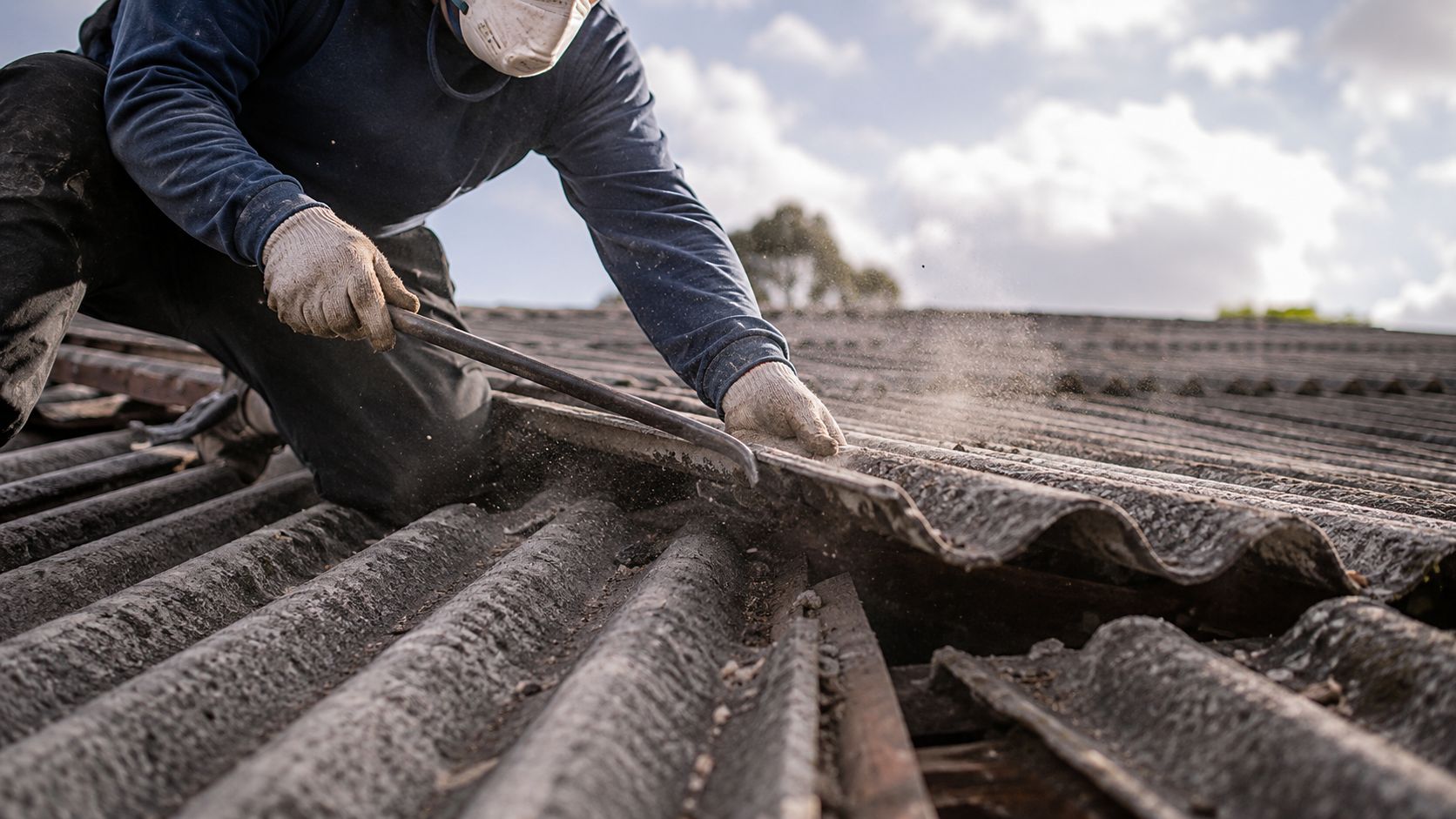
The biggest mistake I see is owners treating an asbestos roof like ordinary demolition. It isn't. The danger isn't just the sheet you can see. It's the fibre release you can't.
The World Health Organization states that asbestos causes lung cancer, laryngeal cancer, ovarian cancer and mesothelioma, with global occupational exposure still causing more than 200,000 deaths each year according to the WHO asbestos fact sheet. That's why roofing is treated as high risk in Australia. Cutting, breaking or rough handling can release fibres, so this work isn't a DIY weekend job.
Why roofs are worse than many people think
Roof sheets sit overhead, they age in the sun, and they often become fragile around fixings, ridges, flashings and penetrations. One cracked sheet can contaminate more than the spot where it broke. Wind, foot traffic and improvised cleanup make things worse fast.
A common pitfall arises when people think, “It's only cement sheet, not fluffy insulation.” Then they attack it with a drill, grinder, claw bar or high-pressure cleaner. That's exactly what shouldn't happen.
If you're still unclear on the difference between bonded material and material that has become much more hazardous through damage, read this guide on friable asbestos vs non-friable. It explains why a roof that starts as one risk category can become another when it's mishandled.
The legal issue is only part of it
People often focus on whether they'll get caught. That's the wrong question. The better question is whether you're prepared to expose your household, your neighbours, and every trade that follows you onto site.
A proper asbestos job uses exclusion zones, wet methods, controlled handling, decontamination, sealed waste packaging and specialised cleanup. If you want a broader view of understanding hazmat risks and cleanup, that resource is helpful because it explains why hazardous materials work has to be planned as a containment exercise, not a rubbish removal exercise.
Don't judge asbestos risk by how dusty the job looks. The problem is what you can't see.
What does not work
Homeowners sometimes suggest the same shortcuts. They don't work.
- “We'll just take the whole sheet off carefully.” Roof sheets often fail at fixings and edges. Breakage during handling is common when people lack the right setup.
- “We'll bag it afterward.” Waste containment starts during removal, not after broken material has been dragged across the yard.
- “We'll hose the area down.” Water helps when used correctly. Random washing can spread contamination rather than control it.
- “It's only a shed roof.” Small structures still sit near fences, gardens, driveways and neighbouring properties.
If the roof is suspect, the safe decision is simple. Stop disturbing it and bring in a licensed contractor.
The Licensed Removal Process from Start to Finish
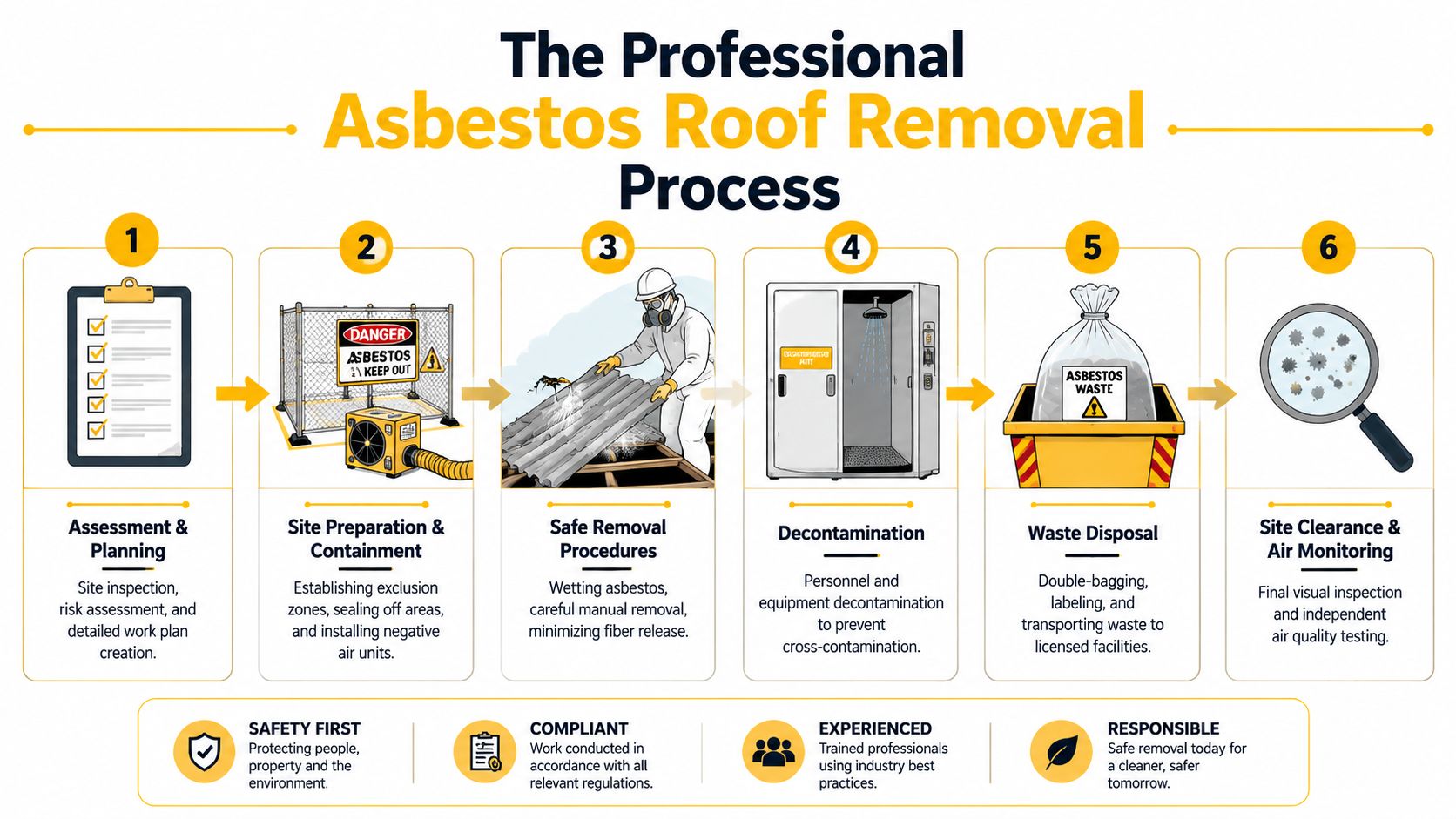
A compliant asbestos roof removal job is methodical. That's what keeps people safe and keeps the project defensible if anyone asks how the work was done. In NSW, the workflow starts by isolating the area, wetting the roofing to suppress fibre release, removing sheets manually rather than with power tools, then finishing with HEPA vacuuming, wet-wiping, and clearance verification before containment comes down, as described in this overview of how asbestos is removed and the abatement process.
Here's what that looks like in practice on a hypothetical older home in Newcastle with a detached garage and tight side access.
Before a single sheet moves
The team doesn't just arrive and start stripping roofing. First comes site control. That means defining the work area, setting barriers, placing warning signage, checking access points, and making sure occupants and neighbours won't wander into the exclusion zone.
On a residential block, this matters more than people realise. Side passages, shared driveways, pets, washing lines, carports and kids' play areas all need to be thought through. A good team plans the site around real life, not just around the roof plan.
A proper setup usually includes:
- Exclusion zones: Clear boundaries so nobody enters the work area by accident.
- Access planning: Safe ladder, scaffold or edge protection arrangements suited to the roof pitch and the site.
- Waste route: A planned path for moving wrapped material off the roof and out to transport without dragging it across clean areas.
- Neighbour awareness: Practical communication if nearby properties sit close to the boundary, which is common in Sydney and older Newcastle suburbs.
Controlled removal, not demolition
Once the area is secure, the roofing is wetted to help suppress fibre release. Then the sheets are removed manually. No grinders. No abrasive cutting. No smashing sheets to make them “easier to handle”.
That manual approach is slower than rough demolition. It's meant to be. Workers loosen fixings carefully and lift sheets in a way that avoids breakage wherever possible. If a roof is brittle or deteriorated, they adjust the sequence and handling to keep control of fragments and residue.
For homeowners watching from a distance, this is the point where the difference between a licensed crew and a handyman becomes obvious. The pace is deliberate. Every movement has a reason.
A useful visual of the process is below.
Cleanup is where good jobs separate themselves
Removal isn't finished when the last sheet is off. The critical test is how the site is cleaned and verified.
Workers clean the area using HEPA vacuuming and wet-wiping. Those two details matter because ordinary domestic vacuums aren't suitable for asbestos cleanup, and dry sweeping is a bad habit that can re-suspend fibres. The area stays controlled until the clean is complete and the required clearance process is done.
On site advice: If a contractor talks mostly about “getting the roof off fast” and barely mentions cleanup, waste handling or clearance, keep looking.
Waste handling and handover
Asbestos waste doesn't go into a standard mixed building skip. It has to be packaged, sealed, labelled, and transported for regulated disposal. That includes broken pieces, contaminated consumables and debris generated by the removal process.
A good contractor also thinks ahead. If reroofing, demolition, or framing repairs are next, they plan handover so the next trade knows exactly when the area can be re-entered and what limitations still apply. That's where safe removal becomes good project management.
Understanding Costs Timelines and Project Planning
Most homeowners ask two questions straight away. How much will asbestos roof removal cost, and how long will it take? Both are fair questions, but the better one is this: how does the removal change the rest of the project?
That's where many guides fall short. The EPA notes roof tear-off methods can involve cutting, prying, lifting, chutes and containment steps designed to limit fibre release, and the operational issue for owners is how long the roof area stays unavailable, when contaminated waste can leave site, and how removal affects follow-on works. That planning gap matters because Safe Work Australia reports around 4,000 asbestos-related deaths in Australia each year, as referenced in this EPA roofing guidance context.
What actually drives cost
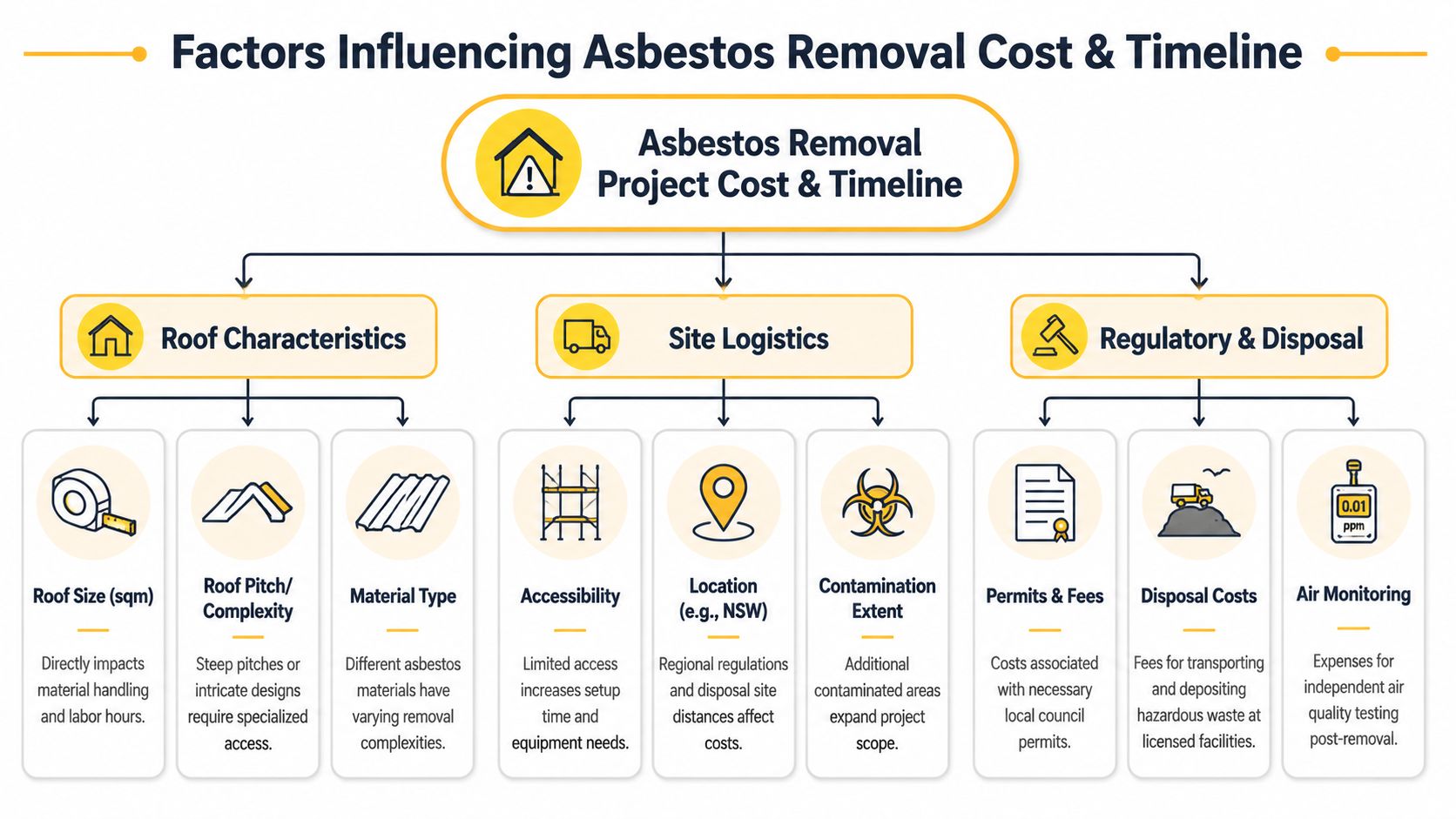
There's no honest flat answer because one roof can be straightforward and another can be awkward from the moment the truck arrives.
A low-set structure with simple geometry and clear access is one thing. A steep roof on a narrow Sydney block with limited side access, nearby neighbours, and staging constraints is something else entirely. Disposal logistics, site setup, roof pitch, contamination spread, and whether other structures are affected all change the scope.
These are the usual cost drivers:
| Factor | Why it changes the job |
|---|---|
| Roof size and layout | More material means more handling, packaging and disposal |
| Pitch and complexity | Steep or broken roof lines slow removal and increase access needs |
| Site access | Tight blocks, poor driveway access, and long carry distances add labour and planning |
| Condition of the sheets | Brittle or damaged material demands slower handling and tighter control |
| Waste transport and disposal | Licensed disposal is part of the job, not an optional extra |
| Project overlap | If demolition, reroofing or framing repairs are tied in, sequencing becomes critical |
If you're already budgeting the broader build, it helps to compare asbestos removal as part of total site preparation rather than as a standalone line item. This guide to demolition costs in Sydney is useful for understanding how hazardous materials can affect the wider demolition budget and programme.
Timelines are about dependencies, not just labour
Owners often assume the new roofing crew can arrive straight after the old roof comes off. Sometimes the sequence is smooth. Sometimes it isn't. The deciding factor is not urgency. It's compliance and clearance.
The roof area may remain unavailable until the cleanup is completed, waste is managed correctly, and the required verification is done. If there are framing repairs beneath the old sheets, those works also need to wait for the correct handover point. The same applies if demolition is coming next.
If you schedule follow-on trades too tightly, asbestos removal can become the bottleneck even when the removal crew performs exactly as they should.
A better way to plan the job
For a Central Coast owner-builder, the safest scheduling approach is to build a buffer around removal day and treat the clearance point as the milestone that enables the next stage. Don't book scaffold changes, carpenters, roof plumbers and demolition plant on assumptions.
Consider this scenario. You're replacing an old roof on a sloping block in Avoca Beach. Access is narrow, weather can turn quickly, and the waste route needs to avoid garden areas. If you only plan for “roof off Monday, roof on Tuesday”, you're setting yourself up for stress. If you plan for controlled removal, cleanup, verified handover, then the next trade mobilisation, the project moves properly.
Hiring the Right Asbestos Removal Contractor in NSW
A good quote tells you what the contractor will do. A good contractor tells you what they won't do. They won't cut corners on containment, they won't be vague about disposal, and they won't brush off your questions.
The minimum starting point in NSW is licence class. For asbestos roof removal, contractors are typically operating under Class A or Class B asbestos removal licensing depending on the material and scope. If they can't clearly explain what licence they hold and why it applies to your job, stop there. For broader licensing context around demolition and regulated work, this guide on demolition licence requirements in NSW helps owners understand how regulated site work is supposed to be handled.
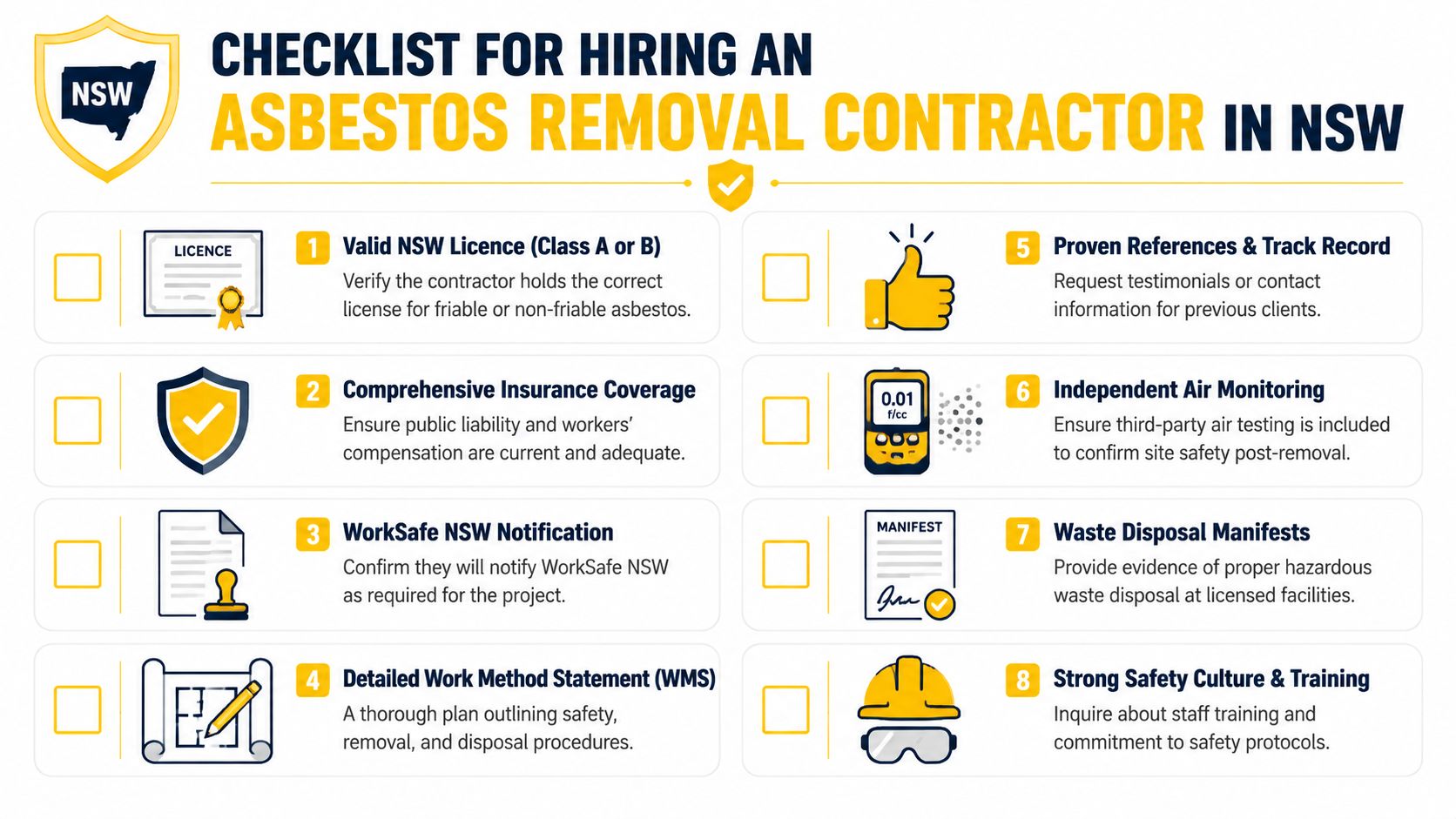
Questions worth asking before you sign
You don't need trade knowledge to vet a contractor properly. You just need to ask direct questions and pay attention to the answers.
- What licence do you hold for this job? The answer should be immediate and specific.
- How will you isolate the area and control fibre release? You're listening for wet methods, manual handling, exclusion zones and cleanup controls.
- What's included in the quote? Containment, removal, cleaning, waste transport and clearance should be clear.
- Where will the waste go? A professional should be able to explain disposal arrangements without hesitation.
- How is clearance handled? The answer should not be vague.
- What happens if damaged sheeting or additional contamination is found? Good contractors explain variations before they happen.
For a broader homeowner perspective, Four Seasons Roofing's expert contractor advice is worth a read because the logic applies here too. Ask clear questions early, and watch whether the contractor answers in detail or tries to rush you past them.
Red flags that should make you walk away
Low quotes can be tempting, especially if you're already spending heavily on roofing or renovation works. But with asbestos, an unusually cheap job often means something important has been stripped out.
Watch for these warning signs:
- Cash-only pricing: That often goes hand in hand with poor paperwork and poor accountability.
- No mention of cleanup or disposal: Removal without a clear waste path is not a real plan.
- Pressure to start immediately: Regulated hazardous work should feel organised, not improvised.
- Vague scope wording: If the quote is thin, disputes later are almost guaranteed.
- No proof of insurance that covers asbestos work: This is paramount.
A proper asbestos quote should read like a method, not like a guess.
What confidence looks like
A reliable contractor is calm, specific, and comfortable being checked. They won't be offended when you ask for licence details, insurance, or a clearer scope. In fact, that's usually a good sign that the client understands the seriousness of the work.
On Central Coast jobs, I'd also expect them to talk sensibly about access, neighbours, weather, roof pitch, and how the removal ties into the next trade. If they only speak in generalities, they probably haven't thought the job through.
After Removal What Comes Next
The most important document at the end of the job is the clearance certificate or equivalent clearance verification for the removal area. That's the point where the site moves from controlled hazardous work back toward normal construction activity. Without that handover point, you're guessing, and guessing has no place on an asbestos job.
After clearance, the focus shifts quickly to practical next steps. If the roof structure needs repairs, your carpenter can assess and proceed. If a new roof is going on, the roofer can mobilise with confidence. If the building is coming down, demolition planning becomes cleaner because one major hazard has already been dealt with properly.
There's also a record-keeping side to this. Owners should keep all removal paperwork, disposal records and site documents with the property file. If you're not sure what should be retained and documented, this guide on the asbestos register in NSW is a useful reference point.
For many Central Coast projects, asbestos roof removal is the gate that opens the rest of the work. Once the hazard is gone and the site is handed over properly, everything becomes simpler. The trades know where they stand. The programme is easier to control. You can move forward without carrying hidden risk into the next stage.
Once the asbestos issue is properly resolved, the rest of the project usually becomes much easier to manage. If you need help with what comes next, whether that's site preparation, excavation, earthworks, demolition coordination, concreting or structural landscaping across the Central Coast, Newcastle, Sydney or the Hunter, Booms Up Civil Group can step in with practical advice and on-site support. If you want to talk through your site, you can contact the team for a quote or a straightforward conversation about the safest way to keep your project moving.