
If you're getting ready to excavate an older block on the Central Coast, this is one of the first questions worth settling before machines arrive on site. A lot of owners hear “asbestos” and assume it's all the same. It isn't. The difference between friable asbestos vs non friable asbestos changes the risk level, who can remove it, how the site is managed, and whether the job can keep moving safely.
That matters on older properties in places like Kariong, Umina, Woy Woy, Newcastle and parts of Sydney where renovation, demolition, driveway replacement and site cuts often uncover legacy materials. In NSW, asbestos was banned nationally on 31/12/2003, but many older homes and buildings still contain it, especially in roofing, wall sheeting, insulation and service areas (NSW asbestos guidance). The practical question isn't just whether asbestos is present. It's whether it's stable, degrading, or likely to become dangerous once excavation or demolition starts.
The Core Difference What Makes Asbestos Friable
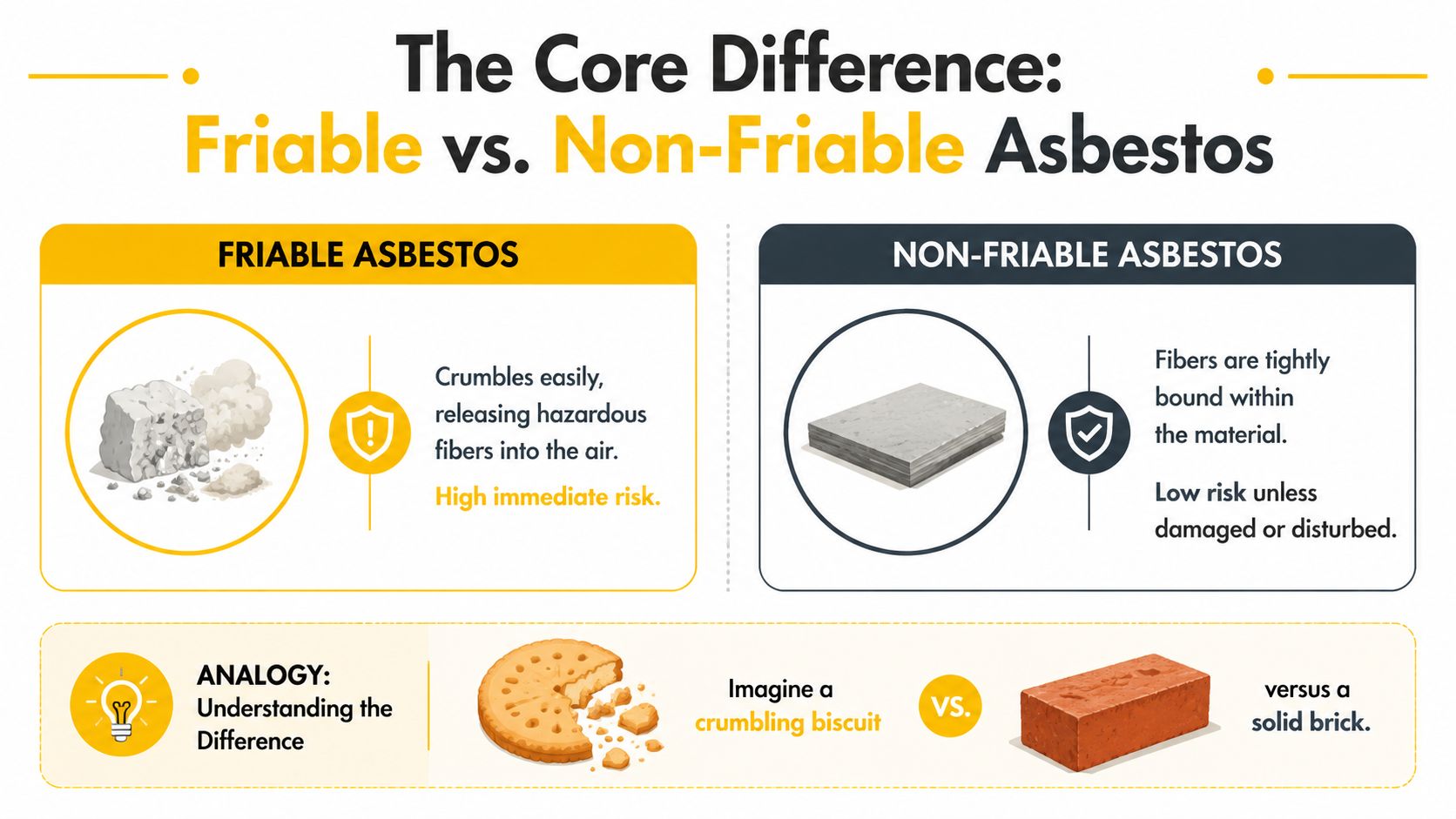
Think of it this way. One material behaves like a dry biscuit. The other behaves more like a brick.
If a material can be crumbled by hand pressure when dry, it's friable. If the asbestos fibres are locked into a bonded product and the material can't be crumbled by hand pressure, it's non-friable. That single physical difference drives almost everything that follows on site.
Why friability matters on a worksite
Friable asbestos is high risk because it can release fibres with very little disturbance. You don't need to cut it with a saw or smash it with an excavator bucket. Handling, vibration, scraping, or deterioration can be enough.
Non-friable asbestos is different. In plain terms, the fibres are bound into another product such as cement or similar bonded material. If it stays intact and undisturbed, the immediate risk is lower. The problem is that excavation, demolition, trenching, driveway removal and service works rarely leave old materials undisturbed.
| Feature | Friable asbestos | Non-friable asbestos |
|---|---|---|
| Physical condition | Can be crumbled by hand pressure when dry | Fibres are bonded into a solid material |
| Immediate risk | High if disturbed, even lightly | Lower while intact |
| Typical site response | Stop work and bring in specialist licensed removal | Assess condition and planned disturbance carefully |
| Removal pathway | Higher level controls and specialist licensing | Depends on condition, disturbance and scope of works |
| What often goes wrong | Dust and fibre release from minor contact | People assume “bonded” means “safe to break” |
The mistake that causes trouble
The most common misunderstanding is treating non-friable asbestos as if it's harmless. It isn't harmless. It's less likely to release fibres while intact.
Once bonded asbestos is cut, drilled, broken, weathered or crushed under plant movement, the risk changes fast. That's why site supervisors treat the material's condition, location and likely disturbance as seriously as the label itself.
Practical rule: On any older property, the question isn't only “Is this asbestos?” It's also “What happens to it when we start digging, cutting, loading or demolishing?”
If you're unsure what older sheeting looks like before work starts, this guide on how to identify asbestos sheeting is a useful first step. It won't replace testing, but it will help you recognise common warning signs before you disturb anything.
Common Asbestos Examples and Where to Find Them in NSW
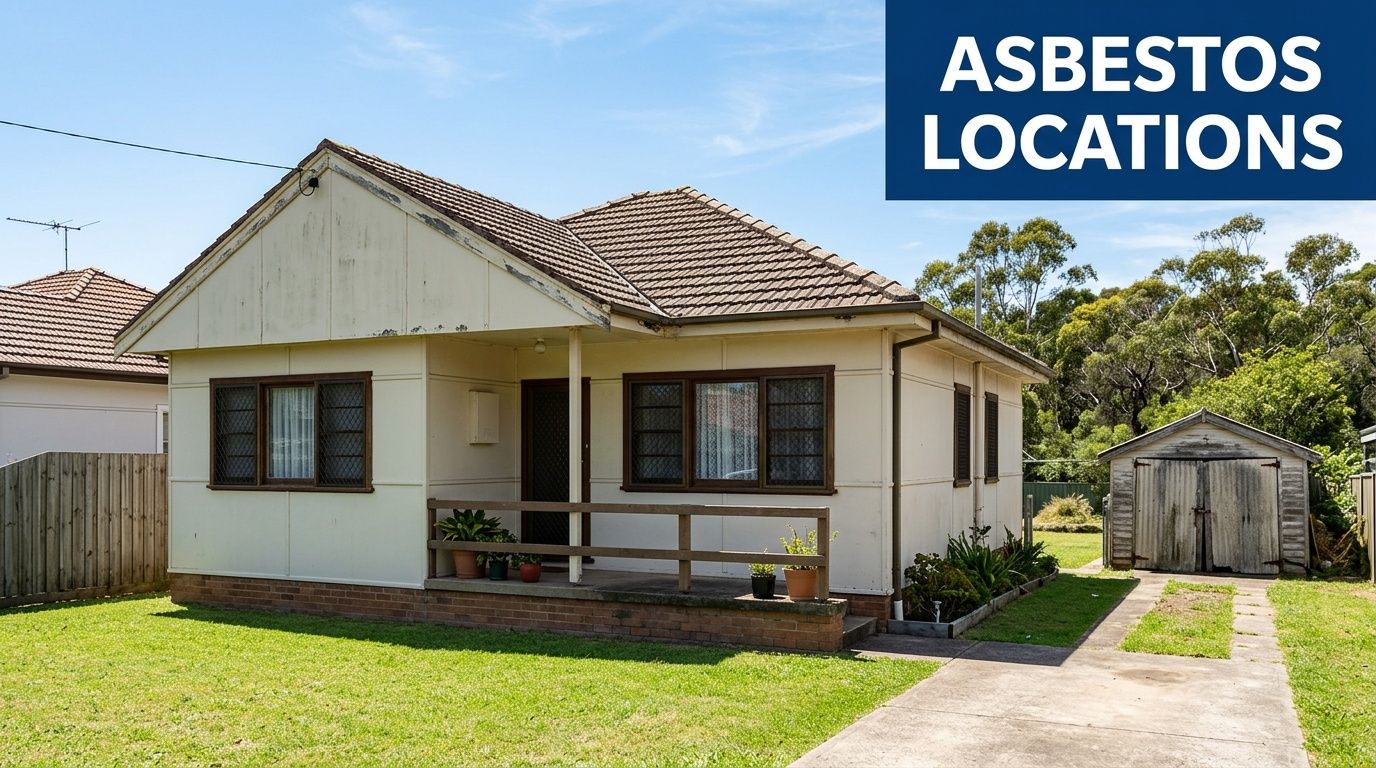
On residential jobs across the Central Coast and Hunter, non-friable asbestos is often encountered first. It often turns up in older fibro products and bonded building materials rather than loose insulation.
Consider a 1970s brick veneer house in Kariong or Narara. You might find asbestos cement sheeting in the eaves, laundry walls, wet area linings, around old meter boxes, or in detached garages and sheds. On older coastal properties in Umina or Ettalong, it can also appear in fences, outbuildings, carports and old roof sheeting.
Typical non-friable locations on home sites
For excavation and site prep, these are the places that often matter most:
- Old outbuildings and garages often have bonded wall or roof sheeting that becomes an issue when demolishing for a new slab or driveway.
- Garden edges and buried fragments can show up during land clearing or trenching where past renovations left broken fibro in fill.
- Bathroom, laundry and service areas may contain old backing sheets or linings hidden behind newer finishes.
- Fences and edging sometimes look minor but still need proper handling if they're disturbed by machines.
These are the materials that catch owners off guard because they look solid. On first glance, they don't always appear dusty or dangerous.
Where friable asbestos is more likely
Friable asbestos is more often associated with older commercial, industrial or specialised building elements. On pre-1980s sites in parts of Newcastle or older Sydney buildings, higher-risk materials may be found in pipe lagging, thermal insulation, sprayed coatings and similar products where the asbestos isn't tightly bound.
That distinction matters if you're demolishing more than just a backyard shed. A house knockdown, factory upgrade, old amenities block removal or services strip-out can expose materials that need a very different response from standard bonded sheeting.
On older mixed-use sites, asbestos isn't always where owners expect it. It can be above ceilings, around services, inside plant rooms or attached to redundant pipework rather than out in the open.
There's another practical point here. Homes and buildings built before the 1980s often carry the highest suspicion, but later work doesn't automatically remove the risk. Renovations can cover asbestos rather than remove it. One extension might be modern, while the original laundry wall behind it is not.
If your project is heading towards full knockdown rather than selective excavation, it's worth understanding the wider demolition picture as well. This guide on the cost to demolish a house helps explain the factors that usually affect planning, approvals and site preparation.
Health Risks and On-Site Dangers Compared
The health risk comes from airborne fibres, not from just seeing an old sheet on the fence line. The problem is that you can't judge fibre release by eye once work starts.
Friable asbestos is the more immediate danger because fibres can become airborne with minimal disturbance. On a live site, that can affect not just the operator or labourer nearest the material, but anyone nearby if the area isn't isolated properly.

Why bonded products still become a site hazard
A lot of people are surprised by this part. Over 95% of asbestos products remaining in homes are non-friable, but Australia's coastal climate with its humidity and salt spray can degrade the material's bond over 10–20 years, increasing the risk of it becoming friable when disturbed during renovations or site works (brownlawyers.ca explanation of friable and non-friable asbestos).
That lines up with what we see in practice on coastal blocks. A sheet that looked stable years ago may now be chalky, cracked, delaminating or soft around edges and fixing points. Add age, past leaks, mechanical damage, or someone hitting it with a grinder or pressure washer, and you've changed the exposure risk.
What creates danger during excavation and earthworks
Excavation changes the environment around asbestos-containing materials. Vibration, impact, scraping and stockpile movement all matter.
Common trouble points include:
- Driveway and slab prep where old buried fibro fragments are mixed through fill
- Service trenching near old outbuildings, drains or retaining edges
- Demolition before excavation when walls or roofs break apart unexpectedly
- Land clearing and site cuts where hidden debris turns up in disturbed ground
A bonded sheet fixed to a wall is one thing. The same sheet snapped, crushed under tracks and loaded into spoil is a very different problem.
On-site advice: If suspected asbestos has been broken by plant, don't keep chasing production. Stop the machine, isolate the area and reassess before anyone walks through the debris.
This short video gives a useful visual overview of handling risk and why disturbance matters:
What doesn't work
Trying to “be careful” without a clear process doesn't work. Neither does assuming wetting the area solves everything. Water can help suppress dust in some controlled situations, but it doesn't make unplanned asbestos disturbance safe.
Sweeping, leaf blowing, dry brushing and ordinary site clean-ups are also poor responses if asbestos debris is suspected. They can spread contamination further across the work zone.
For projects where demolition and excavation overlap, demolition and excavation planning becomes critical because asbestos risk often sits right at that handover point between structure removal and ground works.
NSW Regulations Licensing and Removal Rules
On an excavation job, the legal difference between friable and non-friable asbestos shows up fast. It affects whether work can continue, what licence class is required, how the area is controlled, and who is legally allowed to remove the material.
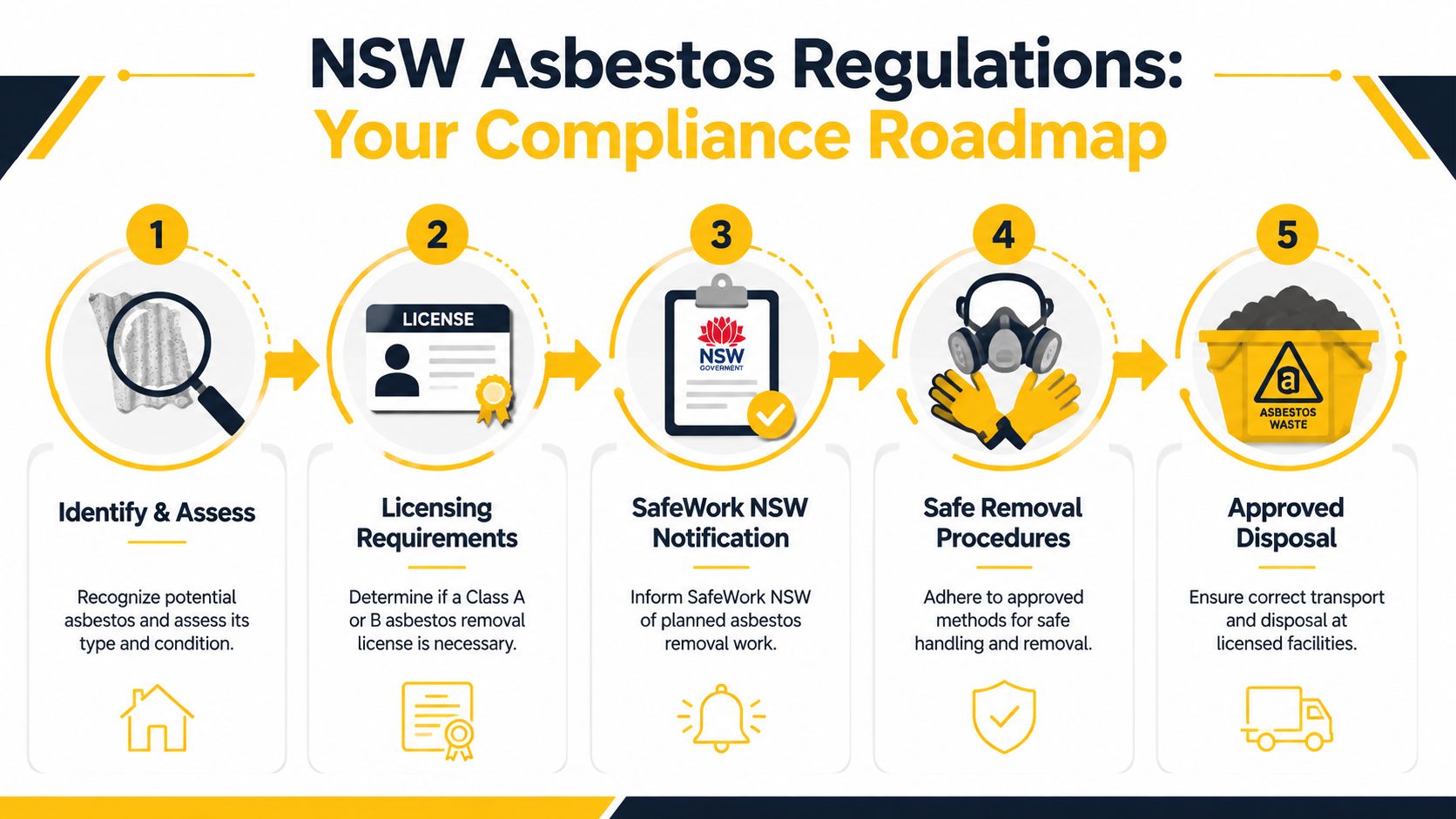
Under the NSW WHS rules, friable asbestos removal requires a Class A asbestos removal licence. Non-friable asbestos removal may fall under Class B licensing, depending on the amount and the work involved. SafeWork NSW also sets notification and licensing requirements for asbestos removal work, and those obligations need to be checked before the job is disturbed, not once plant is already on site.
Class A and Class B in practical terms
In plain terms, friable asbestos is specialist removal work from the outset. The controls are heavier because the fibres can become airborne with very little disturbance. That usually means a licensed Class A contractor, tighter exclusion controls, more formal planning, and a far more controlled removal process.
Non-friable asbestos can look more straightforward on paper, but excavation changes the risk. A bonded sheet or buried fragment that starts as non-friable can become friable once it is cracked by a bucket, crushed under tracks, or mixed through spoil. That is the point many owners and builders get wrong. They assess the material as found, but the law and the safe work method also need to consider what the planned works will do to it.
| NSW compliance issue | Friable asbestos | Non-friable asbestos |
|---|---|---|
| Licence class | Class A required | Class B may be required, depending on quantity and removal work |
| Disturbance tolerance | Extremely low | Low if breakage, cutting or crushing is likely |
| Site controls | Highest level of isolation, air risk control and licensed handling | Controlled removal, containment and lawful disposal still required |
| Excavation impact | Work usually stops in and around the affected area | Work may also need to stop if the material is damaged or likely to be damaged |
What owners and builders often miss
The biggest compliance mistakes on civil jobs are usually about sequence, not definitions.
If asbestos is identified during planning, the removal can be programmed before demolition, excavation, or service trenching starts. If it is found after mobilisation, the site often shifts from production mode to incident management. Plant is parked up, access changes, spoil movement is restricted, and the program starts absorbing delay costs straight away.
That problem is common on older Central Coast blocks where demolition, excavation and retaining work overlap. A small amount of damaged fibro in the wrong location can hold up far more than the removal area itself because the exclusion zone, access path, waste route and neighbour interface all need to be controlled properly.
Site reality: A non-friable product does not stay low-risk once machines start breaking it up.
Councils, notifications and site documentation
SafeWork NSW requirements sit alongside local approval conditions. On projects involving demolition, rebuilds, major earthworks or contaminated waste handling, councils such as Central Coast Council, Lake Macquarie City Council or City of Newcastle may also expect the asbestos risk to be addressed in the project documentation and waste planning.
That is why asbestos should be dealt with at the same time as demolition approvals, site establishment planning and excavation staging. If you need the broader approval context, this guide to a demolition licence in NSW helps explain how asbestos obligations fit into the wider legal process.
On larger jobs, several parties may need to align before removal starts. That can include the licensed removalist, an independent asbestos assessor, the principal contractor, the hygienist, and the waste facility receiving the load. Good paperwork does not make a site safe by itself, but poor paperwork regularly leads to the wrong people making rushed decisions in the field.
A practical compliance sequence usually looks like this:
- Identify suspect materials early during pre-demolition review, site inspection or service investigation.
- Arrange assessment or sampling before disturbance where age, location or debris history raises concern.
- Confirm whether the material is friable, non-friable, or likely to become friable during the works.
- Check licensing and SafeWork NSW notification requirements for the removal method and scope.
- Set site controls and waste handling procedures before removal starts, including access, exclusion zones and disposal pathway.
- Dispose of asbestos waste lawfully through an approved facility, separate from general spoil or mixed demolition material.
The asbestos ban that took effect at the end of 2003 stopped new asbestos materials entering normal use in Australia. It did not remove asbestos already built into older homes, garages, fences, pits, outbuildings and buried site fill. That is why asbestos still turns up regularly on excavation and redevelopment work across NSW, especially on older residential blocks where past repairs, demolition debris or undocumented fill have been left in place.
Your Next Steps When to Stop Work and Call the Pros
If you suspect asbestos on site, the right move is simple. Stop work immediately.
Don't keep digging to “just finish this bit”. Don't ask a labourer to bag it up quickly. Don't hose it, sweep it or throw it in the skip. Once suspected asbestos is disturbed, a small mistake can become a much larger contamination issue.
The immediate action plan
Use this response in order:
- Stop all plant and hand work in the affected area.
- Keep people out so no one walks through debris or dust and spreads it further.
- Leave the material where it is unless a licensed professional directs otherwise.
- Arrange professional assessment and testing so you know what you're dealing with before work resumes.
If the material has already been broken, isolate a wider area than you think you need. Foot traffic, tyres and tools can carry contamination well beyond the original find point.
Leave suspect asbestos alone. The urge to tidy it up is exactly what creates a worse problem.
Why this protects both safety and budget
Calling professionals early usually saves time, not the other way around. Once the material is identified properly, the job can be re-sequenced, the removal can be planned, and the rest of the project can move forward with fewer surprises.
DIY decisions on asbestos rarely stay small. They can trigger delays, disposal problems, re-cleaning, neighbour complaints and questions from regulators that could have been avoided with one early phone call.
If your job is moving toward broader structure removal or site clearance, this guide to the demolition of buildings gives useful context on how asbestos fits into the bigger demolition workflow.
Frequently Asked Questions About Asbestos
Can I tell by looking if a sheet contains asbestos
Not reliably. Age, profile, surface finish and location can raise suspicion, but visual checks alone aren't enough for a firm call. Older sheeting and newer fibre cement can look similar once painted, patched or weathered.
Is non-friable asbestos safe if I leave it alone
If it's intact and won't be disturbed, the immediate risk is lower than friable material. The catch is that renovation, excavation, drilling, cutting, demolition and even deterioration from weather can change that very quickly.
Why does asbestos become an excavation issue if it's part of a building
Because excavation rarely happens in isolation. Site cuts, driveway replacement, slab prep, trenching and demolition often disturb sheds, fences, retaining edges, buried fill and old service areas where asbestos-containing materials may already be damaged or hidden.
Should I pressure wash or break up old fibro before removal
No. High-pressure cleaning, cutting and breaking can increase fibre release and make a manageable problem worse.
What should I look for when hiring someone
Ask whether they understand NSW asbestos compliance, how they identify suspect materials before excavation, how they manage stop-work situations, and how removal is coordinated before spoil, demolition waste or concrete break-up proceeds. You want a contractor who plans for asbestos before the machine bucket hits the ground, not after.
What about older coastal homes on the Central Coast
They deserve extra caution. Salt air, humidity and age can leave bonded materials more brittle than they appear, especially around rooflines, garages, fences and outbuildings.
If you're planning excavation, demolition, site cuts, driveway works or slab preparation on an older property, Booms Up Civil Group can help you assess the site properly before work starts. We work across the Central Coast, Newcastle, the Hunter Valley and Sydney, and we take a practical, safety-first approach to identifying risks early, coordinating the right next steps and getting the job moving the right way the first time. For advice on your block, you can contact the team through the website or call to discuss your site conditions and scope.