Essentially, if you're planning any demolition work in New South Wales, you'll be dealing with SafeWork NSW. This isn't just about ticking boxes; a demolition licence nsw is almost always a legal requirement. It's a critical safety net designed to protect workers, the general public, and surrounding properties from very real dangers.
When You Legally Need a Demolition Licence in NSW
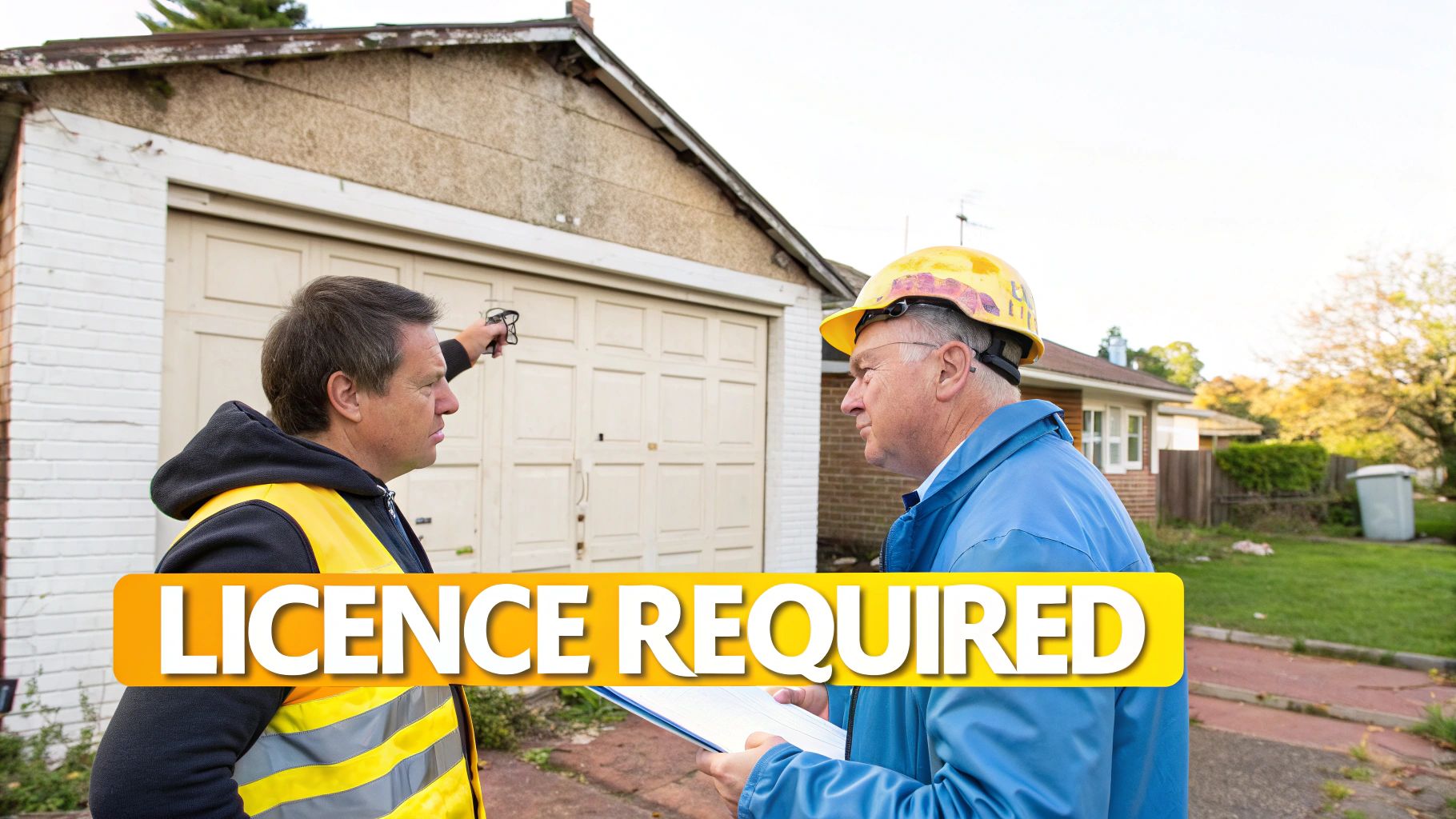
Let's cut through the noise. If you're a homeowner in Gosford looking to knock down an old shed to make way for a granny flat, you've just entered territory that legally requires a licenced professional. The same applies to big commercial jobs, from industrial sites in Newcastle to tight residential blocks in Sydney's suburbs.
These regulations are in place for one simple reason: to make sure the person in charge has proven they can handle the job safely and competently. This is about so much more than just swinging a sledgehammer or firing up an excavator. It's about a deep understanding of structural engineering, on-site risk management, and environmental protection.
Why Unlicenced Demolition Is a Major Risk
Trying to get demolition work done without the proper licence isn't just a compliance headache—it's incredibly dangerous. The risks are severe and can have devastating outcomes for everyone involved.
Three major concerns really stand out:
- Worker and Public Safety: An unlicenced operator might not have the training to spot and manage hazards like an unexpected structural collapse, falling debris, or live utilities. This puts their own crew and anyone nearby in immediate danger.
- Structural Integrity of Adjoining Properties: Demolition sends powerful vibrations through the ground. On a tight block in a suburb like Terrigal or a dense part of the Hunter Valley, using the wrong techniques can easily cause serious cracking or even structural damage to your neighbour’s house.
- Hazardous Materials Handling: Older buildings, especially those put up before 1990, are almost guaranteed to contain asbestos. A licenced contractor is legally required to identify and manage these hazardous materials correctly, preventing deadly fibres from being released into the air.
The entire licencing system is built to prevent these exact scenarios. It ensures the person running the show knows precisely how to plan and execute the safe demolition of buildings, from the first assessment to the final site clean-up.
Recent Changes to NSW Demolition Regulations
The demolition game in NSW has had some important rule changes lately. The Work Health and Safety Amendment (Demolition Licensing) Regulation 2022, which kicked in on 01/03/2023, brought in a much tougher system to get NSW in line with national standards.
This created a clear, tiered licence structure. The idea is to ensure that only contractors with proven, hands-on experience can tackle the more complex or high-risk demolition jobs. It’s a framework designed to give everyone—from property owners to the workers on site—more clarity and a higher standard of safety.
Figuring Out the NSW Demolition Licence Classes
When it comes to demolition in New South Wales, the licence isn't a one-size-fits-all deal. SafeWork NSW has smartly created two different classes, making sure the contractor's qualifications match the real-world risks of the job. Getting your head around the difference is absolutely vital for hiring the right crew and making sure your project is above board from day one.
Choosing between a Restricted and an Unrestricted licence holder isn't just about how big the building is; it's about the specific hazards tied to bringing it down. For a homeowner, knowing this stuff helps you ask the sharp questions and double-check that your chosen demo expert is legally cleared for your type of project.
The Restricted Demolition Licence
Think of the Restricted Demolition Licence as the ticket for your more standard, lower-risk projects. This is the licence you'll see most often for residential jobs across the Central Coast and Hunter Valley, where the buildings are usually less than 15 metres high and don't involve any wild cards.
A contractor holding a Restricted licence has the green light to demolish buildings that tick these boxes:
- The structure is under 15 metres in height.
- The job does not involve explosives.
- The building is not a chemical installation (like a refinery or major processing plant).
So, let's say you're knocking over a single-storey brick home on a typical suburban block in Maitland to make way for a new build. That job falls squarely within the scope of a Restricted licence. The same goes for pulling down a fire-damaged commercial shed in Wyong or dismantling an old farmhouse. It’s the workhorse licence for everyday demolition.
The Unrestricted Demolition Licence
When the risks start to climb, you need a contractor with an Unrestricted Demolition Licence. This is the top-tier qualification, reserved for operators with the serious, proven experience needed to manage massive, complicated, and high-risk demolition projects safely. This is the licence you’d expect to find on major commercial and industrial sites in the thick of Sydney or Newcastle.
An Unrestricted Demolition Licence is required the moment a project involves even one of those high-risk factors, no matter the building's overall size. It's a clear signal that the holder has the expertise to handle serious structural challenges or hazardous demolition methods.
The specific triggers that legally demand an Unrestricted licence holder are:
- Height: Any structure that stands 15 metres or taller.
- Method: Any demolition that needs the use of explosives.
- Type: Any demolition of a chemical installation.
Picture a multi-storey office block being carefully removed from a cramped street in Parramatta, or an old industrial chimney being brought down. These aren't simple jobs; the potential for things to go sideways is immense. Only a contractor holding an Unrestricted licence has the legal authority—and the critical skillset—to oversee this kind of high-stakes work. This is where a deep understanding of advanced demolition techniques, structural engineering, and public safety is completely non-negotiable.
NSW Demolition Licence Classes at a Glance
To make it even clearer, here’s a quick breakdown of what each licence class covers and the typical projects they're suited for.
| Licence Class | Permitted Demolition Work | Common Project Examples |
|---|---|---|
| Restricted | Structures under 15m in height. Does not permit the use of explosives or demolition of chemical installations. | Single-storey houses, two-storey apartment blocks, small commercial shops, farm sheds, fire-damaged residential buildings. |
| Unrestricted | Any structure, including those over 15m high, demolition using explosives, and demolition of chemical installations. | Multi-storey office buildings, industrial plants, public infrastructure like bridges, high-rise apartment towers, large factories. |
Ultimately, picking the right contractor starts with understanding which licence your project demands. It protects you, your property, and the public by ensuring the person in charge has been vetted and approved for the specific challenges your job presents.
The Complete Demolition Licence Application Process
Alright, so you've established that a demolition licence is what you need. Diving into the application process with SafeWork NSW can feel like a maze, but it's a well-trodden path. Let’s walk through it together, breaking down each stage from your initial training right through to lodging the final paperwork. Getting this right the first time will save you a world of pain and delays later on.
The entire process is built to prove two things: that you have the formal qualifications and, crucially, the real-world, on-the-tools experience to manage demolition work safely. It’s not just about ticking boxes; it’s about demonstrating your competence to the regulator.
This visual guide breaks down the typical journey for both Restricted and Unrestricted demolition licences.
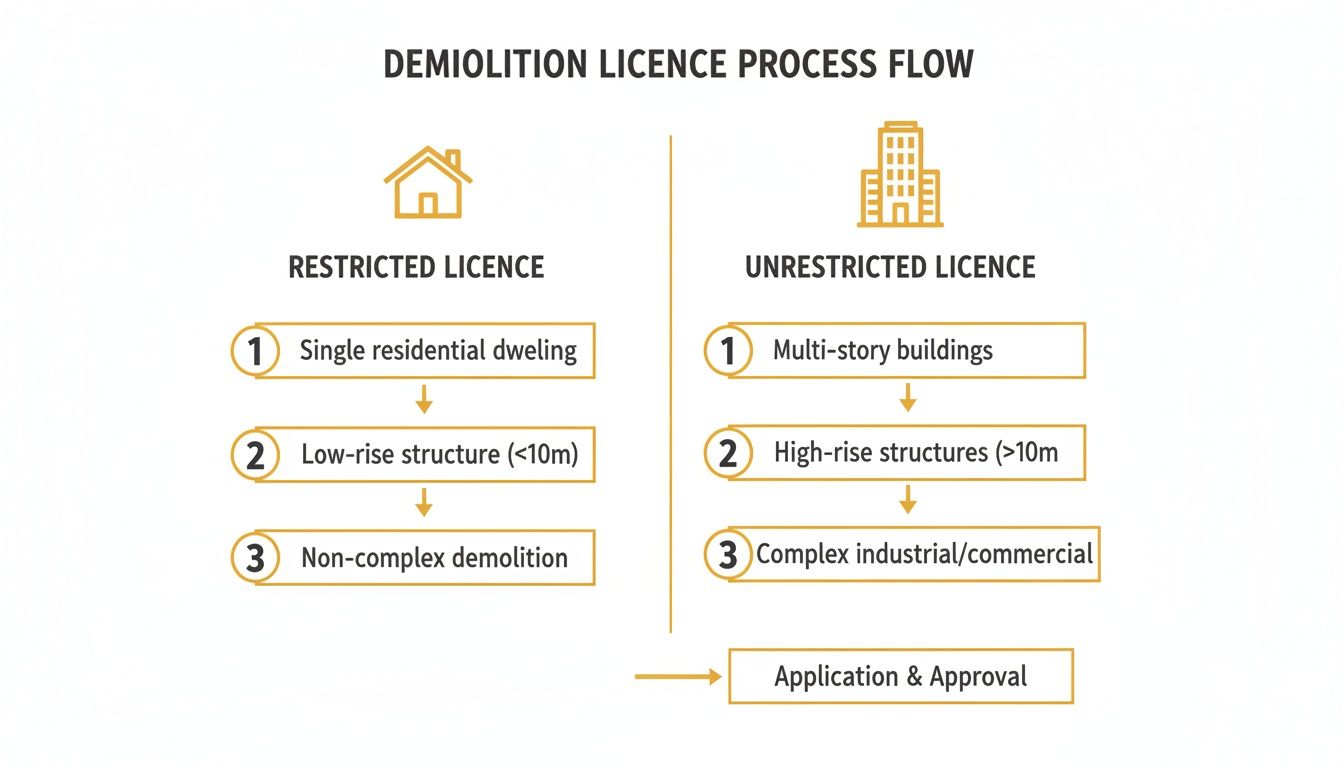
As you can see, while the basic steps are similar for both licence types, the big difference is the sheer depth and complexity of experience you need to prove for an Unrestricted licence.
Finding the Right Training Provider
Your first real step is to find a Registered Training Organisation (RTO) that offers the specific units of competency required for demolition. SafeWork NSW doesn’t run the courses themselves; instead, they approve a list of RTOs you can work with. These are the specialists who deliver the training you need to meet the licencing criteria.
When you're shopping around for an RTO, look for one with a solid reputation in the construction and demolition game. It pays to ask about the trainers' backgrounds—you want to learn from people who’ve spent years on actual demo sites, not just in a classroom. A good RTO will cover the theory and then put you through your paces with practical skills assessments.
Documenting Your Practical Experience
This is where most applications fall over. SafeWork NSW needs to see clear, verifiable proof that you have the required industry experience. This isn't the time for a quick summary on the back of a napkin; you need to build a detailed portfolio that proves you’ve done the work.
Your portfolio of experience is the absolute heart of your application. It must clearly show your direct involvement in a variety of demolition projects, spelling out your specific roles and the tasks you carried out.
Think of it as building a legal case for your competence. For every project, you should include:
- Project Details: The site address, type of structure (e.g., single-storey brick home, commercial concrete panel warehouse), and the dates you were on site.
- Your Role: Be specific. Were you a labourer, a plant operator, a leading hand?
- Tasks Performed: What did you actually do? Did you operate a 20-tonne excavator? Did you handle the manual strip-out? Were you responsible for setting up exclusion zones or managing waste bins?
- Supervisor Verification: This is non-negotiable. Each project log must be signed off by your supervisor, who must hold the relevant demolition licence themselves.
For instance, instead of writing "Worked on a house demo in Wyong," a rock-solid entry would look like this: "Project: Residential demolition at 123 Smith Street, Wyong (15/03/2024 – 25/03/2024). Role: Excavator Operator. Duties: Operated a 20-tonne excavator for primary structural demolition, sorted and loaded C&D waste, assisted with site safety controls. Supervisor: John Citizen (Licence No. XXXXXX)."
Gathering All Your Paperwork
With your training and experience portfolio sorted, it's time to pull all the required documents together. Missing a single piece of paper is the fastest way to get your application bounced.
You'll need to have these ready:
- Proof of Identity: The standard 100-point ID check.
- Training Evidence: Your official Statement of Attainment from the RTO for every required unit of competency.
- Experience Portfolio: Your detailed, supervisor-signed log of demolition projects.
- Application Form: The official form, filled out completely and accurately.
If you want to get a better handle on regulatory paperwork in general, it can be useful to read up on mastering the general building permit process, as a lot of the same principles of thoroughness apply.
Submitting Your Application and What to Expect
Once you have a complete file, the final move is to lodge your application with SafeWork NSW, which is usually done online through the Service NSW portal. You'll upload scanned copies of everything and pay the fee. Check every single document you upload before hitting that submit button. A blurry photo of your driver's licence or a missing page from your logbook will stop your application dead in its tracks.
After you submit, the waiting begins. SafeWork NSW will review everything, which usually takes anywhere from four to eight weeks. Don't be surprised if they contact you or your nominated supervisors to verify the details you've provided. If it all checks out, you'll be issued your five-year demolition licence. This is where our hands-on expertise in demolition and excavation is invaluable—we live and breathe this compliance journey every day.
Meeting the Training and Experience Requirements
Getting your demolition licence in NSW really comes down to proving two things to SafeWork NSW: you’ve done the formal training, and you’ve got the real-world, hands-on experience to back it up. Knowing the theory is one thing, but you have to show you can actually apply it safely on a live demolition site.
This is the part of the process where we see a lot of people get stuck. The regulators need to see clear, undeniable proof that you understand the risks and have the skills to manage them, whether you’re tackling a small residential job on the Central Coast or a complex commercial structure in Sydney.
The Mandatory Training You Need to Complete
Before you can even think about applying, you have to complete specific, nationally recognised units of competency. These have to be done through a proper Registered Training Organisation (RTO). These aren't just tick-and-flick online courses; they cover the absolute essentials for safe demolition, from planning and risk assessment to running machinery and handling emergencies.
For a Restricted Demolition Licence, the training is laser-focused on the core skills needed for smaller-scale projects. Think of it as the foundational knowledge you’d need for your standard residential knock-down or a simple light commercial job.
For an Unrestricted Demolition Licence, the training is a whole other level. The requirements are far more extensive, building on the restricted units and adding specialised skills for high-risk work. We're talking about planning demolitions over 15 metres, managing structural integrity on complex sites, and understanding the ins and outs of advanced demolition techniques.
Proving Your Relevant Industry Experience
This is, without a doubt, the biggest hurdle for most applicants. SafeWork NSW needs to see documented evidence that you’ve spent a significant amount of time working under the direct supervision of a licenced demolition professional. This is where your logbook or portfolio becomes the single most important part of your application.
Your experience log isn’t just a list of jobs. It’s a detailed record that tells a story of your practical learning curve, showing how you've applied your skills on a variety of real demolition projects.
To build a strong portfolio, you need to be meticulous. Let’s say you've been working on residential knockdowns around Newcastle and the Hunter Valley. For every single job, your log has to capture:
- The address and a clear description of the structure.
- The start and end dates of your involvement on that site.
- A detailed list of the actual tasks you performed. Be specific— "operated excavator to demolish brick walls" or "assisted with hazardous material identification."
- The name and licence number of your supervisor for that specific project.
- Crucially, your supervisor’s signature verifying your account of the work.
Photographs and signed letters from supervisors on company letterhead can also powerfully back up your claims. Vague entries are a huge red flag for assessors, so be as specific as possible to paint a crystal-clear picture of your capabilities. If your past work involved specialised techniques, our guide on trenching and shoring methods provides context on the kinds of detailed safety procedures regulators look for.
The Role of the Nominated Supervisor
A key part of the entire licencing framework is the requirement for a nominated supervisor. This isn't just a title; it's a formal role with serious legal responsibilities. Every licenced demolition project in NSW must have a nominated supervisor who is either physically present or can be readily available to oversee the work.
This person is the licence holder's representative on the ground, and they are responsible for making sure all demolition work is carried out according to the plan and in full compliance with WHS regulations. They absolutely must hold the relevant class of demolition licence themselves and have the experience to guide the crew, manage risks as they pop up, and make critical safety decisions on the spot. When you apply for your own licence, you are essentially applying to be that person—which is exactly why the experience requirements are so strict.
Your Ongoing Safety and Compliance Obligations
Securing your demolition licence in NSW is a massive achievement, but it’s really just the start of the journey, not the finish line. Holding that licence means you’ve accepted a serious, ongoing commitment to safety and best practice on every single job. This isn't just about a piece of paper in your wallet; it's a continuous responsibility.
This is what separates the true professionals from the pack. It’s all about embedding safety into your daily operations, from the moment you first step on-site to the final clean-up.
The Non-Negotiable SWMS
For every single demolition project, you are legally required to develop a site-specific Safe Work Method Statement, or SWMS. Let's be clear: this isn't some generic template you can copy and paste. It’s a live document that meticulously details the high-risk work involved and outlines exactly how you will manage those specific risks.
Imagine you're taking down a house with tight access on a busy street in a dense Sydney suburb. Your SWMS has to address the real-world hazards: managing public access, controlling dust, preventing damage to the neighbour's property, and planning the safe movement of heavy machinery. It's your tailored safety playbook for that exact job.
Asbestos and Hazardous Materials Management
Before a single wall comes down, you have a critical obligation to deal with asbestos. This means ensuring a competent person inspects the structure and an asbestos register is available. If asbestos-containing materials are found, they must be safely removed by a licenced asbestos removalist before any demolition work kicks off.
This is an absolute, iron-clad legal requirement under NSW regulations. Cutting corners here can lead to catastrophic health consequences for workers and the public, not to mention severe penalties from SafeWork NSW. The responsibility falls squarely on you, the demolition licence holder, to get this right.
A demolition licence is a promise to the community, your clients, and your crew that you will always prioritise their health and safety. Managing asbestos correctly is a fundamental part of honouring that promise.
Environmental Responsibilities
Your compliance duties extend well beyond the immediate safety of the structure. You also have a significant responsibility to protect the surrounding environment. This is especially important in our local regions, from the sandy soils of the Central Coast to the precious waterways of the Hunter Valley.
Effective environmental controls on a demolition site are non-negotiable and include:
- Dust Control: Using water sprays and other suppression methods to stop dust from blanketing the neighbourhood and affecting air quality.
- Sediment and Runoff Prevention: Installing sediment fences and other controls to stop soil and debris from washing into stormwater drains—absolutely vital in our coastal areas.
- Waste Management: Correctly sorting and disposing of demolition waste, with a strong focus on recycling to minimise what ends up in landfill.
The scale of this work is massive; ABS data shows that approvals were granted for 33,912 dwellings to be demolished between September 2016 and June 2021 alone. Proper compliance ensures this activity doesn't come at the cost of our local environment. And when dealing with unstable ground on these jobs, a solid understanding of protective systems like those discussed in our guide to shoring in excavation is essential.
Common Demolition Licence Questions Answered
We get a lot of questions about getting a demolition licence in NSW, so we've put together some straight answers to the most common ones we hear. Navigating the rules can seem tricky at first, but it’s much simpler when you have clear, practical information from people who've been through it.
Do I Need a Licence to Demolish a Small Shed in My Backyard?
Probably not, but it’s a classic “it depends” situation. For a simple, detached structure like a typical garden shed—something that isn't structurally complex and definitely doesn't contain asbestos—you likely won't need a licenced demolition contractor. This kind of job often falls under exempt development.
However, never assume. The rules can vary slightly between councils; for example, Central Coast Council might have different notification requirements than the City of Sydney. The smartest move is always a quick call to your local council to confirm before you swing a single sledgehammer. A licence becomes mandatory the moment the work involves load-bearing elements or could pose any risk to the public. And if that old shed has asbestos sheeting? You must engage a licenced asbestos removalist. No exceptions, no shortcuts.
How Long Does It Take to Get a Demolition Licence?
The timeline really depends on where you're starting from. The formal training courses at a Registered Training Organisation (RTO) might only take a few days or weeks to complete. That's the easy part. The real commitment—and the longest part of the journey—is clocking up the required practical experience.
To meet SafeWork's criteria, you'll need to work under the supervision of a licenced demolisher for a significant period, which can easily take two or more years. Once you have all your training and your experience is meticulously documented, the application processing time with SafeWork NSW is typically four to eight weeks. This can drag out if your application is incomplete, so it really pays to get it right the first time.
Can I Use My Demolition Licence From Another State in NSW?
Yes, this is generally possible under the Automatic Mutual Recognition (AMR) scheme. If you hold a current and equivalent demolition licence from another Australian state or territory, you can often work in NSW without needing to apply for a brand-new licence from scratch.
It's not a free-for-all, though. Before you start any work, you are required to notify SafeWork NSW of your intention to work here. It's also critical to remember that you must comply with all local NSW safety laws and regulations—ignorance isn't an excuse. The scope of work you can perform is limited to what your original interstate licence authorises, so double-check that it aligns with the NSW project you’re taking on.
What Are Common Reasons an Application Gets Rejected?
From what we’ve seen over the years, the number one killer of applications is poorly documented practical experience. SafeWork NSW needs to see clear, verifiable proof of your hands-on skills. Vague project descriptions, missing details about your specific role, or a lack of verification from a qualified supervisor are massive red flags.
Another common pitfall is incomplete training. You must have completed the exact units of competency required for the licence class you’re applying for—no substitutions. Finally, don't overlook the simple stuff. Administrative errors like an incomplete form or missing proof of identity can cause an outright rejection or, at the very least, long and frustrating delays.
Understanding the financial side of a project is just as important as the licencing. To get a clearer picture of what's involved, you might be interested in our guide covering the average cost to demolish a house in our local area.
Navigating demolition licencing and site preparation can be complex, but you don't have to do it alone. The team at Booms Up Civil Group has over 15 years of experience managing projects across the Central Coast, Newcastle, and Sydney. If you need expert advice or a reliable team for your next demolition or excavation project, give us a call today.