
So, you’re wondering about the cost to demolish a house in NSW? It’s a common question we get asked. The short answer is you can generally expect to pay anywhere from $12,000 to over $40,000 for a standard single-storey home. While plenty of guides throw around a figure of about $17,000 for a typical three-bedroom place, the final price tag is almost never that simple.
Your Guide to House Demolition Costs in NSW
Before you can get stuck into that dream knockdown-rebuild project on the Central Coast or in Sydney, you need a clear, realistic picture of what the initial demolition will set you back. A basic teardown might sound straightforward, but a whole host of critical factors can push your final quote up or down.
Getting your head around these variables from the very beginning is the key to setting an accurate budget and avoiding nasty surprises down the track. We've been doing this for over 15 years, and we know what to look for.
The size of your home, what it’s made of (think a simple timber frame versus a sturdy double-brick build), and the type of foundations it sits on all play a huge part. But honestly, it's often the less obvious things that end up adding the most to the bill. We're talking about things like safely removing hazardous materials, dealing with council permit fees, and the sheer logistics of getting heavy machinery onto your block.
Key Cost Considerations
A proper, comprehensive demolition quote covers much more than just the cost of knocking down walls. It should account for the entire process of getting your site cleared and ready for its next chapter.
Some of the major expenses you absolutely need to factor in include:
- Initial Demolition Labour and Machinery: This is the core cost of physically dismantling the structure.
- Hazardous Material Removal: This is a big one. It covers the safe handling and disposal of materials like asbestos, which must be done by licensed specialists following strict safety rules.
- Waste Disposal and Tipping Fees: The cost of hauling away and properly disposing of all the debris—from concrete and bricks to timber and metal.
- Council Permits and Fees: Every local council, whether it's Central Coast Council or Newcastle Council, has its own set of application fees and specific requirements you have to meet.
- Site Clearing and Preparation: This final stage involves removing the old concrete slab, footings, and any leftover vegetation to leave you with a clean, build-ready site.
When you add it all up, a full knockdown and site reset for a standard three-to-four-bedroom home can realistically cost between $25,000 and $60,000. Industry data shows that demolition can easily make up 5–10% of a total knockdown-rebuild budget.
For a clearer picture of how these costs break down, have a look at the table below.
Estimated Demolition Cost Breakdown for a Standard 3-Bedroom House
This table outlines the typical cost ranges for the main components involved in a house demolition project in NSW, helping you budget for each stage.
| Demolition Component | Typical Cost Range (AUD) | Key Influencing Factors |
|---|---|---|
| Demolition Permits & Council Fees | $500 – $2,500+ | Council requirements, property location, heritage overlays |
| Service Disconnections | $500 – $3,000 | Number of services (gas, water, electricity), provider fees |
| Asbestos Removal & Disposal | $1,500 – $15,000+ | Amount and type of asbestos (e.g., cladding vs. internal sheeting) |
| Labour & Machinery Hire | $6,000 – $20,000 | House size, construction materials (brick vs. timber), site access |
| Waste Removal & Tipping Fees | $3,000 – $10,000 | Volume of debris, material type (concrete is heavy!), tip location |
| Site Clearing & Levelling | $1,000 – $5,000 | Slab/footing removal, tree/stump removal, soil condition |
| Traffic Management | $500 – $2,000 | Required for busy roads to ensure public safety |
As you can see, the final figure is a sum of many parts, not just a single "demolition" line item. Getting professional quotes that detail each of these stages is the only way to compare apples with apples and truly understand what you're paying for.
To get a bit deeper into estimating the expenses for your specific project, our guide on using a demolition cost calculator in Australia can offer some more valuable insights.
The 7 Key Factors That Determine Your Demolition Bill
So, why does one demolition quote come in at $15,000 while a seemingly similar job down the road is closer to $50,000? It’s a common question, and the answer isn't as simple as just the size of the house. The final figure on your quote is a cocktail of several interconnected factors, and understanding them is the key to knowing what you’re paying for.
Think of it this way: the house size is the starting point, but the specific details of your property are what truly shape the final cost. Knowing these drivers helps you read between the lines of a quote and have a much clearer conversation with your demolition contractor. It lets you see your property through a professional's eyes, spotting potential challenges before they become expensive surprises.
The infographic below gives you a quick snapshot of the typical cost benchmarks you'll see, from a basic price right through to a full-service demolition project.
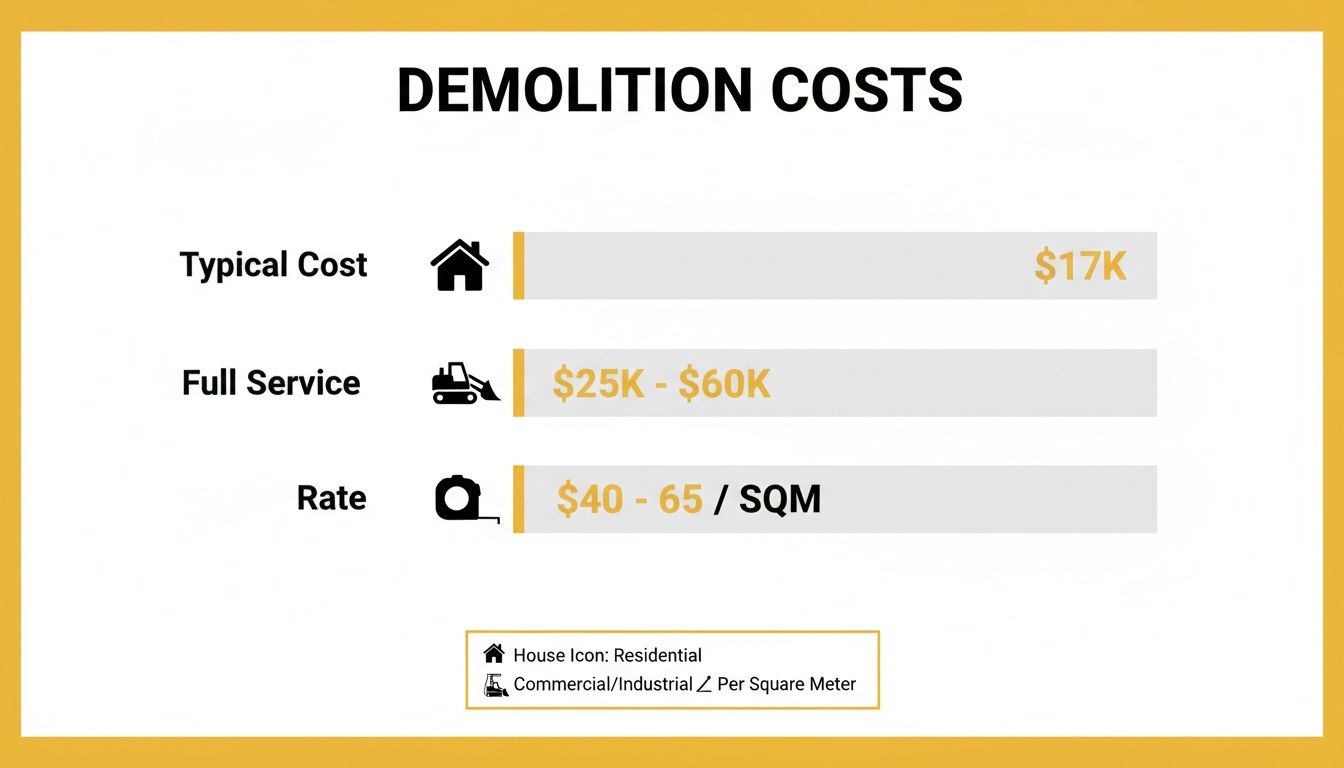
As you can see, the final cost is often a blend of the per-square-metre rate and any extra services needed. Let's break down exactly what influences those numbers.
1. House Size and Square Metres
This is the most straightforward factor on the list. A bigger house simply means more materials to dismantle, more hours for the crew on site, and more truckloads of debris to haul away.
It stands to reason that a sprawling single-storey home in the Hunter Valley will cost more to demolish than a compact cottage in inner-city Newcastle. Most contractors use a rough per-square-metre rate as a starting point, but this is always fine-tuned by the other factors we’re about to cover.
2. Construction Materials
What your house is made of has a massive impact on the demolition bill. A timber-framed house with lightweight cladding? That’s relatively quick and easy for us to dismantle. But a double-brick or brick veneer home is a different beast entirely, requiring heavier machinery and more intensive labour to break down.
Reinforced concrete and solid masonry are particularly tough nuts to crack. They're time-consuming to break up, which translates directly to higher costs for machinery operation and labour.
3. Site Access and Location
This is a huge, and often overlooked, cost driver. Imagine you're trying to get a large excavator down a narrow laneway in a dense Sydney suburb, or navigating a steep, battle-axe block in Terrigal. If we can't get our heavy machinery right up to the structure, the job immediately becomes more complex.
Tight access might force us to use smaller, less efficient machines, or in some cases, rely on manual labour to move debris. Both of these scenarios add significant time and cost to the project. Being close to neighbours also demands extra care and safety measures to ensure their properties remain untouched.
4. Foundations and Slabs
What’s underneath the house is just as important as the structure itself. A simple concrete slab-on-ground is the most common and easiest to remove. But dig a little deeper, and you might find surprises.
Older homes sometimes sit on complex pier and beam systems or have deep, reinforced footings that require serious excavation work. If your property is on tricky ground, like the reactive clay found in parts of the Central Coast or solid Sydney sandstone, breaking up and removing the foundations will be a much tougher, and more expensive, job.
5. Hazardous Materials Present
This is the big one. If there's a single variable that can dramatically inflate a demolition quote, it's the presence of hazardous materials. If your home was built before 1990, it’s highly likely to contain asbestos somewhere—in the cladding, roofing, insulation, or even old vinyl flooring.
By law, handling and disposing of asbestos is a specialised task that must be done by licensed professionals following strict SafeWork NSW regulations. The process is meticulous, slow, and adds a significant cost layer to the project. There's simply no cutting corners here; it’s about getting it right the first time to keep everyone safe.
6. Additional Structures and Landscaping
Your demolition quote needs to cover everything on the block that has to go, not just the main house. This can include old sheds, detached garages, in-ground swimming pools, concrete driveways, and large retaining walls. Each of these requires specific equipment and techniques for safe removal.
Don't forget the garden. Established trees and large stumps can also add to the cost, especially if they are close to the house. Removing them safely might require an arborist and specialised stump grinding equipment to avoid disturbing neighbouring properties.
7. Council Requirements and Permits
Finally, the paperwork. Navigating the necessary approvals with your local council contributes to the overall cost. Every council, from Central Coast Council (covering postcodes 2250-2264) to those across the greater Sydney area, has its own set of fees for development applications (DAs) and demolition permits.
On top of that, if your property is on a busy road, you'll likely need a traffic management plan to ensure public safety during the demolition. This adds another layer of planning and cost to the job. These compliance costs are non-negotiable and are absolutely essential for a legal and safe demolition.
The Asbestos Factor: Why It Can Dramatically Change Your Demolition Quote

If your home was built any time before 1990, there’s one word that can single-handedly have the biggest impact on your demolition costs: asbestos. This hazardous material was once a popular building product, but now its presence is a major complication that adds a significant, non-negotiable expense to any knockdown project.
Simply ignoring it isn’t an option. The health risks from airborne asbestos fibres are severe, and SafeWork NSW has incredibly strict regulations for its identification, handling, and disposal. This isn't a job for your average demolition crew; it demands fully licensed and accredited specialists who follow meticulous safety protocols to the letter. This specialised labour, combined with controlled disposal methods, is exactly why the presence of asbestos can inflate the overall cost to demolish a house.
Where Could Asbestos Be Hiding in an Older NSW Home?
One of the biggest challenges with asbestos is that it can be found in a surprising number of places throughout older properties. Anyone who grew up on the Central Coast or in Sydney’s established suburbs knows the classic ‘fibro’ shack – and that fibro sheeting is a prime suspect.
But asbestos wasn't just for external cladding. It was also commonly used in:
- Roofing and Gutters: Corrugated asbestos sheets were a common, durable roofing material.
- Internal Wall and Ceiling Linings: Especially in wet areas like bathrooms, laundries, and kitchens.
- Eaves and Gable Ends: Used for its weather-resistant properties.
- Old Vinyl Floor Tiles: Both the tiles themselves and the black adhesive used to stick them down can contain asbestos.
- Fencing and Garden Sheds: Those old, wavy asbestos panels were often used for fencing and small outbuildings.
Because it can be so widespread, a professional hazardous materials survey is the critical first step before any demolition work can even begin. This survey identifies exactly where the asbestos is, its type (friable or non-friable), and the quantity that needs to be removed.
Why Asbestos Removal Adds Thousands to Your Bill
The cost of asbestos removal is driven entirely by safety and compliance. When dealing with something this hazardous, having a deep understanding of the required personal protective equipment is non-negotiable, as detailed in this thorough guide to personal protective equipment for chemicals. The entire removal process is slow and methodical to prevent any fibres from becoming airborne.
A major driver of house demolition costs in Australia is asbestos removal, which can add thousands to tens of thousands of dollars. The hazardous materials component can realistically sit in the $8,000–$12,000 range, representing 15–40% of the total demolition bill.
Let's look at a real-world scenario. Imagine removing the asbestos cladding from a small cottage in Gosford. This might add a few thousand dollars to your project. But what if that same cottage also has an asbestos roof and internal asbestos wall linings in the bathroom and laundry? The cost climbs fast. Each area requires careful sealing, negative air pressure units, and meticulous cleaning – all adding significant labour hours and special disposal fees. A full internal and external strip-out can easily push the asbestos portion of your bill into five figures, turning what seemed like an affordable demolition into a much larger investment.
This process is a stark reminder of why getting things right from the start is paramount in our industry. To get a broader perspective on the entire process, check out our guide on the demolition of buildings, which explains all the stages involved.
Navigating Council Permits and NSW Regulations
Demolition is far more than just knocking down walls; it's a highly regulated process that requires careful planning and a stack of paperwork. Understanding the rules set by local councils and SafeWork NSW is non-negotiable, as getting this wrong can lead to eye-watering fines, project delays, and even legal trouble.
Think of the approvals process as the project’s foundation—without the right permits in place, nothing else can happen.
Before any machinery arrives on your Central Coast or Sydney site, you'll need to get the green light from your local council. This isn't just a suggestion; it's a legal requirement designed to ensure safety, protect neighbouring properties, and manage environmental impact. Getting this part right from the start saves you major headaches down the track.
Securing the Right Demolition Approval
In NSW, you generally need one of two main types of approval to demolish a house. The path you take really depends on the complexity of your project and your local council’s specific planning controls.
Your contractor will help you figure out whether you need:
- A Demolition DA (Development Application): This is the more common route, especially for complex sites or properties with planning overlays like heritage or environmental conservation zones. It’s a formal application submitted directly to your local council, such as Central Coast Council or Newcastle Council, for assessment.
- A Complying Development Certificate (CDC): This is a faster, more streamlined approval process for straightforward demolition projects that meet a specific set of state-wide criteria. A CDC can be issued by a council or a private certifier, bypassing the need for a full DA assessment.
The application fees for these permits definitely contribute to the overall cost to demolish a house and can vary quite a bit between councils.
Essential Permits and Pre-Demolition Checks
Beyond the main demolition approval, a series of other critical steps must be completed. These are non-negotiable checks that ensure the site is safe and ready for work to begin.
Important: Failure to properly disconnect utilities or protect council assets can result in significant fines and stop-work orders. Your demolition contractor should manage this process meticulously as part of their service.
Before the first wall comes down, your team must organise:
- Service Disconnections: This is an absolute must-do for safety. All services connected to the property—including electricity, gas, water, and telecommunications—must be professionally and legally disconnected by the relevant authorities. This requires planning, as it can take several weeks to coordinate with all the different providers.
- Asset Protection Permits: If your demolition work is likely to impact council property, like footpaths, kerbs, or street trees, you’ll need an asset protection permit. This usually involves a pre-demolition inspection to document the existing condition of these assets, so there are no arguments later.
- Traffic Management Plans: For properties on busy roads or in dense urban areas like Sydney, a professional traffic management plan is often required. This ensures the safety of the public and your work crew by managing vehicle and pedestrian flow around the site.
Successfully managing these approvals is a core part of professional demolition and excavation services, ensuring your project starts on the right foot—legally and safely.
How Demolition Fits into Your Knockdown Rebuild Project
It's easy to fixate on the cost to demolish a house, but that figure is really just one part of a much bigger picture. The demolition itself isn’t the final goal. Think of it as the critical first act – the stage that clears the path for everything else in your knockdown rebuild journey. It’s the essential site preparation that makes your new build possible.
When you hire a demolition contractor, you’re not just paying someone to tear a structure down. You’re investing in creating a clean, safe, and perfectly prepared canvas for your builders to work on. This process paves the way for the next crucial phases, like the detailed excavation for your new foundation, the earthworks needed to shape your block, and pouring the slab that will eventually support your dream home.
Demolition Costs in the Grand Scheme
Getting a quote for $25,000 to $40,000 can feel like a huge number, but it helps to put it into the context of the entire project budget. A knockdown rebuild is a major investment, and the demolition component often represents a surprisingly small slice of the overall spend. This perspective is vital for planning and allocating your funds properly right from the start.
Recent data from the Australian Bureau of Statistics shows that knock-down-rebuild homes now have an average approval value of over $700,000. With that in mind, the typical cost of demolition usually only makes up about 3–9% of the total project budget. You can read more about these rebuild trends on the ABS website to get a clearer sense of project scales.
Managing Timelines to Minimise Holding Costs
One of the most overlooked parts of a knockdown rebuild is the gap between finishing the demolition and starting the new construction. This "lag time" can get expensive, fast. You’re still paying rates, and maybe a mortgage, on a block of land that isn't doing anything for you. Managing this transition efficiently is one of the keys to keeping your budget on track.
That same ABS data reveals an average lag of about 5.7 months between demolition approval and getting the green light to build. This downtime really shines a light on the immense value of hiring a single contractor who can manage the entire site preparation process seamlessly.
By coordinating demolition, excavation, and site clearing under one roof, you can dramatically shorten this waiting period. This integrated approach cuts down on holding costs and gets your new build started much sooner, avoiding the frustrating delays that come from trying to juggle multiple independent contractors.
A streamlined process means no clumsy hand-offs between clearing the old house and digging for the new one. This efficiency is especially valuable on the Central Coast or in Sydney, where land values make every single week count. And before you get too deep into planning the new build, it pays to understand the key considerations of building for demolition to make sure the whole process is as smooth as it can be.
Choosing the Right Demolition Contractor in NSW
When it comes time to demolish a house, picking the right team is easily the most critical decision you'll make. The contractor you choose doesn't just influence the final price tag; they are responsible for the safety, compliance, and smooth running of your entire project, from the first site visit to the final clean-up. A great partner can turn what seems like a daunting, complex job into a straightforward, predictable process.
Think of a professional demolition contractor as more than just an equipment operator. They're project managers who know how to navigate the maze of council regulations, deal with hazardous materials like asbestos safely, and coordinate the whole site preparation. Choosing an experienced, local team is your best defence against expensive delays, bureaucratic headaches, and dangerous shortcuts.

Licensing and Insurance Are Non-Negotiable
Before you even glance at a quote, the very first step is to confirm the contractor has all the essential licenses and insurance. In NSW, this is the absolute baseline for any legitimate demolition company.
Make sure the team you're considering holds:
- A Demolition Licence: This is issued by SafeWork NSW and is mandatory for the vast majority of demolition work. No licence, no deal.
- An Asbestos Removal Licence: This is a completely separate and specialised qualification. If your home was built before the 1990s, it's vital your contractor is fully licensed to handle and remove asbestos safely and legally.
- Public Liability Insurance: Always ask to see their Certificate of Currency for public liability insurance. It should cover a minimum of $20 million. This is what protects you and your neighbours from the financial fallout of any accidental damage during the job.
What a Professional Quote Should Include
A detailed, transparent quote is the mark of a true professional. Vague, one-line estimates are a massive red flag and should be treated with suspicion. Your quote should act as a clear roadmap for the project, breaking down every single stage.
A proper quote will clearly lay out:
- A Detailed Scope of Work: It should specify exactly what is and isn't included in the price.
- Asbestos Removal Methodology: If asbestos is on site, the quote must detail the safe work methods they'll use to manage it.
- Waste Disposal and Recycling Plan: A good contractor will tell you where the debris is going and how much they plan to recycle.
- Clear Exclusions: The quote should be upfront about any tasks or items not covered by the price.
An unusually low quote might seem tempting, but it often signals that corners are being cut—whether it's on safety, insurance, or proper waste disposal. This can leave you exposed to some serious legal and financial risks down the track.
Proven Local Experience Matters
Finally, look for a contractor who has a solid track record of successful projects in your specific area, whether that's the Central Coast, Sydney, or the Hunter Valley. A team with deep local knowledge understands the unique challenges of the region, from the specific quirks of council regulations to dealing with local soil conditions. When you're vetting potential contractors, our guide on finding the best excavation contractors near you has some great questions to ask.
When you're making your final choice, it's crucial to see a commitment to the highest safety standards, often proven by industry certifications. For Australian businesses in high-risk fields like construction, following strict safety management systems is paramount, like those required for ISO 45001 certification. This kind of dedication shows they take their responsibilities seriously, protecting not only their crew but your property as well.
Your Top House Demolition Questions, Answered
To wrap things up, let's tackle some of the most common questions we hear from homeowners across the Central Coast, Sydney, and Newcastle. Getting clear, straightforward answers can make the whole demolition process feel much less daunting.
How Long Does a Typical House Demolition Take?
The actual knockdown is often the fastest part. For a standard, single-storey timber or brick veneer home, the heavy machinery might only be on-site for one to three days. It's surprisingly quick to watch.
But the full project timeline is a different story. You've got to account for the weeks needed for council approvals, disconnecting services like power and water, and any asbestos removal before a single machine rolls onto your block. From the day you sign the contract to the moment you have a completely clear, ready-to-build site, a straightforward job usually takes about four to eight weeks.
Can I Salvage Materials From My Old House to Save Money?
Absolutely, and it’s a brilliant way to recycle and potentially trim your costs. Things like old hardwood floorboards, solid timber beams, character windows, doors, and unique light fittings can often be carefully removed before the main demolition. This process is called a "soft strip."
It's really important to flag this with your contractor right at the start. It requires more careful, manual labour and changes the demolition plan. While it adds a bit of time to the prep phase, the value you get from the salvaged materials—or the money you save by reusing them—can often make the extra labour worthwhile.
What Happens to All the Demolition Waste?
A professional crew doesn't just haul everything to the tip. We take waste management seriously, and that means sorting materials as they come down.
Concrete and bricks are typically crushed and get a second life as road base or construction aggregate. Steel and other metals are separated and sent off to scrap recyclers. Any clean, untreated timber can be repurposed or turned into mulch. This isn't just better for the environment; it also reduces hefty landfill fees, which directly helps manage the overall cost to demolish a house.
Do I Need to Be on Site During the Demolition?
No, and for your own safety, you shouldn't be. In line with SafeWork NSW guidelines, an active demolition site is a controlled work zone. Only licensed and accredited personnel are allowed inside the safety fencing once the heavy machinery starts up.
Your contractor should keep you in the loop with regular progress updates. They’ll let you know the moment the site is cleared, confirmed safe, and ready for you to come and inspect the finished result.
Ready to get a clear, detailed quote for your demolition project? The team at Booms Up Civil has over 15 years of experience preparing sites across the Central Coast, Sydney, and the Hunter Valley. We handle everything from council applications to final site clearing, ensuring your project is done right the first time.