
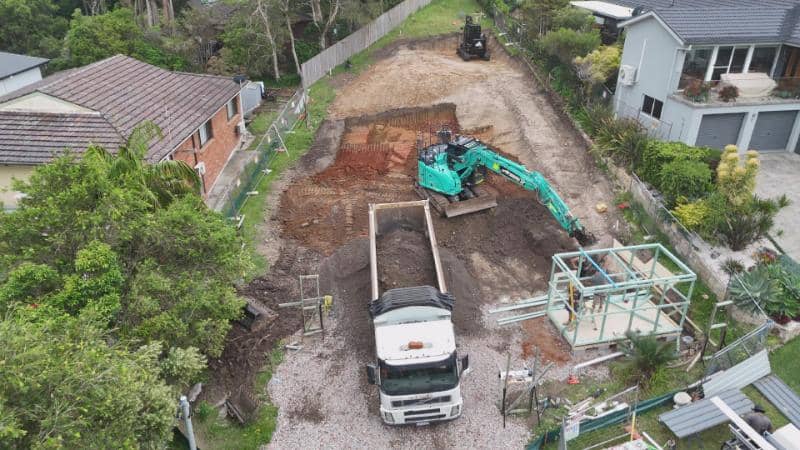
If you are planning to level a sloped block, cut a building pad, or reshape land for a driveway or subdivision, the first question your earthmoving contractor will ask is: how much cut, how much fill, and does it balance?
That question matters a lot more than most people realise. A site that balances means the soil you dig from the high spots can be pushed directly to the low spots. No trucks off site, no imported fill, no extra cost. A site that does not balance means you are either paying to cart spoil away, or paying to bring fill in, and sometimes both.
This free calculator gives you that answer before anyone turns a machine on. Enter your cut and fill areas and depths, set your soil factors, and it tells you whether your site is in surplus, deficit, or balance, along with how many truck loads you are dealing with either way.
Cut & Fill Calculator
Estimate earthwork balance, spoil & import volumes
How to Use This Calculator
The calculator has two inputs for your cut zone, which is the area of ground being lowered and the average depth it needs to come down. Alongside that you enter your fill zone, which is the area being built up and the average depth of fill required.
If your site has an irregular shape, break it into simpler sections, work out the area of each, and use a weighted average depth. That will get you close enough for planning and budgeting purposes.
The two material factor fields are worth understanding before you change them.
Swell Factor accounts for the fact that soil expands when it is dug. A cubic metre of clay sitting in the ground does not come out as a cubic metre of loose material. It bulks up. Typical values are around 15% for sandy soils, 20 to 30% for clay, and up to 40% or more for rock and shale. This matters because it directly affects how much material you are moving by volume once it is loose, and therefore how many truck loads are involved.
Compaction Factor works in the opposite direction. When you place and compact fill, you need more loose material than the finished compacted volume to account for the material being pressed down. A 10 to 15% compaction factor is typical for most engineered fills. This affects how much material you need to either re-use from cut or bring in from elsewhere.
The Truck Capacity field lets you set the size of truck being used. A standard tandem tipper carries around 12 m³. A semi-tipper or dog trailer can carry 20 to 22 m³. Using the right figure here gives you a realistic load count rather than a rough guess.
Understanding the Results
The Balance Banner
The coloured banner at the top of the results is the most important figure on the page.
A green surplus banner means your cut volume, once bulked, produces more loose material than your fill zone needs. That excess has to go somewhere, which is typically off site in trucks. The banner tells you exactly how many loads.
An orange deficit banner means the opposite. Your cut zone does not produce enough material to fill the low areas, so you will need to import fill from elsewhere. This is a common situation on flat sites where you are building up a pad rather than cutting and pushing.
A yellow balanced result is what every site supervisor wants to see. It means the material largely balances on site, minimising haulage costs in both directions.
In-Situ Volume vs. Loose Volume
The in-situ volume is what is sitting in the ground undisturbed. The loose volume is what that same material becomes once it is dug up, broken apart, and loaded into a truck. These are never the same number, which is why the swell factor exists. If you skip this factor and just compare raw volumes, your truck count will be wrong and your budget will miss the mark.
Why Cut and Fill Balance Matters on Real Projects
Most residential and civil earthworks jobs involve some combination of cutting and filling. Very few sites are perfectly flat before work starts. The aim is always to minimise the volume of material leaving and entering the site, because every truck load costs money in labour, fuel, and disposal or supply fees.
On a house pad job, a builder or earthmoving contractor will review the site levels, identify where material needs to come out and where it needs to go, and try to achieve balance on site. When the site cannot balance due to shape, soil type, or level differences, the shortfall either goes to landfill or gets imported as engineered fill.
On subdivision projects, cut and fill planning happens at a larger scale. Getting the balance right across multiple lots can save tens of thousands of dollars in haulage and fill supply costs. That is why civil engineers and earthmoving contractors put a lot of thought into the finished level design before a machine touches the ground.
Typical Cut and Fill Scenarios
Sloped residential block on the Central Coast
A common scenario across the Central Coast and Hunter hinterland is a residential block with a natural fall of 1.5 to 2 metres across the building footprint. Say the house pad is 18 m x 14 m, and the average cut depth across the upper half is 0.8 m while the lower half needs 0.5 m of fill.
Cut zone: 126 m² at 0.8 m depth gives 100.8 m³ in-situ. With a 25% swell factor for clay soil, that becomes approximately 126 m³ loose.
Fill zone: 126 m² at 0.5 m depth gives 63 m³ compacted. With a 12% compaction factor, you need roughly 70.6 m³ of loose material to achieve that.
Balance: 126 minus 70.6 gives 55.4 m³ of surplus spoil to remove. At 12 m³ per tandem tipper, that is 5 truck loads off site.
Site levelling for a driveway in Newcastle
A long sloped driveway measuring 24 m x 4 m with an average cut of 300 mm gives 28.8 m³ in-situ. With 20% swell, that is about 34.6 m³ loose. If the driveway needs no fill at all, all of that material leaves the site, which is roughly 3 tandem tipper loads.
Subdivision pad preparation in the Hunter Valley
On a larger subdivision lot of 600 m² being cut to a level building pad with an average cut of 450 mm, the in-situ volume is 270 m³. At 20% swell that becomes 324 m³ loose. If there is a fill zone of 200 m² at 200 mm depth, that is 40 m³ compacted fill needed, requiring about 44.8 m³ loose. The surplus is 279.2 m³ to remove, which is approximately 24 tandem tipper loads. That kind of volume is where the difference between a 12 m³ tandem and a 22 m³ dog trailer starts to have a real impact on cost.
What Affects Cut and Fill Accuracy on Your Site
These calculations give you a solid planning estimate, but real sites have variables that can shift the numbers.
Variable depths. Averaging a sloped site works well for a broad estimate, but if parts of the site vary significantly in depth, breaking the area into zones and calculating each separately will give a more accurate result.
Soil type changes across the site. If part of your site is sandy topsoil and another part hits clay or rock at depth, the swell factor will differ across zones. On large sites, a geotechnical report can give you soil-specific density and swell data.
Reactive clay. Across much of Western Sydney, parts of the Central Coast, and the Maitland region, reactive clay soils can behave differently depending on moisture content. Wet clay bulks more aggressively than dry clay, so swell factors on these sites can push toward the higher end of the range.
Over-excavation. On site, machines do not cut to millimetre precision. It is normal to allow for some over-excavation, particularly on sloped sites or around structures. Adding a small contingency of 5 to 10% to your cut volume is a sensible practice.
Need Earthworks Help on the Central Coast, Newcastle or Hunter Valley?
Whether you are planning a house pad, a subdivision, a driveway, or a large-scale land cut, getting the cut and fill balance right from the start saves time and money on site. The team at Booms Up Civil handles excavation, bulk earthworks, and site preparation across Sydney, Newcastle, the Central Coast, and the Hunter Valley.
If you have a project coming up and want a proper site-specific assessment, get in touch for a quote.
These calculations are estimates only. Actual volumes will vary based on site-specific conditions, soil testing results, and finished level design. Always engage a licensed earthmoving contractor or civil engineer for site-specific advice on larger projects.