
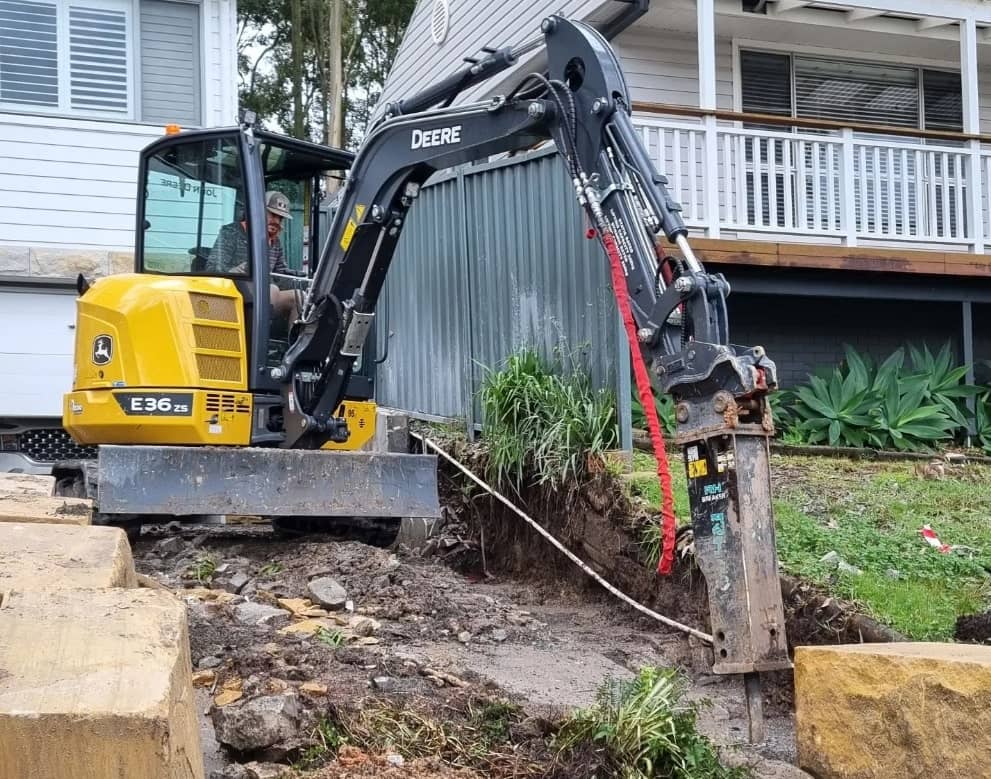
Last year, John from Terrigal thought he’d save a few thousand dollars by tackling the excavation for his new sandstone retaining wall himself. His sloped backyard seemed manageable enough – just a bit of digging, right? Three days later, he was staring at a collapsed embankment, a neighbour’s fence hanging precariously over his property line, and a very expensive lesson about why steep slope excavation isn’t a DIY job.
If you’re planning any excavation work on the Central Coast’s notoriously hilly terrain, John’s story might sound familiar. From the sandstone ridges behind Gosford to the coastal escarpment that runs through suburbs like Avoca Beach and Copacabana, our region’s beautiful topography creates some seriously challenging conditions for excavation projects. Whether you’re planning a new driveway cut in Kariong’s hills, a basement dig in Terrigal Heights, or a pool excavation on your sloped Erina block, understanding the complexities of steep slope excavation could save you from costly mistakes – and potentially dangerous situations.
The truth is, steep slope excavation requires specialised knowledge, proper equipment, and experienced operators who understand the unique challenges of our local geology. From dealing with Hawkesbury sandstone shelves to managing stormwater runoff during the Coast’s unpredictable weather, there’s a lot more to consider than most homeowners realise. Let’s dive into what makes slope excavation so tricky and how to approach your project safely and successfully.
Why Steep Slope Excavation is So Tricky
The Central Coast’s Challenging Terrain
Anyone who’s driven through the back streets of Point Clare or up the hills behind Woy Woy knows our region isn’t exactly flat. The Central Coast sits on some of Australia’s most geologically diverse terrain, with coastal ranges, sandstone ridges, and residential blocks that would make even experienced builders pause for thought. From the steep hillsides of Kincumber that overlook Brisbane Water, to Avoca Beach’s cliff-top properties perched above the Pacific, we’re dealing with slopes that can range from gently challenging to downright intimidating.
The geology here tells a story that’s millions of years in the making. Much of our region sits on Hawkesbury sandstone – that distinctive yellow-brown rock you’ll see exposed in road cuts along the M1 or behind houses in suburbs like Springfield and Narara. While it’s relatively stable when intact, sandstone can be unpredictable during excavation. It might seem solid one moment, then fracture along natural joints the next. Add to this the layers of clay, loose fill, and decomposed granite that overlay the bedrock in many areas from Wyong to Umina Beach, and you’ve got a recipe for complexity that requires real expertise to navigate safely.
Then there’s the human element. Many of the Coast’s most desirable residential areas were developed on blocks that builders today might think twice about. These properties often require excavation work for extensions, pools, or infrastructure upgrades, but their steep gradients and limited access make every project a unique puzzle to solve.
Common Problems That Arise
The challenges of steep slope excavation go far beyond just keeping machinery from sliding downhill – though that’s certainly part of it. Equipment access is often the first hurdle. That standard excavator that works perfectly on flat ground suddenly becomes a liability on a 30-degree slope. Many residential properties, particularly in established areas like Wamberal or Forresters Beach, have narrow driveways and limited street access that make getting large machinery to the worksite a logistical nightmare. In these scenarios, its important to use contractors with expertise in tight access excavation.
Soil stability is another major concern. When you start cutting into a slope, you’re fundamentally changing the forces that have kept that hillside stable for decades or centuries. Remove material from the wrong spot or at the wrong angle, and you risk triggering a collapse that could damage not just your property, but neighbouring homes as well. This is particularly relevant across suburbs like MacMasters Beach and Killcare Heights, where many properties back onto steep bushland or reserves that haven’t been previously disturbed.
Water management becomes critical on sloped sites. Our region’s weather patterns – from summer storms to winter’s steady rain – mean that any excavation needs to account for runoff and drainage. Cut into a slope without proper planning, and you might find yourself channelling stormwater directly toward your home’s foundations or your neighbour’s backyard in suburbs built on ridgelines like Kincumber South or Point Frederick.
Central Coast Council has also tightened regulations around slope work in recent years, with specific requirements for excavation on slopes greater than 18 degrees. These regulations apply consistently across the region, from Budgewoi in the north to Umina Beach in the south. Navigate these incorrectly, and you could find your project stopped mid-dig while you scramble to obtain the right approvals.
Consider a hypothetical scenario in Wamberal where a homeowner decides to save money by hiring a general contractor rather than professional excavation services for their pool dig. The contractor underestimates the slope’s instability and begins cutting without proper shoring. In such situations, sections of excavation can collapse within hours, potentially taking out neighbouring retaining walls and creating expensive remediation work that far exceeds the original budget.

Safety First: Why Professional Help Matters
Real Risks of Slope Excavation
The risks associated with steep slope excavation aren’t just theoretical – they’re documented, measurable, and in some cases, deadly. Soil collapse is perhaps the most immediate concern. Unlike excavation on flat ground where cave-ins are typically localised, slope failures can trigger cascading collapses that affect areas far beyond the original dig site. The physics are unforgiving: remove material from a slope, and you’re concentrating stress on the remaining soil and rock. If that material can’t handle the increased load, failure can happen quickly and without warning.
Equipment rollover is another significant risk that many property owners don’t fully appreciate. Standard excavators and earthmoving equipment are designed with certain operating parameters in mind. Push those limits on a steep slope, and the centre of gravity shifts in ways that can make even experienced operators lose control. WorkCover NSW has specific guidelines for excavation work on slopes, and these aren’t suggestions – they’re legal requirements designed to prevent serious injuries and fatalities.
Underground utilities present amplified risks on sloped terrain. Water, gas, and electrical lines throughout suburbs like Terrigal, Erina, and Long Jetty often follow property boundaries or road alignments that don’t account for the actual slope gradient. What appears to be a safe depth on the utility plans might put you dangerously close to services when you’re working on an angle. Strike a gas main on flat ground and you have a serious problem; do it on a slope where emergency access is limited, and you have a potential catastrophe.
Professional Safety Measures
This is where the expertise of qualified excavation specialists becomes invaluable. Professional operators understand that slope excavation isn’t just about moving dirt – it’s about managing a complex system of forces, drainage, and access requirements. They start with proper soil testing and geotechnical assessment, identifying not just what type of material they’re working with, but how it’s likely to behave under excavation stress.
Proper shoring and retaining systems are standard practice for experienced teams. Rather than simply cutting and hoping for the best, professionals install temporary or permanent support structures that maintain soil stability throughout the excavation process. This might include steel shoring panels, timber cribs, or engineered retaining systems designed specifically for the site conditions.
Equipment selection and operator certification make a crucial difference. Central Coast excavation experts use machinery specifically suited to slope work – track excavators with low ground pressure, long-reach attachments for working from stable positions, and specialised attachments for precision digging around sensitive areas.
Imagine a scenario in East Gosford where a homeowner hires an unlicensed operator to cut a driveway through a steep section of their block. If that operator recognises challenging soil conditions and stops work to recommend professional assessment, that decision could prevent a major collapse that might threaten neighbouring homes’ foundations. This type of professional judgment call represents the difference between experienced operators and those simply looking to complete jobs quickly.

Equipment Solutions for Steep Slopes
Specialised Machinery Options
Not all excavators are created equal, and this becomes especially apparent when working on steep terrain throughout the Central Coast. The choice between track and wheeled excavators, for instance, isn’t just about mobility – it’s about physics and safety. Track excavators distribute their weight over a much larger surface area, providing better flotation on soft soils and significantly improved stability on slopes. This is particularly important when working with the region’s sandstone and clay combinations found throughout suburbs like Narara and Niagara Park, where surface conditions can change dramatically with moisture content.
The track system also provides better traction when working on angles. Those wide rubber pads can grip surfaces that would send a wheeled machine sliding, and the lower centre of gravity inherent in track design makes rollover accidents much less likely. For slopes beyond about 25 degrees – common in hillside suburbs like Copacabana and MacMasters Beach – tracks aren’t just preferable, they’re essential for safe operation.
Compact and mini excavators have revolutionised slope work in residential areas across the Central Coast. These smaller machines can navigate the narrow driveways and tight access points common in established suburbs like The Entrance or Toukley. A 5-tonne mini excavator can fit through a standard residential gate and still provide enough power for most residential excavation tasks, while being light enough to work on slopes that would challenge larger machinery.
Consider a hypothetical Umina Beach property that needs excavation for a new septic system on a block that slopes sharply toward Umina Beach. With narrow street access and established gardens, standard equipment couldn’t reach the worksite. A compact excavator could potentially navigate through existing landscape, complete the excavation with minimal disruption, and use access paths that larger machinery would destroy.
Long-reach excavators represent another solution for challenging slope work throughout coastal suburbs like Killcare and Killcare Heights. These machines can work from stable positions at the top or bottom of slopes, using extended arms to reach areas that would be unsafe for direct equipment access. This approach is particularly valuable for cliff-top properties where getting machinery onto the actual slope isn’t feasible.
Alternative Access Methods
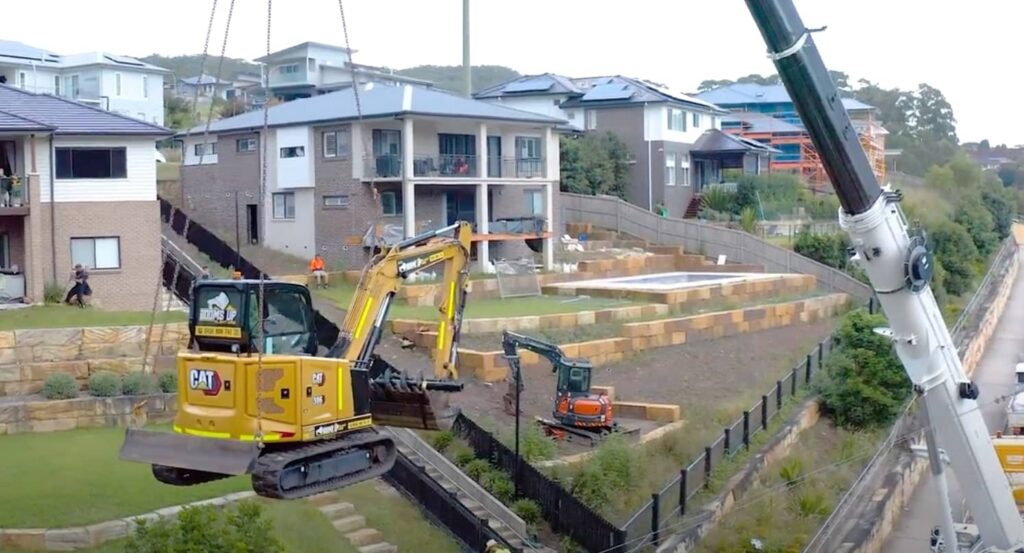
Sometimes conventional equipment access simply isn’t possible, and that’s when creative solutions come into play. Helicopter lifts might sound extreme, but they’re increasingly viable for high-end coastal properties where vehicle access is impossible. Projects in areas like Bouddi or isolated sections of Pretty Beach might require small excavators to be helicopter-lifted to building sites where foundation excavation would otherwise be impossible.
Conveyor systems offer another solution for spoil removal from difficult access sites. Rather than trying to truck material up and down steep driveways in suburbs built on ridgelines like Point Frederick or Kincumber South, conveyor belts can transport excavated material to accessible collection points. This approach is particularly valuable for large excavations where the volume of material would otherwise require dozens of truck trips on narrow, steep access roads.
Hand excavation teams, while labour-intensive, provide precision and access that machinery simply can’t match. For heritage properties in older parts of Gosford or areas with sensitive landscaping throughout the coastal strip, small teams with hand tools can complete excavations that preserve existing features while meeting modern construction requirements.
Planning Your Slope Excavation Project
Council Requirements Across the Region
Central Coast Council has implemented some of the most comprehensive slope development controls in NSW, particularly following several high-profile landslip incidents in the early 2000s. Their requirements kick in for any excavation on slopes greater than 18 degrees, requiring geotechnical assessment and often detailed engineering plans before work can commence. These regulations apply consistently whether you’re working in Budgewoi, Bateau Bay, or anywhere in between.
The council’s approach reflects the diverse geological conditions across our region. Areas like Woy Woy built on reclaimed land have different considerations than the sandstone country around Kariong or the coastal dunes near The Entrance. Understanding which specific controls apply to your suburb and soil type is crucial for project success.
Development Application (DA) processes can take months and require detailed documentation, while Complying Development Certificates (CDC) offer faster approval but with stricter limitations on scope and site conditions. The key is understanding which approval pathway applies to your specific project and location before you start planning excavation work.
Geotechnical Considerations
Understanding your site’s geology isn’t just about meeting council requirements – it’s about making informed decisions that could save thousands of dollars and prevent dangerous situations. Geotechnical assessment becomes mandatory for most significant excavations on slopes across the Central Coast, but even for smaller projects, understanding soil conditions can guide equipment selection and construction methodology.
The Hawkesbury sandstone that underlies much of our region from Wyoming to Woy Woy has characteristics that significantly impact excavation planning. While generally stable, sandstone can fracture along natural joint systems that aren’t visible from the surface. A geotechnical assessment can identify these potential failure planes and recommend excavation techniques that work with, rather than against, the natural rock structure.
Clay layers, common throughout suburbs like Kariong and Mount White, present different challenges. Clay can appear stable when dry but become dangerously unstable when wet. Understanding drainage patterns and seasonal moisture variations helps predict how these materials will behave during excavation and what support systems might be required.
The distinction between soil and rock excavation has major cost implications. Standard excavation pricing assumes soil conditions, but if your project encounters solid sandstone that requires rock-breaking or even blasting, costs can increase dramatically. Proper assessment identifies these conditions before equipment arrives on site, whether you’re working in the sandy soils near Toukley or the rock country behind Gosford.
Timing and Weather Factors
The Central Coast’s climate pattern significantly impacts excavation scheduling, particularly for slope work where water management is critical. Summer storm seasons can transform stable clay soils into unstable slurries within hours, while winter’s steady rain can extend project timelines and increase safety risks across all suburbs from north to south.
The optimal window for slope excavation typically falls in late autumn or early spring, when ground conditions are stable but weather patterns are predictable. However, many projects can’t wait for perfect conditions, making proper planning and contingency measures essential regardless of whether you’re working in Terrigal or Tuggerah.
Working around the Coast’s seasonal population influx adds another layer of complexity. Summer holiday periods bring increased traffic and limited access to coastal areas from Copacabana to The Entrance, while school holidays can restrict working hours in residential areas throughout the region. Professional excavation specialists factor these considerations into project scheduling from the outset.
Cost Factors and Budgeting
What Drives Up Slope Excavation Costs
Understanding the cost drivers for slope excavation helps property owners budget realistically and avoid nasty surprises mid-project. Equipment transportation and setup represent significant cost factors that don’t exist for flat-ground excavation. Getting specialised machinery to challenging sites throughout suburbs like Kincumber or Davistown often requires additional transport equipment, road permits, or even temporary access construction.
Safety measures and insurance requirements add costs that might not be obvious upfront. Professional operators carry higher insurance premiums for slope work, reflecting the increased risk profile. This cost is passed on to clients but represents genuine value in terms of liability protection and professional expertise.
Extended project timelines are almost inevitable for slope work. What might be a two-day excavation on flat ground could require a week on challenging terrain, particularly when weather delays or unexpected ground conditions come into play. Conservative time estimates help avoid the frustration and additional costs associated with rushed or extended schedules.
Spoil removal logistics can dramatically impact project budgets. Standard excavation assumes truck access for material removal, but slope sites might require additional handling, longer haul distances, or specialised equipment for material transport. Factor these costs into initial budgeting to avoid mid-project financial surprises, particularly in areas with limited access like some parts of Pretty Beach or isolated sections of Copacabana.
Getting Accurate Quotes
The importance of detailed site inspection before quoting cannot be overstated. Reputable contractors will insist on visiting the site, assessing access routes, understanding soil conditions, and evaluating all the factors that impact project complexity. Be wary of quotes provided purely from photos or site plans – they’re almost certainly underestimated.
Key questions to ask potential contractors include their experience with similar slope conditions across the Central Coast, insurance coverage specific to slope work, and contingency planning for unexpected conditions. Ask for recent references from comparable projects, and don’t hesitate to follow up with previous clients about their experience.
Red flags in cheap quotes often include unrealistic timeframes, lack of insurance documentation, or reluctance to provide detailed breakdowns of costs. Remember that slope excavation mistakes can be expensive to fix and potentially dangerous. The cheapest quote rarely represents the best value when things go wrong.
Consider a hypothetical scenario where a homeowner in Erina chooses the lowest bidder for sloped driveway excavation. If that contractor’s quote is 30% below others but doesn’t include proper shoring or professional soil assessment, and the excavation partially collapses during the first heavy rain, the property owner might end up paying nearly three times the original quote to fix the damage and complete the work properly. The lesson is clear: pay for experience upfront, or pay for mistakes later – and the mistakes cost significantly more.
Success Stories from Around the Region
Creative Solutions That Work
Terraced excavation approaches have proven particularly successful for large residential projects on challenging slopes. Rather than creating one massive cut that requires extensive retaining, stepped excavation creates multiple smaller level areas that work with natural contours. This approach could work successfully for large properties in suburbs like Copacabana where owners want to create usable outdoor spaces on blocks that slope continuously from street to water.
Temporary access roads represent another creative solution category. For projects where standard vehicle access isn’t possible in suburbs built on steep terrain, constructing temporary roadways – sometimes using geotextile fabrics and recycled materials – can enable conventional equipment access. These temporary works are removed and areas restored once excavation is complete, often at less cost than using specialised access methods throughout projects.
Staged excavation with intermediate retaining has become the standard approach for complex slope projects. Rather than completing all excavation before installing support structures, this methodology involves alternating cut and support phases. Each section is stabilised before moving to the next, reducing risk and often enabling work to proceed even during adverse weather conditions.
The success of these varied approaches reinforces a key principle: there’s no one-size-fits-all solution for slope excavation across the Central Coast. Each project requires assessment of unique site conditions, access limitations, environmental constraints, and client requirements. The professional excavation approach combines technical expertise with creative problem-solving to find solutions that work within each project’s specific constraints.
Conclusion and Next Steps
Steep slope excavation on the Central Coast isn’t just about moving dirt from point A to point B – it’s about understanding geology, managing risk, navigating regulations, and finding creative solutions to complex challenges. Whether you’re planning a simple driveway improvement in Kincumber or a complex residential development in Terrigal Heights, the hilly terrain that makes our region so beautiful also makes excavation work significantly more complex than in flatter areas.
The key takeaways are clear: proper planning prevents problems, professional expertise saves money in the long run, and safety should never be compromised for short-term cost savings. From the sandstone ridges of Gosford to the coastal slopes of Avoca Beach, successful slope excavation requires understanding local conditions, using appropriate equipment, and working with experienced operators who know how to manage the unique challenges our terrain presents.
Before you start any slope excavation project, invest in proper assessment and professional consultation. The examples of successful projects across our region demonstrate that with the right approach, even the most challenging slopes from Budgewoi to Umina Beach can be excavated safely and cost-effectively. But the potential consequences of failed DIY attempts and cut-price contractors also show how quickly things can go wrong when proper expertise isn’t engaged from the start.
If you’re ready to move forward with your slope excavation project, don’t leave success to chance. Contact excavation specialists who understand the Central Coast’s unique challenges and have the experience to turn your sloped site into the foundation for your next project. Your property, your neighbours, and your budget will thank you for making the professional choice.