
You're usually not thinking about as-built drawings when the excavator first rolls in. You're thinking about getting the driveway poured, the drainage in, the slab set out properly, and the job finished without delays. The problem is that the record of what was built becomes most important after the work is covered up.
That's where a lot of small NSW projects come unstuck. A marked-up plan from site isn't the same thing as a council-ready as-built package. If you're building on the Central Coast, in Newcastle, Sydney, or the Hunter, that difference matters. It affects sign-off, future maintenance, safety, and whether someone can locate a buried service without digging blind.
What Are As-Built Drawings and Why Do They Matter
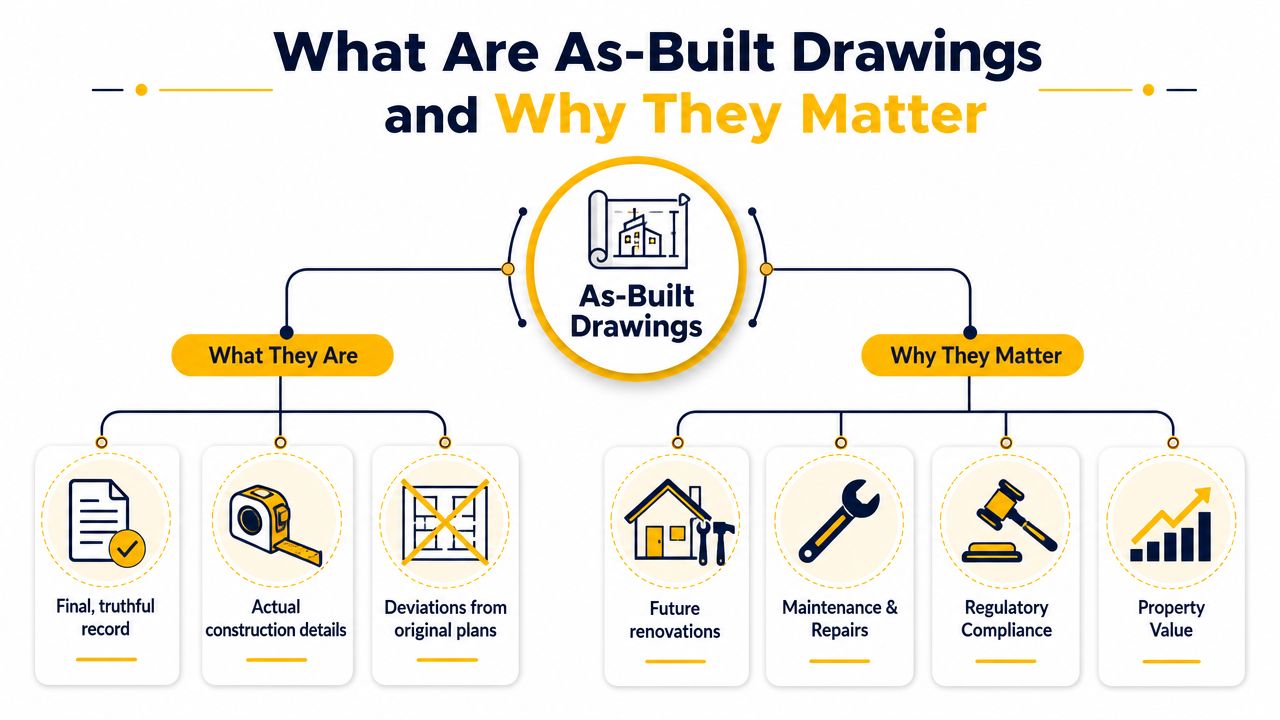
As-built drawings are the final record of what was constructed. They are not just a reprint of the approved design, and they are not just a few handwritten notes from site. They show the finished location, size, level, and arrangement of the work as it exists in the ground.
A simple way to think about it is this. The design drawing is the recipe. The as-built drawing is the finished meal on the table. One shows what was intended. The other shows what you ended up with after site conditions, service clashes, access limits, and practical decisions changed the job.
Why the final record matters more than people expect
On civil jobs, changes happen all the time. A stormwater line might shift to avoid rock. A pit might move because the original position clashes with a tree root or another service. A retaining wall might finish with a slightly different footprint once excavation exposes ground conditions.
If those changes aren't captured properly, the next person works off the wrong information.
That's how you get avoidable trouble later. Someone cores through a slab and hits a line that “wasn't meant to be there”. Someone starts trenching for a new service and finds the previous drainage run sitting off alignment. Someone plans an extension in Wamberal or Terrigal and discovers the existing records don't match the site.
Practical rule: If the work will be buried, covered, or hard to verify later, it needs to be recorded properly while it's visible.
In NSW, that record is becoming more digital and more controlled. NSW ePlanning specifications require project information in standard geospatial formats, and industry reporting notes that around 30% of as-built drawings contain errors or incomplete information according to this overview of digital handover requirements and as-built accuracy. That's a strong reason to treat as-builts as a serious deliverable, not a paperwork chore at the end.
Why homeowners should care too
If you're an owner-builder or homeowner, as-built drawings protect you long after the contractor leaves site. They help with repairs, upgrades, future landscaping, pool installs, granny flats, and resale questions about what's underground and where.
They also tie directly into long-term operations. If you want a clearer picture of how completed site records feed into maintenance planning, this guide on what is asset management for facilities is useful background.
For jobs involving excavation, drainage, or slab preparation, issues often start before concrete goes down. Good planning and accurate records work together, especially on sites that need careful site preparation and excavation planning.
The Difference Between As-Builts Redlines and Record Drawings
Much confusion arises because people on site often use the same words for different documents. This can lead to the wrong thing being handed over at the end.
A redline isn't the same as an as-built. An as-built isn't always the same as a record drawing. If council, a certifier, or a client asks for one and gets another, you can end up with rejection, rework, or handover delays.
As-Built terminology explained
| Term | Who Creates It | Purpose | Level of Formality |
|---|---|---|---|
| Redline markup | Usually site crew, foreman, supervisor, or contractor | Notes field changes on the working set during construction | Low to moderate |
| As-built drawing | Usually contractor, often using survey and verified field information | Compiles actual built conditions into a clean final set | High |
| Record drawing | Often owner's designer, architect, or engineer, depending on the project | Consolidates final information into the project record | High |
What each one does in practice
A redline markup is a working document. It's useful. In fact, it's often the starting point for a good final package. But it's temporary by nature. It might include handwritten notes, clouded changes, arrows, levels scribbled in the margin, and quick site fixes that still need checking.
An as-built drawing is the cleaned-up, verified version. It should show the actual completed work, not just rough notes about what might have changed.
A record drawing can mean slightly different things depending on the consultant or contract setup. In some jobs, it's the owner-issued final record based on the contractor's as-builts. On others, people use the term loosely. That loose language causes problems when approval conditions are strict.
A simple marked-up set might help your crew finish the job, but it often won't satisfy formal handover.
Industry guidance makes that distinction clear. A redline is a temporary markup, while an as-built is a final compiled record. It also notes that some authorities require as-builts to be certified and sealed by a professional land surveyor, with digital CAD and GPS data, which is well beyond what a basic marked-up plan provides, as outlined in this explanation of as-built terminology and acceptance standards.
Why this matters for council sign-off
Let's say you build a driveway and drainage system on a sloping block in Terrigal. During construction, the pit moves, the line shifts, and the finished levels are adjusted to get the falls right. Your foreman marks everything on a printed plan with pen.
That marked-up set helps the team. It does not automatically become the final authority for council handover.
For sign-off, what usually matters is the verified final package. That means the actual finished geometry, suitable file formats, and where required, the right certification. Redlines support that process. They don't replace it.
Council and Regulatory Requirements in NSW
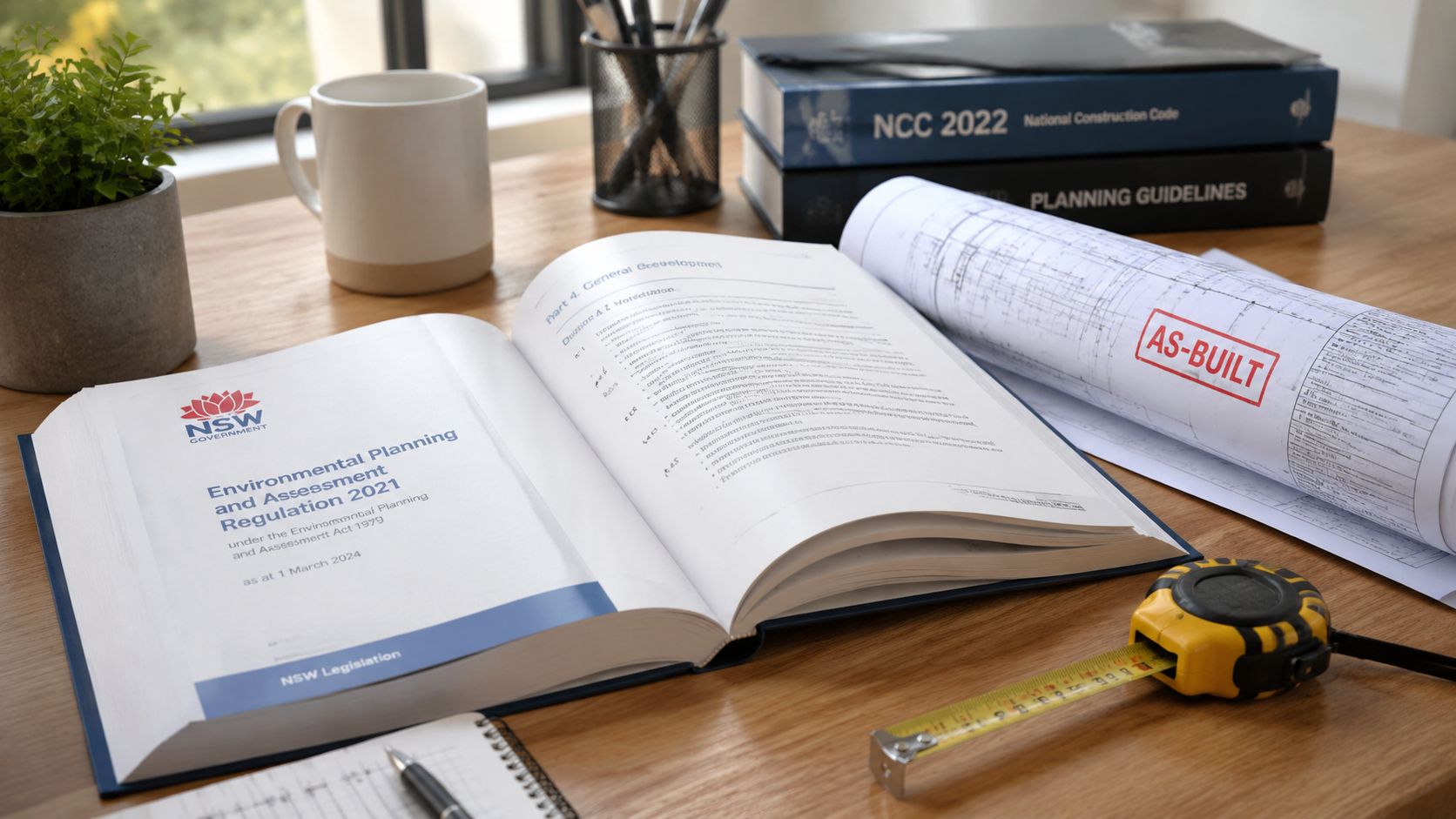
For civil works in NSW, compliance isn't optional. If your project needs council acceptance, subdivision approval, or formal closeout documentation, the as-built package has to meet the required standard. “Close enough” doesn't get many jobs over the line.
That's especially true once the work becomes part of a public or managed asset record. Councils and authorities don't just want a drawing to look tidy. They need information they can use later for maintenance, approvals, service coordination, and future works.
What NSW projects are moving toward
The direction is clear. Authorities increasingly expect digital, survey-grade records rather than a paper plan scanned to PDF. Current guidance points to structured handover packages that include CAD, PDFs, and geospatial data fields, not just drawings on their own. It also highlights the need for records that integrate with GIS and asset-management workflows, as discussed in this industry paper on as-builts and digital handover.
For a practical NSW job, that often means thinking beyond the drawing sheet itself. You need to know:
- What council wants for the specific asset type
- Who must verify or certify the finished information
- Which digital formats are required for submission
- Whether survey pickup is needed before works are covered
Local reality on small and mid-sized civil jobs
On the Central Coast, in Newcastle, and across Sydney growth areas, many jobs sit in the awkward middle ground. They aren't massive infrastructure packages, but they still need proper records. Think stormwater upgrades, vehicle crossings, retaining structures, drainage renewals, subdivision servicing, or hardstand construction.
That's where people get caught. They assume strict handover rules only apply to large civil contractors. Then final approval stalls because the package doesn't match what council or the certifier asked for.
If the approval condition asks for digital as-builts, giving council a photo of a marked-up plan won't rescue the job.
Subdivisions are a good example because they usually involve multiple services, levels, and authority interfaces. If that's the kind of work you're dealing with, it helps to understand how subdivision civil contractors manage compliance and handover.
Why this matters on the ground
Consider a Sydney site with sandstone excavation and stepped footings, or a Central Coast block with sandy soils near the coast and drainage running through fill. The approved design gets you started. The final built condition is what has to be documented.
That permanent record can affect later excavation, retaining upgrades, driveway tie-ins, and utility connections. It also supports safer planning for any future work under SafeWork NSW expectations around locating services and managing excavation risks.
The As-Built Process for Civil Projects
The biggest mistake is leaving as-built drawings until the end. By then, parts of the job are covered, memory is patchy, and everyone's trying to close out defects and move plant to the next site. That's when details get missed.
Good as-builts are built progressively, not retrospectively.
A typical workflow on a civil job
Take a hypothetical driveway and drainage install in Gosford. The approved plan shows a driveway profile, a strip drain near the garage, and stormwater running to a legal point of discharge. Straightforward on paper.
Day one of excavation exposes two issues. The existing ground doesn't match the assumed levels, and one section of service alignment needs to shift to avoid an obstruction. The crew adjusts the run so the drainage still works and the finished surface still drains properly.
That change needs to be captured straight away. Not “when we get a minute”. Not “after practical completion”.
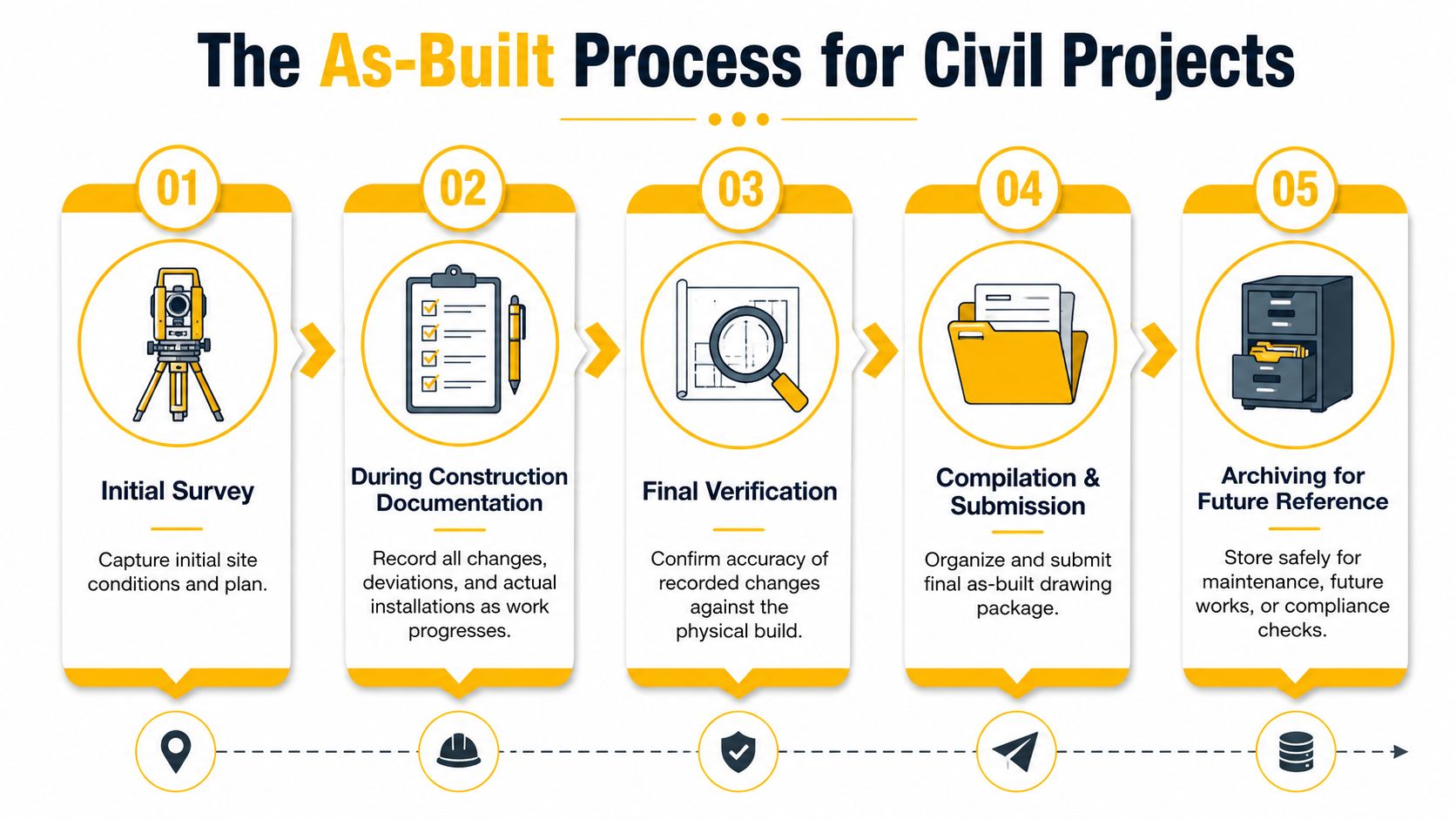
A proper workflow usually looks like this:
- Set-out and survey control establish the project reference points.
- Site changes are recorded during construction on field markups, site notes, and digital photos.
- Critical underground and concealed elements are picked up before cover.
- Final measurements verify the completed work against what was built.
- The final package is compiled with drawings and supporting records.
Why the links between documents matter
As-built drawings aren't just a picture set. They form part of the project evidence. Industry guidance notes that they should be tied to RFIs, change orders, and other change drivers because their real value is in documenting exact final geometry and deviations from design, especially where small discrepancies in levels or service alignments create downstream problems, as explained in this guide to as-built drawings in construction workflows.
That matters on civil jobs because small differences have real consequences. A changed invert level can affect drainage performance. A shifted trench can create a clash for later works. A retaining wall built slightly off line can upset paving, fencing, and boundary clearances.
A useful way to support this process is with better site capture. For teams exploring digital documentation, modern site assessments with drones can help with visibility across changing ground conditions, stockpiles, and progress records.
Later in the job, trench safety and record accuracy often overlap. You need safe access to capture what's been installed before it's backfilled, which is why sound trenching and shoring practices matter as much as the paperwork.
Here's a short visual overview of the process in action:
Who usually does what
The foreman or supervisor often records site changes first. The surveyor captures precise location and level information where accuracy matters. The contractor or consultant then compiles the final set into a clean handover package.
If one of those parts falls over, the whole record weakens. The survey might be right, but the drawing misses a revision. The redlines might be thorough, but nobody verifies the final levels. The photos might exist, but they aren't tied back to the drawing set.
That's why disciplined jobs tend to get better closeout results. The process is simpler when everyone knows from the start that the as-built package is a real deliverable, not an admin task for the last Friday on site.
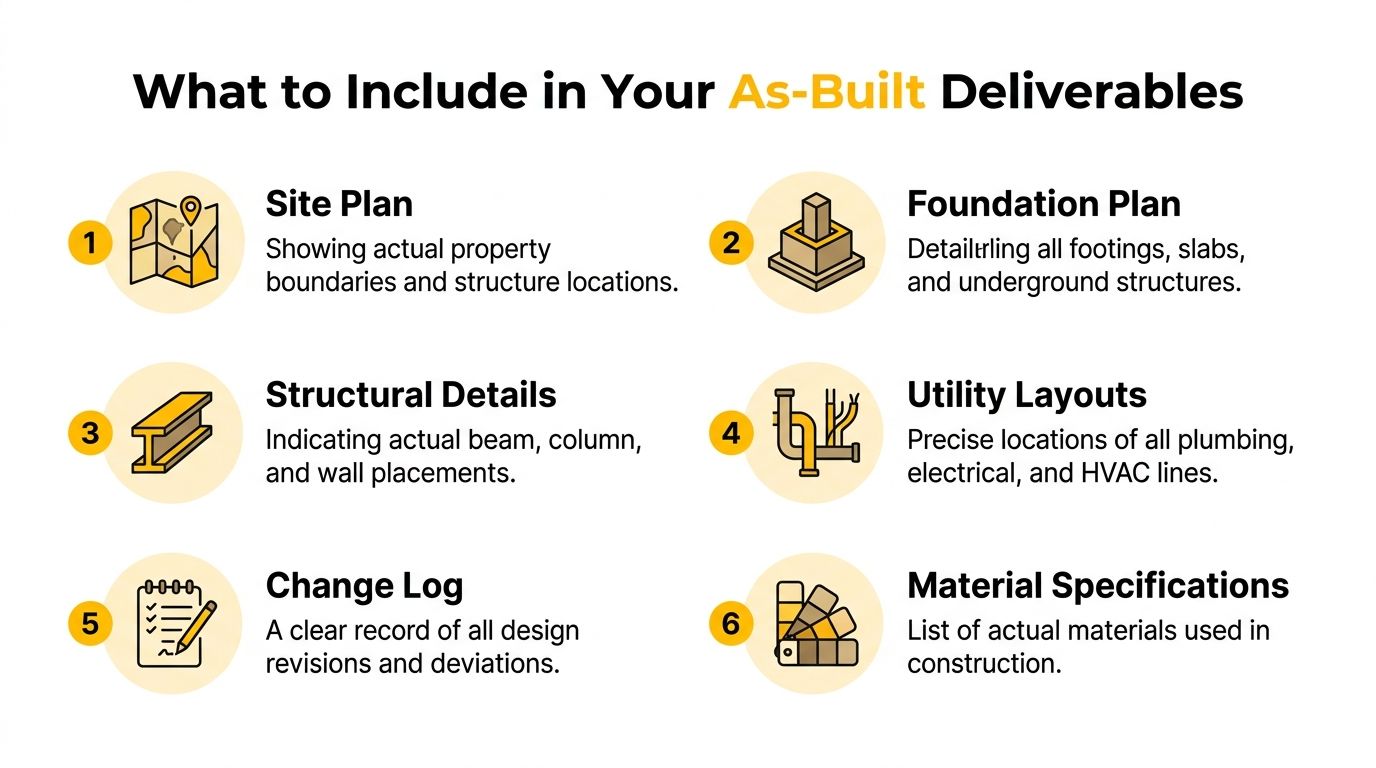
What to Include in Your As-Built Deliverables
A decent as-built package should answer one simple question. If another contractor, owner, engineer, or council officer looks at it later, can they understand what was built without guessing?
If the answer is no, the package isn't finished yet.
The essentials that should be there
Industry guidance is fairly clear on the foundations of a quality package. It should be dimensionally verified against the constructed condition, not the original design. It should include project identification, service locations, deviations, equipment data, and photo evidence for concealed works, and it works best when updates are collected continuously during construction rather than reconstructed later, as outlined in this practical guide to as-built drawing requirements.
For a typical NSW civil job, that usually means including:
- Project identification such as site details, drawing references, revision status, and contractor information
- Final service locations for stormwater, sewer interfaces, conduits, pits, drainage lines, and other underground works
- Actual dimensions and geometry including offsets, alignments, footprints, and tie-in points
- Final levels such as finished surface levels, invert levels, top of wall, slab levels, or grades where relevant
- Documented deviations from the approved design
- Equipment or asset information where installed items need future maintenance
- Photo records for concealed works before backfill, concrete, or final cover
What people often miss
The most common gaps are the boring bits. Missing offsets. No clear level references. Photos that aren't dated or tied back to the drawing. A service line shown generally, but not accurately enough to trust.
Those omissions cause problems later because civil work is all about position. If the stormwater line is shown vaguely, it's not much help when someone has to connect to it. If the retaining wall height is recorded but the toe and top locations aren't, the next stage of work can still go wrong.
A useful as-built package doesn't just say what was built. It shows where it sits and how it relates to everything around it.
For service-heavy work, make sure the deliverables are fit for future excavation too. If your project includes drainage, pits, conduits, or underground runs, it helps to understand the risks around utility and service excavation.
File formats and usability
A handover package should be usable, not just technically complete. In practice, that usually means a readable PDF set plus any CAD or geospatial files required by the approval condition, contract, or authority.
The exact format can vary by project and council. What doesn't vary is the need for clarity. If someone can't open it, trace it, or rely on it, the handover hasn't done its job.
Handover Best Practices and Common Mistakes
A lot of builders still treat as-builts like something you can sort out after the tools are packed up. That approach sounds efficient. It usually isn't.
Retrospective as-builts depend on memory, incomplete notes, and whatever photos happen to be sitting in someone's phone. That's a weak way to document buried work, changed levels, or shifted service alignments.
What works better
The jobs that hand over cleanly usually follow a simple discipline. They nominate responsibility early, collect updates during the build, verify critical locations before cover, and check the final package against approval conditions before submission.
A formal closeout review helps too. Before anything goes to council or the client, someone should confirm that the final drawings, survey information, supporting documents, and file formats match the requirement.
The mistakes that cost time
Some errors are repeated constantly across small and mid-sized jobs:
- Leaving records too late so details are rebuilt from memory
- Relying on redlines alone when a verified final set is required
- Missing survey pickup for critical assets and levels
- Submitting the wrong format when digital files are part of the condition
- Forgetting concealed works evidence before trenches, slabs, or walls are closed up
The hidden cost isn't just admin. It's site return visits, delayed approvals, reopened surfaces, consultant time, and arguments over what was installed.
Site advice: The cheapest time to capture accurate as-built information is when the work is exposed and the crew already knows what changed.
There's also a risk issue. If a dispute starts later about where a service runs or whether the finished levels matched the requirement, weak records don't help anyone. Good handover protects the owner and the contractor.
As-Built Tips for Homeowners and Contractors
Homeowners and contractors look at as-built drawings from different angles, but the best outcome is the same. Both sides want a clear, reliable record that stands up later.
For homeowners, that means less guesswork when you renovate, repair, or sell. For contractors, it means fewer closeout dramas and less exposure if questions come up after completion.

If you're a homeowner or owner-builder
Ask for as-built drawings in your contract, especially if the work involves drainage, retaining walls, slab prep, driveways, service relocations, or subdivision-related works. Don't assume they're included just because plans were approved at the start.
Ask practical questions. Will the final package show actual service locations? Who verifies the levels? Are concealed works photographed before they're covered? Does the job require survey input or council-ready digital files?
If you're building in places like Erina, Gosford, Belmont, or Maitland, local ground conditions can force site changes. Coastal sand, fill, reactive clay, and rock all affect what gets built in the ground. The final record should reflect that reality.
If you're a contractor
Make as-builts part of delivery, not closeout admin. Keep a live marked-up set on site. Save photos into job folders as you go. Capture level changes and service shifts immediately. If survey pickup is needed, book it before the asset disappears under backfill or concrete.
Use simple systems that your team will stick to. A clipboard, a shared folder, dated photos, and a disciplined revision process are better than an elaborate software setup nobody updates.
There's also value in linking the record back to the work sequence. On earthworks and level-sensitive jobs, even small changes in cuts, fills, and finished grades affect the final drawing set. If that's relevant to your project, it's worth understanding how cut and fill earthworks shape the final built condition.
What both sides should insist on
The best projects don't treat as-built drawings as optional paperwork. They treat them as part of building properly.
If the work changes, record it.
If it's about to be covered, verify it.
If council needs a digital package, prepare it that way from the start.
That approach saves stress later. It also gives you something rare on construction jobs. A final record you can trust.
If you need practical help with civil works, excavation, drainage, driveways, slabs, or site preparation across the Central Coast, Newcastle, Sydney, or the Hunter, Booms Up Civil Group can help. We focus on getting the job right the first time, with clear communication from set-out to handover. You can contact the team for straightforward advice, a site assessment, or a free quote through the website.