

If you're reading this, you're probably at the point where the slab has gone from “part of the build” to the thing that could hold everything else up. That's normal. Most first-time owner-builders on the Central Coast, in Sydney, or up around Newcastle know they need concrete slab contractors, but they're not always sure what a contractor needs from them to price and plan the work properly.
From our side of the fence, a good client isn't the one who knows all the trade jargon. It's the one who gives clear information early, understands what can't be guessed from a few phone photos, and doesn't treat site prep like an optional extra. A slab can look simple when it's finished. Underneath it, there's design, excavation, base prep, drainage, access, steel, inspections, curing, and timing.
Australia's slab and foundation work sits inside a much bigger construction pipeline. Non-residential building work was projected at $52.7 billion, engineering construction at $41.6 billion, residential building at $84.0 billion, and new private house commencements at about 145,000 dwellings in 2024–25, according to this market outlook citing ABS projections. That matters because slab demand follows housing starts, civil works, and site preparation activity. On the ground in NSW, that means busy contractors will prioritise jobs that are properly documented and ready to move.
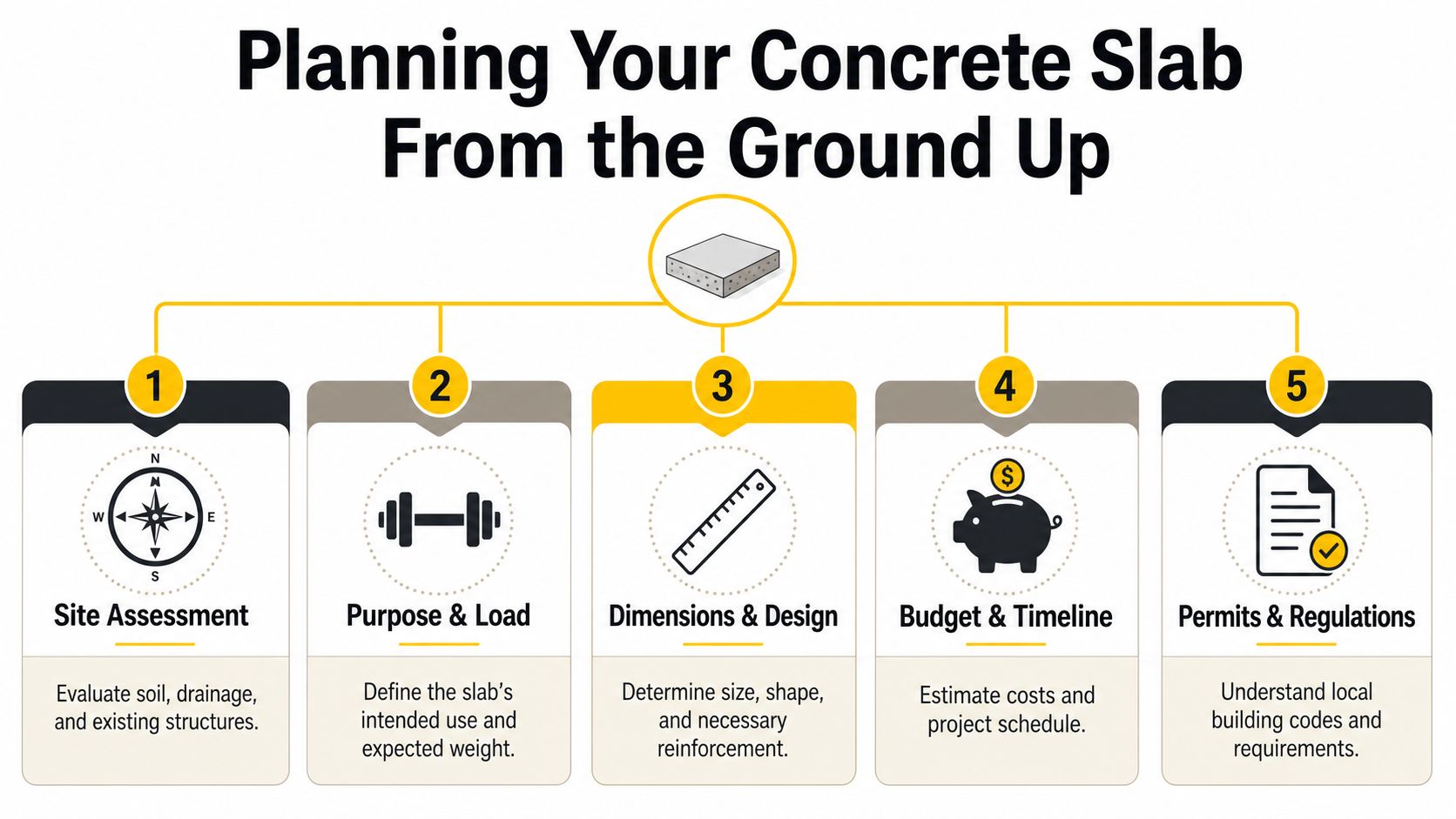
Planning Your Concrete Slab From the Ground Up
A slab starts on paper, not on pour day. If the planning is weak, the contractor spends the whole job chasing problems that should've been sorted before the excavator turned up.
On the Central Coast, the right slab system depends on where you're building and what the structure needs. A flatter block in a newer estate at Warnervale might suit a straightforward slab-on-ground design. A tighter site in Sydney, or a sloping block in Terrigal or Copacabana, can push you toward more complex footing and formwork requirements. Inland areas can bring more reactive clay issues than the sandy coastal pockets closer to the beach.
Know what type of slab you're asking for
Most owner-builders hear terms like waffle pod, raft slab, and suspended slab before they understand what changes from one to the next. In plain terms, they're not interchangeable.
A waffle pod slab is common in residential work. It uses pods and ribs to reduce concrete volume while still creating a stiffened slab system. A conventional raft slab usually relies on beams and slab sections formed and reinforced according to the engineering. A suspended slab is different again. It isn't bearing directly on prepared ground, so the formwork, support, sequencing, and engineering become much more involved.
What matters for you is this. Don't ring concrete slab contractors asking for “a slab quote” without knowing which system the engineer has specified. That's like asking for a roof quote without knowing whether the building wants trusses or structural steel.
Practical rule: If your plans and engineering don't clearly identify the slab type, the quote will carry assumptions. Assumptions are where disputes and variations start.
Geometry matters more than most people realise
Cracking isn't only about bad concrete. A lot of predictable cracking starts in the layout.
Technical guidance on slab crack control says control joints should intersect at 90 degrees where possible and never at angles under 60 degrees, with spacing tied to slab thickness, as outlined in this slab geometry guidance. That matters on real projects because awkward shapes, narrow returns, T-junctions, and sharp internal corners create stress points. Reinforcement helps, but it doesn't replace proper joint design.
Let's say you're building a shed slab behind a house in Erina Heights and the slab shape wraps around an existing retaining wall. If the geometry hasn't been thought through, the slab may crack exactly where the shape becomes weakest. That's not bad luck. That's design.
The ground decides more than the brochure does
Soil and drainage conditions drive a big part of slab performance. Coastal sandy soils drain differently from heavier inland clays. Fill material behaves differently again. A site that looks dry in summer can turn soft after sustained rain.
That's why subgrade preparation matters so much. If you want a plain-English primer before talking to a contractor, it helps to learn how proper soil compaction works so you understand why the slab is only as good as what sits below it.
Here's the contractor view. A neat set of plans is useful. A neat set of plans on a badly understood site is still risky.
How to Find and Vet a Professional Slab Contractor
Finding concrete slab contractors isn't hard. Finding one who'll price the right scope, document it properly, and run the work safely is the true challenge.
A Google search will give you names. Your job is to work out who does this work at the standard your project needs. For a driveway slab in Gosford, the checks are simpler than for a commercial extension in Newcastle or a complex suspended slab in Sydney. The principle stays the same. Verify first, trust second.

What to check before you even ask for a site visit
Start with the basics. In NSW, check the contractor's licence through NSW Fair Trading. Make sure the licence matches the work being quoted, not just some adjacent trade category. Then ask for current insurance certificates. Public liability and workers compensation serve different purposes, and both matter when people, plant, deliveries, and neighbouring properties are involved.
After that, look at whether they regularly handle your kind of work. A team that mainly pours small residential paths may not be the right fit for a large engineered slab with difficult access. A contractor who does subdivisions and civil works might be better equipped for site cuts, haulage, and coordination, but may not be the right match for a fiddly backyard addition with limited access through an existing home.
A useful early filter is to compare how local operators describe scope and process. For example, if you're still narrowing the field, reviewing what concreting services near you should actually include can help you spot the difference between a proper scope and a vague sales pitch.
Red flags are usually obvious
Cash-only pressure is a red flag. So is a contractor who won't put the quote in writing, won't state exclusions, or brushes off questions about engineering, inspections, or access.
Another warning sign is vagueness about past work. You don't need glossy marketing. You do need evidence they've done similar jobs and can explain how they handle formwork, reinforcement placement, site prep, pour sequencing, and cure protection.
A professional contractor won't get annoyed because you asked sensible questions. They'll usually be relieved you understand that slab work isn't just “turn up and pour”.
The business side matters too
Good contractors run tight paperwork because concrete jobs involve suppliers, subcontractors, payroll, insurances, fuel, maintenance, and tax obligations. If you work with owner-builders, subcontractors, or small trade businesses, this guide to EndureGo Tax for tradies is a useful plain-English resource for understanding how serious operators manage the admin side of trade work.
That might sound separate from the slab itself, but it isn't. Poor administration often shows up on site as missed bookings, unclear invoices, labour issues, and quote variations that should've been dealt with properly at the start.
Preparing Your Project for an Accurate Quote
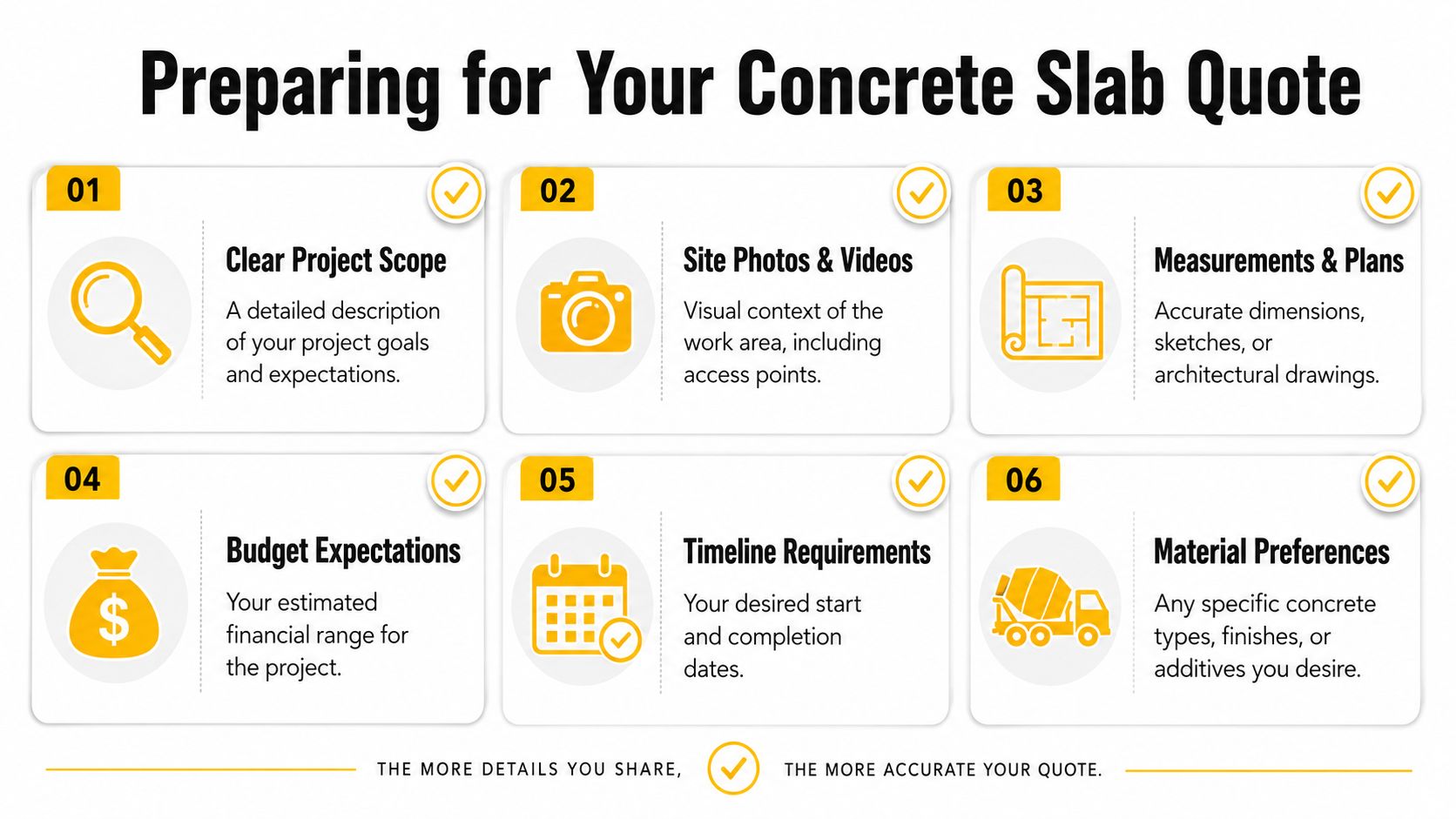
If you want a fast, accurate quote, help the contractor remove guesswork. That's the main difference between a smooth tender process and a quote that's padded with contingencies.
Many clients think they're being helpful when they ask for “just a ballpark price”. Sometimes that's fine for rough budgeting. It's not fine if you want a real figure you can rely on. Concrete slab contractors price risk as much as labour and materials. The more unknowns in your brief, the more room they need to leave themselves.
What a contractor actually needs from you
At minimum, have the drawings ready. That means architectural plans if they exist, structural engineering, slab details, and any council-approved documentation already issued by Central Coast Council, Newcastle Council, or the relevant Sydney local authority.
Then provide the practical information that plans often don't show well:
- Site access: Can a concrete truck get close, or will pumping be required?
- Existing conditions: Fences, trees, retaining walls, neighbouring structures, overhead lines, stormwater pits, and finished surfaces all affect setup.
- Levels and falls: A slab near the house, garage, or carpark area needs the right drainage outcome, not just the right shape.
- Services location: Water, sewer, electrical, and stormwater need to be identified before excavation starts.
Photos and short videos help a lot. A marked-up site plan helps even more.
Why prep saves money
Site preparation and compaction quality are often the main determinants of slab-on-ground performance. Pouring over a poorly prepared base is a recipe for settlement, cracking, and failure, even if the concrete mix is perfect, as discussed in this site preparation commentary. Proper excavation depth, compacted base preparation, and grading aren't optional.
That's why organised clients usually get cleaner pricing. If the contractor can see the excavation extent, spoil handling, imported material needs, and access constraints early, they don't have to cover themselves for every possible surprise.
The cheapest quote often comes from the contractor who hasn't fully understood the job yet.
For example, let's say you've got a sloping block in Avoca Beach and you only send through a rough slab size. The quote may miss retaining requirements, machine access problems, cut and fill imbalance, or the need to remove unsuitable material. If you instead provide plans, levels, and site photos, the contractor can assess the full scope.
If your project includes footing excavation, slab prep, or related earthworks, it's worth reading about excavation and foundation planning before asking for prices. It'll help you understand why two slab quotes can differ sharply even when the slab area looks the same on paper.
The good-client advantage
Contractors notice prepared clients. Not because it flatters the ego, but because it makes scheduling and pricing more accurate.
A good client usually does three things well. They answer questions quickly, they send documents in one organised pack, and they're honest about unknowns. If the geotech report hasn't been done yet, say so. If access is tight, say so. If council approval is still in progress, say so.
That honesty usually produces a better quote than trying to make the job sound simpler than it is.
Decoding Concrete Quotes and Understanding True Costs
Once quotes start arriving, don't jump straight to the bottom line. Read the scope first.
Two quotes can both say “concrete slab” and still be pricing very different jobs. One might include excavation, imported base, compaction, formwork, mesh or bar placement, pumping, finishing, saw cuts, curing, and cleanup. Another might include only the pour and finish over a client-prepared base. If you compare those as if they're equal, you'll make the wrong call.
What should be clearly included
A proper quote should identify the main work items in plain language. You want to see enough detail that you can tell what the contractor is responsible for and what still sits with you, your builder, or another trade.
A simple comparison like this helps:
| Quote item | What you want clarified |
|---|---|
| Site preparation | Is excavation included, and is spoil removal included too? |
| Base works | Who supplies and compacts the base material? |
| Formwork | Are edge boards, setout, and strip-out included? |
| Reinforcement | Is steel included exactly as per engineering? |
| Concrete placement | Does the quote include pumping if truck access is limited? |
| Finishing and curing | What finish is allowed for, and who protects the slab afterwards? |
If a quote is vague around reinforcement, ask questions. Steel supply can change the price meaningfully depending on engineering requirements. If you want context around the supply side, reinforcement steel suppliers and slab steel options are worth understanding before you sign.
Provisional sums and exclusions
A provisional sum is an allowance for work that hasn't been fully pinned down yet. It isn't a fixed price. If the actual requirement comes in above that allowance, the total cost moves.
A prime cost item is more common in building finishes than structural slab work, but the principle is similar. It's an allowance, not certainty.
What matters most is the exclusion list. Read it carefully. If rock excavation, dewatering, pump hire, waste disposal, survey setout, engineering revisions, or council fees are excluded, that doesn't automatically make the quote bad. It just means you need to account for those items elsewhere.
If a quote looks dramatically cheaper, check the exclusions before you assume you've found a bargain.
Value is scope, clarity, and risk control
The best quote usually isn't the lowest. It's the one that describes the job properly, identifies assumptions, and leaves the least room for argument later.
One practical example. If one contractor has allowed for careful setout, proper formwork, and the sequence required to meet engineering and inspection requirements, while another has merely priced “slab supply and lay”, those are not equal offers. The second one may turn into a stream of extras the moment site reality catches up.
Booms Up Civil Group, for example, offers concrete slab shuttering services, which means the temporary formwork is built and held to shape before the pour. That's one specific scope item that some quotes include and others leave out. You want to know which before the first truck is booked.
The Construction Phase What to Expect On Site
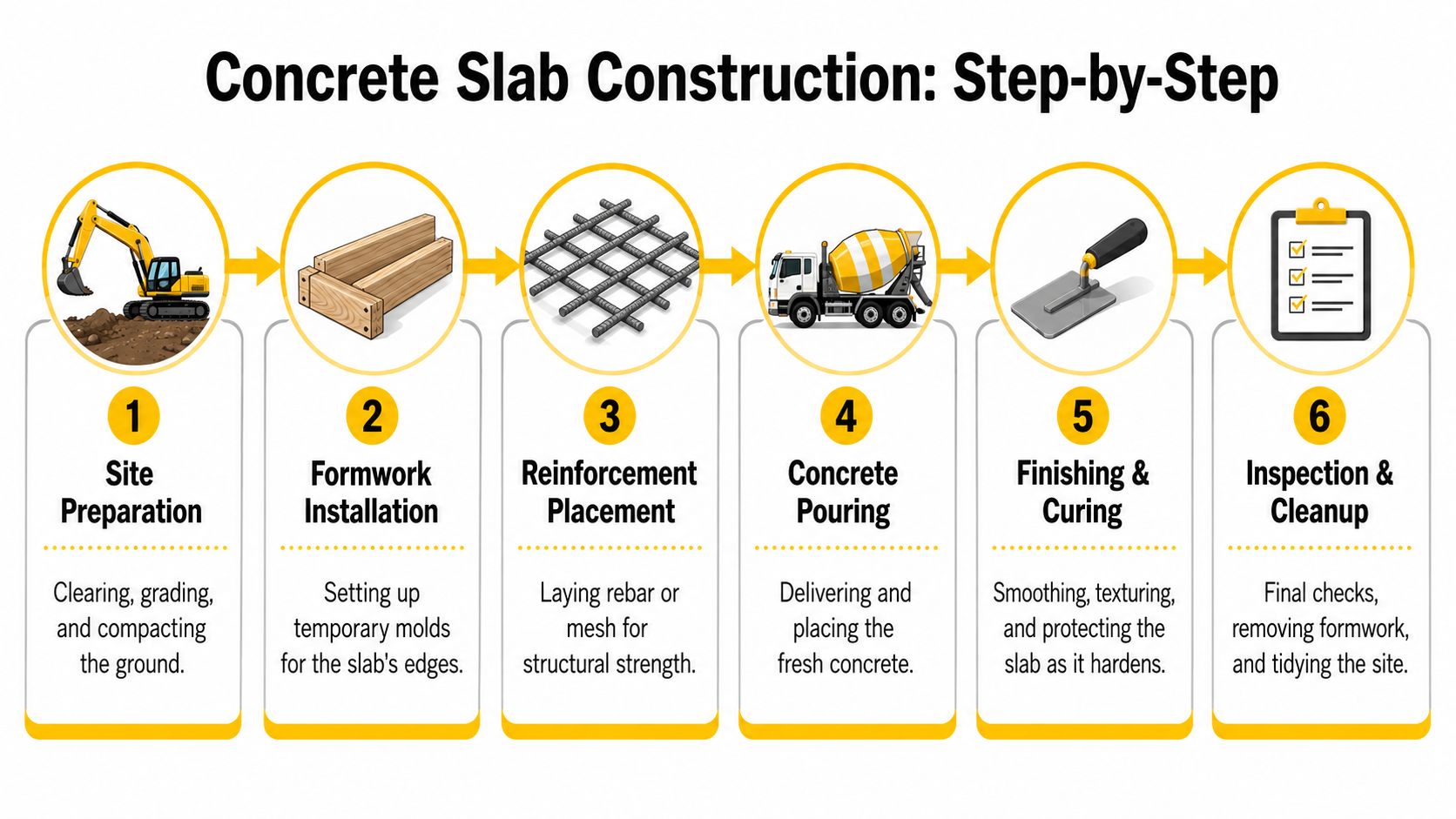
Once the contract is signed, the rhythm of the job matters. Good slab work follows a sequence, and the sequence shouldn't be rushed because the weather window looks good or another trade is pushing to get on site.
Start with site establishment. The crew arrives, confirms setout, checks access, identifies any immediate safety risks, and begins excavation or trimming to level. On a Central Coast block with narrow access or existing structures close by, this part can take more care than clients expect.
From excavation to pour day
After excavation comes base preparation, compaction, moisture management if required, and formwork. Then reinforcement is placed to the engineering detail. This is the stage where council or certifier inspections may need to occur, depending on the project and approval pathway.
If you want to understand that stage better, concrete slab shuttering and formwork basics will make it easier to follow what the crew is doing and why tolerances matter.
Some jobs also need extra quality control before full production pours. Guidance from the American Society of Concrete Contractors on PLC slab work recommends trial batches, bleed-water testing to ASTM C232/C232M, setting-time testing to ASTM C403/C403M, and early-age strength checks at 1, 3, and 7 days, with survey feedback showing roughly 80% reported increased water demand and more than half reported longer set times in PLC mixes, according to this PLC slab guidance document. For owner-builders, the takeaway is simple. Don't assume every cement change behaves the same in finishing and curing.
Here's a visual overview of how a slab build typically unfolds on site:
Finishing, curing, and what happens after the crew leaves
Pour day gets the attention, but curing is where the slab starts earning its strength. The finish needs to suit the final use, whether that's a garage, shed, house floor, or commercial traffic area. Then the slab needs protection from weather, traffic, and premature drying.
If floor coverings are going over the slab later, moisture testing becomes important. For slabs drying from one side, such as slab-on-ground, in-situ probes should be placed at 40% of slab depth so the reading reflects the moisture condition the floor finish will experience, as outlined in this guidance on 40% testing depth. Surface readings can give a false sense of readiness.
Safety stays live through the whole process. Plant movement, wet concrete, reinforcement, trip hazards, pump lines, and public access all need control. On any NSW site, the crew should be working in line with SafeWork NSW expectations and the project's own site rules.
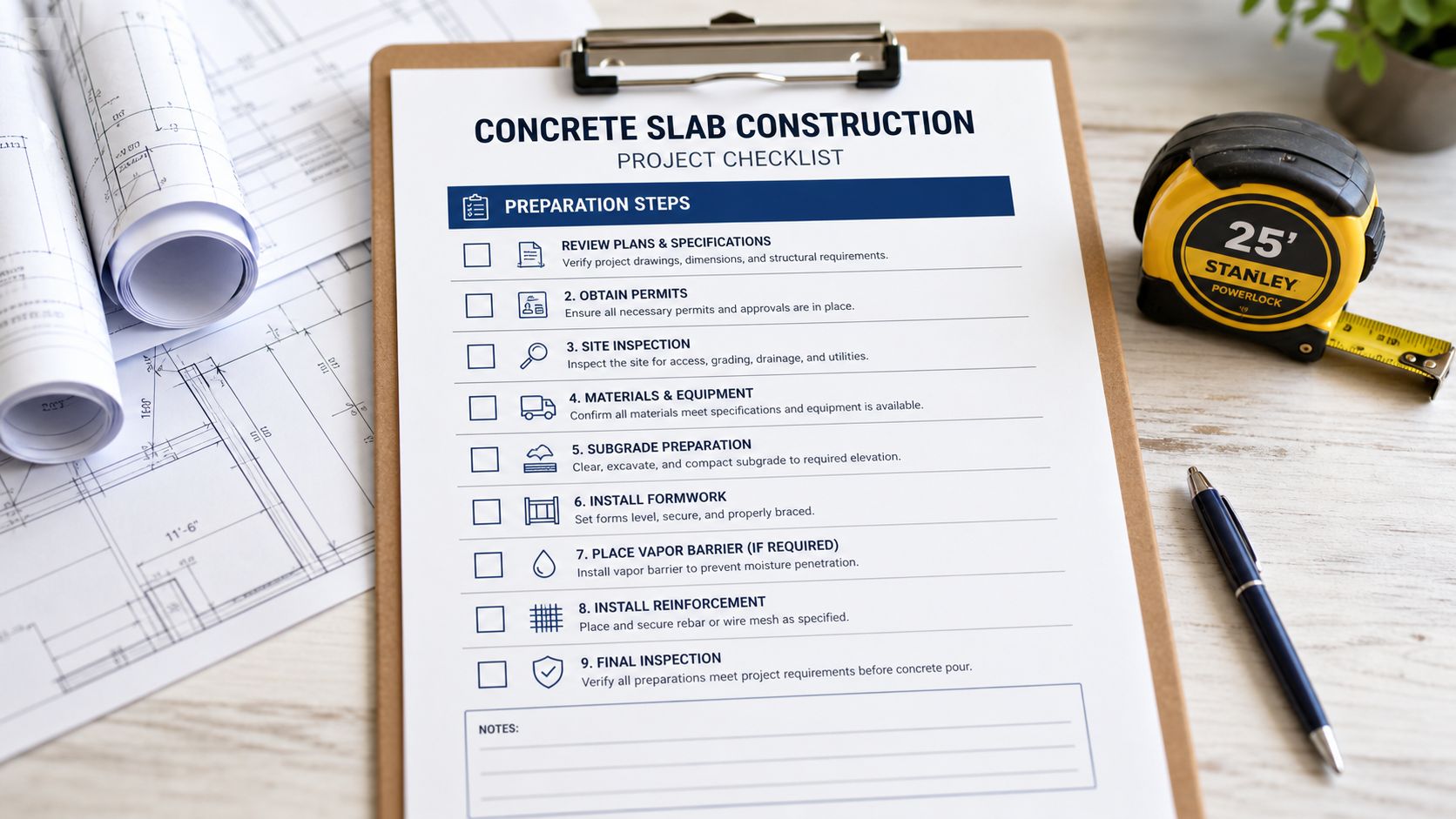
Your Contractor-Ready Project Checklist
By the time you contact concrete slab contractors, you want the project to look real, not vague. That doesn't mean every decision is locked in. It means the key unknowns have been reduced enough that someone can quote and program the work with confidence.
Residential projects
For a house, garage, granny flat, driveway, or shed slab, have your approvals and engineering ready before asking for a final price. If you're in the Central Coast postcodes from 2250 to 2264, that often means dealing with local site constraints like sloping blocks, coastal drainage issues, or narrow suburban access.
A solid residential client pack usually includes the following:
- Approved drawings: DA, CDC, or other relevant approved plans, depending on the pathway.
- Structural details: Slab and footing engineering, not just architectural layouts.
- Site information: Photos, access notes, and any known service locations.
- Ground information: A geotechnical report where the site conditions call for it.
If any of that is missing, say so early. It's better to receive a staged quote with clear assumptions than a fixed price built on the wrong site conditions.
Commercial projects
Commercial slab work carries more coordination. A contractor needs to know not only what is being built, but who else will be on site and what the sequencing looks like.
For a warehouse addition in Newcastle, a shop fitout with external slab works in Sydney, or a carpark extension on the Central Coast, be ready with specifications, service locations, access restrictions, delivery windows, and site management requirements. Existing structures, operational businesses, and public interface change the risk profile fast.
Good commercial clients don't just send plans. They explain the live-site conditions that the plans can't show.
Civil projects
Civil jobs usually involve the broadest pre-start package. That might include traffic control requirements, environmental controls, program sequencing, haulage access, and coordination with other subcontractors.
If the slab forms part of a larger civil scope, clarity around excavation responsibility, survey control, drainage interface, and hold points is essential. Civil contractors price disruption, staging, and compliance risk differently from straightforward residential work. If those items aren't defined, the quote won't be clean.
The short version is this. A contractor-ready project is documented, honest about risk, and easy to inspect before pricing. That's what gets you a better number, a faster turnaround, and fewer arguments once work starts.
If you're planning slab work on the Central Coast, in Newcastle, the Hunter Valley, or Sydney, Booms Up Civil Group can help you review your plans, site access, and preparation requirements before the job reaches pour day. If you'd like practical advice or a quote based on the actual scope, call 0477 444 490, send an enquiry through the website, or email the team with your drawings and site photos.