When you start searching for "concreting services near me," you’re doing more than just looking for someone to pour a bit of concrete. You're making a long-term investment in your property, one that needs to be solid, safe and valuable for years to come. Choosing the right professional is the difference between getting it done and getting it done right.
Why a Professional Concreter Matters More Than You Think
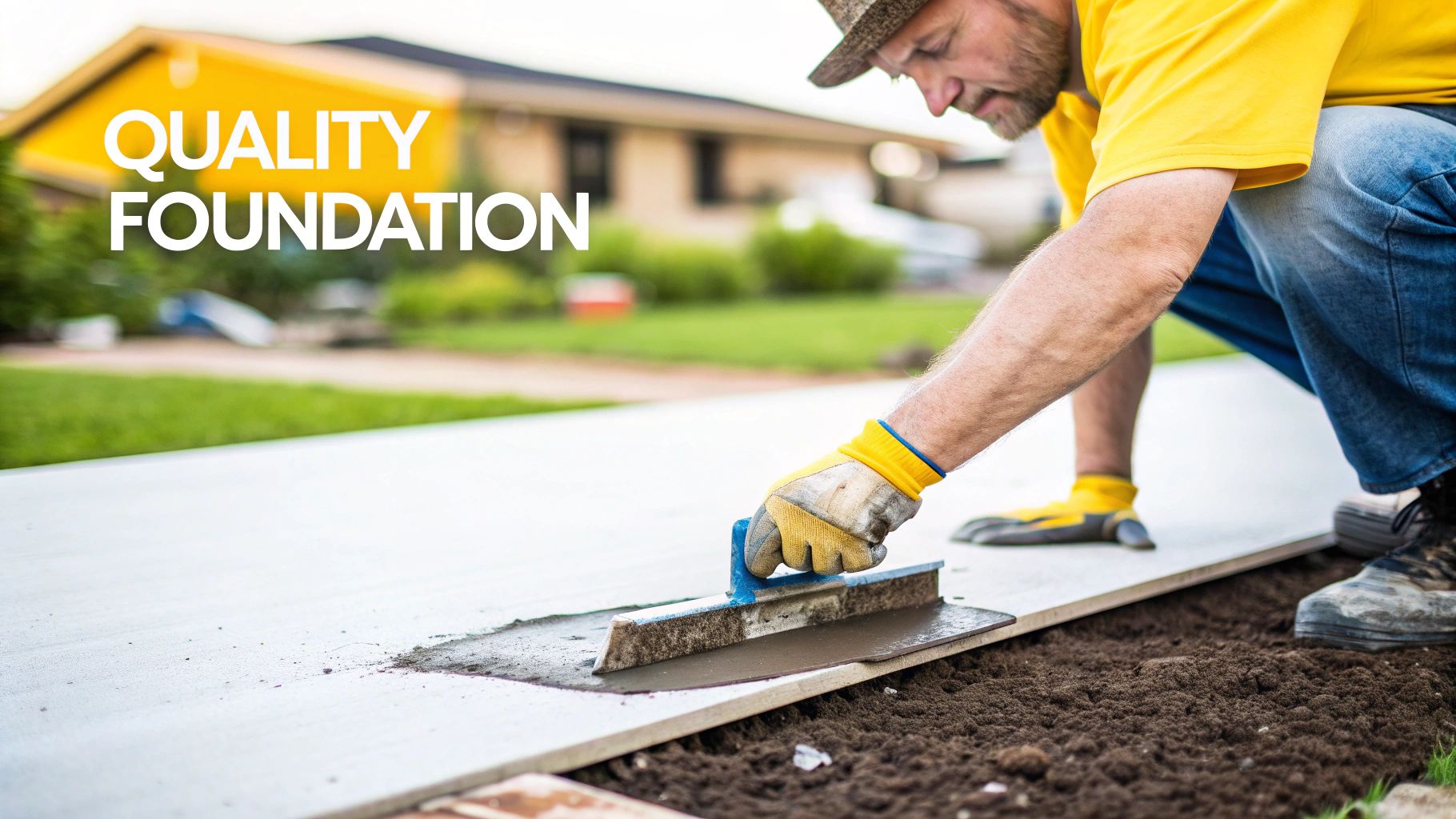
It’s tempting to think of concrete as a basic mix of sand, stone and cement. Simple, right? But the real-world difference between a driveway that starts cracking in a year and one that lasts for decades comes down to the crew doing the work. A cheap job might look fine the day it's finished, but it often hides shortcuts that will cost you dearly down the road.
Take local ground conditions across NSW, for example. A professional concreter knows that a job on the Central Coast's sandy coastal soils needs a totally different sub-base preparation than a slab on the reactive clay we see all through the Hunter Valley. Get that wrong, and you're looking at subsidence and ugly structural cracks. It's a classic case of paying for expertise now or paying for repairs later.
The Science Behind a Quality Pour
True professionalism is about more than just a smooth, pretty finish. It's about mastering the technical side of the trade. This means understanding the right concrete strength (measured in megapascals or MPa) for the job, whether it’s a simple garden path or a heavy-duty workshop floor. It's also about the precise placement of steel reinforcement to give the slab its backbone.
This technical knowledge is what guarantees your investment will last. It's what turns a basic patio into a properly engineered slab that meets Australian Standard AS 3600. A pro will also ensure the concrete cures correctly—a vital step that allows it to reach its full design strength and durability. Skip this, and you’re left with weak, brittle concrete.
A well-laid concrete structure is a genuine asset that adds real value to your property. On the flip side, a poor job isn't just a waste of money; it becomes an ongoing liability, leading to water damage, safety hazards, and a string of expensive repairs.
The Bigger Picture in Construction
The Australian concrete market is a huge and growing industry, directly linked to our nation’s construction and infrastructure boom. The market was valued at around USD 61.4 billion and is only projected to get bigger, driven by major projects that demand high-performance concrete.
This growth highlights just how critical skilled tradespeople are. While your focus might be a local job, many professional concreters also cut their teeth on large commercial sites. On these complex projects, they often use advanced methods like BIM for GC Subcontractors to coordinate everything perfectly. This level of discipline and planning, from getting the footings and excavation spot-on to the final pour, benefits every single project they touch, big or small.
What Are Common Concreting Jobs?
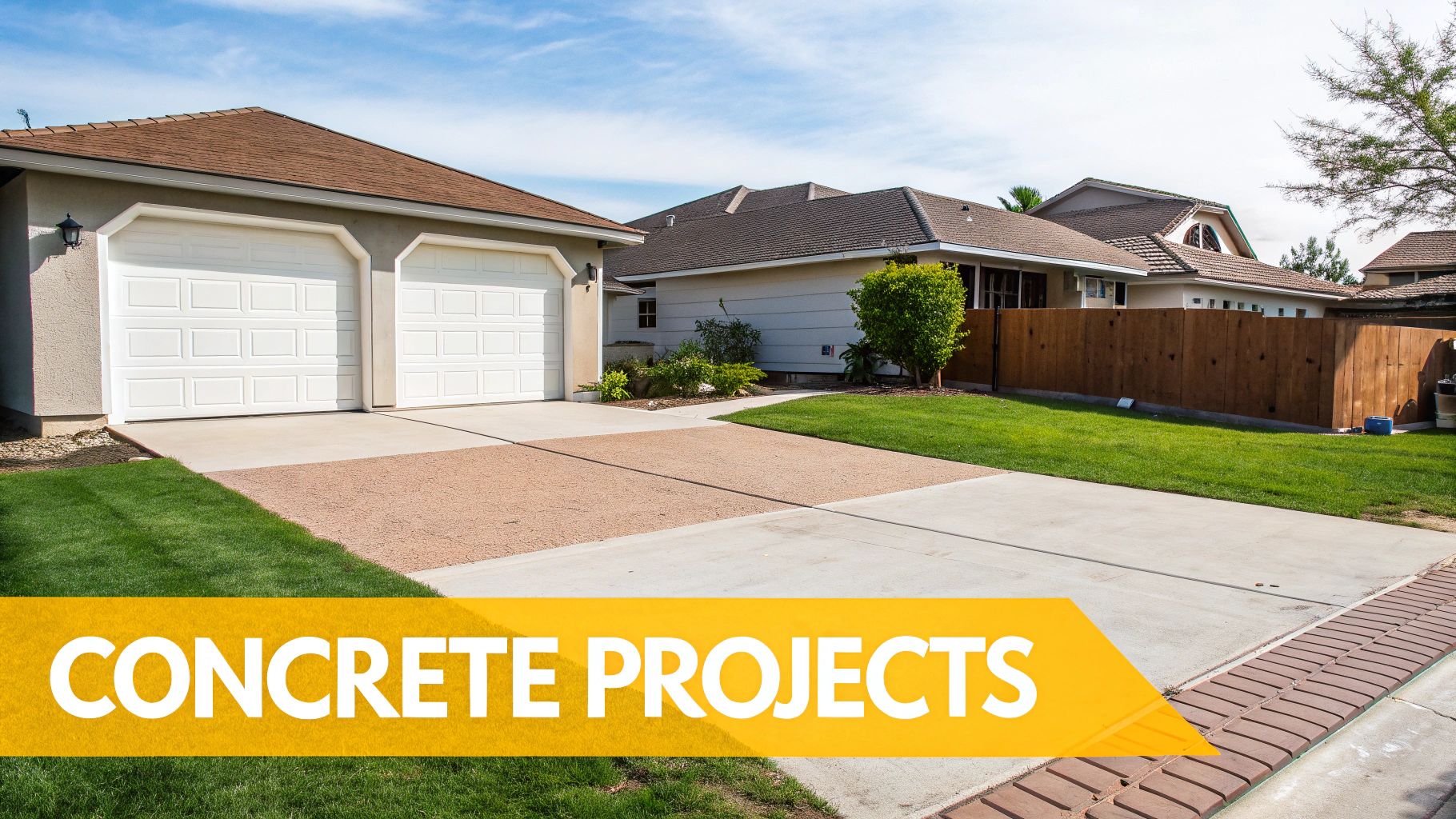
Concrete is one of the toughest, most versatile materials we have, which is why it’s the backbone of countless projects around homes and commercial properties. When you start searching for concreting services, you’re usually thinking about one of a few key jobs, and each one comes with its own set of rules.
It’s crucial to understand what goes into these projects because it highlights why a one-size-fits-all quote just doesn't cut it. Every job needs a specific strategy based on what it's for, the local ground conditions, and what the council demands.
Concrete Driveways Built to Last
Your driveway is more than just the entrance to your property; it’s a hard-working surface that has to take the weight of vehicles, day in and day out, without cracking under the pressure. This is where professional prep work is absolutely non-negotiable.
A truly solid driveway starts long before the concrete truck arrives. It all begins with a properly compacted sub-base. Get this foundation right, and you prevent the slab from sinking, shifting, or developing those dreaded cracks over time. Imagine you're in the Hunter Valley, where the reactive clay soils love to expand and contract with the rain. A poorly prepared base here is just asking for trouble.
We always install steel reinforcement mesh across the entire area. This steel is what gives the concrete its tensile strength, helping it fight the pulling forces that lead to failure. For a deeper dive, check out our guide on what to look for in concrete driveway contractors near me. It really breaks down why getting these foundational steps right is so critical for a job that lasts decades.
Pathways and Patios for Outdoor Living
While they don't carry the same heavy loads as a driveway, your paths and patios are fundamental to how you use and enjoy your property. A well-poured concrete patio can totally transform an outdoor space, and a simple, safe pathway makes getting around your home practical and easy.
With these jobs, the finish is often the main focus. You might go for a non-slip broom finish for safety on a sloped path in Newcastle, or maybe an exposed aggregate finish for a decorative patio on the Central Coast that can handle the salty coastal air. Proper drainage is also a big deal here – you have to stop water from pooling, which can create a slipping hazard or even cause damage to nearby structures.
Structural Concrete Slabs
Now we’re talking about the heavy hitters. This is where concrete becomes a critical structural element of a building. These slabs form the very foundation for everything from a small garden shed right up to a major home extension or a new commercial build. The design and engineering are governed by strict building codes and load-bearing calculations.
For example, a slab for a double garage in a Sydney suburb has to be engineered to hold up not just two cars but the entire weight of the garage structure itself. Your local council, whether it's Central Coast Council or Newcastle City Council, will have laid out very specific requirements in the development application (DA) that must be followed to the letter.
This typically involves:
- Engineered designs that specify the exact thickness of the slab.
- Specific concrete strength (e.g., 25 MPa or 32 MPa).
- Reinforcement schedules detailing precisely where and what type of steel needs to be used.
A structural slab isn't just a flat piece of concrete; it’s an engineered foundation that ensures the safety and stability of the entire building it supports. Getting this wrong can have catastrophic and expensive consequences.
The demand for these foundational materials is huge across the country. The Australian cement market, a core component of our industry, was valued at AUD 3.17 billion and is expected to keep growing, which just shows how much residential and commercial construction relies on this stuff. You can explore more data about the foundations of the Australian construction industry.
Understanding Different Concrete Finishes
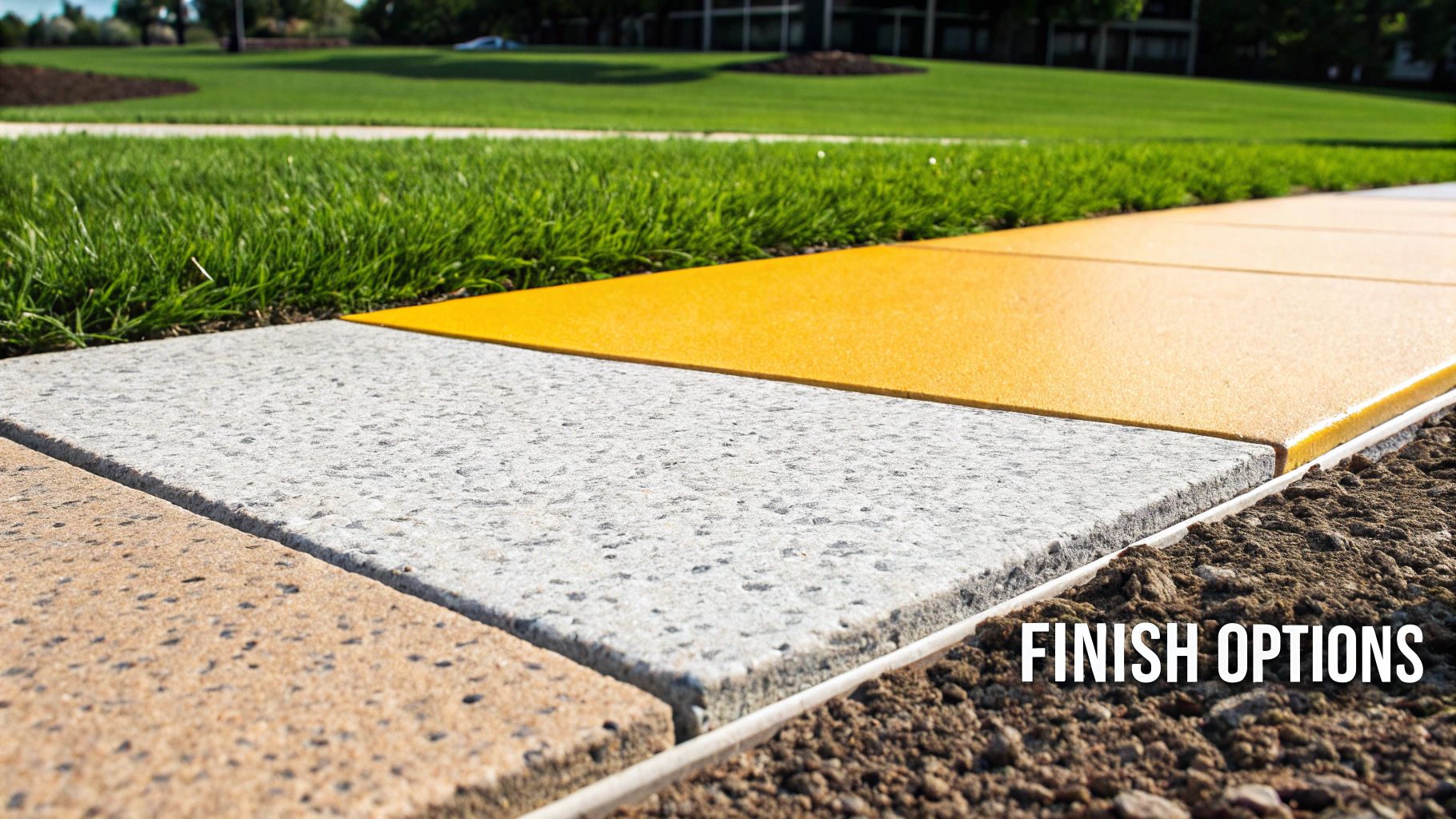
The engineering hidden beneath your concrete slab is vital, but let's be honest—it’s the finish that you'll see and live with every single day. The final surface treatment does so much more than just look good; it adds durability, provides grip, and ultimately sets the entire aesthetic tone for your space.
Choosing the right finish is all about matching the look you want with the practical demands of the area. Let's walk through the most popular options we work with on the ground, explaining where each one really shines.
Exposed Aggregate: A Durable, High-Grip Favourite
You’ve definitely seen this finish around, and for good reason. Exposed aggregate is created by carefully washing away the top layer of cement paste to reveal the small stones (the aggregate) within the concrete mix. This creates a textured, multi-toned surface that is incredibly hard-wearing and offers fantastic grip underfoot.
This makes it a brilliant choice for areas where slip resistance is a genuine priority. Think about a steep driveway in a hilly Newcastle suburb or the splash zone around a swimming pool on the Central Coast. The textured surface provides excellent traction, even when wet, which is a major safety benefit. It also does a great job of hiding minor dirt and stains, making it a low-maintenance hero for high-traffic zones.
Coloured Concrete: For a Cohesive Look
If you want your concrete to blend seamlessly with your home’s colour palette, coloured concrete is the way to go. This isn't a paint or a stain applied afterwards; we integrate a colour pigment directly into the concrete mix before it's even poured.
This ensures the colour is consistent all the way through the slab, so it won’t chip, fade, or peel over time like a surface coating would. You can choose from a huge range of earthy tones to complement your home’s brickwork, render, or landscaping. For instance, a charcoal-coloured driveway can create a sleek, modern entrance, while a terracotta hue can bring real warmth to a garden patio.
Polished Concrete: The Sleek, Modern Choice
For that smooth, high-end look, especially for indoor spaces, polished concrete is hard to beat. The process is pretty intensive, involving grinding the concrete surface down with progressively finer diamond abrasives until we achieve a glossy, almost mirror-like finish.
It's an exceptionally durable and easy-to-clean option, which is why you see it so often in retail spaces, galleries, and modern homes across Sydney. Not only is it tough, but it's also resistant to allergens like dust mites and mould. While the initial cost is higher due to the specialised labour and equipment, its longevity and low maintenance often make it a smart long-term investment.
Plain Concrete (Broom Finish): Practical and Cost-Effective
Sometimes, the simplest solution is the best one. A broom finish is exactly what it sounds like: we run a stiff broom over the surface of the concrete just before it fully hardens. This creates fine, rough lines that provide excellent slip resistance.
It’s a straightforward, no-fuss finish that is highly functional and the most budget-friendly option available. While it might not have the decorative appeal of exposed aggregate, its sheer practicality makes it the go-to choice for footpaths, shed slabs, and any area where safety and cost are the top priorities. It's a key part of many successful jobs, as we've discussed in our guide to concrete driveways on the Central Coast.
What Affects the Cost of a Concreting Job?
One of the first questions we always get is, "So, what's your price per square metre?" And it’s a fair question—but the reality is, a simple m² rate doesn't even begin to tell the whole story. Several crucial factors can dramatically change the final cost of a professional concreting job.
Getting your head around these variables is the key to understanding any quote you receive. A transparent quote should break these elements down, showing you that the price reflects the unique challenges and requirements of your site, not just some generic number plucked from the air.
Site Access and Ground Preparation
Before a single drop of concrete is poured, we have to look at the site itself. This is often the biggest factor that separates one project’s cost from another.
Imagine a wide-open, level block on the Central Coast with great street access. Our trucks and machinery can get in and out with no trouble, keeping labour costs right down. Now, picture a tight residential block in a dense Sydney suburb with a steep, narrow driveway. In that scenario, we’d likely need to bring in a concrete pump to get the mix where it needs to go, which adds a significant cost to the job.
The same goes for the ground prep. If your site is already clear and level, brilliant. But if we need an excavator to dig out soil, rip up old pavers, or level a sloping area, that machine and operator time will be factored into your quote. Any soil we have to remove needs to be managed properly, and knowing how to dispose of soil legally and efficiently is all part of the service.
The Impact of Finish Type and Complexity
Like we covered earlier, the type of finish you choose plays a massive role in the final price. A standard broom finish is the most straightforward and budget-friendly option because it requires the least amount of extra labour and materials.
But when you step into decorative finishes, the cost naturally goes up.
- Exposed Aggregate: This needs extra labour to wash off the top layer of cement at just the right moment, not to mention a final sealing process.
- Coloured Concrete: The cost of the oxide pigments that are mixed right through the concrete adds to the material price from the supplier.
- Polished Concrete: This is by far the most labour-intensive finish. It demands multiple stages of grinding with specialised diamond-tooling equipment to get that perfectly smooth, glossy look.
The complexity of the job also matters. A simple, rectangular slab is far easier to form up than a winding garden path with lots of curves. The more intricate the shape, the more time and skill are needed to build the formwork, and that’s reflected in the cost.
Area Size, Material and Reinforcement Needs
Finally, the core materials themselves are a key part of the budget. The total volume of concrete needed, measured in cubic metres, is a major cost driver. This is calculated based on the slab's area and, just as importantly, its thickness.
A simple footpath might only need to be 100mm thick. But a driveway designed to hold heavy vehicles will need to be thicker—think 125mm or more—and will require much stronger reinforcement.
The type and amount of steel reinforcement are non-negotiable. They are dictated by Australian Standards to ensure the concrete performs as it should. A driveway slab needs robust steel mesh to handle thousands of kilograms of vehicle loads, which costs more than the lighter mesh you'd use for a simple patio. Skimping on steel is just asking for premature cracking and failure.
When you get a quote for concreting services, it should clearly spell out these factors. A true professional will walk you through the costs tied to site prep, your chosen finish, and the specific materials needed to make sure your project is built to last.
How to Choose the Right Local Concreter
Hiring the right team is the single most important decision you'll make for your concreting project. It's the difference between a slab that lasts a lifetime and one that gives you headaches for years to come. A great concreter ensures your investment is solid, while the wrong one can lead to cracks, poor drainage, and costly repairs.
It’s about more than just a quick search for “concreting services near me.” It's about doing your homework to separate the true professionals from the rest.
Check Their Licence and Insurance First
Before you even think about colours or finishes, there are two things you absolutely must verify: their licence and their insurance. This isn't just paperwork; it's your first line of defence against unqualified operators and protects you from massive financial and legal risks.
In New South Wales, any contractor doing residential building work valued over $5,000 (that includes labour and materials) must hold a valid licence. Don't just take their word for it. You can—and should—verify this instantly on the public register on the Fair Trading NSW website. A legitimate contractor will happily give you their licence number.
Just as critical is their insurance. Ask for their Certificate of Currency for Public Liability Insurance. This covers you and your property if an accident happens. If a contractor gets cagey about either of these documents, walk away. It's a huge red flag.
Look at Their Portfolio of Past Work
Once the essential checks are done, it's time to see if their work actually matches your vision. A professional's portfolio is their resume, and it should speak volumes about their skill and attention to detail. A few blurry photos on a phone just won't cut it.
Look for a portfolio that shows variety and high-quality finishes. If you’re dreaming of a decorative exposed aggregate patio, you need to see pristine examples of their decorative work, not just a gallery full of plain shed slabs. Zoom in on the photos. Are the edges clean and sharp? Are the control joints perfectly straight? Does the finish look consistent across the entire job?
A picture is worth a thousand words, but only if it's relevant. A contractor who specialises in huge industrial pours might not have the delicate touch needed for a residential polished concrete floor. Make sure their past projects align with your specific needs.
Ask for a Detailed Written Quote
A vague, one-line quote is a recipe for disaster. A professional quote is a comprehensive document that breaks down every single part of the job, leaving no room for surprise costs or arguments down the track. It shows the contractor has properly assessed your project and is transparent about their process.
Your quote should clearly itemise things like:
- Site Preparation: What excavation, levelling, or removal of old surfaces is included?
- Formwork: The construction of the temporary mould for the concrete.
- Reinforcement: The type and placement of steel mesh or bar.
- Concrete Supply: The specified strength (e.g., 25 MPa) and quantity.
- Labour and Finish: The cost to place, finish, and cure the concrete to your chosen style.
- Clean-up: A clear confirmation that they will leave your site tidy.
This level of detail protects both you and them. While you're at it, check out their online presence. Businesses that are serious about their reputation often put effort into optimizing their online presence with a strong Google Business Profile, which makes it easier to find genuine reviews and more project photos.
Discuss Timeframes and Guarantees
Finally, you need to talk about what happens after the job is done. A reputable concreter stands behind their work. Ask them about their workmanship guarantee and exactly what it covers. This should protect you against defects from poor practices, like significant cracking (beyond the minor hairline shrinkage cracks that are normal) or surface flaking.
This conversation is also a great way to get a feel for their professionalism. Do they communicate clearly? Do they actually listen to your questions and give you thoughtful answers? Trust your gut. You’re inviting this team onto your property, so you need to feel confident not just in their skills, but in their attitude too. When you're assessing their site prep skills, our guide on local excavation services near me can also provide some useful context.
Your Concreting Questions, Answered
When you're investing in a new concrete project, you're bound to have questions. It's a big decision, and you want it done right. We get asked a lot of the same things by clients, so we've put together some straightforward answers to the most common queries. Think of this as your cheat sheet for understanding the nuts and bolts of a professional concreting job.
How Long Does Concrete Actually Take to Cure?
This is a big one, and getting it wrong can cause real problems down the track. Concrete goes through a chemical process called curing, where it hardens and gains its strength. It happens faster at the beginning and slows down over time.
While you can typically walk on a new slab within 24-48 hours, don't be fooled—it's nowhere near its full strength. For something like a driveway, you'll want to keep cars off it for at least seven days. The industry standard is that concrete reaches about 99% of its final compressive strength after 28 days. Rushing this is a rookie error that seriously compromises how long your concrete will last.
Is it Okay to Pour Concrete in the Rain?
Absolutely not. Pouring concrete in the rain is one of the worst things a contractor can do. The extra water completely messes up the water-to-cement ratio on the surface, which is critical for strength. This leads to a weak, powdery finish that can flake away over time—a problem known as "dusting."
Any reputable concreter lives by the weather forecast. If rain is a possibility, the job gets rescheduled. It's that simple. While a surprise shower can sometimes be managed with tarps, it's a last resort. At Booms Up Civil Group, we’d rather wait for a clear day than risk the quality of your finish. Getting the job done right is always more important than getting it done fast.
This process flow illustrates the simple but crucial steps to vet any potential concreter before hiring them.
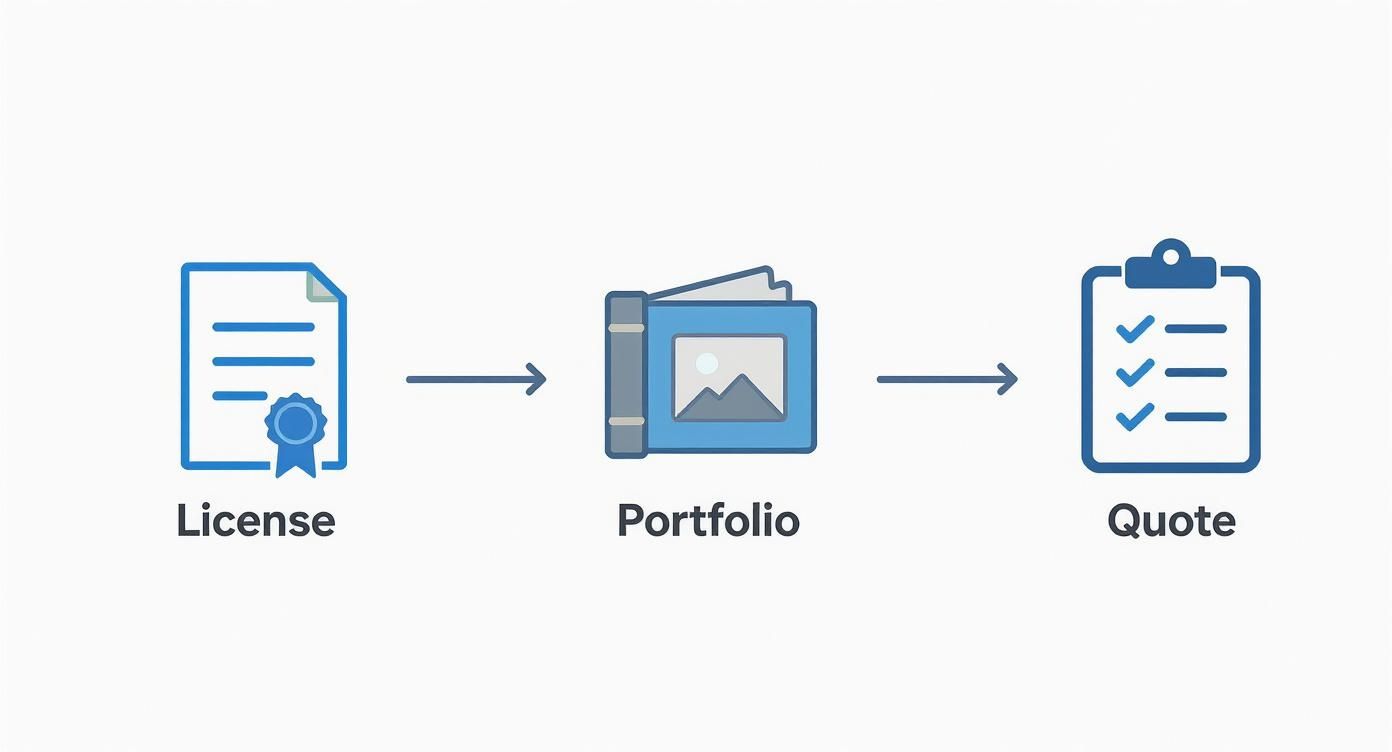
Following this sequence ensures you cover the essential checks—licensing, past work, and transparent pricing—before committing to a contractor.
Will My New Concrete Crack?
Here’s the honest truth: all concrete cracks. It's a natural result of the material shrinking as it dries and cures. The real goal of a professional job isn't to prevent tiny hairline cracks, but to control where they happen so they don't become large, ugly structural problems.
This is exactly why we cut control joints (or expansion cuts) into the slab. These shallow grooves create a planned weak spot, encouraging the concrete to crack in a neat, straight line inside the joint where you'll barely notice it. This, combined with proper ground preparation and the right steel reinforcement, is the key to managing cracks and ensuring a long-lasting, great-looking surface.
What Does Concrete "MPa" Mean?
You’ll hear us and other concreters talk about MPa, which stands for megapascals. In simple terms, it’s the standard measure of a concrete's compressive strength—how much force it can take before it breaks.
Different applications need different strengths. You wouldn't use the same mix for a garden path as you would for a heavy-duty workshop floor.
- 20 MPa is fine for pathways and patios.
- 25 MPa is the standard for a residential driveway.
- 32 MPa or even 40 MPa is needed for slabs supporting heavy vehicles or machinery.
Using a lower-strength mix than required is a corner-cutting tactic some operators use to save a few dollars. We always use the correct strength specified for the job, ensuring it meets Australian Standards and will perform as expected for years to come.
What Kind of Maintenance Does Concrete Need?
One of the best things about concrete is that it's incredibly low maintenance. For most standard finishes, like a broom finish, giving it a good clean with a pressure washer once or twice a year is all it takes to keep it looking sharp.
If you've opted for a decorative finish like exposed aggregate or a sealed surface, we strongly recommend reapplying a quality sealer every few years. This is a game-changer. It protects against stains, stops water from soaking in, and really makes the colours pop, extending the life and look of your investment significantly.