

Footings excavation is the make-or-break first step in any build. This is where we dig the precise trenches that will hold the concrete foundations for the entire structure. Get this stage wrong, and you’re compromising the integrity of the whole building before you’ve even started. That’s why meticulous planning isn’t just a good idea—it’s absolutely non-negotiable. With over 15 years of experience on the Central Coast, we know how to get it right the first time.
Laying the Groundwork for a Solid Foundation
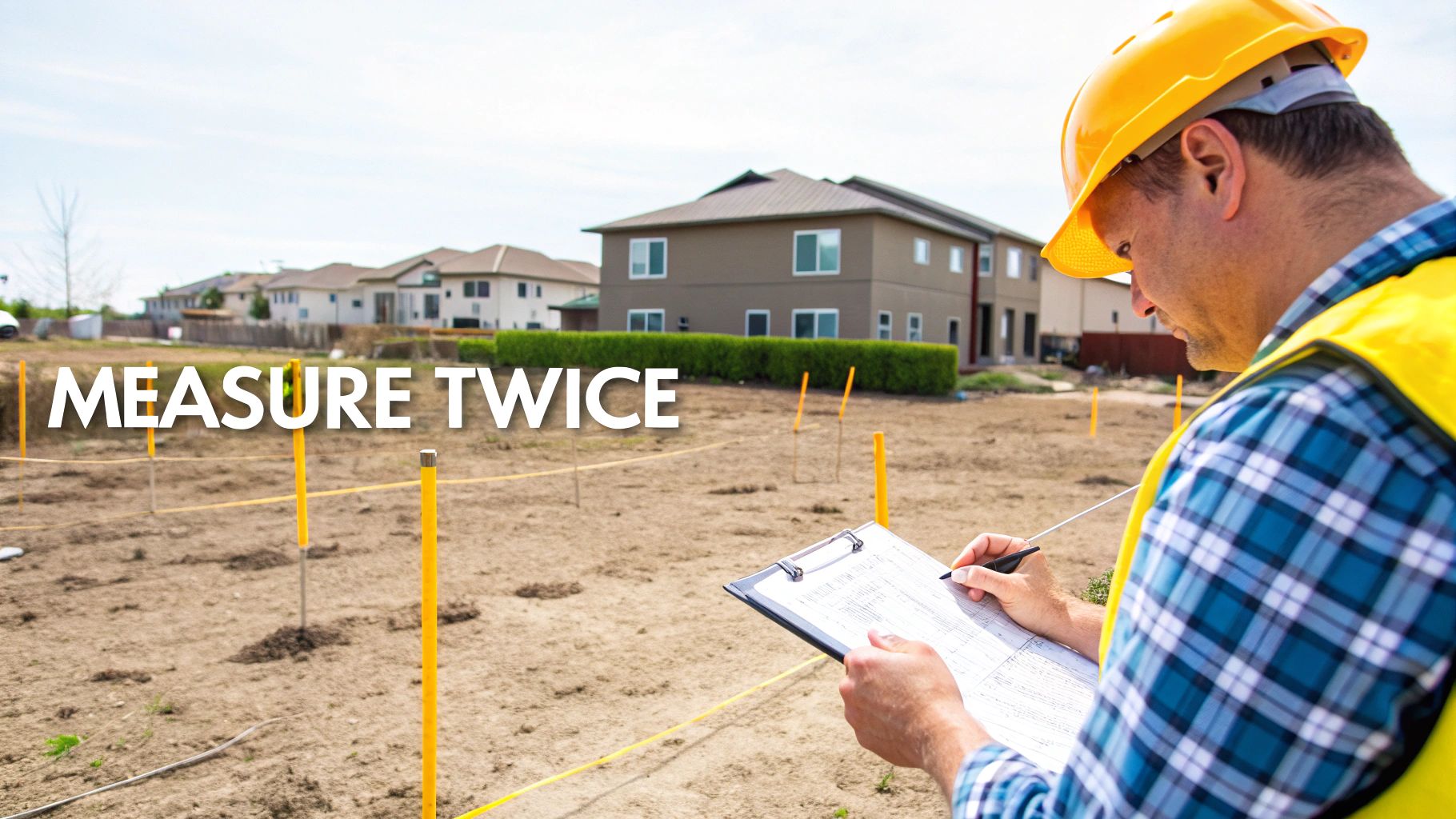
Long before a single bucket of dirt gets moved, the success of your project is decided. This is the part of the job where the old ‘measure twice, cut once’ philosophy genuinely saves you time, money, and a world of headaches down the track. It all kicks off with a detailed review of the architectural and engineering plans to get a crystal-clear picture of what’s required.
From there, we get boots on the ground for a thorough site assessment. Imagine you’re planning a new build in a growing Central Coast suburb like Warnervale. We need to spot potential roadblocks from day one. That means checking machinery access, mapping out all the underground utilities with a mandatory Dial Before You Dig search, and figuring out how the local terrain will shape our excavation strategy.
Navigating Council Requirements and Site Challenges
Getting your head around the local council rules is a critical, non-negotiable step. Whether you’re dealing with Central Coast Council, Newcastle Council, or another local authority, their regulations will dictate everything from setbacks and depths to inspection schedules. Nail this, and you avoid costly stop-work orders and keep the project flowing smoothly.
A well-planned excavation is your best defence against unexpected costs and project delays. It sets the stage for every trade that follows, ensuring a seamless and efficient build from the ground up.
We also have to consider the bigger picture of different types of home foundations, because the specific footing design from your engineer directly impacts our excavation method. We always factor in regional quirks, like the sandy coastal soils common in places like Terrigal, which behave very differently from the reactive clays you find further inland around the Hunter Valley. This proactive approach lets us get ahead of challenges and build a rock-solid plan, guaranteeing your project starts on a truly solid foundation.
How Soil Types Influence Your Excavation
The ground beneath your project dictates everything about your footings excavation. It controls the depth and width of the trenches, the type of machinery we bring to site, and ultimately, the long-term stability of your entire structure.
Here in NSW, the soil can change dramatically from one suburb to the next. A footing design that works perfectly for the sandy coastal soil of Newcastle would be a recipe for disaster in the reactive clay found just a short drive inland. Understanding what you’re digging into isn’t just a box to tick—it’s fundamental to building a foundation that lasts.
This process always starts with a geotechnical soil report, which classifies the ground according to Australian Standard AS 2870. This isn’t just paperwork; it’s the blueprint for your foundation. It tells us everything we need to know about the soil’s stability, how it reacts to moisture, and its bearing capacity—a technical term for how much weight the ground can safely support without giving way.
Common NSW Soil Types and Excavation Implications
To give you a clearer picture, here’s a quick rundown of what we often encounter across the Central Coast, Sydney, and the Hunter Valley, and how it impacts our approach to excavation.
| Soil Type | Common Locations | Key Characteristics | Excavation Consideration |
|---|---|---|---|
| Reactive Clay | Hunter Valley, Western Sydney | Swells significantly when wet, shrinks and cracks when dry. | Requires deeper footings to reach stable ground. May need engineered piers. |
| Sandy Loam | Coastal areas (e.g., Umina, Newcastle) | Drains well, more stable than clay. | Prone to trench collapse, especially when wet. Benching or shoring is critical. |
| Hawkesbury Sandstone | Sydney Basin, parts of Central Coast | Extremely hard and stable. Provides excellent bearing. | Cannot be dug with a standard bucket. Requires rock saws and hydraulic hammers. |
| Silt/Alluvial | River and floodplain areas | Fine particles, can be unstable and poorly drained. | Often has a low bearing capacity. Extensive sub-base prep and engineering required. |
This table is a great starting point, but nothing beats a site-specific geotechnical report. It removes all the guesswork and ensures the engineering is spot-on for what lies beneath.
Dealing with Reactive Clay and Sandy Loam
Reactive clay is a major feature in many parts of the Hunter Valley and Western Sydney. Its defining trait? It swells when it gets wet and shrinks dramatically as it dries out. This constant movement can exert immense pressure on a building’s foundation, leading to those all-too-common issues like cracked brickwork and jamming doors if the footings aren’t designed to handle it.
Because of this, footings in reactive clay have to be excavated much deeper to reach more stable ground that’s less affected by surface moisture. They often require more complex engineering, like reinforced concrete piers, to properly anchor the structure.
On the flip side, the sandy loam you find in coastal spots like Umina Beach or Newcastle’s suburbs is generally more stable. It drains well and doesn’t expand and contract anywhere near as much. While this sounds easier to work with—and in some ways it is—sandy soil can be dangerously prone to collapse during excavation, especially after a downpour. This makes safe digging practices, like benching or shoring the trench sides, absolutely non-negotiable to prevent cave-ins.
The Challenge of Hawkesbury Sandstone
Then there’s the big one: Hawkesbury Sandstone. Found throughout the Sydney Basin and parts of the Central Coast, this stuff is incredibly tough. While it provides an exceptionally stable and high-capacity base for a foundation, digging into it is a completely different ball game. A standard excavator bucket simply won’t make a dent.
When we hit sandstone, we have to switch gears entirely and bring in the heavy artillery—specialised rock saws and powerful hydraulic hammers. This immediately changes the timeline, the budget, and the noise levels on site, all of which need to be factored in right from the very beginning of the project.
The type of soil doesn’t just determine the footing design for the house; it impacts every other structural element on your property. For instance, the stability needed for durable concrete driveways on the Central Coast is directly linked to the ground conditions underneath. A solid, well-compacted sub-base is essential, and our experience across the region means we know exactly what to expect and how to prepare the ground correctly for every part of your project, whether you’re building on sand, clay, or solid rock.
The Footings Excavation Process in Action
Once the site is prepped and the plans are locked in, our focus shifts to the physical dig. A professional footings excavation is a job of precision, not just brute force. It kicks off with the crucial task of setting out the footing locations directly from the building plans—a process that ensures every single trench is perfectly positioned, square, and exactly to spec.
We meticulously mark out the entire foundation grid on the ground using string lines, batter boards, and survey pegs. This physical map is the single source of truth for the excavator operator, guaranteeing the trenches align perfectly with the engineer’s design. This isn’t just about digging a hole; it’s about creating the precise negative space that will soon become your building’s rock-solid skeleton.
Matching the Machinery to the Mission
Choosing the right machinery is absolutely critical and depends entirely on the site’s unique conditions.
Let’s look at a real-world scenario. For a tight-access renovation on a small block in a dense Sydney suburb like Newtown, we’d bring in a compact, tight-access excavator. These machines are purpose-built to navigate narrow spaces without ever compromising on digging power.
In complete contrast, a new build on a sprawling, open block out in the Hunter Valley calls for a larger, more powerful excavator. A bigger machine can shift more soil, faster, making it far more efficient for large-scale projects where space isn’t a constraint. The right machine saves time, reduces unnecessary site disturbance, and ultimately keeps your project on budget.
The infographic below shows how different soil conditions—from loose sand to solid rock—also dictate our approach and machinery selection.
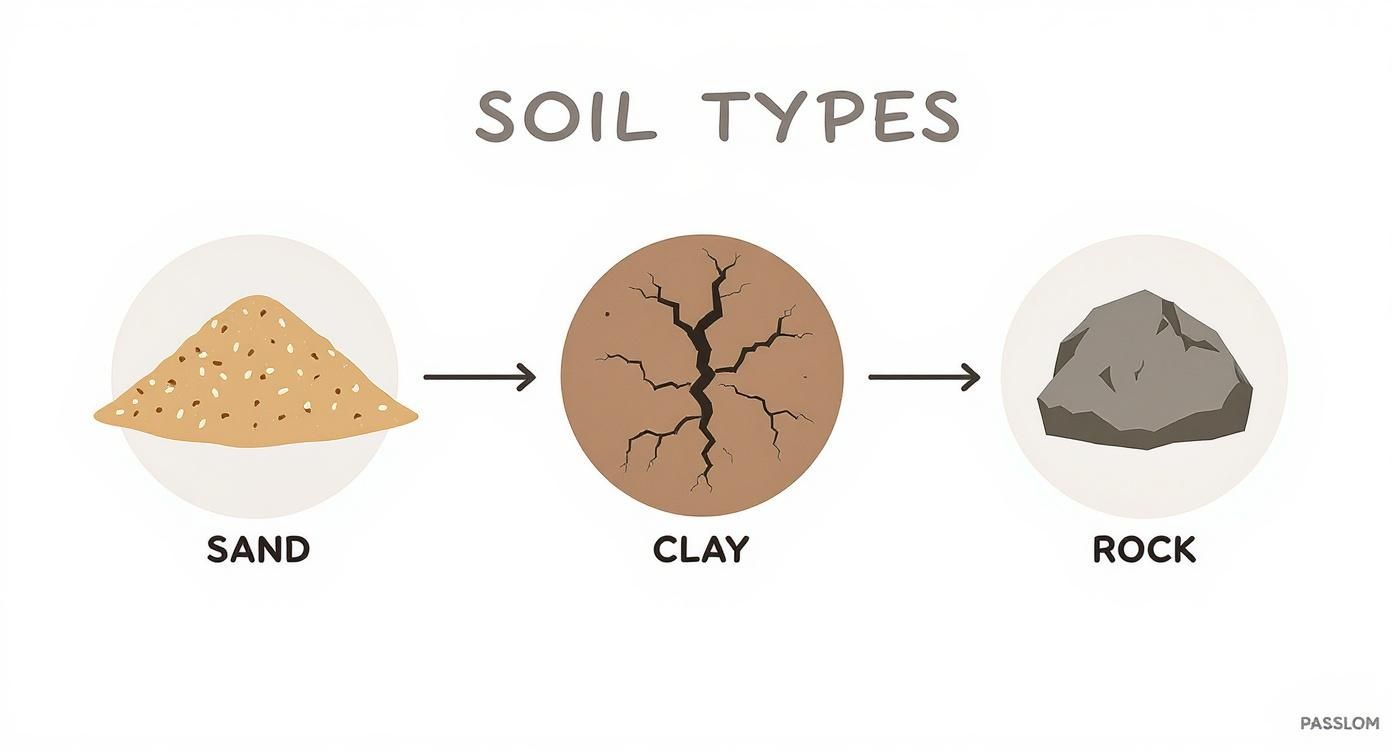
This visual really highlights how the ground itself determines the difficulty and the tools required for the job, with rock always presenting the greatest challenge.
Digging Techniques and Spoil Management
As we start digging, our operator uses a laser level to constantly check the depth. This ensures the base of the trench is perfectly level and hits the required specifications. A consistent, undisturbed base is non-negotiable—it’s what gives the concrete foundation a firm, stable surface to bear on.
Just as important is what we do with the excavated soil, known as ‘spoil’. Spoil management is a key part of the process. We strategically place the excavated earth well away from the trench edges to prevent it from collapsing back in, which is a major safety hazard according to SafeWork NSW guidelines. Depending on the project, this soil might be reused on-site for backfilling or landscaping, or it may need to be loaded into trucks and hauled away for proper disposal.
Adapting to conditions is what separates professional excavators from the rest. Excavating after a week of heavy Central Coast rain, for example, requires a completely different approach. The trenches are far more prone to collapse, and the site becomes a muddy, difficult-to-navigate mess. This demands extra care and slower, more deliberate work to maintain both safety and precision.
The attachments on our excavators also play a massive role. The right bucket width is chosen to match the footing specifications, while other attachments might be needed for different conditions. To see how these tools work, you can explore our complete guide to excavator attachments and get a better understanding of how they allow us to tackle just about any challenge.
Prioritising Safety and Council Compliance
Let’s be blunt: excavation is a high-risk activity. That’s why safety and compliance aren’t just boxes to tick; they’re at the very core of everything we do. When we’re digging footings, we aren’t just moving dirt—we’re managing a live construction site packed with potential dangers. Getting this right isn’t just a good idea; it’s our legal and moral responsibility.
The risks are severe. In fact, site preparation services, which include all foundational work, have been flagged as having one of the highest numbers of work-related deaths in the construction industry. A major cause is workers being hit by moving objects, which really drives home the dangers involved.
Historical data also shows that trench cave-ins are a huge contributor to injuries and fatalities on Aussie sites. This isn’t ancient history; it’s a persistent risk that highlights why strict engineering and safety protocols are non-negotiable. You can dig deeper into these industry stats in reports from SafeWork Australia.
Managing Common On-Site Hazards
Our main focus is always on controlling the most common hazards. These include trench collapse, accidentally hitting underground utilities like gas or power lines, and making sure all machinery is operated safely. Any contractor worth their salt follows strict SafeWork NSW guidelines to keep these risks under control.
For instance, when a trench for your footings gets deeper than 1.5 metres, the risk of a collapse skyrockets, especially in the sandy or wet ground we often see on the Central Coast. To prevent this, we use proven methods like benching (cutting steps into the trench walls) or installing shoring (temporary supports) to make the excavation secure. It’s all about protecting our crew and ensuring the dig stays structurally sound.
Choosing a fully licenced and insured contractor is your only safe bet. It’s your assurance that all work will be performed to Australian Standards, with the right safety systems in place to protect your property, our team, and the public.
Council Compliance and Site Safety Plans
Compliance is more than just following safety rules. It also means meeting every single local council requirement, whether your project is in Newcastle, Sydney, or the Hunter Valley. Your approved building plans will spell out the exact dimensions for the footing excavation, and it’s our job to follow that plan to the millimetre.
Before any concrete gets poured, a certifier or engineer needs to give the final sign-off. If the dig isn’t compliant, you’re looking at costly delays. Simple as that.
To manage all the hazards specific to your project, a comprehensive Construction Site Safety Management Plan is essential. This document isn’t just paperwork; it outlines every potential risk and the specific control measures we’ll put in place to manage it.
This level of detailed planning is a core part of any professional operation, whether it’s a straightforward footing dig or a large-scale project that involves both demolition and excavation. You can find more detail on combining these services in our guide to planning a demolition and excavation project.
At the end of the day, a safe site is an efficient site. It gets your project started on solid ground, without any dangerous or expensive shortcuts.
So, What Comes After the Dig?
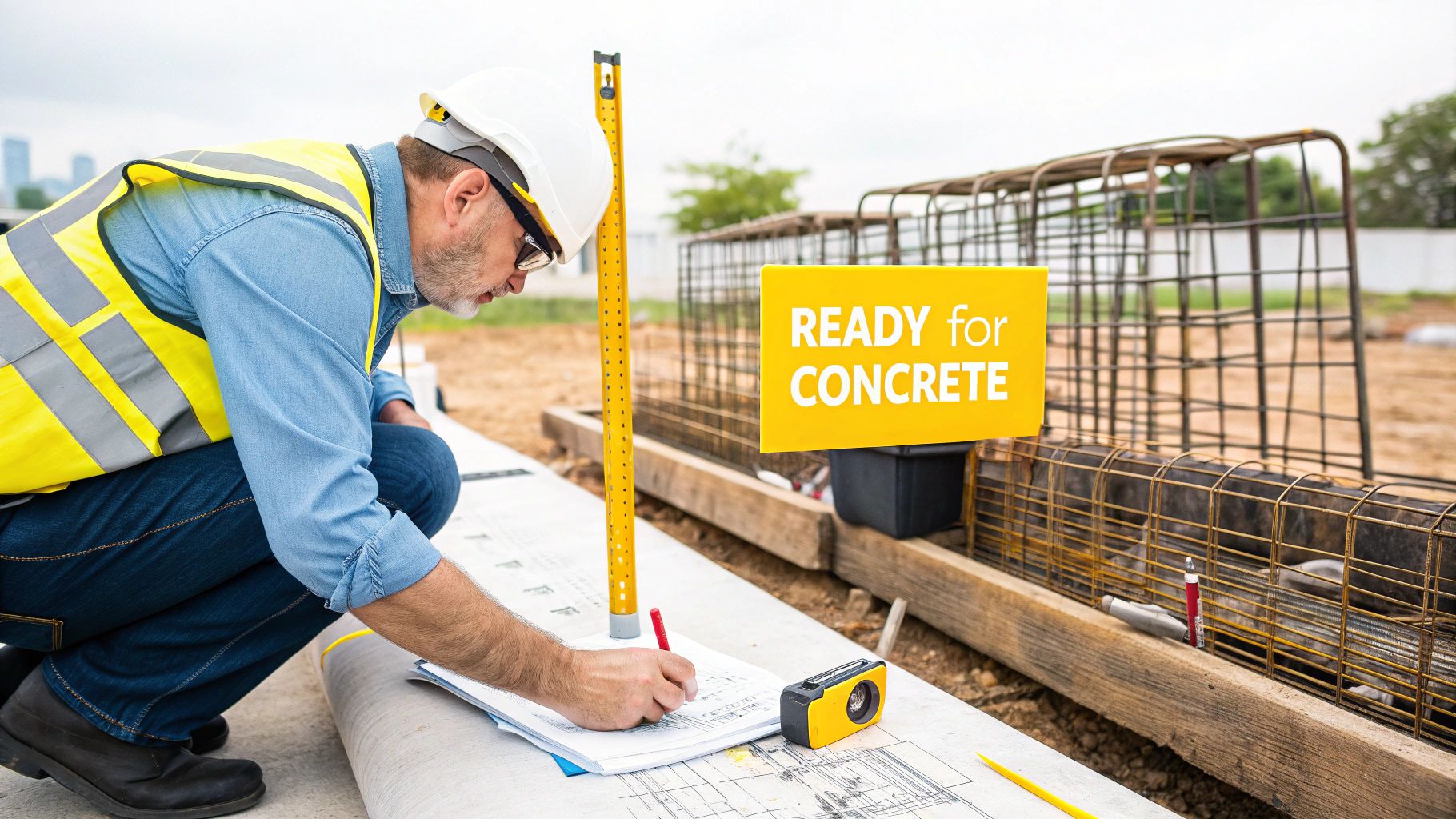
Once the excavator engine cuts out and the trenches are perfectly carved, our main job might be done, but the site is now primed for the next critical phases. The precision of our footing excavation directly impacts how smoothly every other trade can do their work, from the steel fixers to the concreters.
Simply put, a clean, accurate dig makes their jobs faster, easier, and ultimately better. Before a single drop of concrete is poured, those trenches need to pass a crucial inspection.
This isn’t just a quick look-over. It’s a detailed check, usually done by your builder, a structural engineer, or a private certifier. They are meticulously comparing our work against the approved engineering plans, ensuring everything is spot-on down to the millimetre.
Passing the Footings Inspection
This inspection is a non-negotiable step. It’s the final sign-off on the foundation’s integrity before it gets locked in forever with concrete. The certifier will be verifying several key details.
They’ll get the tape measure out, physically checking the width and depth of every trench to confirm they meet the minimum specs on the plans. Especially on the Central Coast’s sandy soils, hitting that specified depth is absolutely vital for long-term stability.
They also make sure the trenches are clean. There can be no loose dirt, pooled water, or any debris at the base, as this could seriously compromise the concrete pour and the strength of the finished slab.
One of the most important checks is verifying the soil condition at the very bottom of the trench. The ground must be firm and undisturbed. Any soft spots or churned-up earth have to be rectified immediately, as this signals poor bearing capacity that could lead to structural failure down the line.
Coordinating with Steel Fixers and Concreters
Once the inspection gets the green light, the site quickly becomes a hive of activity. The steel fixers are next in, placing and tying all the reinforcing steel mesh and bars within the trenches. This reo is what gives the concrete its tensile strength, and its placement is precisely dictated by those same engineering plans.
Our careful excavation work ensures there’s enough clearance around the steel for what’s known as ‘concrete cover’—this is what protects the steel from moisture and corrosion over the decades.
With the steel in place, the concreters can finally move in and pour the footings. This seamless handover from excavation to steel fixing to concrete pouring is what keeps your project moving forward without a hitch.
Your Footings Excavation Questions Answered
We get asked a lot of questions about footing excavations on projects right across the Central Coast, Sydney, and Newcastle. Getting clear, straightforward info is vital when you’re planning a build, so we’ve tackled some of the most common queries we hear from clients.
How Long Does Footings Excavation Take?
Honestly, it varies massively. A straightforward footing dig for a new home on a flat block with good soil? You could be looking at 1-3 days. But throw in a sloping block in Terrigal with a bunch of sandstone to get through, and that could easily stretch out to a week or more.
The biggest variable we can’t control is the weather. A few days of heavy Central Coast rain can grind everything to a halt, making the site unsafe and the ground completely unworkable. We always give a realistic timeline after a full site assessment, factoring in everything from access and soil reports to the sheer complexity of the job.
Is Council Approval Needed for This Work?
Yes, almost without exception. Footings are the primary structural element of your build, so the excavation work is a core part of your Development Application (DA) or Complying Development Certificate (CDC).
Your local council, whether it’s Central Coast Council or Lake Macquarie Council, needs to sign off on the engineering plans. Those plans dictate the exact depth and dimensions of the excavation, and not a single scoop of dirt can be moved until they’re approved.
Make no mistake: starting a footing excavation without the proper approvals is illegal. It will land you with a stop-work order, leading to serious delays and some hefty potential fines.
What Is the Biggest Mistake to Avoid?
The most common—and most costly—mistake we see is trying to cut corners by hiring an inexperienced or under-equipped contractor. Getting the excavation wrong is a disaster for the entire project.
If the trench isn’t deep enough, if the base soil has been disturbed, or if it’s even slightly in the wrong spot, it can compromise the whole building’s integrity. This almost always leads to failed inspections, expensive remedial engineering, and project delays that bleed time and money. It’s always, always more cost-effective to bring in a professional team to nail it the first time.
At Booms Up Civil Group, we have the local experience and machinery to ensure your footings excavation is precise, compliant, and ready for a rock-solid foundation. If you have questions about your upcoming project on the Central Coast, Sydney, or Newcastle, get in touch with our team today.