
When you hear the term demolition excavation, it’s easy to picture a wrecking ball and a big hole. But in reality, it’s a systematic, two-part process: first, the safe and strategic dismantling of a structure, followed by digging out the site to get it ready for whatever comes next.
This isn’t just about knocking things down. It’s a carefully planned operation that clears the way for a fresh start, ensuring your new project is built on solid, perfectly prepared ground. We’ve seen firsthand over 15 years on the Central Coast that getting this stage right is the foundation of a successful build.
What Demolition Excavation Really Involves
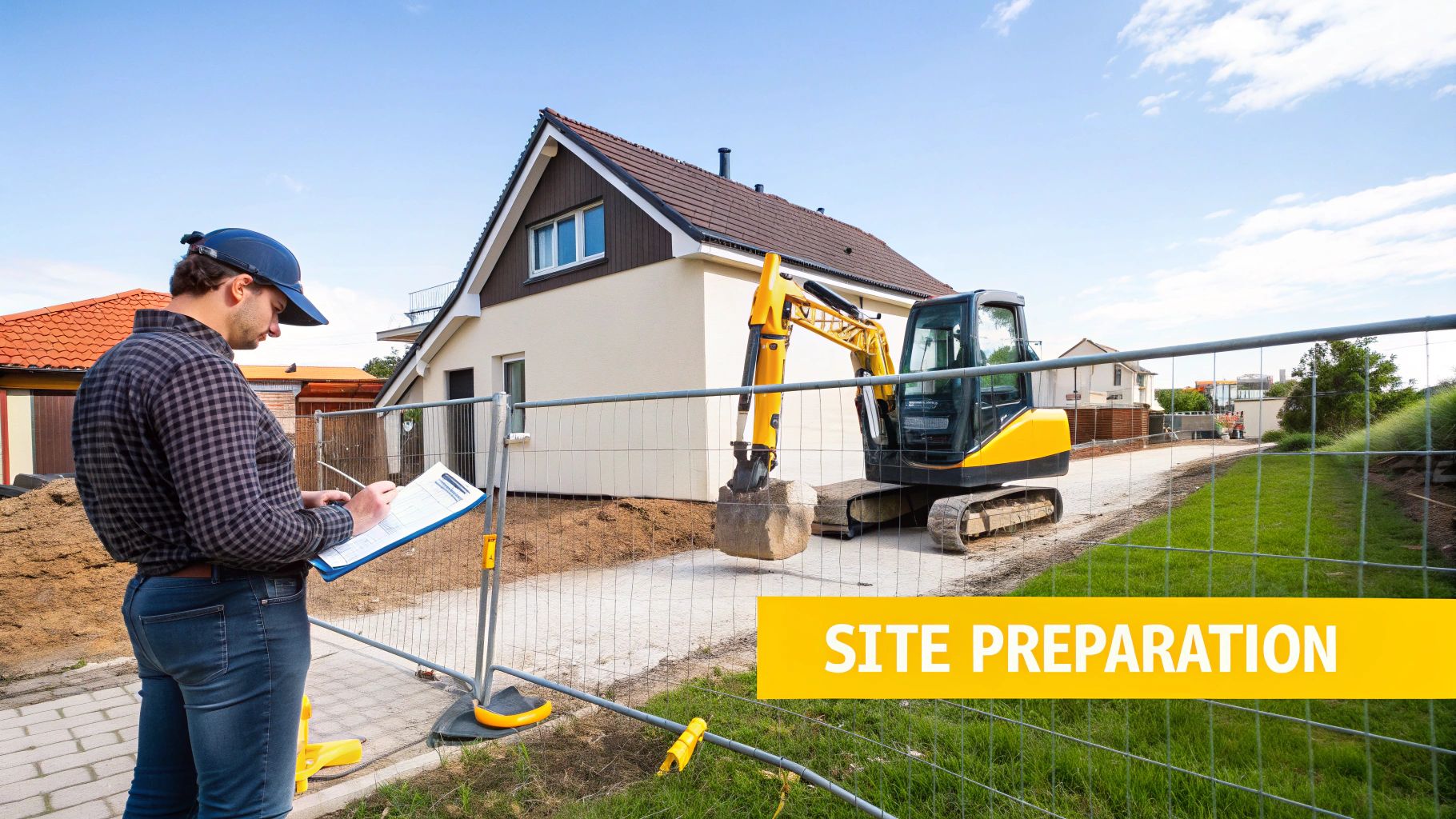
So, let’s get into the nuts and bolts of demolition excavation. The process combines two distinct but closely related fields. If you want to get into the details, you can learn more about the difference between excavation and earthmoving. The main takeaway? Think of it as a carefully choreographed operation that prepares your land for its next chapter.
Whether you’re a homeowner planning a knockdown-rebuild on a tight suburban block in Newcastle, or a developer preparing a major commercial site in Western Sydney, getting this first stage right is non-negotiable.
With over 15 years of hands-on experience across the Central Coast and beyond, we’ve seen it all. We know firsthand that a successful project is quite literally built on solid ground. This guide will walk you through the essential steps to ensure your project kicks off safely, stays on schedule, and avoids those costly surprises that can derail a job before it even gets going.
Getting the Green Light: Council Approvals and Site Assessments
Before the first piece of machinery even thinks about rolling onto your property, the real heavy lifting for any demolition excavation project has already begun. This is the groundwork phase—all about meticulous planning, honest assessments, and getting the right council permissions in place. Nailing the paperwork and prep work from the get-go is what separates a smooth-sailing project from one bogged down in costly delays and council fines.
Every block of land has its own story, and our first job is to figure out what it is. A detailed site assessment is completely non-negotiable.
Let’s say you’re building on a steep Terrigal block with that classic sandy coastal soil. That needs a totally different demolition and excavation plan compared to a flat site with reactive clay out in Maitland. One demands serious planning for erosion control and shoring, while the other forces you to think hard about soil heave and drainage.
Uncovering Your Site’s Unique Challenges
That first look at a site goes way beyond just checking the slope. We’re on the hunt for any potential hurdles hiding just out of sight.
A critical first move is always lodging a Dial Before You Dig enquiry. This free national service is an absolute lifesaver, giving us the plans for underground utilities like water mains, gas lines, telecommunications cables, and electrical conduits. Hitting one of those isn’t just dangerous; it means expensive repairs and a massive stop-work delay.
We also have to be mindful of the neighbours. This means checking for shared walls, how close we are to the boundary, and what the potential vibration effects might be. In tightly packed suburbs across Sydney’s North Shore or inner-city Newcastle, this step is vital for keeping the peace and avoiding messy disputes. Soil testing is another piece of the puzzle, helping us understand the ground’s stability and composition, which tells us exactly how to plan the excavation.
Key Takeaway: A professional site assessment isn’t a box-ticking exercise. It’s a risk management strategy that brings hidden issues—from buried NBN cables to unstable soil—to the surface before they turn into expensive headaches.
Making Sense of the Council Approval Maze
Dealing with local council requirements can feel like you’re trying to solve a puzzle in the dark, but it’s an essential part of the process. For most demolition jobs, you’ll need a thumbs-up from your local council, whether that’s Central Coast Council, Lake Macquarie City Council, or another authority in NSW. The approval you need usually falls into one of two buckets.
A Complying Development Certificate (CDC) is the fast-track option. It’s a streamlined approval path for straightforward projects that neatly fit a specific set of development standards. This is often the right fit for a standard residential knockdown-rebuild on a properly zoned block. The process is usually quicker and less complex than a full DA.
On the other hand, a Development Application (DA) is what you’ll need for more complex projects. If your property is in a heritage conservation area, an environmental protection zone, or has other planning controls on it, you’ll almost certainly be lodging a DA. This is a much more detailed process that involves a thorough assessment by the council. Knowing which path you’re on from the start is crucial, which is why getting expert guidance can make a world of difference. As you get your site ready, it’s also smart to think about how the demolition can set up the next stage, as there are specific techniques for building with demolition in mind that can make future construction a whole lot smoother.
Finally, no demolition can kick off without an approved Waste Management Plan. This document spells out exactly how you’ll get rid of or recycle every bit of material from the site—from concrete and bricks to timber and metal. It’s a legal requirement that proves your project meets environmental regulations, and councils take it very seriously.
Upholding Safety and Compliance on Site
In our line of work, safety isn’t just a policy we follow; it’s the bedrock of every decision we make on a demolition excavation site. Let’s be clear: a project is only a success if everyone goes home safe at the end of the day.
This commitment means we adhere strictly to the regulations set out by authorities like SafeWork NSW, which govern every aspect of high-risk construction work in our state. There’s simply no room for shortcuts or guesswork.
From the moment we first set foot on a site to the final handover, every action is planned and executed with safety as the absolute top priority. This isn’t just about protecting our crew and the public—it’s about giving you complete peace of mind throughout the entire process.
The Role of Safe Work Method Statements
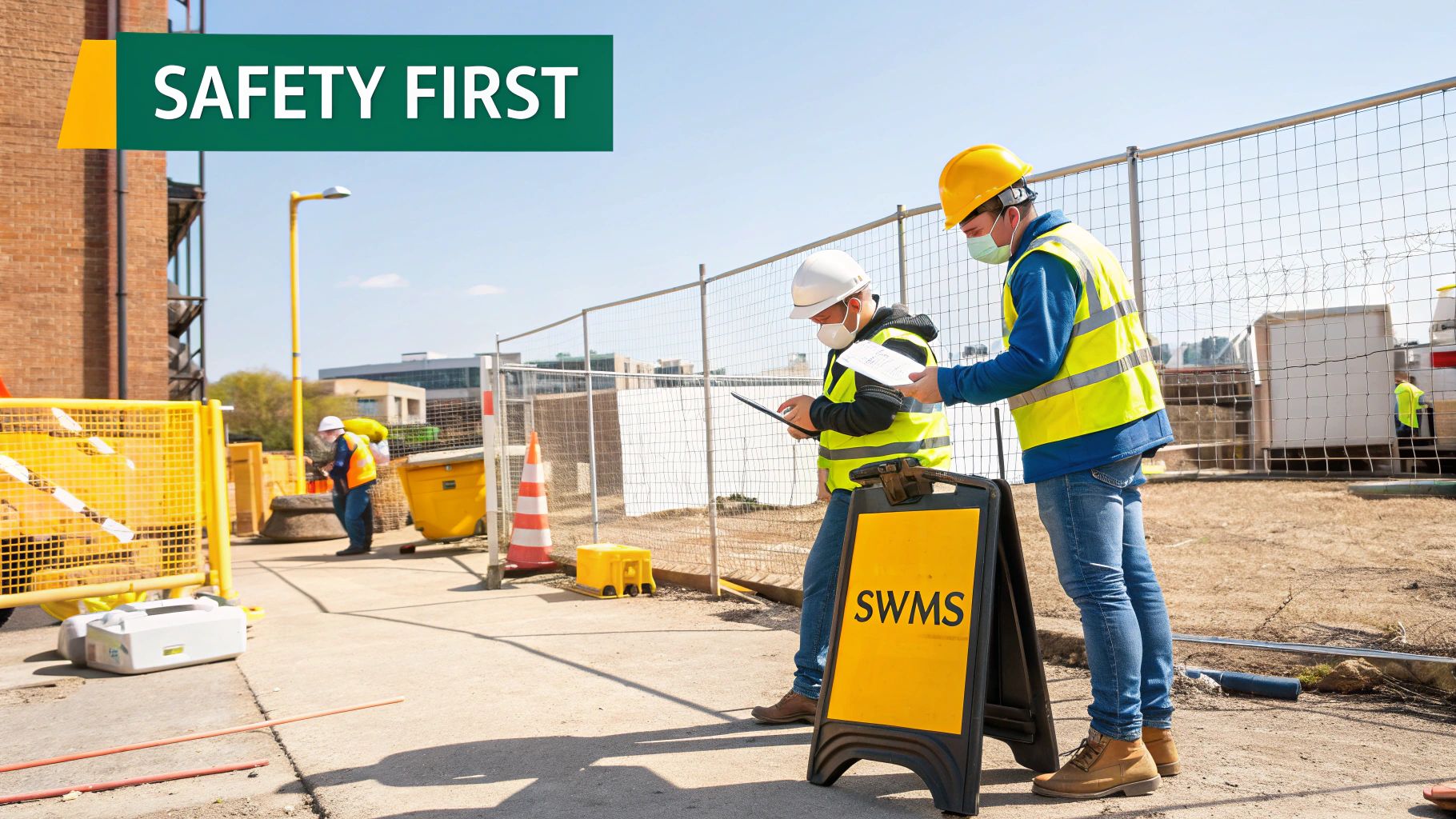
A cornerstone of worksite safety is the Safe Work Method Statement, or SWMS. This isn’t a suggestion; it’s a legal requirement under NSW’s Work Health and Safety (WHS) regulations for any high-risk construction work, which absolutely includes demolition and excavation.
Think of a SWMS as a living document we develop specifically for your project. It methodically breaks down the job into distinct steps, identifies potential hazards for each one, and details the exact control measures we’ll put in place to eliminate or minimise those risks. It’s a proactive safety plan, not a reactive one.
For instance, a SWMS for a demolition in Wyong might focus heavily on identifying and managing asbestos in an old fibro house. In contrast, a project on a tight Hornsby street would have detailed plans for managing traffic and working safely around overhead powerlines. For any excavation, the SWMS will always include robust measures to prevent trench collapse—one of the most serious risks we face.
Securing the Site and Protecting the Environment
A safe site is a secure site. Before any major work kicks off, the entire perimeter must be enclosed with appropriate temporary fencing. This is non-negotiable for preventing unauthorised access and protecting the public from on-site hazards. We also install clear, compliant signage to warn of demolition work, asbestos removal (if applicable), and other potential dangers.
Beyond securing the boundary, we also have a responsibility to protect the surrounding environment. This means implementing sediment and erosion control measures. You’ll often see silt fences or sediment traps installed along the low points of a site. These are designed to capture soil and runoff, preventing it from washing into council stormwater drains and polluting local waterways like Tuggerah Lakes or the Hunter River.
Our Promise: A professional contractor doesn’t just manage the demolition; they manage the entire site. This means integrating robust safety protocols and environmental protections into the project plan from day one, ensuring a secure and compliant worksite.
Specialised Tasks and Asbestos Management
Some tasks demand an even higher level of care and specific licensing. Asbestos removal is the most common and critical example. If we identify or even suspect asbestos-containing materials (ACMs) on your property, all work must stop until a licenced asbestos assessor has confirmed its presence and type.
The removal and disposal process is highly regulated for a reason—inhaling asbestos fibres can cause fatal diseases. Only licenced professionals using specialised equipment and decontamination procedures are legally allowed to handle and remove it. There is absolutely zero room for error here, and we manage this process with the gravity it deserves, ensuring full compliance with SafeWork NSW codes of practice.
At the core of any successful demolition project is a comprehensive approach to safety across all operations. This includes implementing robust fleet safety management essentials for all machinery and vehicles involved.
Managing safety also extends to the unique challenges of the job itself. Some sites, for instance, present significant access issues that demand specialised machinery and careful planning. You can learn more about how we tackle these challenges in our guide to difficult access excavation.
Everyone on-site, from operators to labourers, must wear the correct Personal Protective Equipment (PPE) at all times. This includes hard hats, high-visibility clothing, steel-capped boots, and task-specific gear like respiratory protection and safety glasses. Upholding these standards is simply non-negotiable.
Matching the Right Machinery to Your Project
Choosing the right equipment for a demolition excavation job isn’t just about bringing in the biggest machine; it’s about deploying the smartest and most efficient one for the task. It’s a common mistake to think bigger is always better, but using the wrong size or type of machinery can lead to costly delays, unnecessary site damage, or even bring the project to a complete standstill.
Getting the machinery selection right from the start doesn’t just save time—it saves you money and ensures the job is done properly the first time. The gear we bring to your site is always carefully selected based on a detailed assessment of your specific needs, considering everything from the scale of the demolition and the volume of material to be excavated, right down to site access constraints and the local ground conditions.
From Tight Access to Bulk Earthworks
Not all excavators are created equal, and their size and power dictate exactly where and how they can be used effectively. A nimble, small-scale machine is perfect for delicate tasks in tight spaces, while a heavy-duty excavator is the only real option for large-scale commercial work.
Imagine you’re clearing a small backyard for a granny flat behind a terrace house in inner-city Newcastle. In that scenario, a nimble 1.7-tonne mini excavator is the hero. Its compact size and rubber tracks allow it to navigate narrow side passages without tearing up existing paths or gardens.
Now, picture a massive commercial project in Western Sydney, preparing a site for a new warehouse. This job calls for a powerful 20-tonne excavator. Its reach, digging force, and capacity are essential for bulk earthworks, loading large dump trucks, and handling huge volumes of concrete and steel from a demolished structure.
Key Takeaway: The goal is to match the machine’s power and footprint perfectly to the job. A machine that’s too small will struggle and take twice as long, while one that’s too big is just inefficient and causes unnecessary disruption.
More Than Just a Bucket: The Power of Attachments
An excavator’s true versatility really shines through with its attachments. A standard bucket is great for digging, but specialised tools transform the machine into a multi-purpose workhorse—something that’s absolutely essential for the complexities of a demolition excavation.
Hydraulic hammers, often called “rock breakers,” are indispensable for breaking up thick concrete slabs, footings, and the stubborn sandstone bedrock found across so many Sydney sites. For sorting through demolished materials, a hydraulic grab allows us to separate timber, metal, and concrete with precision, which is crucial for efficient recycling and waste management. You can get the full rundown by checking out our complete guide to excavator attachments.
The Supporting Fleet
While excavators are often the stars of the show, a successful project relies on a strong supporting cast of machinery.
Posi-tracks are compact track loaders that prove invaluable on almost every site. Their low ground pressure makes them ideal for working on delicate surfaces like lawns or newly laid road base without causing damage. They are the go-to machine for final site clean-ups and detailed levelling work.
Of course, all that demolished material and excavated soil needs to be moved off-site. That’s where our range of dump trucks comes in, from smaller tippers that can navigate tight residential streets to large truck-and-dog combinations for bulk haulage on major commercial jobs. Efficiently loading and removing material is what keeps a project flowing smoothly and prevents the site from becoming congested.
The Demolition Excavation Process Explained
So, what does a typical demolition excavation project actually look like from start to finish? While every site brings its own unique set of challenges, the whole thing follows a pretty methodical sequence. Forget the chaotic wrecking ball scenes you see in movies; this is a carefully planned operation designed to safely clear a site and get it perfectly prepped for whatever comes next.
It’s a journey from a standing structure to a clean, construction-ready block.
The moment we step foot on a new job, our first priority is locking down the site. This means establishing clear boundaries, putting up robust temporary fencing, and setting up sediment control measures to protect local stormwater drains. It’s a non-negotiable first step required by councils across the Central Coast and Sydney.
The Soft Strip and Structural Takedown
With the site secure, we move on to what’s known in the trade as a ‘soft strip’. It’s a meticulous process where our crew works through the building, carefully removing all the non-structural items. This means pulling out internal fittings, cabinetry, doors, windows, and floor coverings, all of which are sorted for recycling wherever possible.
Once the building is stripped back to its skeleton, the real demolition begins. We bring in the machinery that’s best suited for the job and start dismantling the structure, usually from the top down. It’s a controlled approach that helps us manage dust and noise, which keeps the neighbours happy. We’re constantly using techniques like water spraying to suppress airborne dust—a critical part of maintaining air quality and sticking to SafeWork NSW guidelines.
On-Site Sorting and Waste Management
As the structure comes down, the critical job of sorting the waste begins immediately. This is one of the most important stages of any modern demolition excavation. Instead of just piling everything into a truck and shipping it off to landfill, we separate materials right there on-site.
This isn’t just about being environmentally responsible; it’s a legal requirement under most council Waste Management Plans and, frankly, a smart financial move. Separating valuable materials makes a huge difference.
- Concrete and Bricks: These heavy materials are piled separately, ready to be crushed and recycled into road base or aggregate.
- Timber: Any untreated timber can be recovered for reuse or turned into mulch.
- Metals: Steel reinforcement, copper piping, and other metals are highly recyclable and are sent straight to scrap metal merchants.
This intense focus on recycling massively reduces the amount of waste heading to expensive landfills. Think about the scale of it: research into Australian building projects found that, on average, 141 kilograms of material is thrown out for every square metre of construction. Concrete, masonry, and soil dominate that waste stream, which is exactly why on-site sorting is so vital. You can read the full research about construction waste findings for a deeper dive.
Why This Matters: Efficient on-site sorting doesn’t just reduce landfill and help the environment. By minimising tipping fees and maximising recycled materials, we can pass significant cost savings directly back to you, the client.
Precision Excavation and Final Handover
With the old structure gone and all the waste responsibly managed, the ‘excavation’ part of the job really kicks into gear. We’re no longer clearing the old; we’re now preparing for the new.
Whether we are digging for a new building footprint, excavating a basement for a home in Newcastle, or trenching for essential services like plumbing and electrical, our focus shifts to absolute precision. We work hand-in-glove with surveyors and builders’ plans to hit the exact levels, known as RLs (Reduced Levels), needed for the next stage of construction.
This infographic shows the simple but critical flow of machinery selection, from assessing the site to excavating material and finally removing it efficiently.
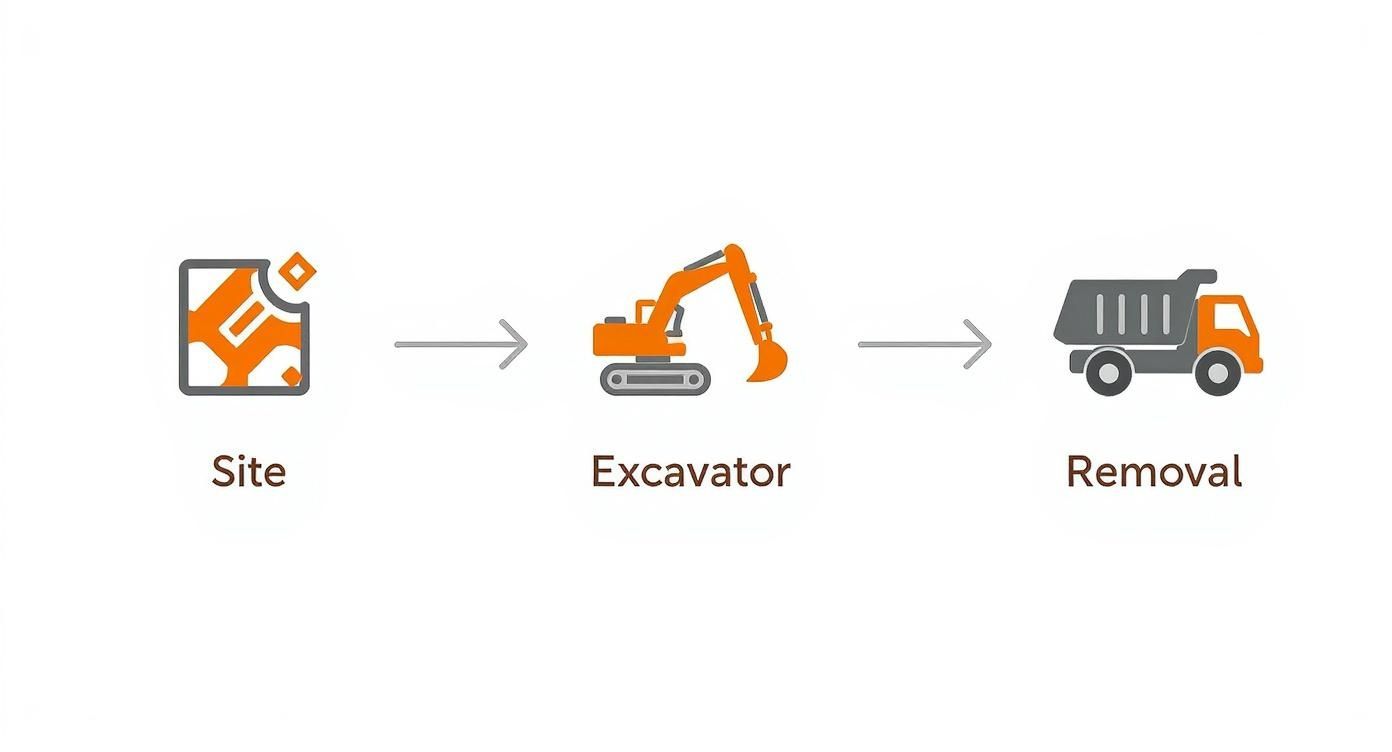
This process highlights that each step—site assessment, excavation, and removal—relies on choosing the right machine to keep the project on track and on budget.
During the excavation phase, we also pay close attention to soil compaction. This step is crucial for ensuring the ground is stable and ready to support the new foundations without any risk of settlement issues down the track.
The project wraps up with a final, thorough site clean-up. We make sure every last bit of debris is gone, the ground is level and tidy, and the site is left in pristine condition. What you’re left with is a perfectly prepared, compliant, and construction-ready block—the ideal foundation for building your vision.
Managing Waste and Environmental Responsibility
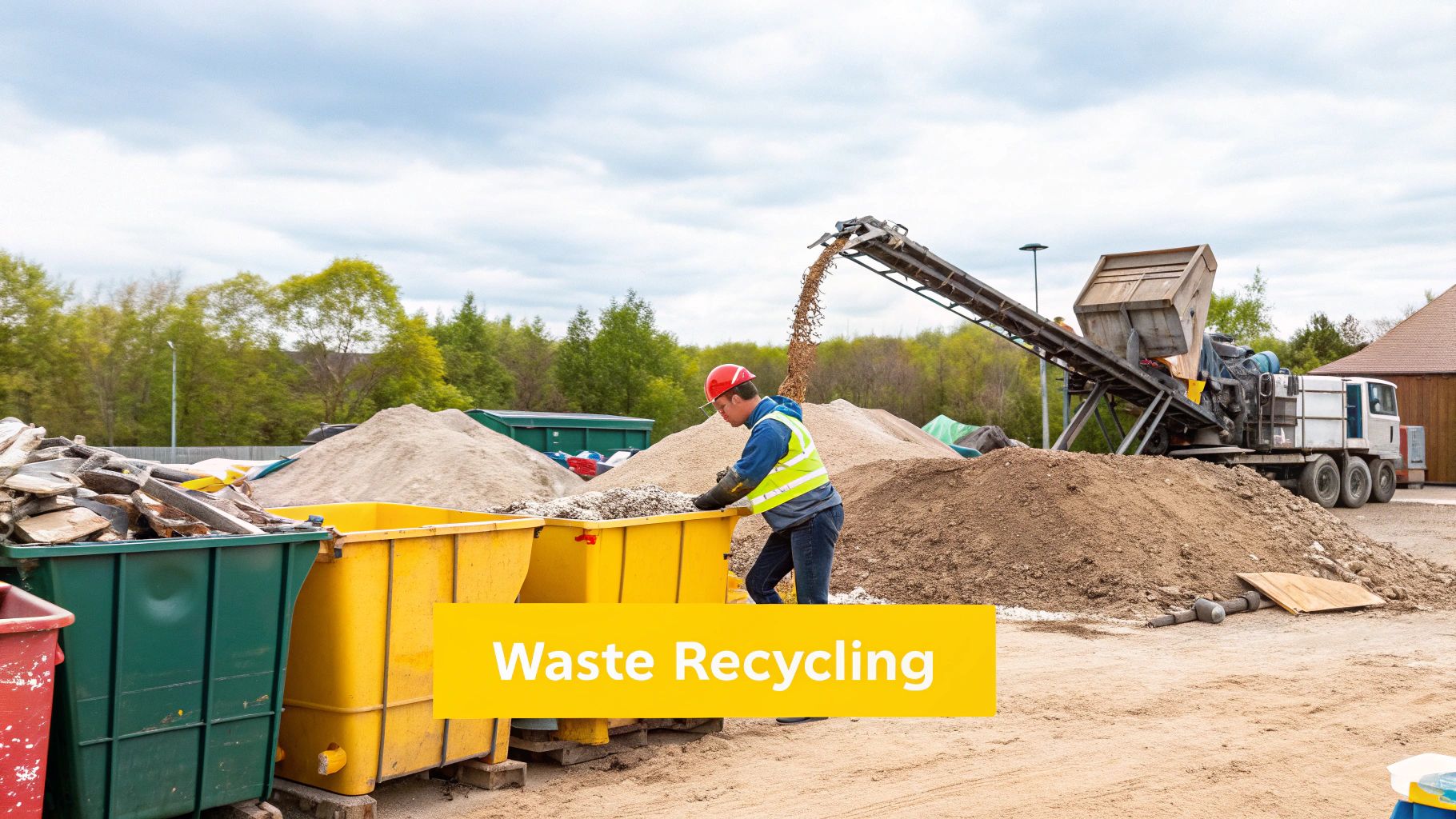
A modern demolition excavation project is as much about smart resource recovery as it is about clearing a site. Gone are the days of just hauling everything off to the tip. Today, the focus is squarely on sustainable practices that cut down on waste, driven by both a strong environmental ethic and savvy economics that directly benefit you.
This commitment to recycling construction and demolition (C&D) waste is now a core part of the job. For instance, we can take the old concrete from a driveway we’ve just pulled up and crush it right there on site. This creates a high-quality recycled aggregate that’s perfect for the base of a new driveway or as backfill, saving you a packet on both disposal fees and the cost of buying new materials.
Sorting and Diverting Waste Streams
Effective waste management kicks off the second the demolition starts. We’re methodical about it, sorting different materials into separate streams right from the get-go. This means things like steel reinforcement, timber framing, bricks, and clean soil are all separated and stockpiled before they head off to specialised recycling facilities.
This on-site diligence isn’t just about ticking a box for the local council; it’s about actively participating in a circular economy. By diverting these valuable resources away from landfill, we shrink the project’s environmental footprint and give these materials a second life. For handling the logistics efficiently, understanding the options provided by Professional Waste Management Services can be a game-changer.
Our Approach: We look at demolition “waste” as a resource waiting to be reused. By recovering and recycling materials on-site wherever possible, we deliver a cleaner project and can often pass significant cost savings directly on to you.
The industry’s shift is clear and it’s happening fast. In fact, Australia’s C&D waste recycling market is growing at a rapid clip, a direct result of tougher environmental regulations and the very real financial incentives for resource recovery.
This focus on responsible disposal is especially crucial when we’re dealing with excavated soil. How we handle it depends entirely on its classification—whether it’s clean fill, contaminated, or full of rock, the disposal method changes completely. Getting this right is non-negotiable for compliance and cost control. If you’re curious about the nitty-gritty, you can learn more about how to dispose of soil the right way.
Ultimately, being a responsible partner in our community means leaving your site clean, compliant, and perfectly prepped for its next chapter.
Your Demolition Excavation Questions Answered
We get a lot of questions about demolition and excavation, which is completely understandable. To help you get a clearer picture and plan your next steps with confidence, we’ve put together some straightforward answers to the queries we hear the most.
How Long Does Demolition And Excavation Take?
This is one of the biggest questions, and the honest answer is: it varies dramatically. For a straightforward residential knockdown on a flat, clear block here on the Central Coast, the whole process might only take one to two weeks from the moment we start to the final site clear.
But a complex commercial site in Sydney? That’s a different story. If we’re dealing with a deep basement excavation, removing hazardous materials, or navigating tight access, the project could easily stretch over several months. Things like unexpected weather, tricky site access for our machinery, and the discovery of asbestos will always play a role in the timeline. We always build a realistic schedule upfront based on a proper assessment of your specific site.
What Approvals Do I Need From The Council?
Navigating council approvals really depends on the scale and nature of your project. A lot of standard residential knock-down-rebuilds in NSW can get the green light through a Complying Development Certificate (CDC). Think of it as a faster, more streamlined approval pathway compared to lodging a full Development Application (DA).
A DA is almost always needed for bigger, more complex jobs, or for sites in sensitive areas. For example, if your property is in a heritage zone, an area with environmental protections, or on bushfire-prone land, you’ll definitely need to go through the full DA process with your local council, whether that’s Newcastle Council or Hornsby Shire Council.
Our Tip: We can help you figure out the most likely approval path for your project right from the get-go. Getting this sorted out from the beginning saves a massive amount of time and avoids those frustrating back-and-forths with the council.
Can I Do Any Of The Demolition Work Myself?
For both safety and legal reasons, structural demolition and operating any heavy machinery is a job that must be left to licenced and insured professionals. The risks involved are just too high for a DIY attempt, and SafeWork NSW has very strict regulations for this kind of high-risk work.
You might be able to handle some of the smaller, non-structural tasks like removing internal fixtures—a process we call a ‘soft strip’—but it’s crucial to chat with your contractor about it first. For a small job, like digging a trench for garden irrigation by hand, a DIY approach might be fine. But as soon as machinery is involved, or you’re dealing with anything structural, it’s time to call in the professionals. And this is critical: handling or removing materials like asbestos is illegal without the proper licence and poses serious, long-term health risks to you and your family. Always, always leave that to the experts.
Ready to clear the way for your new project? With over 15 years of hands-on experience across the Central Coast, Sydney, and Newcastle, Booms Up Civil has the expertise and machinery to get your demolition excavation done right the first time.
Get in touch for a free, no-obligation quote and site assessment today.