
You've lined up the machine, booked the crew, and the site is ready to open up. Then the real question lands. How do you get an excavator, loader, roller, or telehandler into a tight NSW site without losing a day to access issues, permits, or a trailer that was wrong for the job in the first place?
That's where heavy machinery transport stops being a simple pickup and delivery task. Let's say you're starting a build on a narrow block in Kariong, or preparing a commercial site in Warnervale where access runs through local streets, roundabouts, parked cars, and overhead services. The machine may be ready, but the route, trailer, timing, and unloading area still decide whether the move goes smoothly or turns into a problem for the whole programme.
In Australia, road planning matters because heavy equipment moves mostly happen by truck, not rail or air. The Bureau of Infrastructure and Transport Research Economics reported that road freight moved about 223.6 billion tonne-kilometres in Australia in 2021–22, with road transport the dominant mode, which is why proper road logistics sit at the centre of machinery moves in NSW (BITRE freight context). If you're looking at Central Coast haulage support, that planning piece matters just as much as the truck itself.
A rushed move usually costs more than a well-planned one. The delays don't just sit with the transport contractor. They flow into your concrete booking, steel delivery, earthworks sequence, and the trades waiting on site access.
Introduction
On a live project, machinery transport is often the first test of whether the job has been planned properly. A machine that fits on paper can still be awkward in practice if the street is narrow, the driveway entry is soft after rain, or the site bench isn't ready for unloading.
That's common across the Central Coast, Sydney and Newcastle. In older suburbs, you'll find tight kerb lines and parked vehicles. In growth areas, you'll deal with unfinished roads, soft verges and temporary traffic conditions. In rural parts of the Hunter Valley, the challenge is often gate width, turning space and longer travel windows.
Practical rule: If the machine, trailer and destination haven't been checked as one package, the move isn't ready.
Heavy machinery transport works best when someone takes ownership of the whole chain. That means plant dimensions, trailer selection, route constraints, permit triggers, weather, site access, loading conditions and the unloading plan all get checked before dispatch. If one of those is left until the day of the move, you're relying on luck.
The projects that stay on programme usually do one thing well. They treat transport as part of site planning, not as an afterthought after the machine has been hired or purchased.
The Pre-Move Assessment Your First Step
Measure twice, move once. That old rule still applies, and it matters more with heavy machinery than almost anywhere else on a civil job.
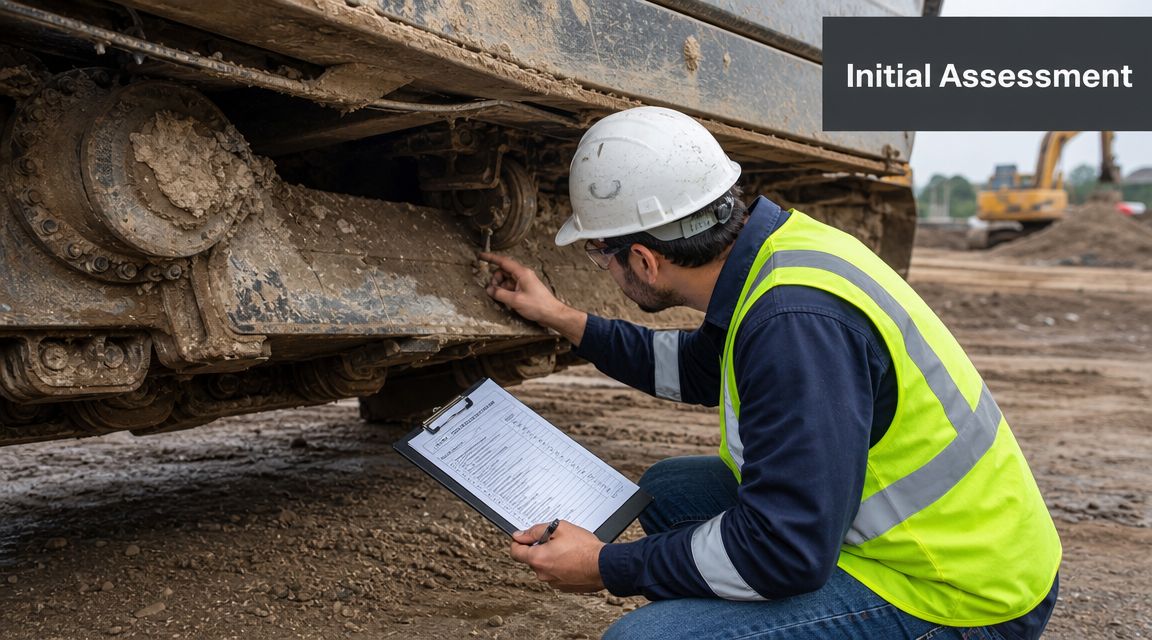
The most reliable workflow is straightforward. Measure the machine's exact dimensions and mass, match it to a compliant trailer, check route constraints, secure permits, and complete pre-trip inspections. Guidance on route planning also notes that the most common failures come from skipped permit checks and underestimated route restrictions (route planning workflow).
Start with the machine, not the truck
A lot of transport problems begin because someone uses brochure specs instead of actual transport measurements. That's risky. Buckets, rippers, mud, attachments, stick position, handrails and fuel levels can all affect the transport profile.
Before booking anything, confirm:
- Overall width: Include tracks, tyres and any protrusions in transport position.
- Transport height: Measure it as it will sit on the chosen trailer, not just standing on the ground.
- Overall length: Include attachments if they're staying fitted.
- Operating mass: Use the complete machine setup, not the base machine only.
If the dimensions are close to a legal limit, small errors matter. A machine that was “about right” in the yard can become a permit issue once it's loaded.
For builders who don't move plant every week, plant hire options and transport planning need to talk to each other early. The machine you choose affects the trailer, the route, and sometimes whether the move is practical at all for that site.
Check the pickup and drop-off like a supervisor would
The second half of the assessment is the site. Clients often underestimate the job at this stage.
A machine might travel legally on the road and still be difficult to load or unload if the site has soft ground, steep entries, poor turning room or overhead obstacles. On the Central Coast, sandy coastal areas can make the unloading zone less stable than it looks. In older Sydney streets, the issue may be driveway angle and kerb clearance. In rural Hunter Valley locations, the problem is often gate alignment and room for a low loader to swing in.
A useful pre-move check looks like this:
| Item | What to confirm | Why it matters |
|---|---|---|
| Entry width | Gates, fences, parked cars, verge space | Prevents trailer access failure |
| Ground condition | Wet soil, sand, fill, loose gravel | Affects safe loading and unloading |
| Overhead constraints | Trees, powerlines, site sheds | Limits safe movement |
| Turning space | Street corners, cul-de-sacs, internal haul roads | Determines whether the trailer can position correctly |
If the destination area can't safely take the truck and machine together, the move isn't solved yet. It's only been booked.
Good pre-move assessment doesn't slow the job down. It prevents the expensive kind of delay that happens with a truck standing by, a crew waiting, and no safe way to finish the unload.
Choosing Your Haulage Method and Trailer
The right trailer does more than carry the weight. It controls loading angle, travel height, axle distribution and how much room you need at both ends of the trip.
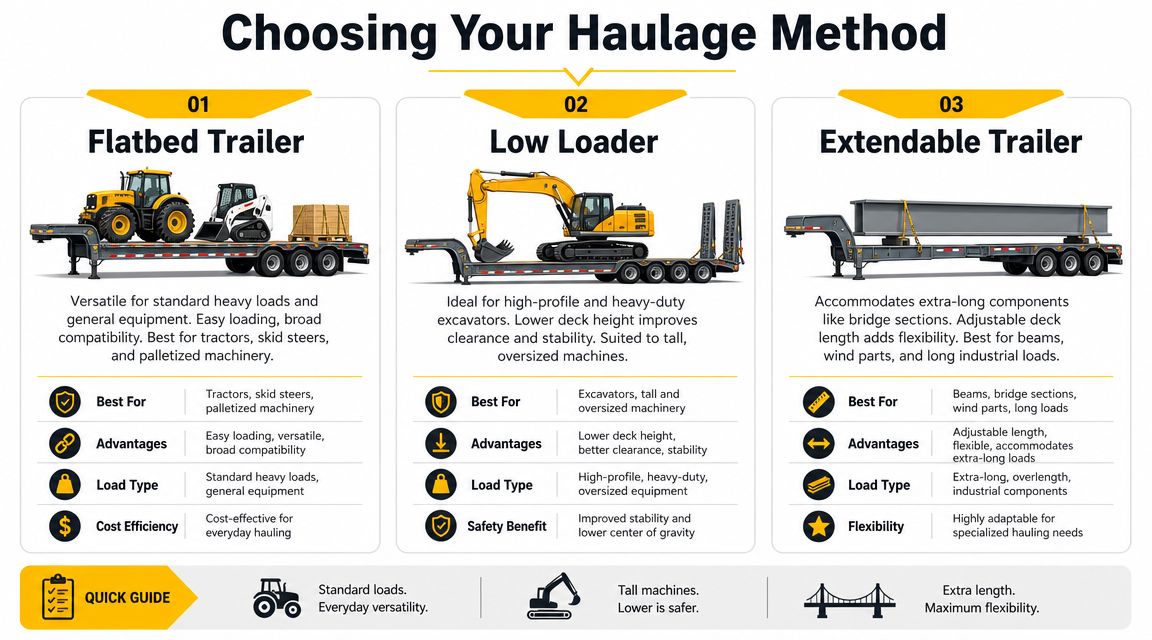
A lot of people use trailer names loosely, but the differences matter on site. A tilt tray, super tilt, low loader and extendable trailer all solve different problems. Choosing the wrong one can create a height issue, a bad ramp angle, or an unload that won't work in a tight street.
What each trailer type is really for
A tilt tray suits smaller machines and straightforward access. Think mini excavators, skid steers, small rollers or site support gear heading to a landscaping or residential job in Gosford, Wamberal or Erina. It's practical when loading needs to be quick and the machine isn't pushing transport limits.
A super tilt helps when you need a lower loading angle or a bit more flexibility with awkward plant. It can be useful where a standard tilt tray is borderline on clearance or ramp transition.
A low loader is the workhorse for larger excavators, loaders, compactors and civil plant. Its lower deck helps keep overall transport height down, which is often the difference between a viable route and a permit headache.
An extendable trailer comes into play when length becomes the issue. That may be for plant with long attachments, oversized components, or site equipment that won't fit a standard platform cleanly.
Match the trailer to the site, not just the machine
The machine spec sheet only tells half the story. A trailer also needs to suit where it's loading and unloading.
Consider this quick comparison:
| Trailer type | Best fit | Common limitation |
|---|---|---|
| Tilt tray | Smaller plant, easier metro deliveries | Less suitable for larger or taller machines |
| Super tilt | Plant needing better ramp geometry | Still limited for major heavy haul work |
| Low loader | Heavier and taller machinery | Needs more room to manoeuvre |
| Extendable | Long or awkward loads | More planning for turns and route access |
Let's say you're sending a skid steer into a tight residential excavation near Terrigal. A smaller tray truck may be the cleaner answer because the street layout matters as much as the load. On a larger Newcastle or Hunter job with a heavier excavator, a low loader usually makes more sense because deck height and axle setup become the priority.
That same logic applies to access-focused work. If you're dealing with confined entries or awkward site geometry, it helps to understand the same constraints that apply in tight access excavation work. The transport method has to respect the physical site, not just road legality.
Insurance matters here too. If you're reviewing carrier credentials, it's worth understanding what proper insurance for heavy haul companies is meant to cover, especially when the load is high value or the route has more risk than usual.
One practical option for projects that need both plant and coordinated site works is Booms Up Civil Group, which provides civil contracting, haulage and plant-related support across the Central Coast, Newcastle, Sydney and the Hunter. The key point isn't branding. It's that the transport provider and the site works team need to work from the same access and programme assumptions.
Navigating NSW Permits and Escort Requirements
Most clients only start thinking about permits when someone says the machine is too wide, too high or too heavy to move as a standard load. By then, time is already tighter than it should be.
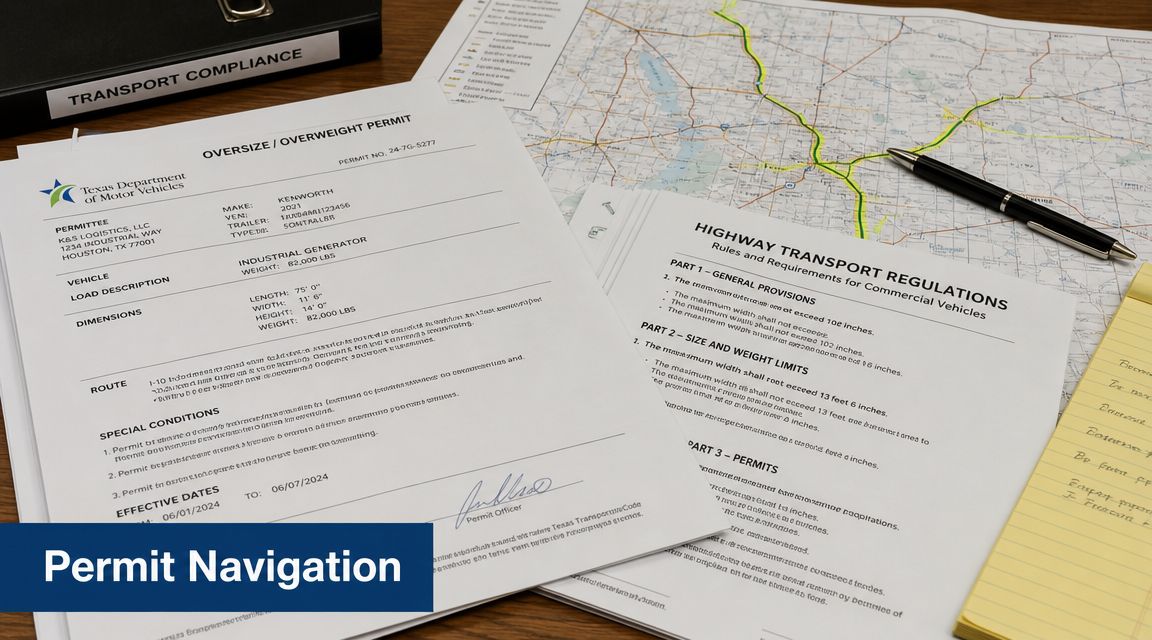
In plain terms, if your load exceeds standard legal access conditions, you may be dealing with an oversize or overmass move. That changes the job from a normal truck booking into a regulated movement with route conditions, paperwork, possible escorts and specific travel windows.
What usually triggers extra approvals
A practical example is a wide-track dozer heading into a Sydney or Newcastle job. Even if the machine can be loaded safely, legal road access may still depend on the route, time of travel and whether escort vehicles are required.
Permit planning usually involves checking:
- Load dimensions and mass: These determine whether the move can travel under notice conditions or needs a permit.
- Trailer configuration: Axle setup and load placement affect compliance.
- Approved route access: Some roads, bridges or local approaches may not allow the move.
- Travel restrictions: Urban movements may face time-of-day limits or local access constraints.
This is why lead time matters. The permit decision doesn't sit in isolation. It depends on the route, the combination, and the authority conditions that apply to the roads you need to use.
Escort vehicles are part of the safety plan
Pilot and escort vehicles aren't decoration. They exist to protect the public, guide the load through problem areas and help manage road positioning where a standard vehicle envelope no longer applies.
That becomes more important in dense areas. North Sydney, inner-west corridors, industrial parts of Newcastle, and constrained links around local centres can all introduce issues with lane width, turning paths, parked vehicles and temporary works. Council conditions can also affect access around local roads and crossings, especially where verge damage or crossover geometry is a concern. If that's relevant to your site, vehicle access crossing requirements are worth checking early because the road interface often shapes the unloading plan.
Site lesson: A permit doesn't mean every part of the trip is simple. It means the move is allowed only under stated conditions.
The main mistake is leaving permits until the machine is already committed to site. Once your earthworks, demolition, retaining wall crew or concrete preparation is booked, any hold-up in transport starts affecting everyone else.
Clients often assume the issue is truck capacity. In NSW, the bigger issue is usually access approval. A machine can be easy to haul physically and still difficult to move legally.
Route Surveys Scheduling and Real-World Costs
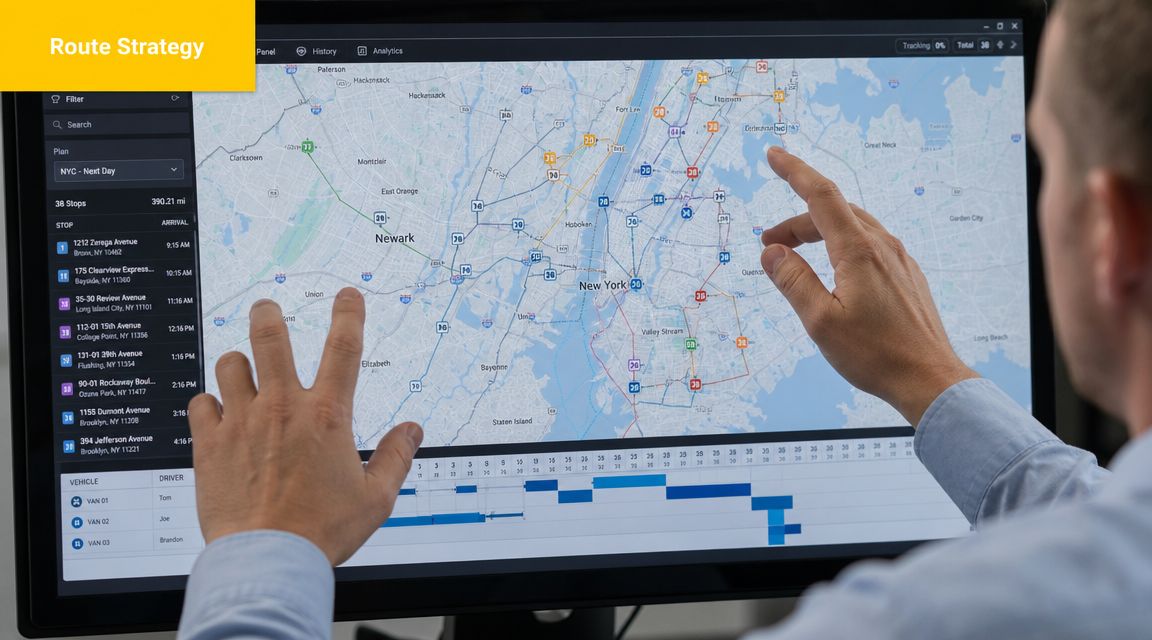
The shortest route is often the wrong route. In heavy machinery transport, the best route is the one that gets the machine there safely, legally and without blowing out the programme.
That's where route surveys earn their keep. They pick up the problems that don't show on a quick map search. Low clearances, weak bridges, tight roundabouts, school zones, narrow regional approaches, roadworks and poor shoulder conditions can all force a change.
Why route choice affects more than freight
A commonly missed issue is project feasibility. In NSW, oversize and overmass movements run under strict, route-specific access conditions, and those conditions can trigger detours, escort requirements and time-of-day restrictions that materially change schedules and costs (route-specific transport constraints).
That matters on real jobs. A detour doesn't just add driving time. It can shift delivery outside your planned site window, push unloading into a busier traffic period, or force another trade to stand down while the machine arrives late.
For example, a builder in western Sydney may allow for a morning delivery, only to learn the approved access window sits outside that plan. A regional move into the Hunter may be simpler on traffic, but longer in distance and more exposed to road condition changes after rain. Both affect labour sequencing.
The quote covers planning, not just the tray
Transport pricing changes with complexity, and that complexity is often invisible to clients at the start.
Here's where costs usually move:
- Detours and access limits: Longer compliant routes mean more truck time.
- Escort and permit conditions: These can add coordination and waiting time.
- Staged delivery planning: Some sites need the machine moved in a different sequence from what the builder expected.
- Traffic windows: Metro moves may need off-peak scheduling, which can affect the rest of the day's work.
A route survey also helps answer a more useful question than “Can you move it?” The better question is “Can you move it in a way that still suits the project?”
A cheap transport booking can become the expensive option if it arrives at the wrong time, on the wrong trailer, with no workable unload plan.
Transport and earthworks planning need to stay joined up. If your broader site programme includes excavation, spoil removal, fill import or multiple machine movements, it helps to look at the whole logistics picture, not just the single trip. That's the same thinking behind choosing the right earthmoving contractor near your site, because the machine move is only one part of site productivity.
Weather also changes the equation quickly. NSW jobs can lose time not just to rain, but to soft entries, flooded detours, and rescheduled unloads where the site can no longer safely support the truck. Good planning leaves room for that reality.
The Critical Steps of Loading Securing and Unloading
This is the part people notice when it goes wrong. Loading and restraint failures are visible, dangerous and expensive. They also tend to come from very ordinary mistakes, such as poor positioning, rushed checks, worn gear or a machine loaded on unsuitable ground.
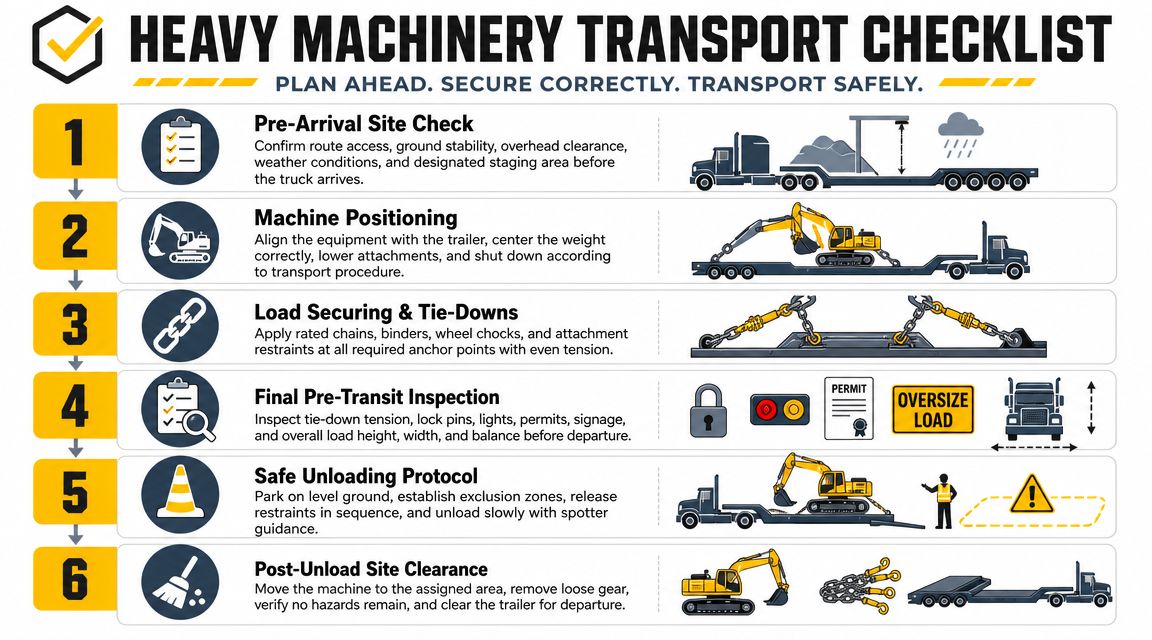
Safe loading starts before the machine climbs the ramps. The trailer needs stable ground, enough room, and a clear path. The machine should be free of loose material that can drop on the road or shift during travel.
Loading position matters as much as the restraints
One of the most overlooked issues is machine position on the deck. If the excavator or loader sits badly, axle loads can become the actual compliance problem even when the tie-downs look fine.
For heavier machines, restraint should be treated as an engineering check, not just a habit. A practical benchmark for machinery over 4.5 tonnes is restraint at all four corners plus an additional restraint over moving parts such as a boom, with the combined restraint strength equalling at least 50% of the machine's total weight (load securement benchmark).
That benchmark helps because it forces the right questions. Are the chains or straps rated correctly? Are the tie-down angles working properly? Has the boom or attachment been dealt with separately? Has the machine been placed far enough forward to load the trailer correctly without overloading axles?
A clean handover prevents damage and disputes
This video gives a useful visual reference for the kind of checks that matter on real transport jobs.
Loading and unloading should run to a simple discipline:
- Prepare the area: Use level ground where possible, remove debris, and control site traffic.
- Position the machine carefully: Keep attachments in the transport position and align properly on the deck.
- Apply rated restraints: Match the restraint method to the machine and the movement risk.
- Complete a final walk-around: Check chains, binders, boom position, tyre or track placement, and any loose gear.
- Unload to a prepared zone: Confirm the destination area is stable and clear before release.
- Inspect after unload: Look for movement, damage, leaks or site hazards before the machine goes to work.
On-site reminder: The unload area needs the same attention as the pickup point. A perfect trip can still end badly on soft fill or a rushed site handover.
There's also a legal and insurance side to this. If you want a plain-English explanation of what can sit inside a freight claim after damage or loss, this guide to cargo liability is a useful reference when reviewing transport risk.
In NSW, good operators also work in line with SafeWork NSW expectations, the National Transport Commission load restraint approach, and the broader chain of responsibility mindset. In practical terms, that means nobody gets to ignore a bad load just because the truck is already on site.
Get Your Machinery Moving Right the First Time
Heavy machinery transport looks simple from the outside. It's a truck, a machine and a destination. On a real NSW project, that's never the full story.
The move only works when the details line up. Machine dimensions, trailer choice, permit triggers, route constraints, weather, escort needs, loading method and site access all affect whether the machine arrives on time and ready to work. If one part is missed, the transport delay usually turns into a project delay.
That's why planning is an investment, not overhead. It protects programme certainty, reduces rework, and lowers the chance of damage, non-compliance or a failed unload in the middle of a busy site. If you want extra reading on restraint fundamentals from a training angle, HGV Learning's transport advice is a useful companion to the practical points above.
If you're moving plant across the Central Coast, Sydney, Newcastle or the Hunter Valley, get the transport plan sorted early. The jobs that run smoothly usually do.
If you want a practical second opinion on an upcoming machinery move, Booms Up Civil Group can help you assess site access, haulage requirements and likely compliance issues before the truck is booked. Call, email or send through your machine and site details for an obligation-free discussion. It's a straightforward way to avoid surprises and get the move organised properly from the start.