

You're probably here because a job is about to start. Maybe it's a shop fit-out in Gosford, upgrades to a strata block in Newcastle, or civil works on a commercial site in western Sydney. The skip bin is booked, the trades are lined up, and someone's asking when demolition or drilling can begin.
Before any of that, the first serious question is simple. Do you have an asbestos register, and is it current?
For NSW property owners, builders, strata managers, and contractors, that document often decides whether work starts smoothly or stops at the gate. A proper asbestos register nsw process isn't just about ticking a compliance box. It helps you avoid disturbing hidden asbestos-containing materials, protects workers, and prevents the kind of delay that costs real time and money once a site is already moving.
Starting a Project in NSW? Your First Check is Asbestos
A common scenario goes like this. A property owner on the Central Coast is getting ready to refurbish an older commercial building. The plan sounds straightforward enough. Remove some wall linings, open a service trench, upgrade plumbing, patch concrete, and keep tenants informed while the works move through.
Then the right question gets asked. Was the building put up in the era when asbestos was commonly used, and if so, where is the register?
That's the point where a lot of projects either stay controlled or become messy. If the asbestos record is clear and available, contractors can plan around it. If it's missing, outdated, or buried in someone's office file, even routine works like drilling, cutting, or accessing old service penetrations can become a risk.
The system in NSW isn't just a relic from older building stock. The NSW Government created the Loose-fill Asbestos Insulation Register to track affected homes, and Safe Work Australia confirms asbestos registers are a formal workplace health and safety control, which shows this is an active compliance system rather than a historical archive, as outlined in the Loose-fill Asbestos Insulation Register dataset.
If you're still at the stage of working out what material you may be dealing with, it helps to understand the basics of how to identify asbestos sheeting before anyone starts poking into old linings or eaves.
Practical rule: If the site is older and people are about to disturb building fabric or ground around old structures, check the asbestos position before you check the construction program.
That approach is what keeps a manageable project manageable.
What Is an Asbestos Register and Why Does It Matter?
An asbestos register is a formal record of asbestos-containing materials in a workplace, or materials that are presumed to contain asbestos. In plain terms, it's the site's hazard map for a risk you often can't spot just by walking around.
If a sparky is chasing a cable through an old switch room wall, or an excavator operator is breaking out around a footing beside an older structure, they need more than a verbal warning. They need a document that tells them what's there, where it is, and what condition it's in.
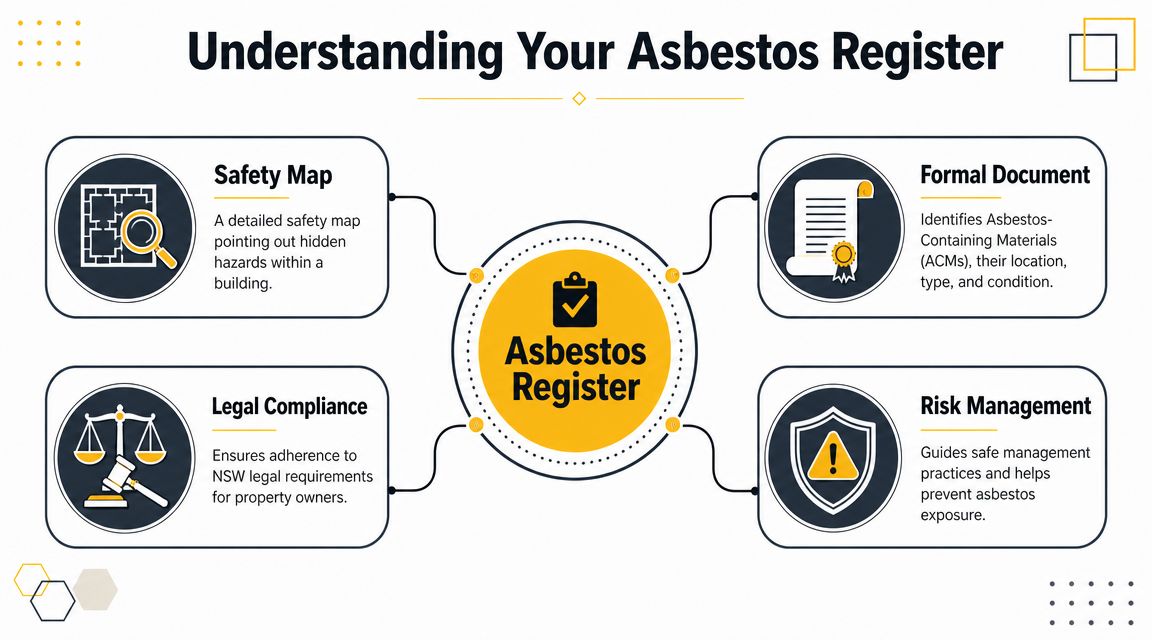
Think of it as a site safety map
On a live site, hidden risks cause the biggest trouble. You can see an open trench. You can barricade a drop-off. Asbestos is different because workers often disturb it while doing normal tasks.
That's why the register matters. It lets the people doing the work make decisions before they start. Not after the dust is already in the air.
A useful register usually answers these practical questions:
- Where is the material in the building or work area
- What is it likely to be or what has been identified
- What condition is it in and how easily might it be disturbed
- What work needs extra controls before it proceeds
If you're comparing material types, the difference between bonded products and higher-risk materials matters. This guide on friable asbestos vs non-friable is worth reading because that distinction affects how work is planned and who can remove it.
Why owners and contractors both rely on it
Property owners sometimes assume the register is mainly for compliance. On paper, yes, it's part of your WHS duty. On site, though, it's a coordination tool.
Without it, the builder guesses. The demolition crew gets cautious and slows down. The plumber refuses to core a wall. The electrician asks for more invasive investigation. That all costs time.
The best asbestos register nsw documents aren't long for the sake of it. They're clear enough that a contractor can stand in front of a wall, ceiling void, riser or plant room and know what they're dealing with.
That's why a register has value even before any asbestos removal is discussed. It helps people choose the right method, sequence works properly, and avoid unnecessary disturbance.
Do You Legally Need an Asbestos Register in NSW?
For most NSW workplace sites, the answer turns on one date. Safe Work Australia's guidance says workplaces built before 31/12/2003 are generally required to have an asbestos register under the model WHS Regulations, with different treatment for newer workplaces because asbestos was phased out of construction materials after that date, as set out in the Safe Work Australia asbestos registers guide.
That date matters because it gives owners and contractors a clear starting point. If you're dealing with an older office, warehouse, retail tenancy, workshop, school facility, government building, or the common areas of a multi-occupancy residential building, you should treat the asbestos question as part of your first due diligence.
Who holds the duty
In NSW, the duty usually sits with the person with management or control of the workplace, often referred to as the PCBU in WHS language. Depending on the site, that could be:
- The building owner who controls the premises
- A landlord or facilities manager responsible for workplace areas
- A strata body or strata manager where common areas are part of the workplace environment
- A tenant if they control the area where work is taking place
The practical test is less about title and more about control. If you control the site where people work, you likely carry the duty to make sure the asbestos information is there and usable.
Which properties are commonly caught
For NSW projects, this most often affects older:
| Property type | Typical issue |
|---|---|
| Commercial buildings | Ceiling tiles, wall linings, service risers, plant rooms |
| Warehouses and factories | Roof sheeting, wall cladding, insulation around services |
| Strata common areas | Meter rooms, foyers, carparks, service ducts |
| Government and institutional sites | Older fit-outs, pipe lagging, backing boards |
Private homes sit a bit differently. A standard standalone house isn't automatically treated the same way as a workplace, but once contractors are engaged and work starts, asbestos risk still becomes a live issue that needs proper management.
If the project is moving toward strip-out or knockdown, it also helps to understand where asbestos planning intersects with approvals and site controls. This guide on a demolition licence in NSW gives useful context.
A short overview can help if you want to hear the legal side explained in plain language:
If your Newcastle warehouse, Sydney shopfront, or Central Coast strata block predates 31/12/2003, don't leave the register question until trades are on site. By then, you're already late.
What Must Be Included in a Compliant Asbestos Register
A compliant register isn't just a note saying “asbestos present”. It has to be detailed enough to help someone work safely. SafeWork NSW requires the register to record whether asbestos is identified or assumed, along with the date of identification, its location, type, and condition. It also needs to note when no asbestos has been identified, as explained in the SafeWork NSW asbestos registers and management plans fact sheet.
The information that needs to be there
Think about a contractor arriving on an older Hunter Valley workshop site to cut a new opening through a wall. “Possible asbestos somewhere in shed” is useless. A compliant entry needs enough detail to guide a work method.
Here's what that usually looks like.
| Required Information | What It Means | Example |
|---|---|---|
| Whether asbestos is identified or assumed | States if the material has been confirmed or treated as asbestos until proven otherwise | Assumed asbestos-cement wall sheeting |
| Date of identification | Shows when the material was recorded or reviewed | Identified during survey on the listed inspection date |
| Precise location | Tells workers exactly where the material is | North-west internal wall of warehouse, adjacent to roller door |
| Type | Describes the material or product | Asbestos-cement sheet, backing board, pipe insulation |
| Condition | Notes whether it is stable, damaged, sealed, or deteriorating | Stable with minor cracking near fixing points |
Why detail changes site decisions
Owners sometimes underestimate the value of a good register. The wording affects how the next contractor plans the job.
For example, “eaves contain asbestos cement in stable condition” points the team toward caution during access and drilling. “Damaged lagging to services in plant room” points toward stopping ordinary works and getting specialist advice before anyone proceeds.
If your project involves enabling works, excavation, or structural strip-out, the register should also be visible to the crews coordinating demolition and access. That's especially important on mixed sites where building fabric and earthworks overlap. For works of that kind, understanding how demolition and excavation services fit together helps avoid one trade creating a problem for the next.
A clear register also records a negative finding
This point gets missed often. If no asbestos has been identified, the register still needs to say so.
That matters because contractors need documented confidence just as much as they need warnings. On a newer build in places like Erina, Charlestown, or the Hills District, a clear “no asbestos identified” entry can prevent unnecessary destructive investigation and keep the work moving.
A weak register creates doubt. A strong register creates decisions.
How to Create and Manage Your Asbestos Register
Creating an asbestos register nsw document starts with the right inspection. This isn't a casual walk-through by a handyman or a note from a previous contractor. You need a competent person to assess the site properly and document what's identified or presumed.
The process is straightforward when it's done in the right order.
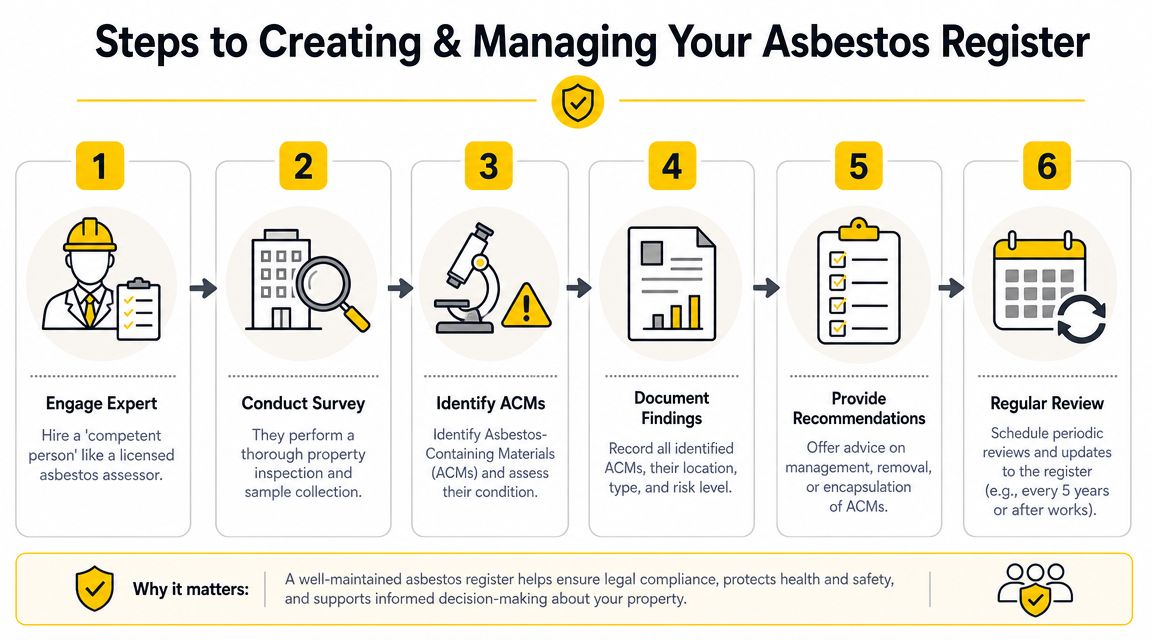
Start with a proper survey
A competent assessor inspects the building, reviews accessible areas, and identifies materials that are known or likely to contain asbestos. Depending on the situation, they may recommend sampling and testing where visual identification alone isn't enough.
That part matters because old sites around Sydney, Newcastle, and the Central Coast often have layered renovations. A wall might have modern plasterboard over an older lining. A plant room may have services added at different times. A quick glance doesn't tell the full story.
A sensible process usually follows this sequence:
- Inspect the site carefully and identify suspect materials.
- Record exact locations so the information works for contractors later.
- Assess the condition of each material and how likely it is to be disturbed.
- Prepare the register in a format that can be kept on site and read easily.
Keep it live, not forgotten
A register only helps if people can access it and trust it. SafeWork NSW requires the person in control of the workplace to keep the register at the workplace, keep it current, and hand it to the next controller when management changes, with the register recording the location, type and condition of identified or assumed asbestos, as outlined in the earlier SafeWork NSW fact sheet.
In practice, that means:
- Store it where site staff and contractors can get it before starting work
- Update it after changes such as removal, enclosure, damage, or new findings
- Transfer it during handover if ownership, leasing, or management control changes
If the register sits in an inbox no one can access from site, it isn't doing its job.
What works and what doesn't
What works is a register tied into site induction, contractor sign-in, and pre-start planning. On better-run sites, supervisors know where it is, contractors are told to check it, and any work near identified materials is planned around it.
What doesn't work is relying on memory. It also doesn't work when owners assume an asbestos survey from years ago is still accurate after repeated tenancy changes, minor works, moisture damage, or partial removal.
Keep the register where the work happens, not where the paperwork happens.
That simple habit prevents a lot of avoidable problems.
When the Register Says Yes to Asbestos What Next?
Finding asbestos in the register doesn't mean the project falls apart. It means the project needs controls. That's a big difference.
The first step is to look at the material's condition and whether the planned works will disturb it. If it's in sound condition and won't be touched, it may be managed in place under proper site controls. If the job involves demolition, cutting, excavation beside old structures, or invasive refurbishment, the answer is often removal before the main works begin.
Treat the register as the trigger for action
Consider a Terrigal or Newcastle scenario. The register shows asbestos-containing wall sheeting in an area where new services need to be chased in, or asbestos around old service penetrations where demolition access is planned. At that point, the right move isn't to “work carefully around it” and hope for the best.
The right move is to stop ordinary works, assess the scope, and bring in the properly qualified people for the next step.
That may involve:
- Labelling and isolating the area where practical
- Using an asbestos management plan if the material will remain in place
- Arranging licensed removal before any disturbance occurs
- Sequencing civil or demolition works after clearance, not before
If you want a plain-English outside perspective on what to do once asbestos appears in survey findings, this asbestos report advice from Survey Merchant is a useful companion read.
Why early action saves money later
Delays caused by asbestos usually aren't caused by the asbestos itself. They're caused by discovering it too late.
When removal is planned early, the builder can sequence trades properly, the owner can budget for the right controls, and site access can be staged cleanly. When asbestos is found after demolition starts, everything becomes reactive. Labour stands around. Plant sits idle. Supervisors start rearranging the week.
If you're trying to understand how disruption flows into the wider job cost, this guide to a demolition cost calculator in Australia helps show why pre-start planning matters.
The register doesn't finish the job. It starts the right one.
Frequently Asked Questions About NSW Asbestos Registers
A lot of owners ask the same handful of questions, especially when they're dealing with an older property for the first time. The answers are usually simpler than people expect.
Quick answers that matter on site
| Question | Answer |
|---|---|
| Does every old building in NSW need an asbestos register? | The main trigger for workplaces is whether the building was constructed before 31/12/2003. The duty is tied to workplace control, not just the age of the structure on its own. |
| Who should be able to see the register? | Workers and contractors who may be affected by the information should be able to access it before they start work. If they can't see it, they can't plan safely. |
| What if no asbestos is found? | The register should still record that no asbestos has been identified. That gives contractors a documented basis for choosing a work method. |
| Is an asbestos register the same as removal approval? | No. The register identifies and records asbestos risk. If work will disturb asbestos, further management or removal steps are needed before the main job proceeds. |
A few practical points owners often miss
Older strata properties across Sydney and Newcastle often focus on residential units and forget about common areas. That's where the asbestos question tends to catch committees out, especially in meter rooms, service cupboards, foyers, and older carpark areas.
Renovation planning also trips people up. A register might exist, but if it's stale, incomplete, or doesn't reflect later alterations, contractors still won't rely on it confidently.
Good compliance feels organised before work starts. Bad compliance feels like a scramble after someone opens a wall.
If you're unsure, treat uncertainty as a sign to check the document properly rather than pushing ahead.
If you're planning site works and need practical guidance around demolition, excavation, or safe project sequencing, Booms Up Civil Group can help you assess the site conditions early and coordinate the next steps properly. We work across the Central Coast, Newcastle, the Hunter Valley and Sydney, and we're happy to have a straightforward conversation about what your project needs before work begins.