

Ever wondered how a swimming pool gets dug in a terraced backyard? Or how builders lay the foundations for an extension when it’s wedged tightly between two existing houses? That’s exactly the challenge that tight access excavation is designed to solve. It’s a highly specialised field of earthmoving, focused on working in confined spaces where standard machinery simply can’t fit or operate safely.
So, What Is Tight Access Excavation Anyway?
Think of tight access excavation as surgical work for your property. It’s far more than just using smaller machines; it’s a complete methodology for navigating narrow side paths, steep blocks, and tricky areas with minimal clearance. These conditions are incredibly common across the Central Coast and in Sydney’s dense suburbs, where every square metre counts.
Often, this expert service is the only way to unlock your property’s true potential when space feels like an insurmountable barrier. It’s essential for any project where the entry point is restricted, whether that’s a laneway less than two metres wide, a standard garden gate, or even the cramped space underneath an existing deck. Without the right approach, these projects would either be impossible or force you into relying on incredibly costly and time-consuming manual labour.
Defining a ‘Tight’ Site
So, what actually qualifies as “tight access”? While there’s no single definition set in stone by SafeWork NSW, in our 15+ years of hands-on experience on the Central Coast, it almost always involves one or more of these classic constraints:
- Narrow Entry Points: Access paths, gates, or laneways under 1.8 metres wide are a dead giveaway. We’ve squeezed machinery through spaces barely wider than a standard doorway to get the job done.
- Low Overhead Clearance: This is a big one. It includes working under carparks, beneath the canopies of established trees, or near low-hanging power lines, all of which severely restrict the height of any equipment we can bring in.
- Steep or Unstable Ground: Consider this scenario: a challenging block in Terrigal or a sloping site in Kariong needs more than just a small machine. It requires equipment with exceptional stability and traction to operate safely and effectively.
- Proximity to Structures: When you’re digging within centimetres of your home’s foundation, a neighbour’s fence, or sensitive underground utilities, there is zero room for error. This demands absolute precision to prevent hugely expensive damage.
Getting a handle on these factors is the crucial first step in mapping out a successful project. For a deeper look into the specific challenges these sites present, you can find more detail on our approach to difficult access excavation.
Ultimately, this discipline combines advanced, compact machinery with highly skilled operators who can perform intricate work safely and efficiently. It’s about turning a logistical nightmare into a straightforward project and being able to say “yes” when plenty of others would say it simply can’t be done.
The Specialised Equipment for Precision Work
Successfully navigating a tight space demands more than just a small digger. It calls for a purpose-built toolkit designed for absolute precision and the protection of your property. This isn’t about brute force; it’s about using the right machinery to perform intricate work without leaving a mark on your home, garden, or driveway.
The cornerstone of any tight access excavation is the mini excavator. These are compact yet surprisingly powerful machines, engineered to operate where others simply can’t. Many models feature a zero-swing or minimal-swing radius, which means the machine’s body doesn’t extend beyond its tracks when rotating. This is a game-changer, allowing us to dig right up against a building or fence on a narrow Central Coast block without the constant risk of accidental impact.
Of course, digging is only half the job. Once the soil is out of the ground, it needs to be moved efficiently. This is where compact loaders and tracked dumpers come into their own. These machines are narrow enough to fit through standard garden gates, perfect for transporting material from an enclosed backyard in a Newcastle suburb out to a truck on the street. Their rubber tracks are a non-negotiable feature, distributing weight evenly to protect your concrete driveway, pavers, and precious lawn from damage.
Tools for Every Unique Challenge
Different scenarios call for different tools. For instance, safely exposing underground pipes or cables in an established area requires a delicate touch, not a heavy hand. This is where vacuum excavation (or non-destructive digging) becomes essential. It uses high-pressure water and a powerful vacuum to carefully remove soil without risking a costly and dangerous utility strike—a critical technique when working around services in dense Sydney neighbourhoods.
The versatility of our equipment is pushed even further by a wide range of attachments. From augers for drilling pier holes to rock hammers for breaking through stubborn Sydney sandstone, having the right gear on hand is everything. You can get a better sense of how these attachments transform our machinery by exploring our detailed guide to excavator attachments. It’s also useful to see the range of top construction tools available for these specialised jobs.
To help you visualise whether your project might need this specialised approach, we’ve put together a simple decision-making flowchart.
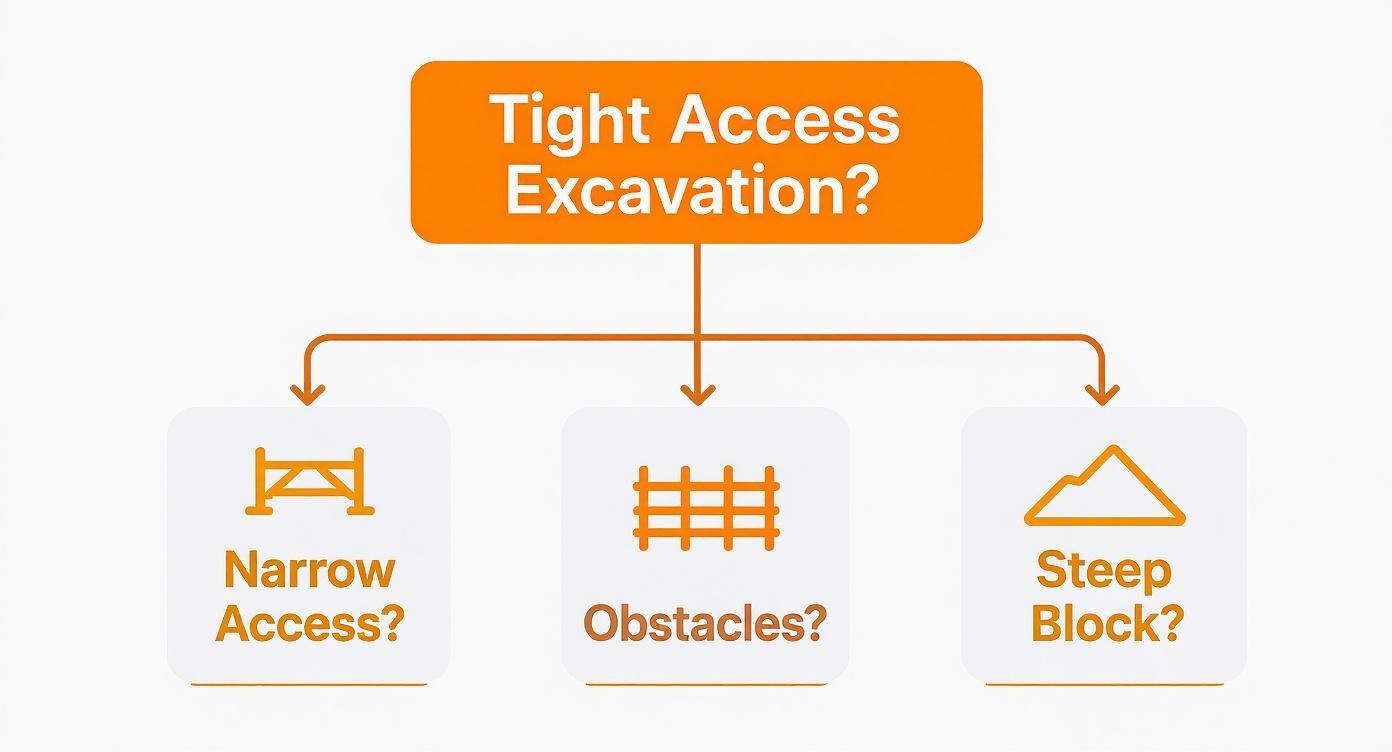
This visual guide helps clarify that factors like narrow entry points, existing obstacles, or a sloping site are clear indicators that specialised tight access solutions are necessary. Ultimately, it’s about having a complete system—from the excavator to the final clean-up—that gives you peace of mind that your property is in safe, capable hands.
Common Projects That Need Tight Access Solutions
Tight access excavation isn’t some obscure, specialist service—it’s the secret weapon behind a surprising number of everyday residential and commercial jobs. This is where the rubber hits the road, showing you exactly how the right gear and a skilled team can solve those frustrating “how do we even get in there?” problems. Frankly, many projects just wouldn’t get off the ground without it.
Let’s say you’re adding a granny flat to your backyard in Gosford. The only way to get equipment to the site is down a skinny 1.2-metre path alongside the house, squished right up against your neighbour’s fence. That’s a textbook tight access job. It’s the perfect scenario for our mini excavators to sneak in, dig the foundations, and trench for services with surgical precision—no fences harmed in the process.
Backyard Transformations and Essential Upgrades
Some of the most popular home improvement projects you see across the Central Coast and Hunter Valley are completely reliant on our ability to work in tight corners. We deal with these situations every single day.
A classic example is putting in a new swimming pool or even pool removal. When your backyard is already a beautiful, established space, the last thing you want is a big machine tearing up your driveway and landscaping just to dig a hole. Our specialised equipment is designed to navigate those existing obstacles, carefully removing soil and prepping the site for the pool builders with minimal fuss. The same goes for getting rid of old pools, where we have to break up and haul out tonnes of concrete from a completely enclosed space.
Consider this scenario: A client in a tight Newcastle terrace house needed to remove an old, cracked concrete pool. With no rear lane, the only way in was through a standard side gate. Our mini excavator squeezed through, broke up the pool with a hammer attachment, and loaded the rubble into small dumpers that ferried it back and forth to a truck on the street. Problem solved, with almost zero disruption to the property.
Foundations, Trenching, and Landscaping
It’s not all pools and granny flats, though. Our tight access services are the backbone for a huge range of other essential works. Think about digging foundations for a home extension, where we’re often working just centimetres away from the existing building. Or detailed trenching for new plumbing and electrical lines, weaving through established gardens and under pathways without turning your whole yard into a demolition site.
For properties on tricky, sloping blocks—like you see all over beautiful but challenging places like Terrigal—our equipment is what makes ambitious structural landscaping possible. We can carve out level tiers for garden beds, excavate for retaining walls, and precisely shape the land on sites where larger machines would be either dangerous or physically unable to fit. These tight access excavations are fundamental to unlocking the true potential of even the most difficult properties.
Why a Specialist is Your Best Investment
Hiring a contractor for tight access excavation isn’t just another line item on your project budget; it’s essential insurance for your property. While a general earthmover might own a small machine, a true tight access specialist brings a completely different level of skill, experience, and precision to the job. It’s the critical difference between getting the work done and getting it done right.
Operating machinery within centimetres of your home’s foundations, established gardens, or underground services demands immense skill and focus. A tiny miscalculation by an inexperienced operator can lead to thousands of dollars in damage, from a cracked retaining wall to a severed water main. A specialist understands it’s not about speed; it’s about a steady, methodical approach that protects your assets at every single stage.
Beyond Just the Digger
A specialist’s expertise goes far beyond just driving the machine. It involves a deep understanding of site logistics and how to protect a property, which has become non-negotiable as our suburbs get more crowded. To prevent property damage, a professional team will have a complete system in place.
This includes using heavy-duty ground protection mats to create temporary roadways over your lawn or driveway, preventing ugly ruts and cracks. We also establish clear worksite isolation and exclusion zones, which are crucial for complying with SafeWork NSW regulations and keeping everyone on-site safe from harm. This is a key thing to check for when hiring a contractor.
Managing Complex Logistics Safely
One of the biggest headaches in tight access jobs is figuring out what to do with all the excavated material. Imagine trying to efficiently remove tonnes of soil from an enclosed backyard in a Newcastle suburb without making a colossal mess.
A specialist has this process down to a fine art. We use a coordinated system of mini-dumpers and careful scheduling to move spoil out to a truck on the street with minimal disruption to you and your neighbours.
A generalist might see a narrow gate and a backyard. A specialist sees the precise turning radius of the excavator, the load capacity of the ground surface, the location of underground services, and the safest path for material removal.
Ultimately, investing in a specialist is about foresight and managing risk. With over 15 years of experience on the Central Coast, we’ve seen nearly every potential pitfall and know exactly how to avoid them. We see problems before they happen, protect your home and garden, and make sure the job is done correctly the first time. This approach prevents the costly mistakes and frustrating delays that can derail a project. Before you make a decision, it’s worth reviewing some key questions when considering excavation companies near you.
How to Prepare for Your Tight Access Project
A successful tight access excavation starts long before the first scoop of dirt is moved. Getting your Central Coast site ready is a team effort, and a bit of prep work from you can make all the difference. It helps us map out a precise strategy, sidestep any nasty surprises, and get your project underway smoothly from day one.
The absolute first thing to do is get a crystal-clear picture of your access path. We need to know the measurement of the narrowest point between the street and where the work needs to happen. So, grab a tape measure and physically walk the route our machinery will have to take, keeping a sharp eye out for any potential bottlenecks.
Checking Your Clearances
Think in three dimensions here: width, height, and the corners. You’ll want to jot down anything and everything that could get in our way. The access requirements will determine what equipment size is possible.
- Width Obstacles: Look for the obvious stuff like air conditioning units, hot water systems, or gas meters. Even fixed garden taps can stick out just enough to cause a problem.
- Overhead Obstacles: Don’t forget to look up! Eaves, carparks, pergolas, and low-hanging tree branches are common culprits. Also, check for any overhead power or communication lines crossing the path.
- Tight Corners: A straight path might seem wide enough, but can a machine actually pivot around a sharp corner of the house? It’s a detail that’s easy to miss but crucial for us to know.
This simple walk-through gives us the intel we need to pick the perfect machine for your specific job. For a deeper dive into getting your site ready, our guide to effective site preparation for any excavation is a great place to start.
Identifying Underground Hazards
What’s buried underground is just as critical as what’s visible above it. Before any digging begins, it is absolutely essential to know what services are running through your property. We’re talking about water pipes, sewer lines, stormwater drains, gas lines, and any electrical or NBN conduits.
The best and safest way to do this is by lodging a free enquiry with Dial Before You Dig (DBYD). It’s a fantastic service that contacts all the utility owners on your behalf, and they send back plans showing the approximate location of their underground assets. This is a simple, non-negotiable safety step that protects you from eye-watering repair bills and genuinely dangerous accidents.
At the end of the day, solid preparation for a tight access job is all about safety and making sure everyone on site understands the risks. For a wider view on worksite safety, this essential construction site safety checklist is packed with valuable insights.
By taking these few steps, you’re not just preparing your property; you’re arming us with the vital information we need to plan and execute your project safely, efficiently, and get it right the first time.
Frequently Asked Questions About Tight Access Excavation
When you’re looking at a project in a hemmed-in space, it’s only natural to have a few questions. We get it. Here are some of the most common queries we hear from clients across the Central Coast and Sydney, with clear, straightforward answers to help you feel confident about what’s involved.
How Much Space Do You Really Need for a Mini Excavator?
This is the number one question, and for good reason. The good news is our most compact mini excavators can often squeeze through a standard one-metre-wide gate, which opens up a huge number of backyard projects that would otherwise be impossible.
But it’s about more than just width. We also need to look up – is there enough height clearance under eaves, pergolas, or carparks? Just as important, is there enough room for the machine to actually turn and work once it’s inside? During our initial site visit, we take precise measurements to match the right machine to your property, making sure we can get the job done safely and efficiently.
Will Your Equipment Ruin My Driveway or Lawn?
Protecting your property is our top priority. We know how much you’ve invested in your home and garden, and our entire process is designed to be as low-impact as possible.
Our specialised machines are fitted with rubber tracks, which are far gentler on surfaces like concrete, pavers, and asphalt than old-school steel tracks. For especially sensitive areas like an established lawn, we take it a step further by laying down heavy-duty ground protection mats. Think of them as a temporary roadway that spreads the machine’s weight, preventing ruts and damage.
Our commitment is simple: we aim to leave your property looking just as it did when we arrived—minus the dirt we’ve excavated, of course. It’s a promise that requires careful planning and the right gear.
How Do You Get the Soil Out of an Enclosed Backyard?
This is another great question that gets to the heart of tight access logistics. It’s not about one machine; it’s a carefully coordinated system.
Here’s how it works: the mini excavator does the digging in the work zone. From there, we use small, motorised buggies or compact tracked dumpers to transport the soil. These nimble machines are designed to ferry material efficiently from the hardest-to-reach places right out to a larger truck parked on the street. It’s a methodical approach that lets us move a surprising amount of material with minimal disruption.
Does Tight Access Excavation Cost More Than Standard Excavation?
The short answer is yes, the cost often reflects the specialised nature of the work. It requires more advanced equipment, a higher level of operator skill, and often more labour to manage the logistics of working in such a confined space.
While the hourly rate for a mini excavator might differ from a large machine, the overall cost is always project-dependent. Because the work is more precise and sometimes needs more manual handling of materials, the cost per cubic metre can be higher. The trade-off? This approach makes projects possible that would otherwise be completely off the table. We always provide a detailed, transparent quote upfront, so you see a full cost breakdown and can make an informed choice.
Ready to discuss your project? The team at Booms Up Civil has over 15 years of experience solving tight access challenges across the Central Coast, Sydney, and Newcastle. Contact us today for a free, no-obligation site assessment and quote.
Our Locations
Tight Access Excavation Sydney
Tight Access Excavation Central Coast
Tight Access Excavation Newcastle
Tight Access Excavation Hunter Valley
Get a Free Quote or call us on