
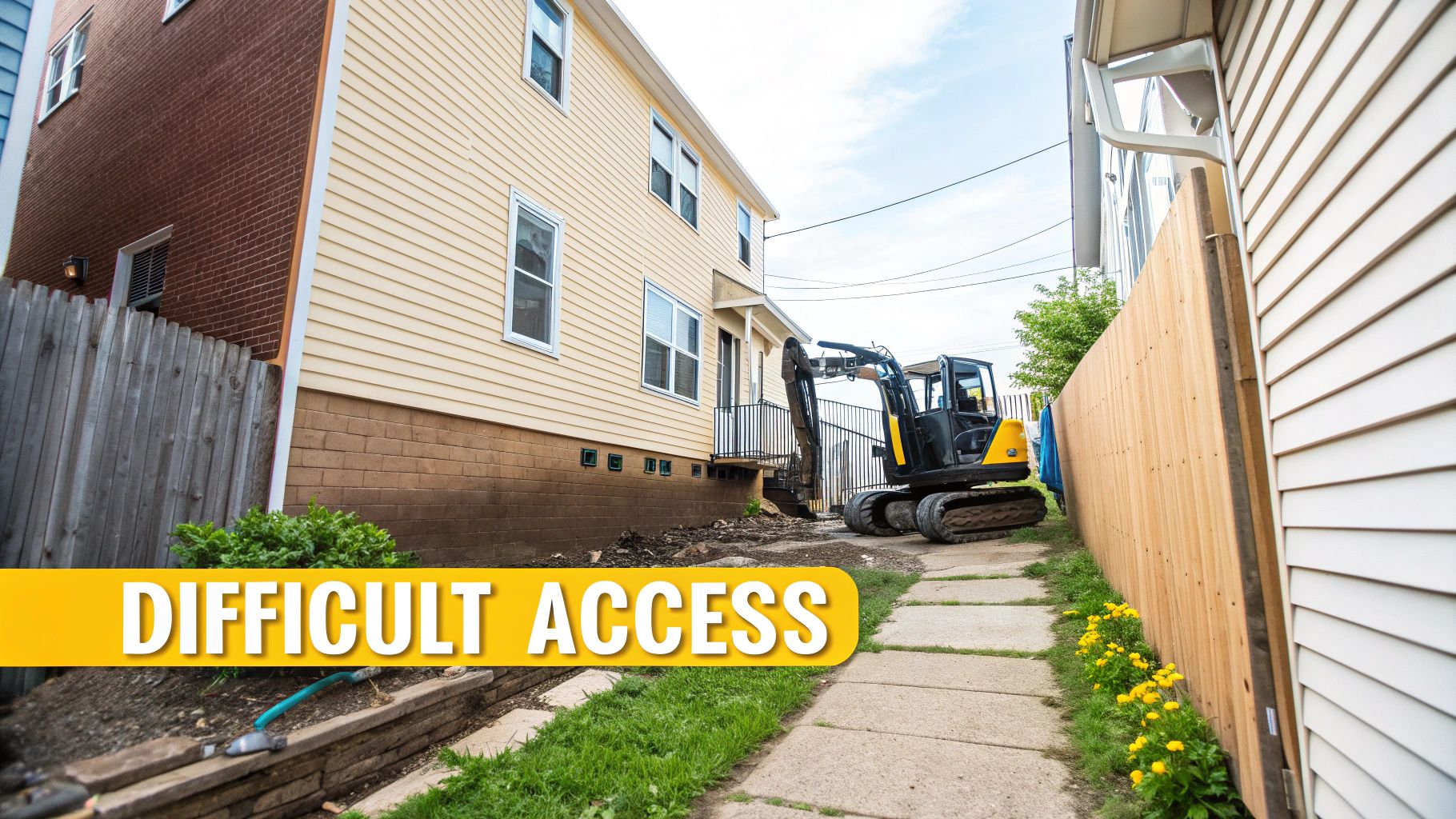
Difficult access excavation isn’t just a service; it's a specialised solution for those tricky spots where standard machinery simply can't go. We're talking about the tight laneways, steep blocks, and awkward under-house areas across the Central Coast and Sydney that make you scratch your head and wonder, "How on earth are we going to dig there?"
Obstacles like low-hanging powerlines, nearby buildings, or tight property boundaries immediately shift a project out of the "standard" category and into the realm of difficult access. This is where, with over 15 years of local experience, we thrive on finding the right solution to get your project moving.
So, What Really Defines Difficult Access Work?
At its heart, difficult access excavation is all about problem-solving. It’s not just about digging a hole; it’s about strategically figuring out how to dig that hole safely and efficiently when every obvious path is blocked. This kind of work is a world away from a straightforward job, demanding a completely different level of planning, specialised equipment, and logistical know-how. If you're curious about the general distinctions, you can explore them in our guide to residential and commercial excavation differences.
Picture this: you're dreaming of a new pool for your backyard in a tightly packed Sydney suburb. The only way in is a narrow, one-metre-wide path down the side of the house, which is a non-starter for a conventional excavator. Or maybe you're building on a steep, sloping block in Terrigal on the Central Coast, where just getting a machine onto the site safely is the first major hurdle.
These are the exact scenarios that define this field. They throw up a unique set of challenges we have to navigate every day:
- Physical Constraints: This covers everything from narrow gateways and laneways squeezed between properties to low-hanging awnings, overhead powerlines, and significant ground slopes that would stop larger machines in their tracks.
- Logistical Hurdles: Often, the digging itself isn't the hardest part. The real puzzle is getting the excavated soil and rock out of that confined space. It requires meticulous planning and often a combination of machinery to ferry material away.
- A Sensitive Environment: Working millimetres from neighbouring properties, protected trees, or delicate heritage structures means there is zero room for error. We have to operate with absolute precision to prevent any damage.
- Hidden Dangers Below: Densely packed urban areas in Newcastle or Sydney are a maze of underground utilities. Gas lines, water mains, and fibre optic cables make every single dig a high-stakes operation that demands caution.
To effectively tackle these jobs, you have to be able to "make it work" when others might just walk away. It calls for a fleet of specialised, compact machinery, seasoned operators who can think on their feet, and a planning process that leaves no stone unturned, accounting for every potential obstacle before we even break ground.
Planning Your Project The Right Way
Before a single shovel hits the dirt, careful planning is the most important thing you’ll do. This isn't just about drawing up a timeline; it's about the essential groundwork that protects your property, your neighbours, and everyone on site. A huge part of this is a solid understanding of what is hazard identification to catch problems before they even start.
The very first move, always, is to lodge a Dial Before You Dig (DBYD) enquiry. This is a non-negotiable legal and safety step under Australian Standards. Skipping it can lead to absolute disaster. Hitting a single optic fibre cable can knock out internet for an entire suburb, while striking a gas main creates a genuine life-or-death emergency.
Interpreting Utility Plans and Why It Matters
When you get the plans back from DBYD, you'll see a map showing where underground utilities are supposed to be. The key word here is supposed to be. These plans are often just a guide, not a precise, to-the-millimetre blueprint. They show the general area of assets but don't account for ground shifts or small installation errors made decades ago.
This is exactly why we always bring in a professional service locator. Using specialised electronic gear, they physically trace and mark the exact location of every pipe and cable on your property with spray paint. This simple step turns a vague map into a real-world, actionable guide, giving our operators the confidence they need to dig safely.
Getting this wrong is a massive risk. A Dial Before You Dig member reports that its telco network is hit around 20,000 times a year, causing an estimated $20 million in damages annually. It's not just about money, either. Contact with a live electrical cable can create an arc flash reaching up to 30,000 degrees Celsius—a catastrophic risk for anyone nearby.
Beyond the Plans: Site Assessment and Access
With all the underground services marked out, we can move on to a full site assessment. This is absolutely critical for any kind of difficult access excavation.
If we're dealing with a steep or unstable site, we might need a geotechnical report to really understand the soil composition and its stability. This is especially true for jobs involving steep slope excavation on the Central Coast, where sandy soils and the potential for landslip are always a concern.
Key Takeaway: A proper site plan is your safety blueprint. It's not just one thing; it's a combination of Dial Before You Dig info, professional service locating, and a hands-on physical site walk-through. Investing this time and expertise upfront is what prevents expensive delays, damage, and serious injuries later on.
Matching Specialised Equipment to Your Site
The success of any difficult access excavation hinges entirely on having the right tool for the job. It's not just about finding a small machine; it's about matching highly specialised equipment to the unique constraints of your site, whether it's on the Central Coast, in Sydney, or across the Hunter Valley.
Using the wrong machinery doesn’t just slow things down—it can cause property damage, create safety hazards, and lead to costly rework. Standard excavators are designed for open spaces, but on a tricky site, they're simply not an option. This is where our professional assessment makes all the difference, ensuring the selected equipment is powerful enough to do the work but compact enough to operate safely.
From Micro-Machines to Steep Slope Specialists
The world of difficult access machinery is incredibly diverse. You need to think like a surgeon, selecting a specific instrument for a specific problem.
For example, an under-house dig in a dense Newcastle suburb might require a micro-excavator that's narrow enough to fit through a standard doorway. These machines are surprisingly powerful for their size and are perfect for excavating basements or footings where nothing larger could possibly reach.
In stark contrast, tackling a sheer, sloping block in Terrigal demands a completely different solution. This is where a spider excavator truly shines. With its independently adjustable legs, it can safely position itself on extreme inclines that would be impossible for any conventional machine, allowing for precise work on challenging terrain.
Then there's the situation where you know sensitive utilities like fibre optic cables or gas lines are present. In that case, mechanical digging is far too risky. The solution is a vacuum excavation truck. This hydro-excavation method uses high-pressure water to liquefy the soil and a powerful vacuum to suck it away, safely exposing services without any risk of a damaging strike.
This infographic shows a quick comparison of which machine suits which type of site constraint.
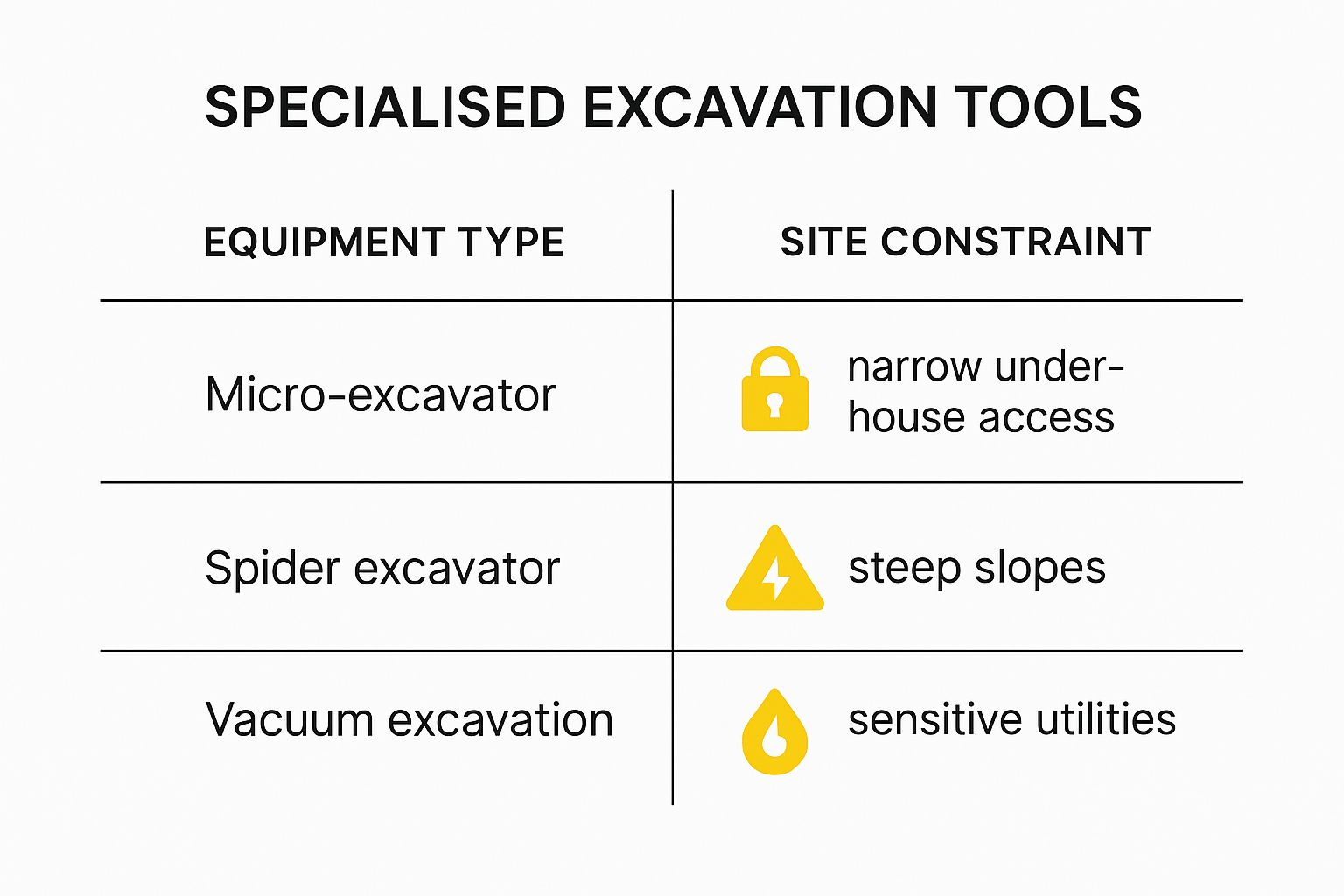
As you can see, each piece of equipment is a specialist, chosen to overcome a specific barrier that would otherwise halt the project.
For a clearer picture, this table breaks down the common machinery we deploy for restricted access jobs and where each one excels.
Specialised Equipment for Restricted Access
| Equipment Type | Best Used For | Key Advantage |
|---|---|---|
| Micro-Excavator | Under-house digs, basements, narrow laneways | Fits through standard doorways, powerful for its size |
| Spider Excavator | Extremely steep or uneven slopes, embankments | Can stabilise on inclines over 45 degrees |
| Vacuum Excavation | Exposing sensitive underground utilities | Non-destructive, eliminates risk of service strikes |
| Tracked Dumper | Removing soil and debris from tight spaces | Compact and low-impact, can access backyards |
Each of these machines represents a targeted solution to a problem that standard equipment simply can't solve safely or efficiently.
The Importance of Attachments and Support Gear
The excavator itself is only half the story. The right attachments are what turn a good machine into a versatile problem-solver. Rock hammers, augers for drilling piers, and specialised buckets all play a vital role. You can explore the possibilities in our complete guide to excavator attachments to see how they expand our capabilities.
Key Takeaway: Choosing equipment for a difficult access site is a strategic decision. It involves carefully balancing power, size, and function to ensure the machinery can not only enter the site but also perform the work safely and effectively once it's there.
Finally, we also need to consider support equipment. This could be anything from tracked dumpers designed to ferry soil out of tight spaces to crane and kibble systems for deep basement digs. It all forms part of a logistical plan designed to get the job done right, the first time.
Given the significant investment required for these excavation tools, securing appropriate construction equipment financing is often a primary concern for any contractor building a capable fleet.
Navigating Council and Safety Compliance
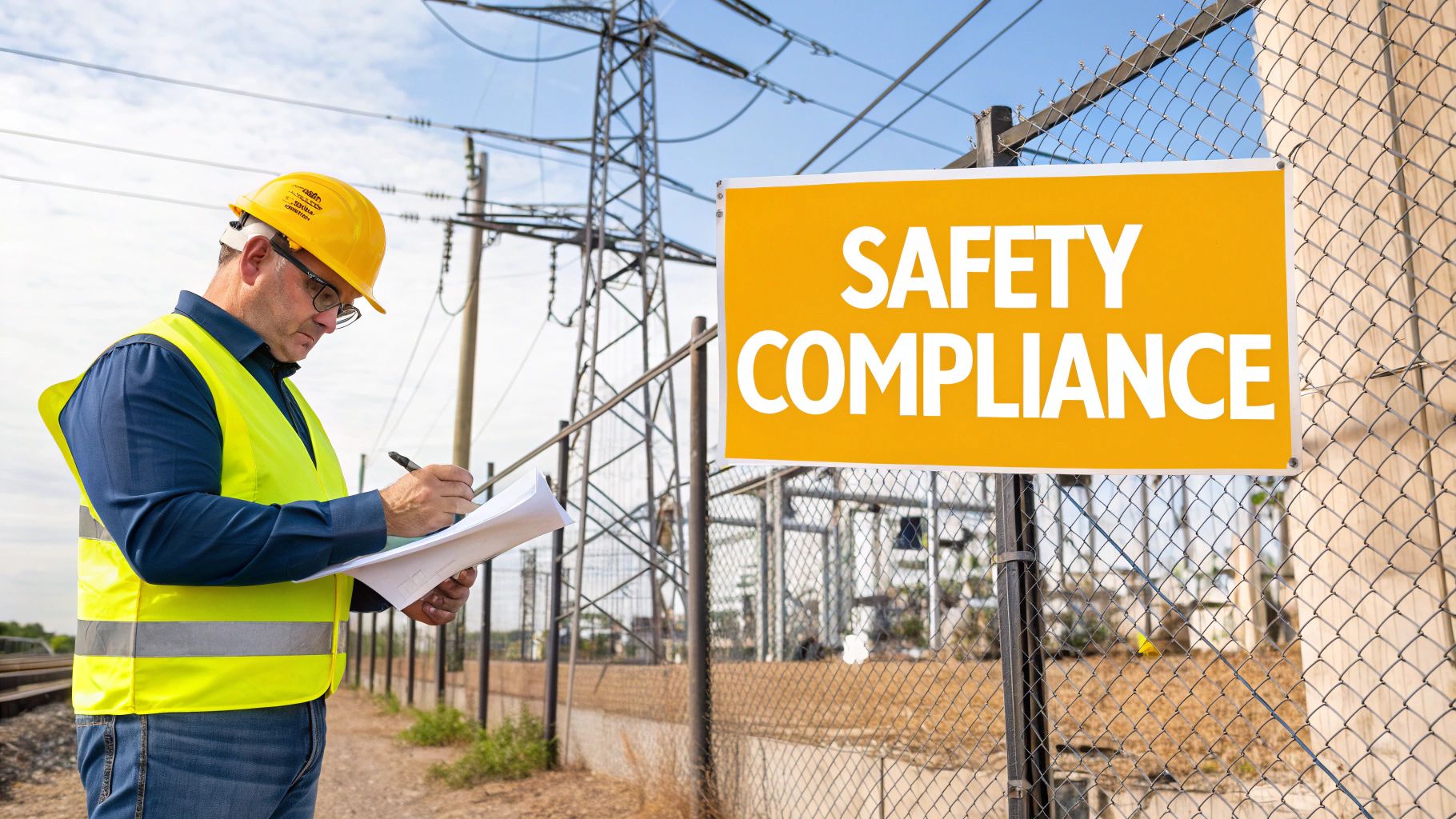
Getting compliance right isn’t about ticking boxes on a form. It's about ensuring your difficult access excavation project is safe, legal, and built to last. The moment a dig goes deeper than 1.5 metres, SafeWork NSW classifies it as 'high-risk construction work', and that changes everything. The safety standards jump significantly.
This classification isn't just bureaucratic red tape. Safe Work Australia mandates that a Safe Work Method Statement (SWMS) must be prepared for any high-risk job. Think of the SWMS as a detailed game plan. It outlines every potential hazard on your specific site—from trench collapse in a tight backyard to machinery operating near footpaths—and spells out exactly how we'll manage those risks.
These rules are strict for a very good reason. A 2016 case saw a company hit with a $30,000 fine after a worker was seriously injured in a deep trench with inadequate safety gear. You can find more details on excavation work hazards directly on the Safe Work Australia website, and it's a sobering read.
Common Council Requirements
On top of state-level safety laws, you've got local councils with their own rulebooks. While there are minor differences between, say, Central Coast Council and Newcastle Council, some requirements are pretty much universal.
A classic example is the need for a dilapidation report. Before we even think about digging next to your neighbour's property, this report documents the existing condition of their home, driveway, and fences with detailed photos and notes. It’s a simple step that protects everyone involved, providing a clear baseline to prevent any arguments about potential damage down the track. In dense Sydney suburbs where houses are practically touching, this is an absolute non-negotiable.
Another big one, especially in coastal areas like the Central Coast, is sediment control.
Protecting Your Site and the Environment
Councils are, quite rightly, very serious about stopping soil, sand, and other debris from washing off your site and polluting local waterways. This means having effective sediment control measures in place is mandatory. We're talking about things like silt fences and gravel socks at entry points to contain any runoff.
These measures are just as crucial as the excavation itself. They're a fundamental part of preparing your property correctly, which is a key step in any successful residential land clearing project.
Nailing these compliance details from the outset means your project can move forward without the threat of costly fines or stop-work orders from inspectors. It’s all part of doing the job properly, the first time.
Managing Soil Removal and Site Logistics
Getting the right machinery onto a tricky site is one half of the battle. The other, often more complex half, is getting all the excavated material back out again.
This is where the real headaches can start. Effective soil removal and site logistics are what separate a smooth, efficient project from a chaotic and costly one. Every single bucket of dirt, clay, or rock needs a clear path out, and on a constrained site, that path needs some serious forward planning.
Take a job with a narrow side path, for example—a common scenario in established suburbs across the Central Coast and Sydney. We often rely on compact tracked dumpers for this. These agile machines can navigate tight spaces, ferry material to a waiting truck, and keep the workflow moving without needing a wide access point.
Spoil Management and Removal Strategies
The way we remove spoil (the excavated material) is dictated entirely by the site's limitations. A simple tracked dumper is great for level ground, but what about a deep basement dig where the excavation is metres below street level?
In these scenarios, a crane and kibble system is our go-to solution. A large steel bin, called a kibble, is lowered into the excavation pit, filled by a micro-excavator, and then craned out to a designated stockpile area or directly into a truck. This method allows us to efficiently shift large volumes of material from sites with zero ground-level access, like those found in dense urban renewal projects in Newcastle.
Smart spoil management isn't just about removal; it's about keeping the site organised, safe, and productive. A clear site allows machinery and people to move freely, drastically reducing hazards and improving overall efficiency.
Understanding Soil Classification and Its Impact
The type of soil we're removing is another critical piece of the puzzle. Before it can be hauled away, it has to be properly classified. This process determines where the material can be legally and safely disposed of, which has a massive impact on your project's timeline and budget.
For instance, older industrial sites around Newcastle can sometimes contain contaminated soil, which demands specialised handling and disposal at a licensed facility. It's a whole different ball game.
Similarly, many coastal areas from the Central Coast down to Sydney have Acid Sulfate Soils (ASS). Once disturbed and exposed to air, these soils can release harmful acidic runoff, creating a serious environmental risk.
Managing these materials requires strict adherence to environmental regulations and often involves working with environmental consultants to ensure full compliance. Nailing the soil identification early is key, as it allows us to plan for the necessary handling procedures and factor in the additional costs. Our expert team coordinates the entire process, from the first dig to responsible disposal, offering professional haulage services for the Central Coast and beyond to ensure every load is managed correctly.
Why Experience Is Not Negotiable
When you're dealing with tight access excavation, experience isn't just a nice-to-have—it's the critical line between a smooth, successful project and a costly, dangerous disaster. An experienced operator does far more than just move levers on a machine. They can read the ground, anticipate how different soils will behave, and pivot their strategy on the fly when the inevitable surprise pops up.

Sure, anyone can hire a mini-excavator for the weekend. But it takes years of hands-on work to truly understand the nuances of different ground conditions. A crew that's familiar with the local geology knows what to expect, whether it’s the notoriously tough sandstone bedrock of Sydney or the reactive clays you find further inland in the Hunter Valley. That kind of local knowledge dictates everything, from the choice of attachments to the precise angle of a batter.
Safety as a Skill
An experienced team puts safety above everything else, mainly because they’ve seen what can go wrong. They understand the very real risks of a trench collapsing, accidentally striking a utility line, or causing structural damage to a neighbouring property.
This deep, practical understanding of risk is precisely why you should always ask a contractor about their safety record and to see examples of similar jobs they've completed.
The statistics on excavation incidents are sobering. In just one six-year period, there were 359 accepted workers’ compensation claims for incidents in trenches and pits, with almost half of those being classified as serious injuries. One significant prosecution even led to a $75,000 fine for an employer after a worker suffered multiple fractures in a trench collapse where proper safety measures were completely absent. You can learn more about excavation safety incidents from WorkSafe Queensland.
Getting It Right the First Time
Choosing an experienced crew means you're investing in a team that knows how to get the job done right—and safely—the first time around. They make sure every part of the project, from the initial site cut to the final cleanup, is handled professionally and in full compliance with SafeWork NSW regulations.
This foresight and expertise are what ultimately protect your timeline, your budget, and most importantly, everyone on site.
Your Tricky Site Questions Answered
We get a lot of calls from homeowners and builders wrestling with plans for a difficult site. It's a common scenario. To help you out, we’ve put together answers to some of the most frequent questions we hear, drawing from our years of hands-on experience on complex jobs across the Central Coast.
How Much Does Difficult Access Excavation Cost?
This is the big one, and the honest answer is: it varies dramatically. The final cost really hinges on the specific constraints of your site, the machinery we need to bring in, and where the excavated soil needs to go.
For example, a project with an extremely steep slope that requires a crane to lift soil out is going to be a different ballpark figure than one where we can use a conveyor belt system. Managing contaminated materials or dealing with significant groundwater will also push the price up. Because no two tricky sites are the same, we always insist on a detailed site assessment to give you an accurate, no-surprises quote.
How Long Will My Project Take?
The timeline is completely dictated by the project's complexity. A straightforward backyard pool dig on a block with a narrow laneway might only take a few days of our time.
In contrast, a deep basement excavation underneath an existing house could stretch over several weeks. That kind of job involves careful coordination with engineers, shoring specialists, and other trades. Factors like unpredictable weather, hitting unexpected ground conditions (like a buried concrete slab), and waiting on council approvals all play a major role in the final schedule.
What Happens If You Find Rock On My Site?
Finding rock is almost a given on many Central Coast and Sydney sites, especially the notoriously hard Sydney sandstone. Honestly, we expect it and plan for it from the get-go.
We come prepared with powerful hydraulic hammers and rock saws that attach directly to our excavators, allowing us to break it up efficiently. While hitting rock will add some time and cost to the job, an experienced team won’t be thrown off course. We'll have the right gear and a solid plan to manage it without derailing your entire project.
If you’re facing a project that has other contractors shaking their heads, have a chat with the team at Booms Up Civil. We specialise in finding practical solutions for the jobs others walk away from.
Get in touch with us for a detailed site assessment and a clear plan for your difficult access excavation.