
So, you’ve got a block of land and a vision for your new home. Starting a residential land clearing project is that first, thrilling step towards making it real. But it’s about much more than just knocking down trees. Think of it as preparing the perfect canvas for your build, and the most critical first brushstroke is a professional site assessment—especially across the varied terrains of the Central Coast, Sydney, and the Hunter Valley.
Laying the Groundwork for Your Project
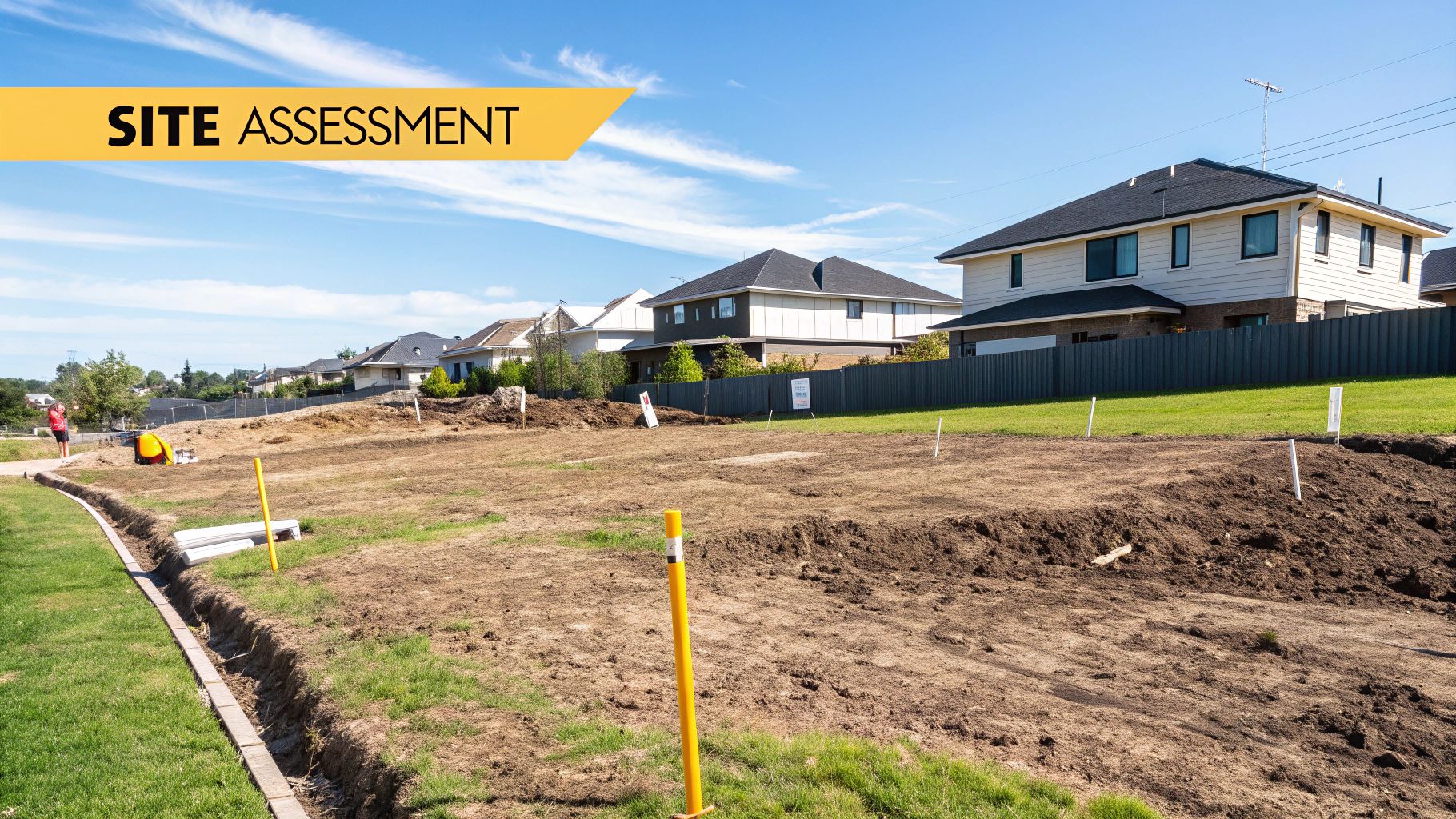
Before a single piece of machinery rumbles onto your block, a thorough site assessment is non-negotiable. This isn’t just a quick walk-around. It’s a detailed analysis that sets the foundation for a safe, compliant, and efficient project, and it’s what separates a smooth start from a project plagued by costly surprises down the track.
This is where the real planning happens. We figure out which trees have to go and which can be saved—a decision often guided by council regulations and your building plans. We’re also looking at how the slope of your land will affect everything from machinery access to future drainage and even where you might need retaining walls.
Understanding Your Site’s Unique Challenges
Every block of land has its own personality. With over 15 years on the Central Coast, we’ve seen it all. Imagine you’re building on a steep Terrigal block with sandy soil; that needs a completely different game plan than a flat block in the Hunter Valley known for its reactive clay. Hit Sydney’s notorious sandstone bedrock while digging, and you’ll wish you had planned for the specialised equipment needed to deal with it.
While your project might be smaller than a massive commercial development, residential excavation requires a unique level of precision and care. Knowing the difference helps you appreciate the specific skills needed to get your job done right the first time.
Planning for Debris and Environmental Responsibility
A big part of laying the groundwork is figuring out what to do with all the green waste. You can’t just pile it up and hope for the best. A solid waste management strategy is essential for keeping the project efficient and staying on the right side of environmental laws. It’s worth looking into a complete guide to preparing a waste management plan to get your head around handling the cleared materials responsibly.
It’s easy to forget, but even a single-house project contributes to wider environmental changes. It might not seem like much compared to huge agricultural operations, but residential development is a major driver of urbanisation and habitat modification in NSW. Understanding the bigger picture helps put your own project into context.
Navigating Council Approvals and NSW Regulations
Before we even think about firing up an excavator, the most important work happens on paper. Honestly, navigating the maze of local council and NSW state regulations is the first real hurdle in any residential land clearing project.
Getting this part wrong can bring everything to a screeching halt with hefty fines and frustrating delays. It’s a process we’ve guided hundreds of clients through, and it always boils down to one key question: what kind of approval does your project need?
The answer really depends on the size and location of your job. Some smaller, more straightforward projects might just need a Complying Development Certificate (CDC), which is a much faster, streamlined approval process. But for most significant land clearing jobs, you’ll be looking at lodging a full Development Application (DA) with your local council.
Complying Development or a Full DA?
A CDC is possible when your project neatly fits a set of predetermined standards laid out in state planning policies. Think of it as a checklist. If your plans tick all the boxes for things like block size, setbacks, and environmental impact, you can get a quick green light from a private certifier and avoid a lengthy council assessment.
More often than not, though, land clearing needs a proper DA. This is a much more detailed application that gets assessed by your local council, whether that’s the Central Coast Council or Newcastle Council. They’ll pore over your specific plans, weighing them against local environmental plans, zoning rules, and the potential impact on the community. It takes longer, but it’s essential for more complex projects.
Key Documents Your Council Will Want to See
When you submit a DA for land clearing, you’re not just handing over a simple site plan. Councils need to see that you’ve thought through all the potential impacts of your work.
Here are some of the most common things they’ll ask for:
- Tree Preservation Orders (TPO): Most councils have strict rules about which trees can and cannot be touched. You’ll almost certainly need an arborist’s report to identify any protected species and provide a solid justification for removing any significant trees.
- Erosion and Sediment Control Plan: This is a big one, especially for coastal areas or sloping blocks. The plan needs to detail exactly how you’ll stop soil and sediment from washing off your site and into local waterways while the work is happening and afterwards.
- Bushfire Attack Level (BAL) Assessment: If your property is in a bushfire-prone area—which covers a lot of the Central Coast and Hunter Valley—a BAL assessment is mandatory. This report determines the construction standards needed to protect your future home and dictates exactly how much vegetation needs to be cleared to create a safe, defendable space.
A critical takeaway: The rules for clearing a block in a high BAL-rated zone like the Blue Mountains are a world away from those for a suburban block in inner Newcastle. These requirements are non-negotiable and are there to keep your property and your neighbours safe.
The Importance of Getting It Right
Trying to clear land without the proper approvals is a recipe for disaster. Councils have the power to issue stop-work orders and hand out significant fines that can completely derail your project and blow your budget.
Your best defence is working with a contractor who genuinely understands the local requirements. We know what councils are looking for and can help make sure your application is complete and compliant from day one. It’s also crucial to think about how your work might affect those next door; understanding the rules around excavation near neighbouring properties in NSW can prevent disputes and legal headaches before they even start.
By taking a thorough, by-the-book approach to approvals, you’re creating a solid, lawful foundation for the rest of your build.
Choosing the Right Land Clearing Equipment
Once all the permits and paperwork are signed off, we get to the really practical part of residential land clearing—picking the right machinery for your specific block. No two clearing jobs are ever the same. There’s a world of difference between carefully taking out a few problem trees and doing a full “clear and grub” to get a site ready for a new home slab.
The whole game is about working smarter, not just harder. That means choosing equipment that gets the job done efficiently while causing the least amount of disruption to your land and your neighbours. A tight residential block in Newcastle with houses on all sides needs a completely different set of tools compared to a sprawling, overgrown acreage out in the Hunter Valley.
Matching Machinery to Your Block
The tools of our trade are pretty diverse, and each one has a specific job to do. You’ll almost always see an excavator playing a starring role. Kitted out with a grab attachment, it can lift and shift heavy logs like they’re toothpicks. Swap that out for another attachment, and it’s digging out the most stubborn tree stumps.
If you want to dive deeper into just how versatile these machines are, have a look at our complete guide to excavator attachments.
For those blocks with tricky access or steep slopes, a posi-track loader is an absolute lifesaver. Its tracks spread the machine’s weight evenly, so it can operate on soft ground or inclines where a wheeled machine would just get bogged or tear the place up. That agility is perfect for navigating some of the challenging blocks we often come across around the Central Coast.
Common Land Clearing Methods and Best-Use Scenarios
The method we choose really comes down to what you’re trying to achieve with your property. We’ve put together a quick table to break down the most common approaches we use across NSW.
| Method | Description | Best For | Typical Equipment Used |
|---|---|---|---|
| Selective Clearing | A precise operation focused on removing specific trees, invasive weeds, or dense undergrowth while protecting the established trees you want to keep. | Preserving mature gum trees, creating a parkland feel, or enhancing views without a full-scale clear. | Mini excavators with grabs, posi-track loaders, chainsaws. |
| Clear and Grub | The most comprehensive method. We remove all surface vegetation—trees, shrubs, grass—and then “grub” out all the root balls and stumps below ground. | Preparing a clean slate for new home foundations, driveways, or major landscaping projects. | Large excavators with grabs & rakes, bulldozers, posi-track loaders. |
| Forestry Mulching | A powerful attachment grinds trees, scrub, and undergrowth into mulch right where it stands. This eliminates the need to haul away green waste. | Quickly clearing dense vegetation on larger blocks, fire hazard reduction, or managing invasive species like lantana. | Posi-track or excavator with a forestry mulching head attachment. |
Each technique offers a different outcome, and the right choice depends entirely on your block’s characteristics and your final vision for the land.
Different Methods for Different Outcomes
So, what’s the end goal? Are you trying to keep those beautiful, mature gum trees while just clearing out the messy undergrowth? Or do you need every single stump and root system gone to create a perfectly clean building pad?
-
Selective Clearing: This is more like surgery than demolition. We target specific trees, invasive species, or dense scrub while carefully protecting the trees you want to keep. It demands precision work, often with smaller machinery and highly skilled operators.
-
Clear and Grub: This is the full works. We remove everything you can see on the surface—trees, shrubs, and grass. Then we “grub” the site, which means digging out every last root ball and stump. This leaves you with a completely clean slate, which is essential before you can pour a foundation.
-
Forestry Mulching: For blocks choked with dense vegetation, a forestry mulcher is a brilliant piece of kit. This beast of an attachment grinds up trees and shrubs into mulch on the spot. It’s incredibly efficient and saves you the cost of countless truckloads needed to haul away all that green waste.
To get a better sense of how this all fits into the bigger picture, the visual guide below breaks down the typical approval process that happens long before any equipment arrives on site.
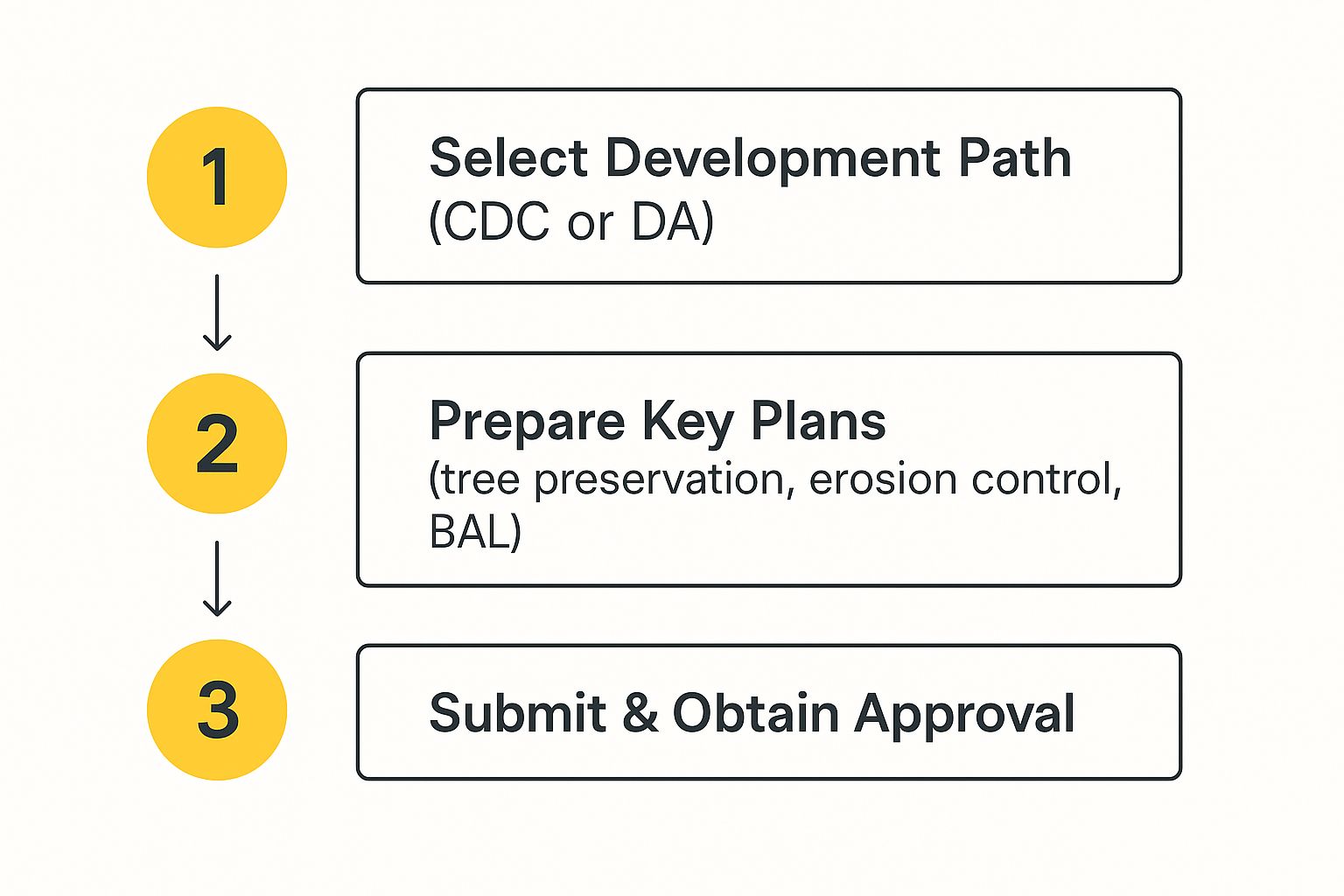
As you can see, the key is to lock in your development plans first, which then informs the entire approval pathway, making for a much smoother process.
Ultimately, choosing the right gear and the best method comes down to a professional site assessment. We’ll walk your block and look at everything—the soil type, the slope, how thick the vegetation is, and what your building plans are. From there, we map out a strategy that is safe, compliant, and perfectly prepares your site for whatever comes next. It’s all about getting it right the first time to set your entire project up for success.
Understanding Your Land Clearing Costs

It’s the first question on everyone’s mind, and rightly so: “How much is this actually going to cost me?” While a precise dollar figure is impossible without a proper site assessment, we can absolutely break down all the moving parts that shape the final quote for your residential land clearing project.
Getting a handle on these factors empowers you to read quotes properly, budget with more confidence, and see exactly where your money is going. A well-planned project has no hidden costs, just a series of variables that need to be accounted for right from the start.
Core Cost Factors
The primary drivers of your land clearing cost come down to two things: the physical reality of your block and the scope of work needed. These are the big-ticket items that determine the machinery, the manpower, and the time we’ll need on site.
-
Size and Accessibility of Your Block: It’s a simple starting point—a bigger block will naturally take more time and resources to clear. But access is just as critical. A tight site in a dense Sydney suburb with overhead power lines and limited street access demands more meticulous planning and specialised machinery than an open, easy-to-reach block on the Central Coast.
-
Slope and Terrain: A flat, level site is always the most straightforward and cost-effective scenario. The moment we introduce a steep slope, the complexity and the cost ramp up. Working on an incline requires more skilled operators and specific equipment to keep everything safe, and it can slow the whole process down. A challenging, sloping block in Terrigal will always involve more intensive work than a flat one in Wyong.
-
Vegetation Density and Type: What are we actually clearing? Light scrub and a handful of small trees are one thing. A block choked with mature gum trees, dense lantana, and established root systems is a completely different ball game. Even the type of trees matters; some hardwoods are far more difficult and time-consuming to remove and process than softer woods.
The “Hidden” Costs to Factor In
Beyond the on-site machinery and labour, several other critical costs often get overlooked in early budgets. Any professional quote will account for these, ensuring there are no nasty surprises down the track.
Think of these as the project’s essential support services. They aren’t part of the physical clearing, but the job simply can’t happen without them. Clearing a block is much more than just digging; it’s about managing the entire site preparation from start to finish. To get a better feel for the work involved, it helps to understand the difference between excavation and earthmoving, as both can play a role.
Key Takeaway: The cheapest quote is rarely the best one. A price that seems too good to be true is likely leaving out crucial costs like waste disposal or council fees, leaving you to foot an unexpected bill later on.
Here’s a breakdown of those additional expenses:
-
Council and Certification Fees: Your Development Application (DA) or Complying Development Certificate (CDC) comes with application fees payable directly to your local council or private certifier. These can range from a few hundred to several thousand dollars, depending on your project’s scale.
-
Waste Disposal and Tipping Fees: All that green waste and soil has to go somewhere. Whether we’re chipping it on-site or hauling it away in trucks, there’s a cost involved. Tipping fees at licenced facilities are charged by weight, so a block with heavy, dense timber will cost more to clear than one with light scrub.
-
Specialised Reports: As we mentioned earlier, your council might require reports from specialists like arborists (to assess significant trees) or bushfire consultants (for a Bushfire Attack Level assessment). These are professional services you’ll need to pay for before clearing can even be approved.
-
Erosion and Sediment Control: This is non-negotiable. Under NSW law, we must set up silt fences and other control measures to protect local waterways from runoff. The cost for the materials and labour to do this properly is a vital part of the project budget.
Managing Site Safety and Environmental Duties
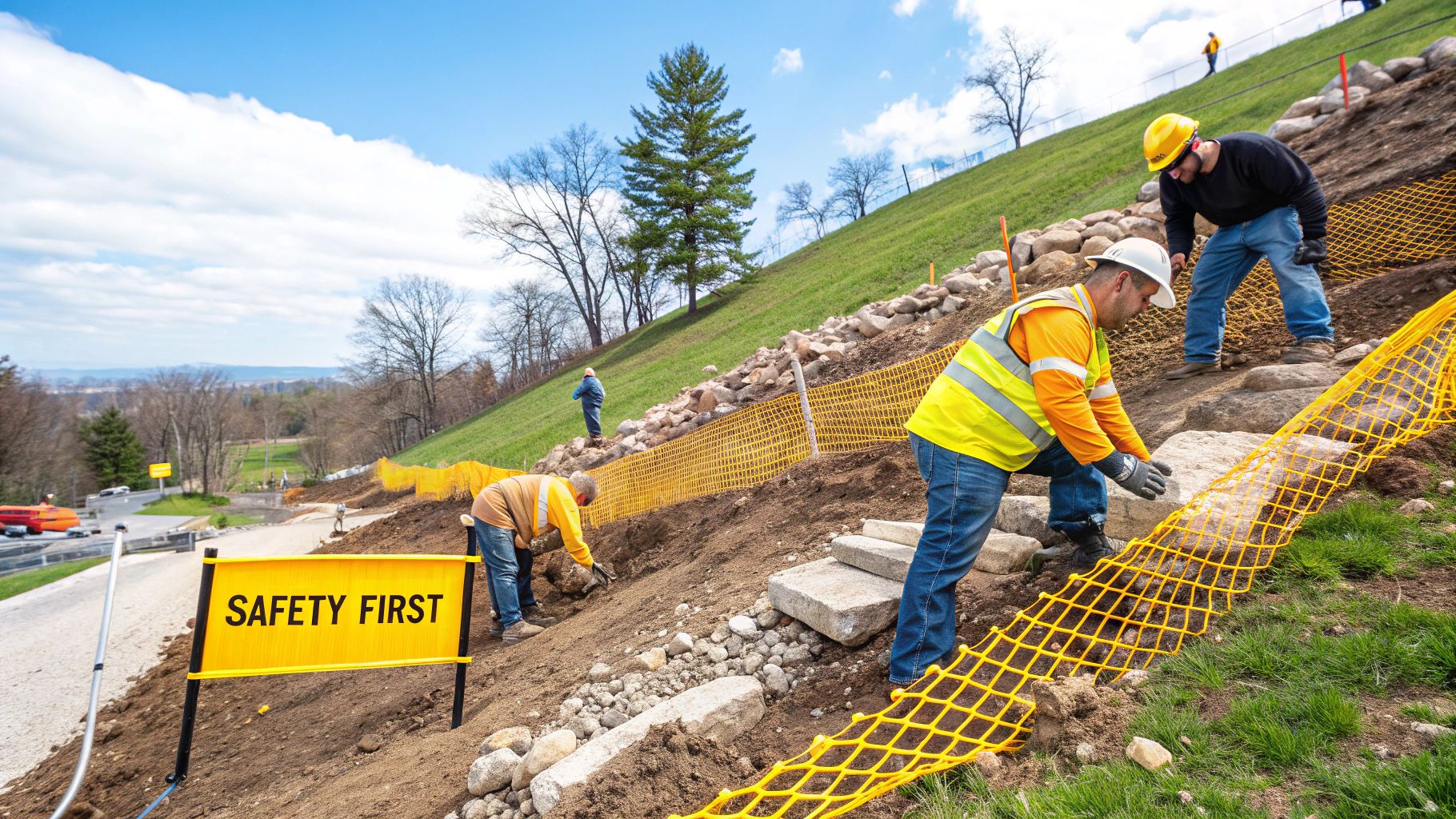
A professional residential land clearing project is about much more than just speed and efficiency. It’s built on a foundation of safety and environmental responsibility. Getting this right isn’t just good practice—it’s a legal requirement guided by SafeWork NSW, and we build safety into every single step.
This commitment starts well before any machinery even arrives on site. We establish clear exclusion zones around the entire work area, using temporary fencing and signage to keep anyone unauthorised from wandering in. This is especially crucial on tight suburban blocks or properties near footpaths, where keeping the public a safe distance from active operations is non-negotiable.
Site Safety Fundamentals
One of the biggest risks on any land clearing site is hidden just below the surface. Before we break ground, identifying and locating underground utilities is an absolutely critical safety check. We handle all “Dial Before You Dig” enquiries to map out essential services like water mains, gas lines, power cables, and comms. Hitting one of these can cause dangerous outages and lead to eye-watering repair bills, so it’s a step we never, ever skip.
Every project requires a commitment to effective workplace safety procedures, but some sites throw extra curveballs. Challenges like steep terrain can introduce unique hazards that demand a specialised approach. If your block has a tricky slope or tight access, you can read more about how we handle these situations in our guide to difficult access excavation on the Central Coast.
Protecting the Local Environment
Beyond keeping people safe, we have a serious duty of care to the environment. While residential jobs are smaller in scale than broadacre clearing, they still contribute to the broader environmental picture, making responsible practices on every single site essential.
Our environmental obligations really boil down to two things: managing what leaves the site and what we do with all the green waste.
Crucial Responsibility: Preventing soil and sediment from washing off your property isn’t just a good idea—it’s a legal requirement. Here on the Central Coast, with our stunning lagoons and waterways, failing to manage runoff can lead to hefty council fines and cause real harm to local ecosystems.
To get this right, we implement robust erosion and sediment control measures. You’ll typically see us installing silt fences along the lower boundaries of the block. These fences act as a filter, trapping sediment while letting water pass through, which is vital during a sudden downpour.
Managing Green Waste Responsibly
Finally, there’s the big question of what to do with all the cleared trees, shrubs, and vegetation. You’ve got a couple of solid options here, and we can walk you through what’s best for your project and budget.
We can bring a powerful wood chipper to your property and process everything into mulch right there and then. This is a fantastic, sustainable choice because you can reuse the mulch in your future landscaping, which saves you money and cuts down on waste.
Alternatively, we can load all the green waste into our trucks and haul it away for responsible disposal at a licenced local facility.
Getting Your Site Ready for the Build
Once the last tree is down and the final truckload of green waste has been hauled away, you might look at your block and think the job is done. But this is where the real groundwork begins. Clearing the land is one thing; preparing it for construction is another ball game entirely. This is the crucial bridge between clearing and building, and getting it right sets the stage for a smooth, headache-free construction process.
This part of the job isn’t about brute force removal anymore. It’s about precision and refinement. We’re talking about the final grading and levelling—the detailed work that turns a raw, cleared site into a perfect platform for your builders.
Why Final Grading and Levelling is a Non-Negotiable
This is where we meticulously shape the earth to perfectly match your building plans. Using machinery like excavators and posi-tracks, we cut and fill the soil, sculpting a perfectly level pad for your home’s foundation. It’s a game of millimetres, not metres. Being even slightly off here can create major headaches for your concreters and frame carpenters down the track.
The aim is to create a solid, compacted base that won’t shift or sink over time. Just as important is establishing the correct “fall,” or slope, away from where the foundation will sit. It seems like a simple detail, but it’s one of the most critical steps in protecting your future home. Proper drainage stops water from pooling around your foundation, which is a one-way ticket to serious structural problems like cracking concrete, rising damp, or even a flooded sub-floor.
A Pro Tip for Homeowners: Never, ever underestimate the power of water. It’s far easier and cheaper to get the site drainage sorted out during the earthworks phase than it is to fix foundation issues or install expensive drainage systems after your house is built.
Creating a Truly Builder-Ready Site
With the building pad perfectly prepared, the last piece of the puzzle is making sure the entire site is ready for the parade of trades that are about to descend on it. This means creating clear, safe, and stable access for everything from concrete trucks and delivery vehicles to other heavy machinery. We ensure access tracks are solid and wide enough so no one gets bogged—a common and costly problem, especially after a bit of rain.
Depending on the block, soil stabilisation might be needed. This is particularly common on sites with the loose, sandy soil you find all over the Central Coast, or the reactive clays that pop up in parts of the Hunter Valley. We can use techniques like adding specific materials or using heavy compaction equipment to improve the soil’s load-bearing capacity, making sure it provides a rock-solid base for everything to come.
Ultimately, handing over a clean, accessible, and perfectly graded site does more than just look good. It saves time, cuts down on unexpected costs, and prevents potential arguments during the build. It’s the final handshake of the land clearing process, ensuring a seamless transition to the exciting part: construction.
Common Questions About Land Clearing
Even with the best plan in place, it’s completely normal to have questions pop up before a big residential land clearing project. With over 15+ years of experience working on all kinds of blocks across the Central Coast and beyond, we’ve pretty much heard it all.
Here are some of the most common queries we get from homeowners, answered straight up.
How Long Does Land Clearing Usually Take?
Honestly, this is a “how long is a piece of string?” question. The timeline can vary wildly from one job to the next.
For instance, a small, fairly level block in a suburb like Umina with just some light scrub might only take our team a day or two of on-site work with the machinery. Easy. But then you have larger, steeper, or heavily wooded blocks—those could easily keep us busy for a week or more.
The biggest wildcard is often the council approval process. That part alone can sometimes stretch out for several weeks, or even months, before we can even think about starting. And of course, you can’t discount Mother Nature; unexpected heavy rain, a classic on the coast, can definitely press pause on things. We’ll always give you a realistic timeline estimate after we’ve had a proper look at your site.
Do I Need to Be On-Site During the Work?
You definitely don’t need to hang around for the entire job. What we do need, though, is for you to be there for our initial site meeting. It’s crucial we walk the block together to confirm the exact scope of works and mark out any important boundaries or specific trees you want to keep.
Once we kick off, it’s just helpful if you’re reachable by phone in case any quick questions come up. It’s important to remember that for everyone’s safety, access to the active work area will be strictly restricted to our trained crew. It’s always best to let the pros handle the on-site operations without any interruptions.
What Happens to All the Green Waste?
Managing the leftover green waste responsibly is a huge part of our process. We’ve got a couple of great, environmentally-friendly options, depending on what you need and your budget.
One of the most popular choices is to process the cleared trees and shrubs into mulch right there on your property. We bring in a powerful wood chipper and turn it all into a valuable resource. It’s a fantastic, sustainable approach because you can then reuse that mulch for your future landscaping, saving you on waste fees and the cost of buying mulch later on.
The other option is for us to load all the green waste, timber, and stumps straight into our trucks. We then haul it all away to a licenced green waste recycling facility. We’ll talk through the most practical and cost-effective solution for your specific project during our first chat and make sure it’s all clearly laid out in your quote.
Ready to start your project with a team that gets it right the first time? For a clear plan and a professional approach to your land clearing needs on the Central Coast, Sydney, or Newcastle, get in touch with Booms Up Civil Group.