

Site preparation excavation is, without a doubt, the most important first step in any construction project. It’s the process of clearing, grading, and digging the land to create a solid, secure footprint for whatever you’re building. Think of it as laying the groundwork—literally—to ensure the long-term integrity of homes, driveways, or commercial buildings. We’re here to explain how getting it right from the start protects your entire investment.
Why Getting the Groundwork Right Matters Most
Picture an artist preparing a canvas before they start painting. That’s what site preparation and excavation are to construction. It’s the foundational work that guarantees everything that comes next—from the concrete slab to the roof—is stable, secure, and built to last. Skimp on this stage, and you’re inviting serious, expensive problems down the track, like foundation movement, terrible drainage, and even structural failure.
Professional site preparation is much more than just digging holes. It’s a methodical process that turns a raw piece of land into a build-ready platform. This is especially true across the varied landscapes of NSW, where we deal with everything from the sandy soils of the Central Coast to the notoriously stubborn sandstone bedrock found all over Sydney.
The infographic below breaks down the core stages of getting a site ready for construction.
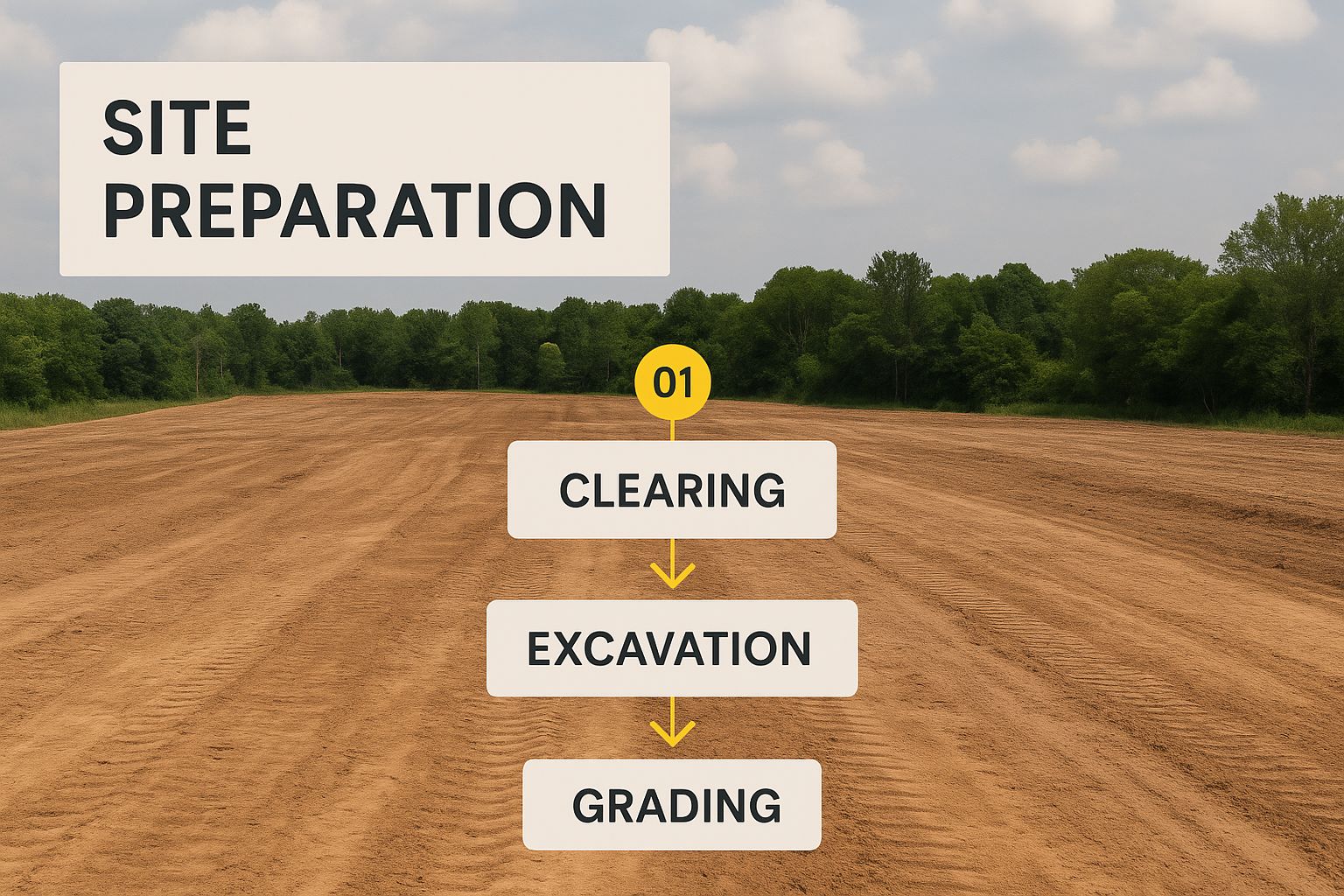
As you can see, the aim is always the same: a clean, correctly graded, and stable site that’s primed for the next phase.
Key Outcomes of Professional Site Preparation
At the end of the day, a professionally prepared site is:
- Safe and Clear: All obstacles are gone. That means trees, old debris, and any leftover structures have been completely removed.
- Correctly Graded: The land is expertly shaped to handle water. This ensures proper drainage and directs runoff away from your future foundation.
- Structurally Stable: The soil is properly compacted and ready to bear the load of the new building without shifting or settling over time.
A crucial part of understanding a site involves detailed topographic and environmental analysis. This is increasingly done using advanced methods like aerial surveying UAV technology, which gives us pinpoint accurate data for planning.
A Growing and Essential Industry
The sheer demand for skilled site preparation really highlights how critical it is in Australia’s construction sector. The industry has seen consistent growth, with nearly 21,000 businesses operating in this space as of 2025. This reflects a steady, ongoing need for expert groundwork across both residential and commercial projects.
While people often use terms like ‘excavation’ and ‘earthmoving’ interchangeably, they play distinct roles. If you’re a bit fuzzy on the terminology, you can get a clearer picture by reading our guide on the differences between excavation and earthmoving.
Ultimately, whether it’s for a new home in Gosford, a commercial carpark in Newcastle, or a retaining wall in the Hunter Valley, meticulous site preparation is simply non-negotiable.
Breaking Ground: A Step-by-Step Process
Getting a block of land ready for construction isn’t a single event; it’s a carefully orchestrated process. Think of it less like a sprint and more like a methodical journey. Each step builds on the last, ensuring the final platform is stable, secure, and perfectly prepared for whatever comes next.
Let’s walk you through how a raw piece of land is transformed, from the initial survey right through to the final compaction.
Stage 1: Site Assessment and Surveying
Before a single shovel hits the dirt, we need to know exactly what we’re working with. This initial stage is all about gathering intelligence. It involves a detailed survey to map out the contours of the land (the topography), confirm the property boundaries, and flag any potential hurdles.
A huge part of this is finding all the underground services. Using a combination of official plans and electronic locators, we pinpoint the precise location of water mains, sewer lines, gas pipes, and telecommunications cables. Striking one of these isn’t just an inconvenience—it can lead to major disruptions and eye-watering repair bills. Getting this right first is non-negotiable.
Stage 2: Site Clearing and Demolition
With a complete picture of the site, the clearing can begin. This is where we systematically remove anything standing in the way of the build. That could be trees and thick scrub, old concrete paths, a forgotten shed, or even an entire house that needs to be demolished.
The focus here is on doing the job safely and efficiently. We strip the site back to bare earth, creating a clean slate for the real earthworks to start.
Stage 3: Bulk Excavation and Earthmoving
Now for the main event—the heavy lifting. This is where the land is fundamentally reshaped to match the architectural plans. Bulk excavation, often called “the big dig,” involves moving huge volumes of soil, rock, and other material to create the basic form and levels for the project.
It’s at this stage that a steep, sloping block in the Hunter Valley gets cut and filled to create a level building pad. The process is a careful balancing act. We strategically ‘cut’ into the high side of the block and use that excavated soil to ‘fill’ and build up the low side. This cut-and-fill approach minimises the amount of soil we need to haul away, saving time and money.
Stage 4: Detailed Excavation
Once the general shape of the land is established, we swap brute force for precision. Detailed excavation is about the finer points, digging out the specific elements needed for the structure itself. This is where we cut trenches for plumbing and electrical services and meticulously dig out the foundations and footings for the building.
This work demands incredible accuracy. A footing trench has to be dug to the exact depth and width specified by the engineers to ensure it can support the building’s load. This is also the point where specialised jobs, like digging for a new pool, take place. If you’re wondering what that involves, you can check out our complete guide to pool excavation.
Why Precision Matters: Being off by just a few centimetres in a detailed excavation can create a domino effect, throwing off the concrete pour, the frame, and the entire structure’s integrity. In this game, “close enough” is never good enough.
Stage 5: Final Grading and Compaction
The last—and arguably most critical—step is the final trim and compaction. Grading involves creating the exact slopes needed to ensure water drains away from the future building, not towards it. It’s all about managing future water flow.
With the levels perfected, the ground is then compacted using heavy rollers or plate compactors. This process squeezes out air pockets in the soil, making it denser and dramatically increasing its ability to bear weight. Proper compaction is what prevents the ground from sinking and causing foundation cracks down the line, giving the builder a rock-solid base to start from.
Using the Right Equipment for Your Project
Choosing the right machine for a site preparation and excavation job is the difference between an efficient, precise project and a costly, drawn-out mess. Having access to a specialised fleet isn’t about having the biggest toys on the block; it’s about matching the perfect tool to the unique challenges of your land, ensuring every single scoop of dirt is part of a deliberate plan.
Using the wrong equipment can quickly lead to project delays, budget blowouts, and even damage to your property. Imagine trying to force a massive 20-tonne excavator into a tight backyard in a dense Sydney suburb—it’s a recipe for disaster. On the flip side, a mini excavator would be completely overwhelmed on a major civil works project that calls for serious bulk earthmoving.
Matching Machinery to the Terrain
Every site has its own personality, and the machinery we select is a direct response to that. The sandy, loose soils common along the Central Coast, for example, require a completely different approach than the hard clay or solid sandstone you’ll find further inland.
A posi-track loader is our go-to for levelling sandy sites. Its tracks distribute weight evenly, which stops it from getting bogged down while giving it fantastic traction for grading. A wheeled machine, in contrast, would just struggle, spin its wheels, and make a mess of the delicate surface.
Then you have the infamous Sydney sandstone. When we run into that, a standard bucket just won’t cut it. This is where specialised equipment becomes absolutely essential for breaking through hard ground without causing frustrating delays.
The Power of Specialised Attachments
An excavator is the Swiss Army knife of any construction site, but only if it has the right attachments. The machine itself provides the raw power and reach, but it’s the attachments that do the real specialised work. This versatility is the key to efficient and effective site preparation.
A few examples of critical attachments include:
- Rock Hammers: These are non-negotiable for breaking through rock. A hydraulic hammer turns an excavator into a powerful demolition tool, which is a must-have for projects on the rocky outcrops around Sydney and parts of the Hunter Valley.
- Augers: When you need to drill perfectly round holes for footings, piers, or retaining wall posts, an auger is the only tool for the job. It ensures a level of precision and consistency that manual digging could never hope to achieve.
- Rippers: For compacted earth or shale that isn’t quite solid rock, a ripper attachment is used to tear up and loosen the ground. This makes it much easier for the bucket to come in and excavate the material afterwards.
Having the right tool means we can adapt on the fly. If we start a dig and hit an unexpected layer of rock, we don’t have to halt the project and wait for different gear to arrive. We can simply switch attachments and keep your project moving forward.
Understanding the full range of options is crucial for any project manager. For a deeper dive into what these tools can do, it’s well worth exploring a complete guide to excavator attachments to see exactly how they solve specific site challenges.
Ultimately, having a professional, well-maintained fleet with a wide array of attachments allows us to tackle any ground conditions with precision. This commitment to using the right equipment for your specific site preparation excavation saves you time, money, and a whole lot of headaches in the long run.
Navigating Council Approvals and Australian Standards
Embarking on any excavation project is about more than just moving dirt. It’s about doing it safely, legally, and with respect for the community and environment. Think of compliance not as red tape, but as the rulebook that protects your investment and ensures every job is done to a professional standard.
Before a single bucket of soil is moved, the first and most critical step is a Dial Before You Dig search. This free national service is non-negotiable. It gives us the plans for all underground utilities, showing exactly where crucial water, gas, and telecommunications lines are buried. Hitting one of these isn’t just an inconvenience; it can cause massive service outages and lead to eye-watering repair bills. This initial check is absolutely fundamental.
Working with Local Councils
Every project, whether it’s on the Central Coast, in Newcastle, or deep in the Sydney metro area, falls under the watchful eye of a local council. Their job is to manage the impact of construction on the wider community, and we handle all these interactions on your behalf.
Most councils enforce strict, common-sense rules around things like:
- Approved Working Hours: To keep the peace with your neighbours, work is usually limited to set times, typically 7:00 am to 5:00 pm on weekdays. No one appreciates the sound of an excavator at dawn on a Sunday.
- Sediment Control: You’ve probably seen those black fabric fences around building sites. Known as silt fences, they are a legal must-have. Their purpose is simple but vital: to stop loose soil from washing off your property during a downpour and polluting local waterways like Tuggerah Lakes or the Hunter River.
- Tree Removal Permits: Just because a tree stands on your land doesn’t automatically mean you can remove it. Many councils use Tree Preservation Orders to protect important local greenery. We make sure all the right permits are secured before any clearing starts. You can find out more in our NSW guide to residential land clearing.
Adhering to Australian Standards and SafeWork NSW
Beyond the local council, our work is governed by state and national regulations that set the benchmark for quality and safety. We operate in strict accordance with the guidelines from SafeWork NSW, making sure every site is managed to prevent accidents and protect our team, the public, and your property.
This commitment also means following all relevant Australian Standards (AS), especially those covering earthworks and construction. These aren’t just vague guidelines; they provide incredibly detailed technical specs for everything from achieving the right soil compaction to the proper methods for trenching and shoring.
Following these standards isn’t optional for us. It’s how we guarantee the long-term stability and safety of your project. It’s our promise that the groundwork we lay isn’t just visually correct but is engineered to last.
The Bigger Picture of Compliance
This web of regulations is more crucial now than ever. With Australia planning to invest over $300 billion in its infrastructure pipeline over the next decade, the demand for high-quality, fully compliant site preparation is only going to grow. The sheer scale of this development underlines why professional, sophisticated excavation that meets strict national standards is so important.
Navigating all these rules can feel overwhelming, but that’s what we’re here for. Managing these complexities is a core part of our service. We take care of the paperwork, planning, and permissions so your project moves ahead without the costly delays that non-compliance inevitably causes.
Solving Common Site Preparation Challenges
Even the most buttoned-up plans can’t predict everything hiding beneath the surface. The real measure of an experienced excavation contractor isn’t just following a blueprint; it’s the knack for adapting when the ground throws you a curveball.
After 15+ years working across the Central Coast, we’ve built our reputation on turning potential project-stoppers into solved problems. No two sites are ever the same. From the stubborn sandstone of Sydney to the temperamental clays of Wyong, we’ve seen it all and know that a flexible approach is the only way to keep a project on time and on budget.
Dealing with Unexpected Rock
It’s a classic story on NSW job sites. The excavation starts smoothly, then you hear that unmistakable crunch of a bucket hitting solid rock. This is a regular occurrence across Sydney’s sandstone basin, and for an inexperienced crew, it can signal a major delay. For us? It’s just another day at the office.
When we hit rock, the first step is to quickly assess its type and scale. We then bring in specialised gear, like a powerful hydraulic hammer attachment, to break it up efficiently. This means we can get back to the detailed work—like digging footings or service trenches—with minimal downtime.
Managing Reactive Clay Soils
Head a little further inland from the coast, especially around the Hunter Valley and parts of the Central Coast, and you’ll often run into reactive clay soils. This stuff is notorious for swelling up when it gets wet and shrinking dramatically as it dries out. If it isn’t managed properly, that constant movement can wreak havoc on foundations and concrete slabs down the line.
Imagine we start a dig in Wyong and find a deep layer of reactive clay. Our strategy is to over-excavate the area, removing the unstable soil and replacing it with a stable, engineered fill. We compact this new base layer by layer to create a solid, non-reactive platform for the build, effectively shielding the foundation from any future ground movement.
Navigating Difficult Access Sites
One of the biggest hurdles, particularly in established urban areas like Newcastle or Sydney’s inner suburbs, is simply getting the machinery on site. Narrow laneways, steep driveways, or homes with no side access are enough to make many contractors walk away. This is a challenge we specialise in solving.
We tackle these jobs with a combination of smaller, powerful machines and meticulous planning. Sometimes it means using mini excavators that can squeeze through a standard doorway; other times it involves coordinating crane lifts for larger equipment. Solving these logistical puzzles is a core part of what we do. You can read more about our approach in our article on tackling difficult access excavation.
Problem-Solving in Action: Picture a steeply sloping block in Terrigal with a tight, winding driveway. Our solution might be to use a smaller excavator to first cut a temporary, gentler access track. This allows the bigger machines needed for the bulk earthworks to safely get to where they need to be.
Handling Groundwater and Sloping Blocks
Coastal and low-lying areas often come with the challenge of groundwater seeping into the excavated site. A solid dewatering plan is non-negotiable here—it keeps the site workable and ensures the foundation can be poured in dry conditions. We use specialised pumps and smart drainage techniques to manage water flow from the get-go.
Looking ahead, the site preparation field is getting smarter. Between 2025 and 2030, the construction industry is projected to lean more heavily on AI systems to help with decision-making on excavation projects, making it easier to predict and manage challenges like these. You can discover more insights about the industry’s digital evolution on onshift.edu.au.
Planning Your Project Timeline and Budget
Let’s get straight to it: the two biggest questions on everyone’s mind are “How long will this take?” and “What’s it going to cost?” While every single excavation job has its own unique quirks, we can break down the key factors that will shape your project’s timeline and budget.
Getting a realistic handle on these variables from the very beginning is the secret to a smooth, stress-free project. It helps you understand exactly where your money is going and why a detailed, professional quote is an investment in quality, not just an expense line.
Factors That Influence Your Timeline
Getting your site ready for building can take anywhere from a few days to several weeks. It’s almost never a simple, straight line, as there are a lot of moving parts that all need to fall into place.
Here’s what really drives the schedule:
- Site Size and Complexity: It’s common sense, really. Prepping a small, flat residential block in a Newcastle suburb is going to be worlds faster than a huge, steeply sloped property in the Hunter Valley that needs major cut and fill work.
- Council Approval Times: This is often the biggest hold-up. Submitting applications to bodies like the Central Coast Council and then waiting for the green light can easily add weeks, sometimes even months, to your schedule before a single machine can even start.
- Weather Delays: Ah, the weather. It’s the one variable nobody can control. A few days of heavy rain, especially common along the coast, can completely saturate the ground, making it unsafe and impractical to work. We always bake contingency days into our schedules to account for this reality.
- Unexpected Discoveries: You never truly know what’s underground until you start digging. Hitting a massive seam of solid sandstone or uncovering a bunch of old, buried construction debris can bring everything to a halt while we adjust our strategy, often bringing in specialised gear like rock hammers.
What Goes Into a Professional Quote
We can’t give you a price without seeing your site, but we can pull back the curtain on what makes up a proper, comprehensive excavation quote. A suspiciously cheap quote is a massive red flag that dangerous corners are being cut. Understanding the value behind each item is key. As you map out your budget, it’s smart to look into strategies for reducing construction costs that don’t sacrifice quality or safety.
A Key Takeaway: The cheapest quote is rarely the best value. If a price seems too good to be true, it probably is. It could mean they’re skipping vital steps like proper soil compaction or using undersized machinery, which can lead to catastrophic foundation issues down the track.
Your final cost will always be a mix of several core components.
Key Cost Components
- Volume of Material: The biggest driver of cost is often the sheer volume of dirt, clay, or rock that needs to be moved. We measure this in cubic metres (m³), and the more there is, the more it costs.
- Machinery and Labour: This covers the specific excavators, loaders, and attachments needed for your job, plus the skilled operators who know how to run them safely and efficiently. A tight-access job needing a mini excavator has a completely different cost structure than a bulk earthworks project.
- Spoil Disposal Fees: Getting rid of all that excavated material isn’t free. The cost includes the time to load it, transport it, and pay the tipping fees at a licensed facility. These fees change depending on what the material is (e.g., clean fill is much cheaper to dispose of than contaminated soil).
- Site-Specific Challenges: This is where the unique nature of your block comes in. Things like steep slopes, tricky access for machinery, or the need for extensive rock breaking will naturally add complexity and, therefore, cost. Prepping a level block is a walk in the park compared to excavating a basement into solid Sydney sandstone.
Got Questions About Site Preparation? We’ve Got Answers.
We get asked a lot about the nuts and bolts of site preparation excavation. Here are some of the most common questions that come our way, with straight-up, practical answers based on our years of experience on the ground.
How Long Does Site Preparation Usually Take?
This is the classic “how long is a piece of string?” question, because it all comes down to your specific block of land. A small, flat, and clear residential lot? We might be in and out in just a few days.
But if you’re looking at a large, steeply sloped site with dense bush, stubborn rock, and a mountain of council paperwork, you could be looking at several weeks or even longer. The biggest hold-ups are almost always council processing times and the weather. We always build in a buffer for potential rain delays, especially on the Central Coast where the weather can turn on a dime.
What is the Most Important Step in Site Preparation?
Every single step is vital, but if we had to pick the two most critical moments, it would be the initial site assessment and the final compaction. The initial assessment, which absolutely must include a thorough Dial Before You Dig search, is what stops a project from turning into a disaster. It prevents catastrophic—and incredibly expensive—damage to underground services and gets the entire job started on the right foot.
At the other end of the process, you have the final compaction. This is non-negotiable. If you don’t get the soil compacted to the right density, the ground simply won’t be stable enough to hold up the structure. Down the track, that leads to sinking, shifting, and ugly cracks in your foundation. Think of it as the final guarantee that your build has a rock-solid base.
Can I Do My Own Site Preparation?
Look, for tiny jobs—like levelling a little patch for a garden shed—you could probably give it a go. But for anything structural? A house slab, a driveway, a retaining wall? Our professional advice is simple: don’t do it. The risks are just way too high.
Operating heavy machinery isn’t something you learn on YouTube; it requires a licence and thousands of hours of experience. More importantly, a professional understands soil mechanics, drainage principles, and how to navigate the maze of council regulations and Australian Standards. If you get it wrong, you’re not just looking at a wonky driveway. You’re facing potential structural failure, drainage nightmares, and eye-watering costs to fix it all.
What Happens to all the Excavated Soil?
All that dirt and rock we dig up has to go somewhere. In the industry, we call it “spoil.” Our first choice, always, is to reuse as much of it as we can right there on-site. For example, in a “cut and fill” job on a sloping block, we use the excavated soil from the high side to build up the low side. It’s the most cost-effective and environmentally sound way to do it.
Any soil that’s left over gets loaded onto trucks and hauled to a licensed waste management or recycling facility. The cost of this disposal is a major line item on any excavation quote. It covers the labour to load it, the transport to get it there, and the tipping fees at the facility, which change depending on what we’re hauling (clean fill is much cheaper to dispose of than rock, for instance).
Ready to get your project’s groundwork right the first time? The team at Booms Up Civil has the local knowledge and professional fleet to handle any site preparation challenge on the Central Coast, Sydney, or Newcastle.
Contact us today for a free, no-obligation quote and expert advice.