You're usually not thinking about environmental impact assessment when you first sketch a driveway, slab, subdivision road or bulk cut. You're thinking about levels, access, spoil, stormwater, retaining, programme, and whether the job can start when the machine rolls in. Then council asks questions, a consultant mentions an EIA, and suddenly the project feels a lot heavier.
On the Central Coast, Sydney, Newcastle and through the Hunter, that moment catches plenty of people out. The trouble isn't just the paperwork. It's that excavation, land clearing and concreting can change runoff, expose soils, affect vegetation, increase dust and noise, and create impacts beyond your fence line. If you treat environmental impact assessment like a box to tick late in the piece, you usually pay for it in redesign, RFIs, consultant back-and-forth, and lost time on site.
What Is an EIA and Why Does It Matter for Your Project
You can have a job priced, the excavator booked, and the pour sequence mapped out, then hit a wall because council wants a clearer picture of what the work will do outside your lot. I see it on steep Central Coast sites all the time. A cut for a slab or driveway looks simple in the quote, but once runoff, spoil handling, tree removal, sediment control, neighbour impacts, and stormwater discharge are examined properly, the job can change fast.
An environmental impact assessment is the process used to identify those effects before work starts and before approval is granted. In NSW, it sits inside the planning system under the Environmental Planning and Assessment framework, with the Department of Planning, Housing and Infrastructure setting out how environmental impacts are assessed for development and infrastructure projects in the state, as outlined by the NSW planning system guidance on environmental assessment.
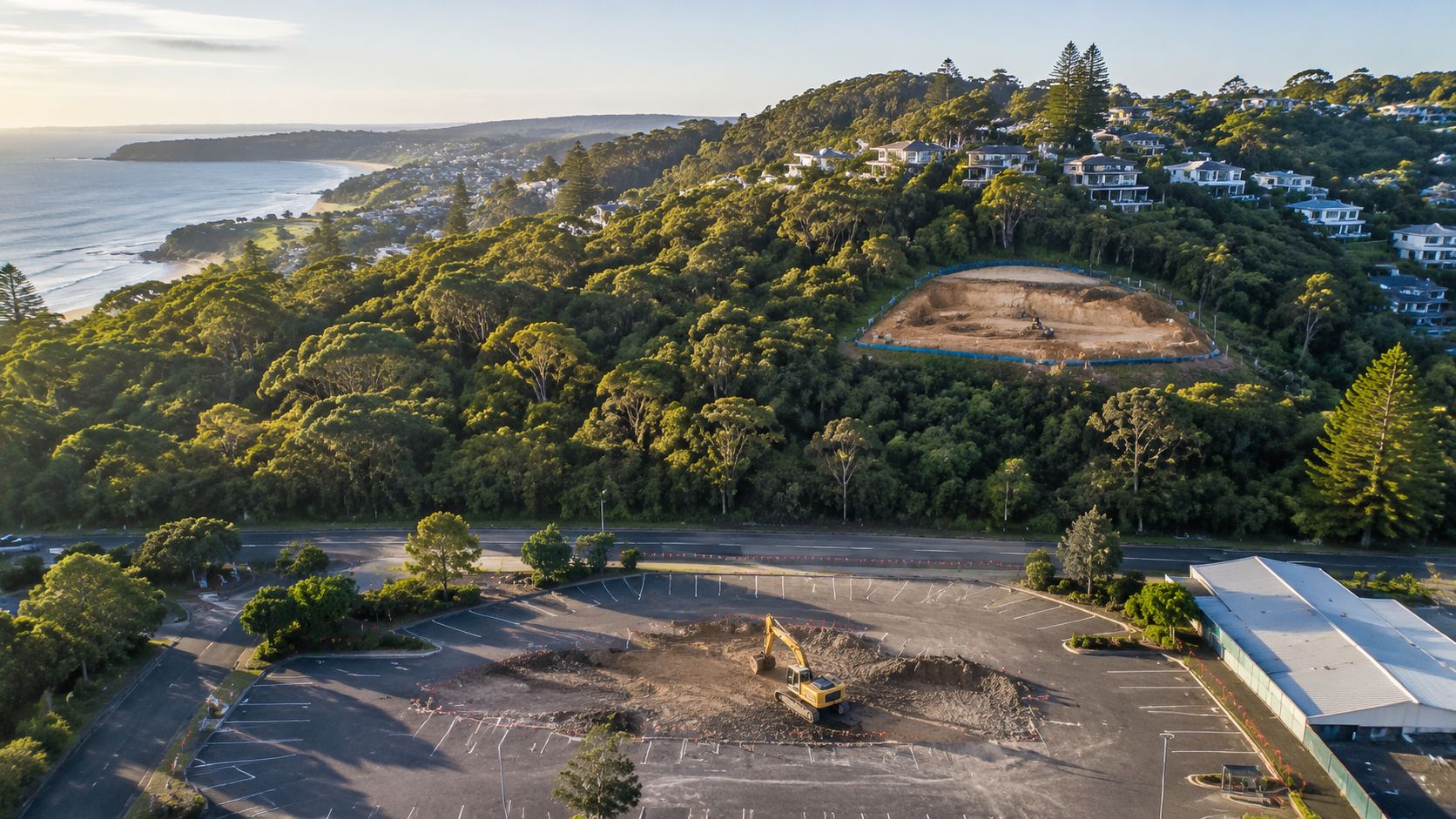
For excavation, land clearing, and concreting work, the practical difference is simple. EIA is not paperwork bolted on after the design is locked in. It affects where you cut, how you stage the works, what controls you install, what specialist reports are needed, and whether council is satisfied the job can proceed without creating drainage, erosion, biodiversity, noise, dust, or access problems.
Why developers get caught out
New developers often assume environmental assessment is for major highways, mines, or big government projects. On the ground in NSW, the issue is usually much more ordinary than that. Bulk earthworks behind a new duplex, clearing for access, reshaping a block, or pouring hardstand near a drainage line can all raise questions that need proper assessment.
Council is not just looking at your finished structure. They want to know what happens during construction as well. On Central Coast jobs, that usually means the practical risks. Sediment washing into the street. Water redirected onto the neighbour. Fill or spoil stockpiles left in the wrong spot. Clearing that reaches further than the approved work zone. Concrete washout managed badly.
Land clearing is a good example. The machine work itself may only take a day or two, but the approval issues around vegetation, habitat, erosion, and site access often need attention much earlier. If clearing is part of your programme, it helps to review the likely constraints before tender and before contracts are signed. A practical starting point is this guide to land clearing in Sydney, especially if your project team is still working out scope and sequencing.
Site rule: If the works will change water movement, disturb soil, remove vegetation, alter levels, or increase impacts on adjoining properties, treat environmental assessment as an early project item, not a late consultant task.
Why it matters to your budget and programme
The direct value of EIA is that it exposes trouble before it turns into redesign, conditions you cannot meet, or delays on site.
A good assessment gives council clear answers. It shows what is being disturbed, what could be affected, and what controls will be in place. For a civil package, that can mean revised cut and fill limits, better stormwater details, tighter clearing boundaries, sediment controls that actually suit the site, or a different sequence for excavation and concreting.
That work costs less at planning stage than it does once crews are booked and approvals are still unresolved. In practice, EIA protects programme as much as compliance.
When Is an Environmental Impact Assessment Required in NSW
You buy a site, line up the excavator, and assume the hard part starts when machines roll in. In NSW, the hard part often starts earlier. If your job involves clearing, bulk excavation, cut and fill, drainage changes, or a large concrete pour, council may want environmental impacts addressed before consent is issued, not after the site shed arrives.
The legal framework sits under the Environmental Planning and Assessment Act 1979, which is the starting point for working out what level of assessment a proposal needs in NSW. For the Act itself, use the NSW legislation site: Environmental Planning and Assessment Act 1979. On the ground, that usually means one practical question. Will the work change the site in a way that creates off-site effects or affects a sensitive part of the land?
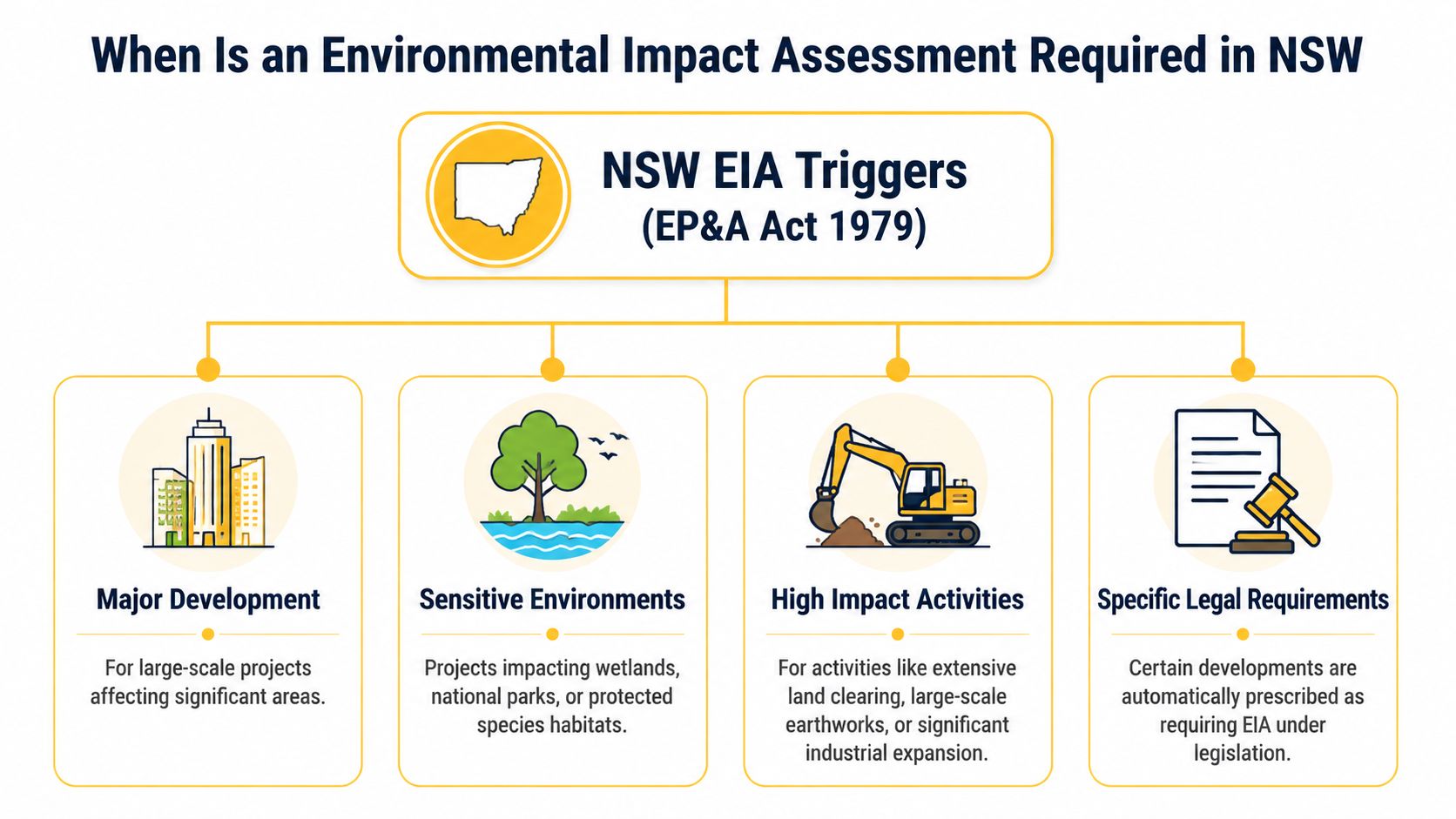
The triggers you actually need to think about
For civil works in NSW, EIA requirements usually become a live issue when the proposal is more than routine site prep. Large excavation volumes, imported or exported fill, vegetation removal, creek or overland flow impacts, retaining walls, access roads, and hardstand or slab areas can all lift the level of scrutiny. The name of the job matters less than the effect of the job.
Site context matters just as much. On the Central Coast, council will look closely at slope, runoff paths, receiving stormwater systems, proximity to vegetation, and whether disturbed material can leave the site in rain. A block that looks straightforward on a sales plan can become a problem once cut levels, spoil haulage, and concrete washout are shown properly.
Clearing is a common trigger. If you are removing trees or understorey, council will want to know exactly what is being cleared, where the clearing limits are, and what that means for habitat, erosion control, and adjoining land. The same goes for excavation near drainage lines or low points where sediment can move fast after one storm.
Concreting can also pull environmental assessment into the approval process, especially where new impervious area changes drainage behaviour or where the work sits close to neighbours, roads, or waterways. Noise, truck movements, pump setup, washout management, and stormwater design all start to matter.
A practical test before you lodge
Before lodging, check the proposal against the issues councils usually focus on:
- Will the works change levels or water movement? Cut and fill, trenching, new pits, kerb, pipes, and slabs can alter drainage on and off site.
- Will you clear vegetation or disturb bare ground at scale? That raises questions about erosion, sediment control, and possible ecological impacts.
- Will the work affect neighbours or public land? Dust, truck access, noise, vibration, and runoff are standard council concerns.
- Will the job need specialist reports to explain risk properly? Ecology, arboriculture, flooding, geotechnical, traffic, or contamination advice may be needed before design is locked in.
A good rule is simple. If the project needs more than a basic site plan to explain how you will stop sediment leaving the block, protect adjoining land, and manage clearing or spoil, you are already in environmental assessment territory.
That is why early review matters for demolition and excavation projects. A suburban job may look minor at first glance, but once you add deep cuts, spoil export, shoring, stormwater changes, tree removal, and concrete works, council often expects much clearer environmental documentation than a developer allowed for.
Councils do not assess the drawing title. They assess the actual site impacts. If your works change runoff, disturb soil, remove vegetation, or increase risk to neighbouring land, expect environmental assessment to become part of the approval path.
The Stages of the EIA Process From Start to Finish
Most EIA processes follow a logical sequence. Once you see the order of operations, it becomes easier to manage consultants, design revisions and council expectations without everything colliding at once.
A straightforward way to think about it is this: first you work out whether the job needs detailed environmental assessment, then you define what needs studying, then you gather evidence, respond to feedback, and carry those obligations through construction and monitoring.
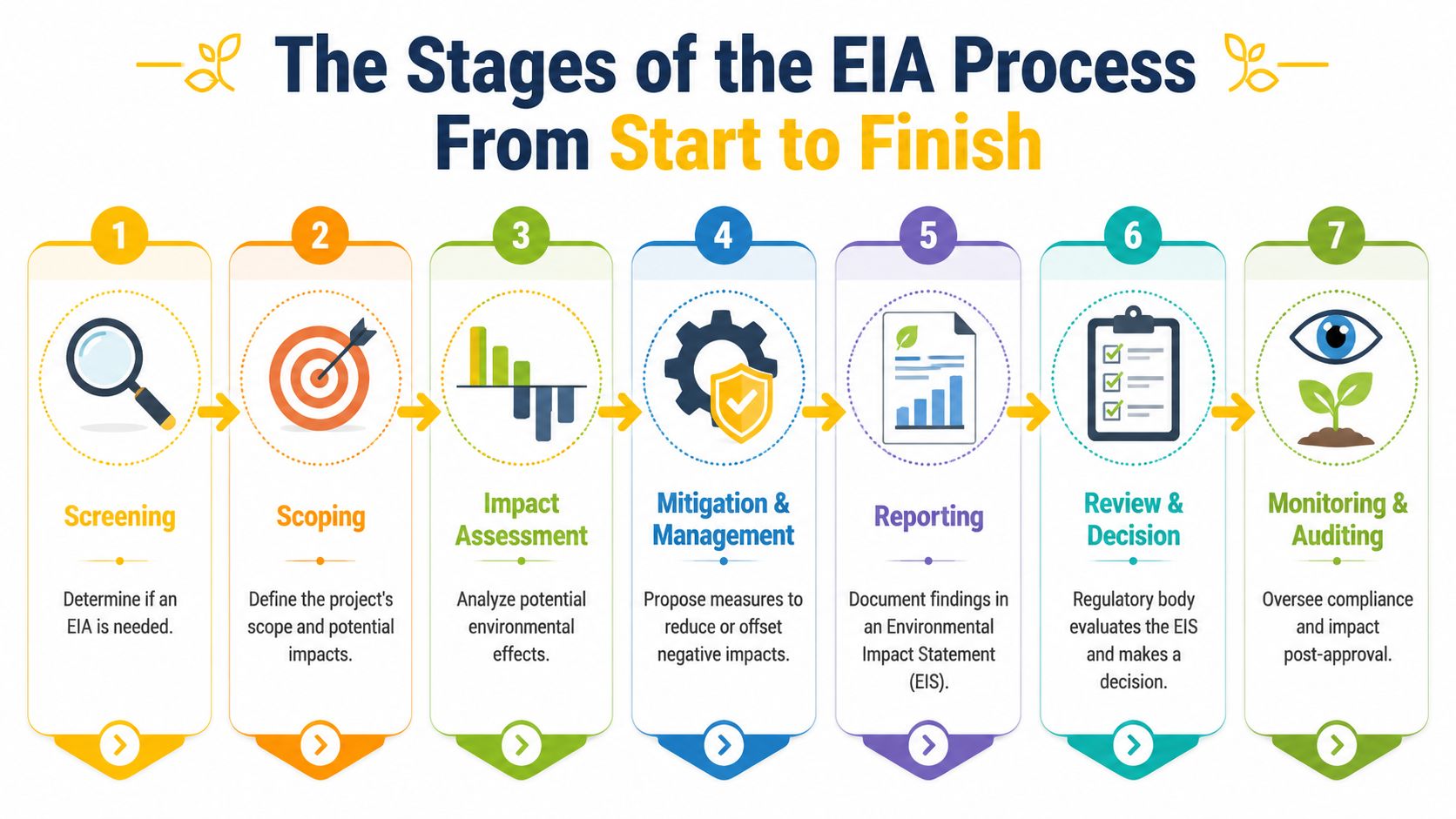
Screening and scoping
Screening is the first gate. At this stage, the team asks whether the project is likely to require a more formal environmental assessment.
Scoping comes next. Experienced teams prevent difficulties during this phase. A weak scope usually means the wrong issues get studied while critical site risks stay unresolved.
If you're doing subdivision works, this matters more than generally anticipated. Roads, service corridors, drainage, lot grading and clearing can all interact. Looking at subdivision works early helps because the environmental questions often sit inside the civil design, not beside it.
Assessment and reporting
Once the scope is set, the team collects baseline information and predicts likely impacts. That can include physical, biological and social conditions, depending on the job and the site. The point is to understand the existing condition before anyone claims the work will be manageable.
Then the reporting gets pulled together. Different projects use different documentation pathways, but the practical aim is always the same. The report has to explain what the project will do, what it may affect, how significant those impacts are, and what controls will be used.
Here's a useful explainer if you want a visual overview before diving into consultant documents:
Consultation, decision and monitoring
This is the stage many proponents underestimate. Critiques of EIA note that communities are often brought in only after projects already have momentum, which reduces the practical value of public submissions, as discussed in this critique of environmental impact assessment practice.
That's not just a policy issue. On the ground, late consultation can produce avoidable objections about haulage, noise, clearing, traffic and stormwater that should have been addressed in concept design.
Good consultation changes the design. Bad consultation produces a thicker file.
After review, the consent authority decides whether the project can proceed and on what conditions. Then comes the part plenty of people forget. Monitoring and compliance don't end at approval. Once works start, the environmental controls have to work in real weather, with real plant movements, real sediment loads, and real neighbour exposure.
Key EIA Considerations for Civil Works Projects
For excavation, clearing and concreting jobs, the strongest EIA documents aren't the ones packed with generic environmental language. They're the ones that match the actual site conditions and the actual work sequence.
The first thing assessors look for is whether the study area makes sense. A project's technically defensible study area should be defined by its effects footprint rather than just the construction lot, because significant impacts can extend across the surrounding watershed, airshed, and connected ecosystems, as explained in US EPA guidance on significance and study area.
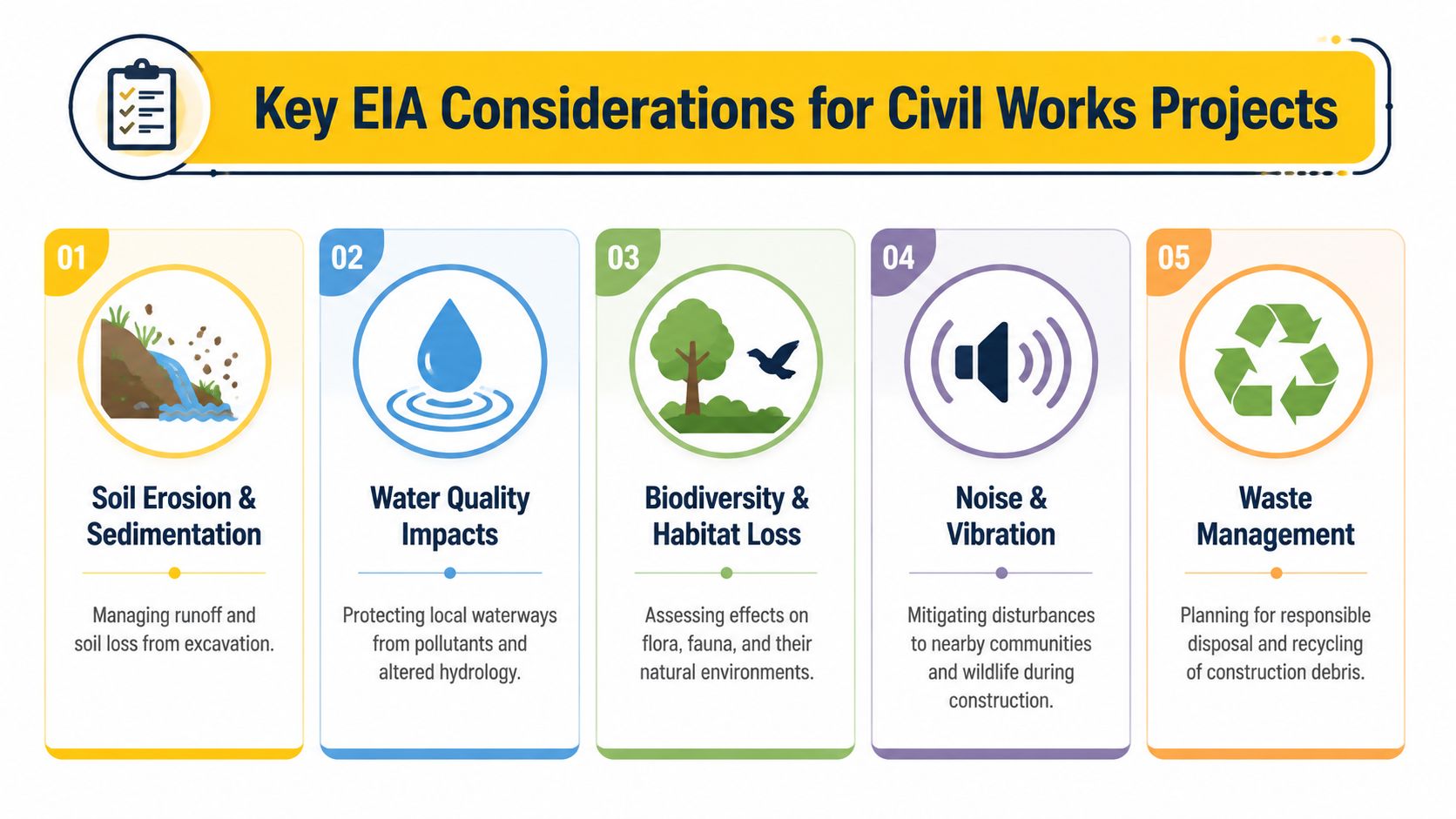
Excavation and earthworks
On a sandstone site in Sydney, assessors usually focus hard on cut stability, spoil handling, dust, vibration, and stormwater management during exposed-earth stages. On the Central Coast, especially around coastal suburbs with sandier profiles, erosion and sediment movement can become the bigger concern once vegetation comes off and rain hits an open batter.
If the block falls toward adjoining lots or a drainage line, the environmental question isn't limited to your title boundary. It's whether runoff, silt or dewatering impacts travel downslope.
Land clearing and habitat issues
Land clearing raises a different set of questions. Once vegetation removal enters the picture, the environmental assessment has to look beyond “we'll clear the site and tidy up later”.
Assessors want to know what's there now, what habitat connections may be affected, whether staged clearing makes more sense, and whether access tracks, stockpile areas and temporary works enlarge the disturbance area. That's one reason site safety and environmental planning often overlap with other compliance checks, especially where contamination or hazardous materials are in play. If you're reviewing legacy site risks as part of due diligence, understanding the NSW asbestos register requirements can help avoid blind spots before disturbance begins.
The fence line isn't the real boundary of impact. Water, dust and noise don't stop at pegs.
Concreting, runoff and site operations
Concreting projects create their own environmental pressure points. Washout, slurry, stockpiled materials, vehicle tracking and stormwater contamination are the usual traps. A slab or hardstand can also permanently change how water moves across the site, which means the environmental logic has to tie back to finished surface levels and drainage design.
A simple comparison helps:
| Work type | Typical EIA focus on site |
|---|---|
| Bulk excavation | Erosion, sediment, dust, vibration, spoil movement |
| Land clearing | Vegetation loss, habitat effects, access disturbance, runoff |
| Concreting works | Washout control, water quality, hardstand drainage, material handling |
The better the EIA aligns with the actual civil methodology, the fewer surprises you'll have once machines, trucks and crews are on site.
Mitigation Compliance and How We Manage EIA Obligations
A workable EIA doesn't stop at identifying risk. It has to show how the site will be managed day to day. That means controls, responsibilities, inspection routines, and a method that still holds up when the weather turns or sequencing changes.
A rigorous EIA process is data-driven. Project teams are expected to collect baseline data, predict impacts against standards, and implement monitoring to verify that mitigation for stormwater, noise, dust, and sediment remains effective over time, as summarised in this overview of environmental impact assessment practice.
What good mitigation looks like on site
Good mitigation is practical, visible and tied to the programme. For civil works, that usually means controls such as sediment fencing, stabilised access points, stockpile management, dust suppression, designated wash-down or washout areas, drainage protection, and staged disturbance rather than opening the whole site at once.
What doesn't work is copying a generic environmental management plan from another job and hoping it fits. Councils and certifiers can spot that quickly. In practical terms, the site crew can't use a generic plan properly because it doesn't reflect the actual access, grades, laydown areas or wet-weather risks.
The difference between paperwork and compliance
A lot of delays happen because the project technically has controls on paper, but nobody has integrated them into the construction method. For example:
- Sediment controls installed too late. If they go in after bulk disturbance starts, the site is already chasing the problem.
- Dust suppression with no water source planning. Saying water carts will be used isn't enough if access or supply hasn't been sorted.
- Stockpiles in the wrong place. A spoil pile near a drainage path can undo a lot of careful planning.
- No inspection rhythm. Controls fail unnoticed if nobody checks them after rainfall, traffic or sequencing changes.
Site lesson: Environmental controls only count when the crew can maintain them under real operating conditions.
The best-managed projects treat environmental obligations the same way they treat levels, safety and programme. They're built into pre-starts, inspections, subcontractor coordination and hold points. That's how you avoid the ugly version of compliance, where issues get picked up after neighbours complain or after sediment leaves the site.
Timelines Costs and Finding the Right Partners
This is the part most clients want answered first. How long will it take, and what will it cost? The honest answer is that environmental impact assessment can take time because the quality of the output depends on the quality of the information going in.
If surveys, concept design, drainage thinking, access planning and specialist input are all loose, the assessment drags. If the site is constrained, environmentally sensitive, or likely to attract neighbour concern, allow more time, not less. Rushing usually just shifts the delay downstream.
Where the money actually goes
The cost isn't one line item. It usually sits across several moving parts: environmental consultants, specialist surveys or reports, revised engineering input, extra design coordination, and potentially more detailed construction planning.
Land clearing jobs are a good example. The clearing itself is only one component. The planning, access method, spoil handling, disposal pathway, erosion controls and environmental documentation can materially change the overall budget. If you want a plain-English benchmark for how clearing costs can vary by site conditions and scope, Swift Trees Perth's price guide is a useful general reference, even though local NSW conditions and approval pathways will differ.
What to look for in a consultant or contractor
You want people who can read the site, not just the drawings. That means asking direct questions.
- Have they worked on comparable civil scopes. Excavation, clearing and concreting create different environmental issues.
- Can they explain likely approval risks in plain English. If they can't simplify it, they probably don't control it.
- Do they understand cumulative and human impacts. Practical EIA coverage is often thin on human health and cumulative impacts, even though they matter in Australian growth corridors where multiple earthworks and clearing projects can combine into broader effects, as discussed in this paper on health and impact assessment.
- Will they coordinate with the build team early. The job runs better when the design, approvals and construction method line up.
When you're vetting civil partners, it also helps to know what separates experienced operators from simple plant providers. A guide to choosing excavation contractors near you can help frame those conversations properly.
Your Client Checklist for EIA Readiness
If you think your project might trigger environmental impact assessment, get organised before the first formal lodgement. That doesn't mean overcomplicating it. It means getting the basics right early so council, consultants and contractors are all looking at the same job.
The first thing to lock down is your full project scope. Not the short version. The full one. Include clearing, temporary access, cut and fill, retaining, drainage, haulage, stockpiles, hardstand areas and likely staging.
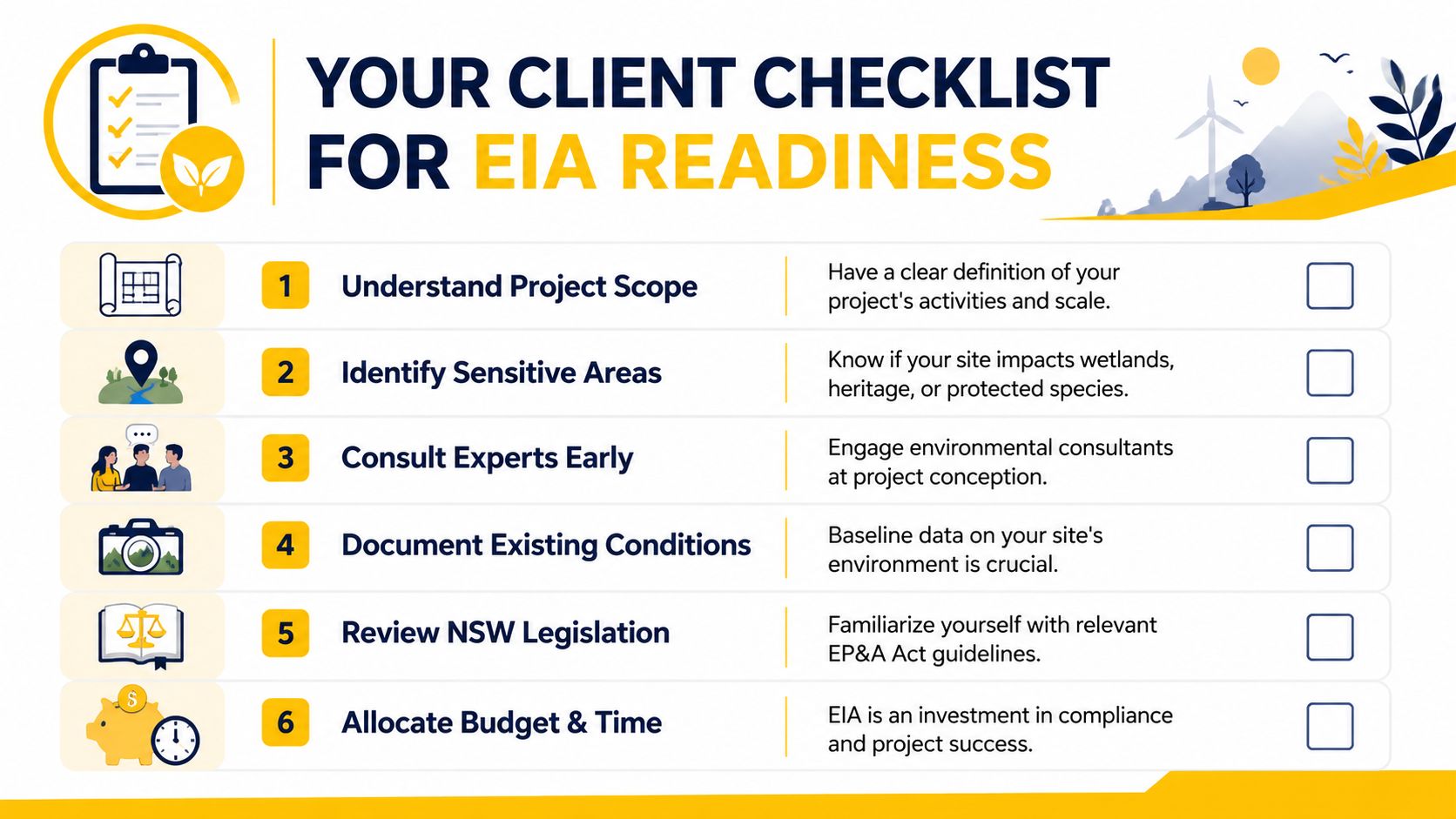
The questions worth asking early
Then look hard at the site itself.
- What sensitive features are present. Think slope, vegetation, drainage paths, neighbouring residences, heritage context, and any nearby water features.
- What information do you already have. Survey, concept plans, geotechnical input, title details and service information all help.
- Who needs to review it first. Council planners, environmental consultants, civil designers and sometimes specialist advisers should be involved before the design is too settled.
A quick early conversation with the relevant council can save a lot of churn. Central Coast Council, Newcastle Council and other NSW authorities want clarity. They want to understand the nature of the work, the site constraints, and how the likely impacts will be controlled.
A good readiness check sounds like this
You should be able to explain the job in a few direct sentences. What are we building? What ground will be disturbed? What leaves the site? What changes permanently once construction is finished? If those answers are vague, the approval process usually becomes vague too.
Get the site story straight first. Most EIA problems start because the project team is describing different versions of the same job.
Allow budget and time for proper assessment, and don't leave environmental review until the machines are booked. That's the simplest way to protect both programme and compliance.
If you're planning excavation, land clearing, concreting or full site prep across the Central Coast, Newcastle, Sydney or the Hunter, Booms Up Civil Group can help you sense-check the civil scope before it turns into an approvals headache. If you want practical advice on staging, access, drainage, spoil movement and how to set the job up properly from day one, get in touch for a straightforward conversation about your site.