
You're probably looking at a patchy old driveway, a bare block, or a set of plans for a new build and trying to make one call that affects both the look of the property and how much grief it gives you later. On the Central Coast, that decision usually comes down to concrete or asphalt.
It sounds simple until you factor in slope, drainage, council crossover rules, summer heat, coastal exposure, and how long you plan to keep the place. A driveway in Terrigal doesn't face exactly the same conditions as one in Kariong, and a long rural access in the Hunter doesn't behave like a short suburban driveway in Gosford.
The mistake I see most often is choosing on upfront price alone. That matters, but it's only part of the story. If you're still weighing up materials, this practical piece on choosing the right driveway surface is worth a look as well, especially if you're comparing more than one finish. If your job leans commercial or mixed-use, our article on commercial driveway considerations also adds useful context.
The Great Driveway Debate Concrete or Asphalt
Stand on a typical Central Coast block for five minutes and the trade-offs become obvious. A coastal site at Avoca or Wamberal might deal with salt air, blowing sand, and regular moisture. Move inland toward areas like Narara or Lisarow and you start thinking more about drainage paths, subgrade behaviour, and how the driveway ties into the house slab, garage level, and street.
For most homeowners, asphalt appeals first because it usually looks like the quicker, cheaper path. Concrete often wins later, once people think beyond handover day and ask what the driveway will look like in ten or twenty years.
Practical rule: A driveway is only partly about the surface. The bigger decision is how that surface will cope with your block, your vehicles, and your maintenance tolerance.
There's also the use case. A couple with two standard cars on a flat block may value a tidy finish and low fuss. A household with a boat, caravan, delivery traffic, or a steep access usually needs a tougher conversation about edge support, turning pressure, and heat performance.
That's where the concrete vs asphalt driveway debate gets more real than generic online advice. On NSW sites, especially around the Central Coast, the right answer often comes from whole-of-life thinking, not the first quote.
A Quick Comparison Concrete vs Asphalt
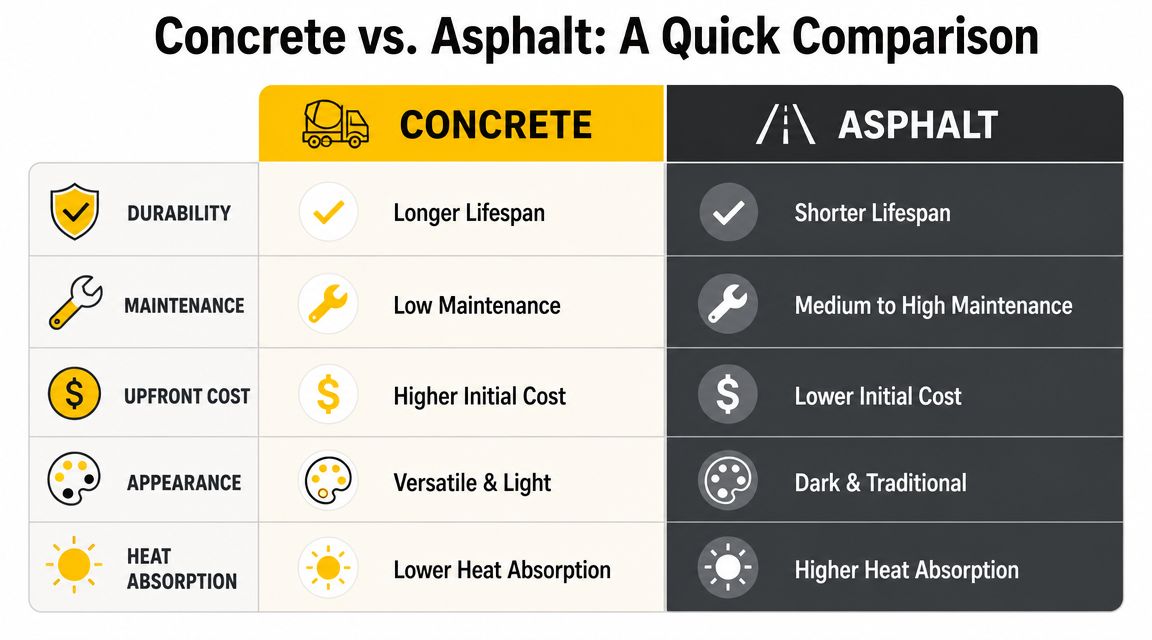
Some differences are immediate. Others only show up after a few summers, a few storms, and a few years of use. This side-by-side view gives you the short version.
| Factor | Concrete | Asphalt |
|---|---|---|
| Upfront cost | Higher initial spend | Lower initial spend |
| Long-term outlook | Usually stronger lifecycle value for long holding periods | Can suit tighter initial budgets |
| Maintenance pattern | Less frequent sealing and generally lower routine upkeep | More regular resealing and patch attention |
| Heat behaviour | More stable in hot conditions | More prone to softening in strong heat |
| Ground movement | Rigid surface, depends heavily on quality base prep | More flexible on minor movement |
| Appearance | Broader finish options, lighter visual look | Traditional darker finish |
| Best fit | Owner-occupiers planning to stay, heavier use, premium finish | Budget-focused installs, some lower-demand applications |
What usually pushes the decision
On a practical level, choices are often based on one of four priorities:
- Lower upfront spend: Asphalt usually gets attention first.
- Longer service life: Concrete usually comes out ahead.
- Less ongoing upkeep: Concrete generally suits this better.
- A forgiving surface on a less-than-perfect subgrade: Asphalt can help, but only if the base is still prepared properly.
Concrete suits clients who want to build once and move on. Asphalt suits clients who want a lower starting cost and accept more upkeep.
The important part is matching the material to the site. A driveway isn't an isolated surface. It works with the base, kerbs, falls, drainage, crossover, and the traffic it carries.
The Cost Breakdown Upfront Investment vs Lifecycle Value
Price matters. No one pretends otherwise. But the first number on a quote doesn't tell you what the driveway will cost to own over time.
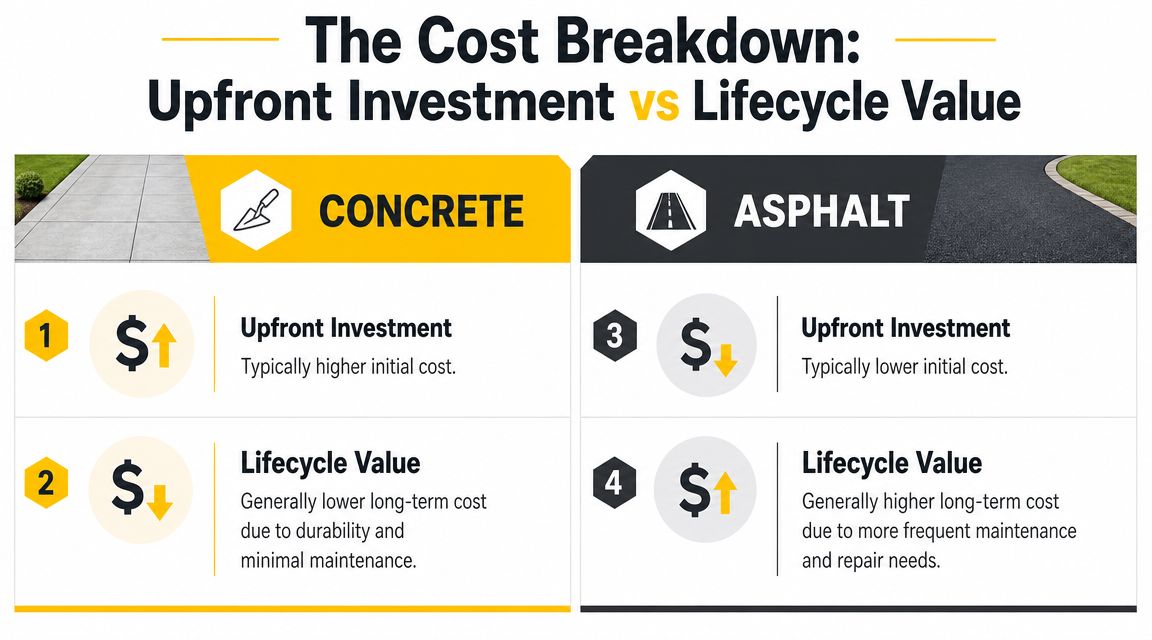
Industry comparisons report asphalt is usually $4 to $8 per square foot, while concrete is about $6 to $12 per square foot, making concrete roughly 40% to 60% more expensive upfront in many cases, according to this concrete and asphalt driveway cost comparison. That's the part most homeowners see first.
Why the cheaper quote can cost more later
The same comparison notes that asphalt generally needs resealing every 2 to 4 years, while concrete typically follows a 5 to 7 year sealing cycle with proper care. That difference changes the actual cost perspective over a long ownership period.
On a Central Coast property, that means you're not just comparing install day. You're comparing:
- Repeat maintenance visits: Asphalt needs more regular attention.
- Disruption: Sealing, patching, and repairs all take coordination.
- Regional contractor access: On some sites, especially where access is awkward or travel is longer, each return visit adds labour and mobilisation costs.
What NSW owners should focus on
A short-term owner may still prefer asphalt. If you're managing immediate build costs and need to keep initial spend down, that can be a rational decision. It's not wrong. It just needs to be made with open eyes.
A long-term owner usually benefits from looking at the driveway the same way they'd look at roofing or drainage. You don't only ask what it costs to install. You ask how often it needs work, how well it wears, and what it will be like to live with.
Cost check: If you're staying in the property for decades, lifecycle value often matters more than the day-one quote.
There's also the part many articles skip. Excavation, spoil removal, imported base, edging, stormwater control, and access constraints can shift the final price of either option. If you want a better handle on the earthworks side of that, our guide to the cost of excavation per cubic metre helps explain where driveway budgets often move.
Durability and Lifespan in NSW Conditions
NSW conditions expose weak driveways fast. Hot western sun, coastal moisture, poor drainage, and subgrade movement will all test the surface. The material you choose needs to suit the environment, not just the brochure.
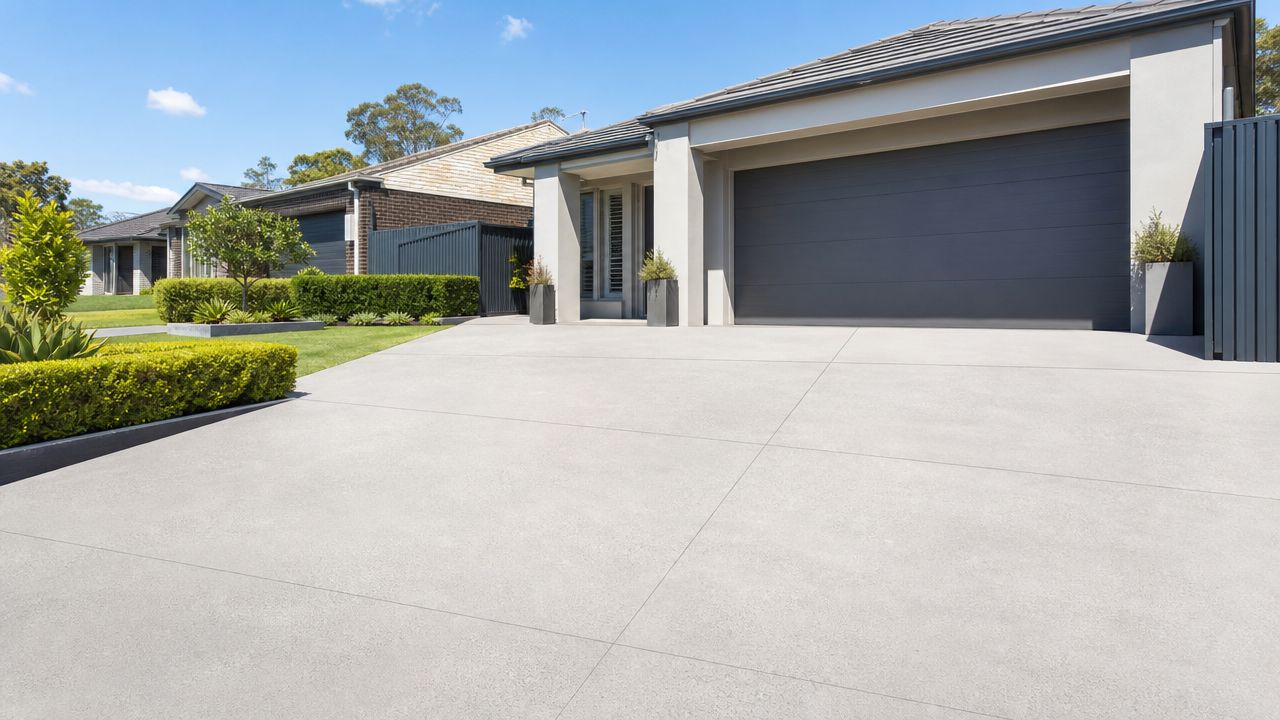
Major studies cited by the Michigan Concrete Association report an average service life of 27.5 years for concrete pavement versus 15.5 years for asphalt, and the same source notes concrete interstate pavements last about 2.5 times longer on average than asphalt in federally funded studies, as outlined in this concrete vs asphalt lifespan comparison. For residential driveways, concrete is often expected to last 30 to 40 years, while asphalt is typically 15 to 20 years before major repair or replacement.
Heat, load, and surface stability
This matters a lot in NSW. Asphalt is more prone to softening, rutting, and deformation under high temperatures, while concrete doesn't soften in the same way and is generally preferred where thermal stability and heavier vehicle loading matter.
Consider a sloping driveway in Wyoming or a long access where a caravan sits in one spot through summer. Surface pressure and heat can combine to stress asphalt more quickly. Concrete usually handles that type of loading with less shape change, provided the base has been built properly.
Ground conditions still decide a lot
Asphalt does have one practical advantage. Its flexibility can make it slightly more forgiving on suboptimal subgrades or where there's minor ground movement. That can help on some sites, but it doesn't cancel out the need for proper excavation, compaction, and drainage.
On the Central Coast, we deal with sandy coastal soils in some suburbs and heavier, more reactive material inland. In parts of Sydney, sandstone can simplify some areas and complicate others. In sections of the Hunter, clay movement can become the bigger issue. The common thread is simple. The surface only performs as well as the foundation under it.
If you want to understand why the base matters so much, our guide on how to compact soil properly for civil works is worth reading before you compare finishes.
A quick visual rundown can help if you want to see the broad performance differences in plain language.
Ongoing Maintenance and Repair Realities
Maintenance is where a lot of driveway decisions get tested. People often accept a lower upfront price without fully thinking through what routine upkeep looks like in practice.
What asphalt usually asks from you
Asphalt needs a more active maintenance approach. Resealing is part of the normal ownership cycle, and small cracks need attention before water gets into the base. Once water gets under the surface, damage tends to spread faster.
That means you need to stay on top of:
- Surface sealing: Done regularly to protect against UV, moisture, and contamination.
- Crack filling: Early repairs matter more than waiting.
- Edge care: Broken edges often start where vehicles run off unsupported sides.
If you leave asphalt too long between maintenance cycles, the surface can age faster than expected. The driveway may still be usable, but it won't stay neat or structurally consistent for long.
What concrete usually asks from you
Concrete is generally lower-fuss. You still need to clean it, manage staining, and reseal it on a sensible schedule, but you're usually not dealing with the same frequency of routine intervention.
The trade-off is different. If concrete cracks or chips, cosmetic repairs can be harder to blend neatly than an asphalt patch. So the goal with concrete is to get the base, joints, drainage, and finishing right from the start.
A low-maintenance driveway doesn't mean a no-maintenance driveway. It means fewer recurring jobs if the install was done properly.
For appearance, sealing makes a noticeable difference. It helps with staining, weathering, and the general finish. If you've got a plain concrete driveway and want practical ideas to achieve a lasting driveway finish, that guide is a useful companion read.
The repair reality most owners forget
Every repair costs more than materials. It costs your time, access, disruption, and sometimes extra traffic management if the driveway layout is tight or shared. That's one reason whole-of-life thinking matters so much on owner-builder and family-home projects.
If you don't want to keep revisiting the driveway, concrete usually suits that preference better.
Installation Process and Council Compliance
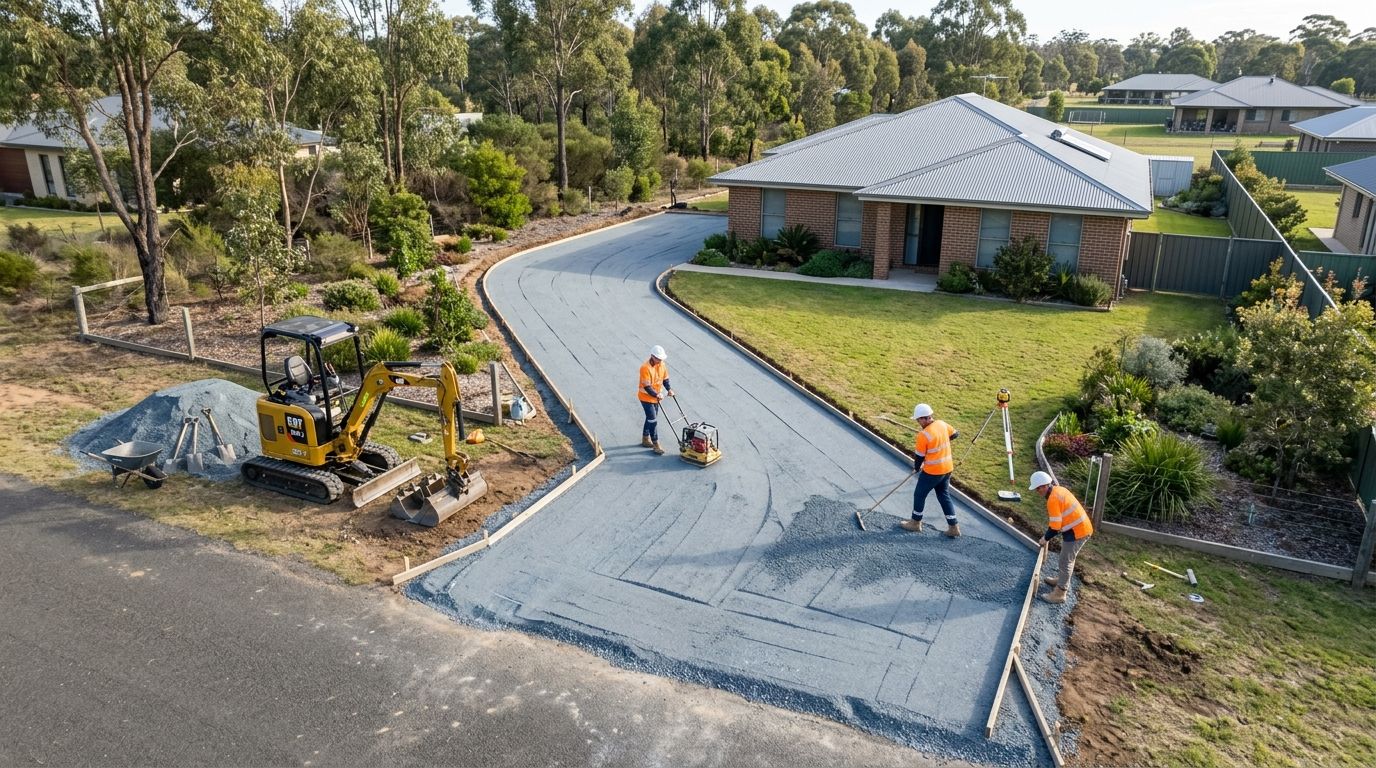
A lot of driveway problems start before the surface goes down. On the Central Coast, I see the same pattern over and over. The quote looks fine on paper, but the true risk sits in the excavation depth, the base build-up, the drainage falls, and how the driveway ties into the street.
What the install process actually involves
Both concrete and asphalt need a properly prepared foundation. On reactive soils, wet patches, or older sites with fill, that groundwork matters more than the final surface choice. If the subgrade is soft, the water has nowhere to go, or the falls are wrong, both products will show it.
Concrete usually takes longer because there are more steps to control. Set-out, boxing, reinforcement where required, pour planning, finishing, joint placement, and curing all need to be right. You also need to stay off it long enough for it to gain strength. That longer program can be worth it on owner-occupied homes where the goal is lower intervention over time.
Asphalt is faster to lay and usually quicker to reopen, which can suit busy households or jobs where access is tight. But the speed only helps if the base is built properly first. A rushed asphalt install over a weak or damp foundation often costs more later through reshaping, patching, or early resurfacing.
The council side catches owners out
The part inside your boundary is only half the job. Once work reaches the verge, kerb, footpath, or road reserve, council requirements come into play. On the Central Coast, that often affects crossover width, levels, kerb modifications, stormwater discharge, and how the driveway meets the street without sending water into the wrong place.
That matters for cost as much as compliance. A cheaper quote can become expensive if it leaves out council approvals, kerb reinstatement, or rework at the frontage. If your job touches the street interface, read up on driveway crossover requirements and construction before work starts.
SafeWork NSW obligations also sit in the background on residential jobs. Excavation safety, plant access, spoil placement, and pedestrian separation all need to be handled properly, especially on narrow frontages or occupied sites.
Questions worth asking before you sign
Before accepting a quote, get clear answers on these points:
- Excavation scope: How deep is the dig, and what happens if the crew finds soft spots or unsuitable material?
- Base specification: What material is going in, how will it be compacted, and is it suited to the vehicles using the driveway?
- Drainage and falls: Where will surface water go during heavy rain, and how is runoff being controlled at the garage and street?
- Council responsibilities: Who is handling approvals, inspections, and any work in the verge or kerb area?
- Access and curing time: When can you walk on it, park on it, and use it normally?
Good driveway work is quiet, methodical civil work. The finished surface gets the attention, but the long-run value comes from the parts below it and the way the frontage is built to local requirements.
Even if you are comparing other surface options, broader design references can still help you frame the right questions. This guide for Austin homeowners on driveway pavers is one example. The materials are different, but the planning issues around base prep, drainage, access, and street connection are much the same.
Making Your Final Decision
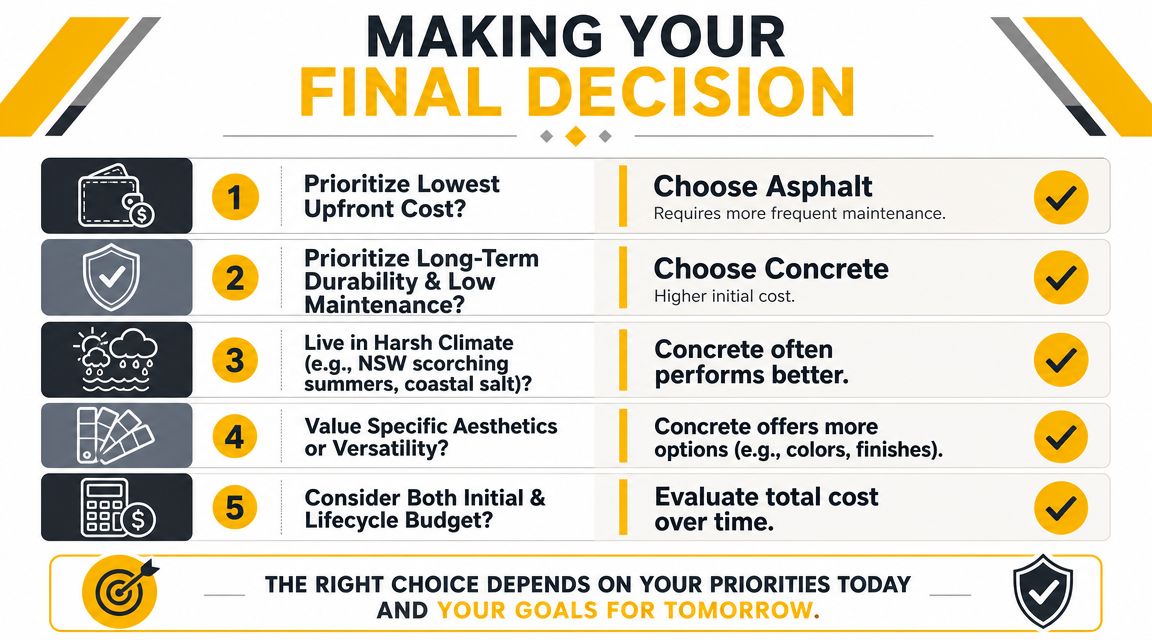
The right answer usually shows up once you stop asking “Which is cheaper?” and start asking “Which suits this block, this budget, and this ownership plan?”
A simple way to decide
If your main priority is the lowest upfront cost, asphalt often makes sense. If your priority is a longer-lasting driveway with less ongoing maintenance, concrete usually suits better.
A few practical scenarios make that clearer:
- You're building a forever home in Terrigal or Matcham: Concrete often lines up better with long-term ownership.
- You need to control initial spend on a secondary property or shorter-term hold: Asphalt can be a reasonable fit.
- You park heavier vehicles or deal with strong summer exposure: Concrete tends to be the safer long-run choice.
- You care a lot about finish options and presentation: Concrete usually gives you more visual flexibility.
Don't choose by photos alone
Online inspiration is useful, but it can also distract from the basics. A polished image doesn't show the base, drainage, or council interface. Even when you're comparing other materials, broader design guides can still help sharpen your priorities. For example, this guide for Austin homeowners on driveway pavers is outside NSW, but it's still useful for thinking through appearance, function, and long-term maintenance as separate decisions.
The best concrete vs asphalt driveway choice is the one that matches your site conditions and how you'll use the space. If you're narrowing that down, our article on how to compare concrete driveway contractors near you can help you assess quotes and ask better questions.
Frequently Asked Questions
Which option is better on a steep block
Both can work on sloping sites, but the build quality matters more as the slope increases. On steep Terrigal, Copacabana, or Northern Beaches blocks, drainage, traction, edge restraint, and sub-base stability need close attention.
Concrete is often preferred where you want a stable finished shape and better resistance to heat-related deformation. Asphalt can still work, but slope and summer heat can be a tougher combination if the driveway carries heavier vehicles or regular turning loads.
Which one handles minor ground movement better
Asphalt's flexibility can make it slightly more forgiving than rigid concrete on suboptimal subgrades or for minor ground movement, but it also requires periodic resealing every 2 to 4 years to protect against UV, water ingress, and oil damage, as noted in this driveway performance comparison focused on flexibility and maintenance.
That doesn't mean asphalt is the fix for a poor base. If the ground is moving enough to worry you, the first conversation should be about site preparation, drainage, and whether extra ground treatment is needed.
Which one is easier to customise
Concrete usually gives you more finish options. Plain grey, exposed aggregate, broom finishes, and coloured treatments are common choices depending on the style of the house and slip-resistance needs.
Asphalt is more limited visually, but some owners still prefer its darker, simpler look, especially for longer rural or semi-rural driveways.
What should I look for in a contractor
Check that they understand excavation, compaction, drainage, and council crossover requirements, not just the surface layer. Ask who manages approvals, what's included in the base, how they handle stormwater, and when you can safely use the driveway.
If they gloss over falls, sub-base, or verge interface details, keep looking. That's where most avoidable problems start.
If you're planning a driveway on the Central Coast, in Newcastle, Sydney, or the Hunter, Booms Up Civil Group can assess the site, explain whether concrete or asphalt makes more sense for your conditions, and provide practical advice on excavation, drainage, crossover compliance, and construction. You can call, email, or send an enquiry through the website for a straightforward quote and site discussion.