At its heart, land subdivision is simply the process of taking one piece of land and legally dividing it into two or more smaller, independent lots. Once the process is complete, each new lot gets its own separate property title. That means it can be sold off, built on, or kept, completely separate from the original block.
It’s a powerful strategy many property owners use to unlock the hidden value in their land. For over 15 years, we've helped landowners on the Central Coast, in Sydney, and across the Hunter Valley navigate this process, turning their plans on paper into tangible, valuable assets.
What Is Land Subdivision and Is It Right for You?
Think of it as more than just putting up a new fence. A subdivision is a formal, legal process that creates entirely new, saleable properties. For many homeowners across the Central Coast, Sydney, and the Hunter Valley, it's a popular way to generate wealth from an asset they already own. Maybe you have a big backyard in a suburb like Umina Beach or Adamstown Heights and want to build a second home for family, or perhaps sell the new lot to top up your retirement fund.
The reasons people choose to subdivide are diverse, but they usually boil down to a few key goals:
- Generating Profit: Selling a newly created lot is the most direct way to turn your land into liquid capital.
- Family Accommodation: It's a fantastic option for creating a separate lot for your kids or parents to build on, letting you live close by while maintaining independence.
- Small-Scale Development: Some people choose to build a new home on the subdivided land to rent out for passive income or to sell as a complete house-and-land package.
Before you get too far down the road, it's crucial to understand the very first steps. It always starts with a detailed assessment of your property, which means getting it professionally surveyed. For a deeper dive into this critical first step, check out a practical guide on how to survey land. This survey becomes the foundation for all your plans and council applications.
Key Types of Subdivision in NSW
In New South Wales, you’ll mainly come across two types of land subdivision. The one you choose really depends on what you're trying to achieve with your property.
The most common by far is a Torrens Title subdivision. The best way to think of this is creating a completely independent, freestanding block of land. Once the subdivision is registered, the new lot is entirely separate from the original—no shared property, no ongoing legal ties. This is the standard path you'd take to carve a new residential block out of a larger one.
The other option is a Strata Title subdivision. You see this all the time with apartment blocks, townhouses, or commercial units where there are common areas like driveways, gardens, or shared walls. With a Strata Title, you own your individual unit or 'lot', but you also share ownership and responsibility for all the common property through an owners' corporation.
Navigating the NSW Subdivision Approval Process
Getting council approval for a subdivision can feel like wading through mud, but once you understand the lay of the land, it becomes a much clearer path. The whole journey starts long before you even think about lodging paperwork. Your first port of call, without exception, should be your local council’s planning rules – specifically their Local Environmental Plan (LEP) and Development Control Plan (DCP).
Think of these documents as the rulebook for your local area. They’ll tell you exactly what you can and can’t do on your block, spelling out things like minimum lot sizes, frontage requirements, and zoning restrictions. The rules for carving up a residential block in Newcastle, for instance, are worlds away from what’s allowed on a rural property in the Hunter Valley. This initial homework isn’t optional; it’s the foundation of your entire project and the best way to sidestep costly dead ends.
Development Application vs Complying Development
Once you've confirmed your plans actually line up with what the council allows, it's time to seek formal approval. In NSW, there are two main tracks you can take: a full Development Application (DA) or the more streamlined Complying Development Certificate (CDC). The path you end up on really boils down to how complex your subdivision is.
A Complying Development Certificate (CDC) is the faster, more straightforward option. It’s designed for low-impact projects that tick all the boxes of a clear, black-and-white set of state-wide criteria. A simple two-lot subdivision on a flat, easily accessible block in a suburb like Gosford is a classic candidate for a CDC, which could see you get the green light in a matter of weeks.
The Development Application (DA) is for everything else. It’s the more common route for subdivisions because, let’s face it, most projects have a wrinkle or two that don’t fit the strict CDC mould. If you’re dealing with a sloping block in Terrigal that needs significant earthworks, or if your land has protected trees or sits in an environmentally sensitive area, you’ll be lodging a DA. This process is far more detailed, involves a public notification period where neighbours can have their say, and can take anywhere from six to twelve months for a council decision.
This decision path shows how your end goal often points you toward a certain type of subdivision, which in turn influences the approval process you'll need to follow.
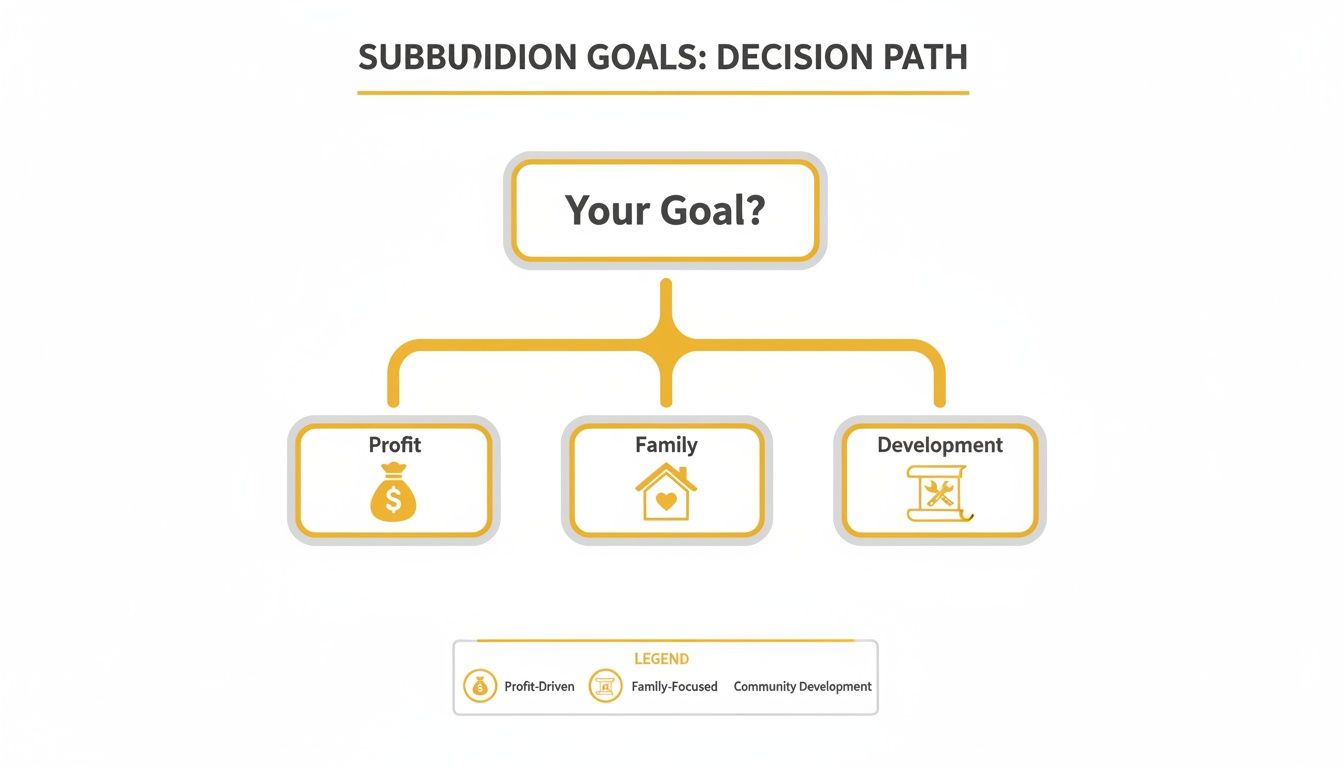
Whether you’re aiming for profit, setting up lots for family, or kicking off a larger development, knowing the scale of your ambition early on helps you prepare for the complexity ahead.
Essential Documents for Your Application
Whichever path you take, you’ll need a solid stack of documents to back up your application. Getting this part right is absolutely critical for a smooth run. Councils need to see that your proposal is well-thought-out, compliant, and has considered all the potential impacts.
You'll typically need to pull together:
- A Detailed Survey Plan: Prepared by a registered surveyor, this is the master plan showing your property boundaries, contours, existing structures, and the proposed new lot layout.
- Statement of Environmental Effects (SEE): This report details the potential environmental impacts of your subdivision and, more importantly, how you plan to manage them.
- Civil Engineering Plans: This is where the practical details come to life. These plans map out crucial elements like drainage, driveway access, earthworks, and service connections. A civil contractor's input here is invaluable.
- Site-Specific Reports: Depending on your block, you might need extra reports covering things like bushfire risk, Aboriginal heritage, or flora and fauna. If your land has significant trees, you’ll need a plan that respects council preservation orders. You can find information on effective land clearing services that know how to navigate these important regulations and get your site prepared correctly and legally.
Submitting a complete, professional application is your best strategy for minimising delays. It signals to the council that you’ve done your due diligence and are serious about getting the project right from day one.
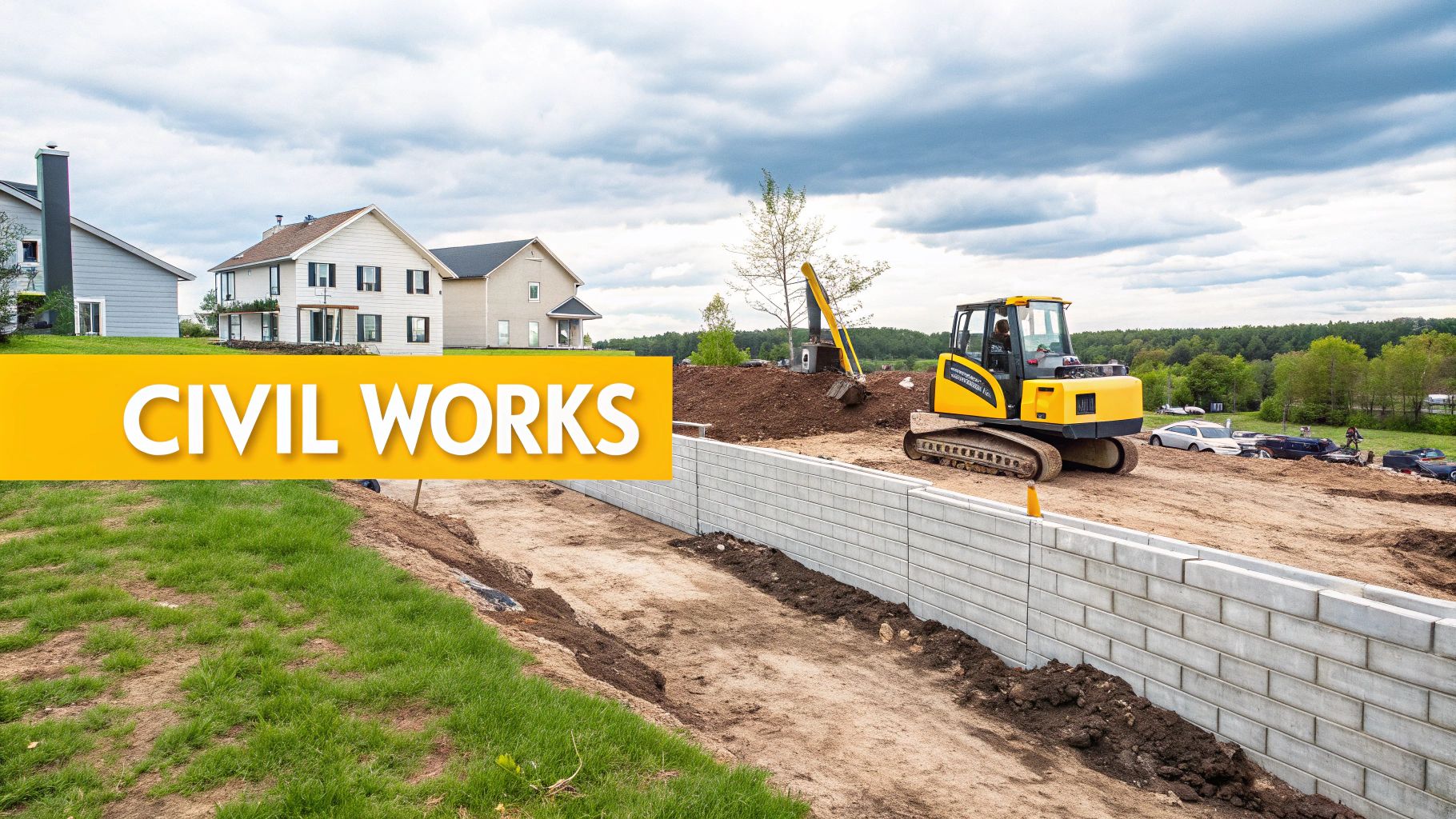
The Critical Civil Works Your Subdivision Will Need
Once your plans get the green light from the council, the project shifts from paperwork to groundwork. This is where your subdivision truly starts to take shape, and where a skilled civil contractor becomes your most important partner.
The quality of these physical works determines not just the success of the project, but also its final cost and timeline. Getting it right the first time is non-negotiable. This phase is all about transforming a plan on paper into registered, serviceable lots ready for building. It’s a carefully sequenced process that involves clearing the site, shaping the land, and installing all the essential infrastructure.
Let's break down exactly what that looks like on the ground.
Site Clearing and Preparation
Before any earth can be moved, the site must be properly prepared. This starts with clearing any unwanted vegetation, demolishing old structures, and removing debris.
However, this is more than just a rough clean-up; it must be done in strict compliance with your council’s conditions, especially their tree preservation orders. Let's say your property in a leafy Newcastle suburb has several large gum trees. Your DA approval will specify exactly which trees must be protected and which can be removed. An experienced contractor knows how to work carefully around protected vegetation, setting up exclusion zones to prevent root damage from heavy machinery.
Earthworks and Site Levelling
With a clean slate, the next step is earthworks—the process of cutting, filling, and shaping the land to create the final contours for your new lots. The goal is often to create level, stable building pads (known as 'building envelopes') where future homes will stand.
Imagine a sloping block on the rolling hills of the Hunter Valley. It needs careful excavation, where soil is 'cut' from the high side and 'filled' on the low side to create a level platform. This process requires precision to ensure the finished levels match the engineering plans, the soil is correctly compacted to prevent future movement, and the site drains effectively away from the building areas.
Access and Retaining Walls
Every new lot needs safe, legal access. This typically involves constructing a new driveway or road from the street to the property boundary, built to strict council specifications for things like gradient, width, and materials.
On sloping sites, retaining walls are often needed to support the newly levelled ground. An engineered retaining wall isn't just a garden feature; it's a structural element designed to hold back tonnes of soil safely. Building these correctly is critical for preventing landslip and maximising the usable, flat area on each new lot.
Drainage and Service Connections
Proper stormwater drainage is one of the most critical parts of any subdivision, especially in coastal areas like the Central Coast that experience heavy rainfall. Your civil plans will detail a complete drainage system, including pits and pipes, to capture rainwater from roofs and hard surfaces and direct it to the council's system. Failing to get this right can lead to flooding, erosion, and expensive rectification works.
Finally, each new lot needs to be connected to essential services. This involves excavating trenches to lay conduits and pipes for:
- Water and Sewer: Connecting to the mains supplied by authorities like Hunter Water or Sydney Water.
- Electricity and Telecommunications: Laying conduits for power and NBN connections, ready for the service provider (e.g., Ausgrid) to run their cables.
- Gas: If available and required in your area.
This trenching work must be done safely and to the exact depth and location specified in the plans. For a detailed look at the safety and technical aspects of this work, you can learn more about our approach to safe and compliant trenching and shoring techniques.
A well-executed civil works program is the backbone of a successful subdivision. It ensures the new lots are safe, stable, and fully serviced, meeting all council and utility authority standards for a smooth final sign-off and registration of titles.
Understanding Your Subdivision Costs and Timelines
When you’re thinking about subdividing a block of land, two questions always jump to the front of the queue: "How much is this going to cost?" and "How long is this going to take?" There’s no magic number, because every project is unique. However, we can definitely break down the key factors that will shape your budget and schedule, giving you a much clearer picture of the road ahead.
Getting a handle on these elements from the start helps you set realistic expectations. It’s the best way to prevent budget blowouts and minimise stress, making sure your project stays on track from the first council application all the way through to getting those new property titles in your hand.
Breaking Down the Costs of Subdivision
The final price tag on your subdivision isn’t just one big number; it’s a sum of several distinct parts. It’s about much more than the cost of excavation work. You’ve got to factor in professional fees, council contributions, and the costs to get services connected.
Here are the key expenses you’ll typically encounter:
- Professional and Consultant Fees: This covers the essential experts who get your project designed and ready for council. You’ll need a registered surveyor, a town planner, and likely engineers for drainage designs and any structural elements like retaining walls.
- Council Fees and Contributions: Just lodging a Development Application comes with significant fees. On top of that, councils also levy 'Section 7.11' contributions, which are payments that go towards funding local infrastructure like parks, community facilities, and roads.
- Civil Works Costs: This is your on-the-ground construction budget. It covers all the physical work, including clearing the site, all the earthworks, building retaining walls, installing drainage, and forming the new driveways or roads.
- Service Connection Fees: You'll need to pay fees to authorities like Ausgrid and Sydney Water or Hunter Water. These are for the formal connection of essential services like power, water, and sewer to your newly created lot.
Putting together a detailed construction estimate format in Excel is a fantastic way to keep a firm grip on your subdivision costs. It helps you track every single expense, from the first surveyor fee right down to the final connection charges.
What Influences Your Final Budget?
Several site-specific factors can dramatically change the cost of your civil works. A flat, clear block in a suburb like Cessnock, for example, is going to be far more straightforward and affordable to work on than a steep, rocky site on Sydney's Northern Beaches.
The main variables that move the needle are:
- Site Slope: A steep block means more extensive earthworks. This often involves significant site cuts and potentially large retaining walls just to create stable, level building areas.
- Soil Type: The ground conditions dictate the equipment and methods we need to use. Dealing with Sydney's hard sandstone bedrock, for instance, requires specialised rock saws and hammers. In contrast, the sandy coastal soils on the Central Coast present their own unique challenges for compaction and stability. If any contaminated soil is discovered, that will add costs too; you can learn more about the processes for compliant soil removal and management.
- Existing Vegetation: The number and size of trees that need to be removed (or protected) will directly affect your land clearing costs and timeline.
- Access: A tight site or one that’s difficult to get into might require smaller machinery or specialised equipment, which can increase labour time and costs.
Mapping a Realistic Project Timeline
When it comes to property development, patience is a genuine virtue. A subdivision is not a quick project, and funnily enough, the timeline is often dictated more by council processing times than the physical construction work itself.
To help you plan, we've put together a table outlining the typical phases and their durations. Keep in mind that these timelines can shift quite a bit depending on how complex your project is and how busy your local council is.
Typical Subdivision Project Timeline
| Project Phase | Typical Duration | Key Activities |
|---|---|---|
| Planning & Design | 1-3 months | Engaging your surveyor and planner, conducting site investigations, and preparing all necessary documents for your council application. |
| Council Approval | 6-12 months (DA) | This is often the longest wait. A straightforward Complying Development Certificate (CDC) might be faster, but a full DA can easily take a year. |
| Civil Works | 1-4 months | The on-site construction. The duration depends heavily on project complexity, the scope of works, and, of course, the weather. |
| Final Certification & Titles | 1-3 months | After construction, you'll need final inspections, a Subdivision Certificate from council, and then you can lodge your plans with NSW Land Registry Services. |
Once the final plans are registered, the new property titles are officially created, and your project is complete.
Why Engaging a Civil Contractor Early Is Key
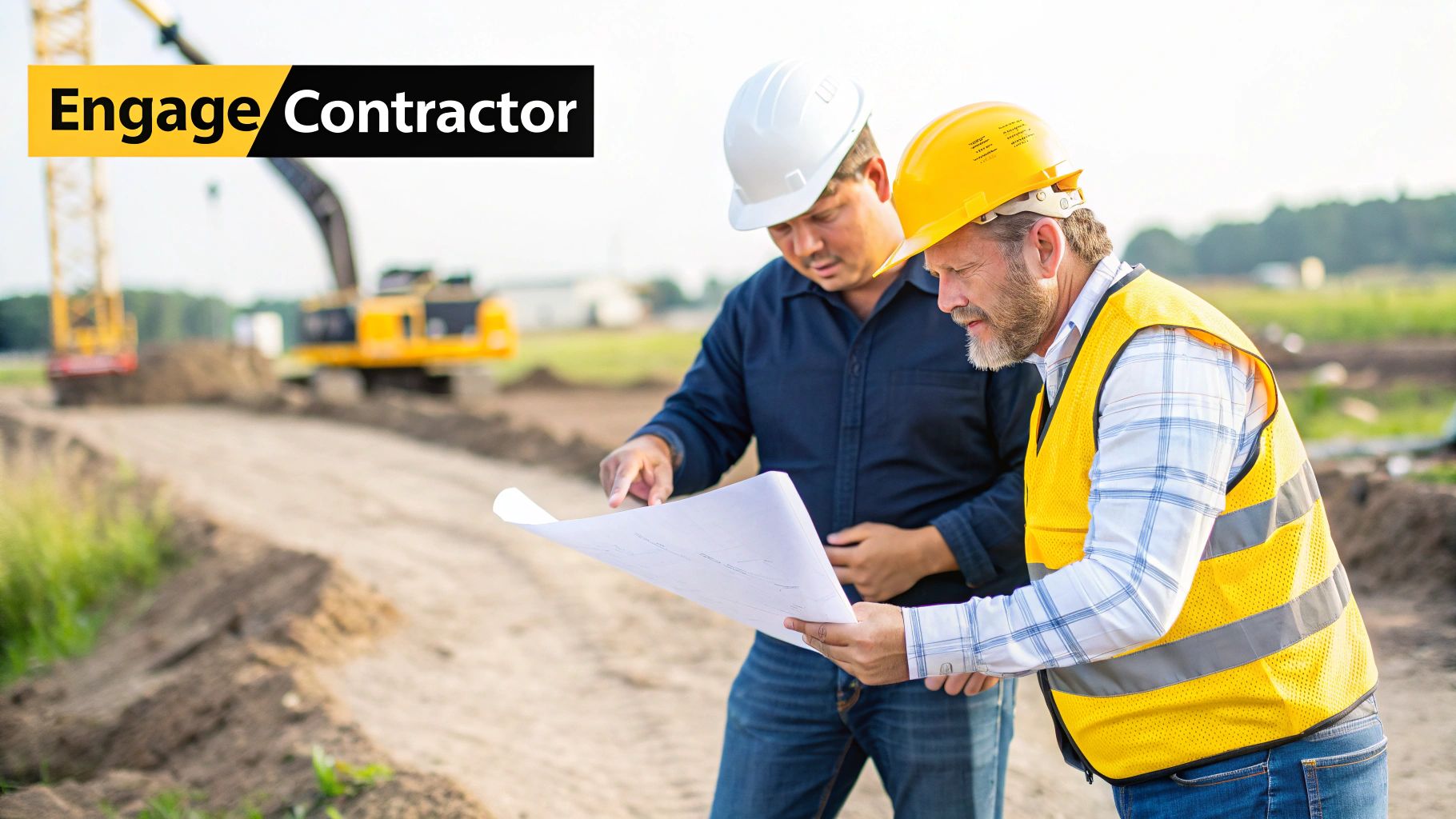
Bringing a civil contractor onto your subdivision project early is one of the smartest moves you can make. It’s a common misconception that we just show up to dig holes when the plans are done, but getting an experienced team involved during the planning phase can save you a phenomenal amount of time, money, and stress down the track.
This simple step shifts your contractor from being just an operator to an essential project partner. Think of it as an investment in foresight—we provide the practical, on-the-ground advice that can shape your plans for the better before anything is set in stone.
Identifying Problems Before They Cost You
Getting an expert on-site sooner rather than later helps you spot potential showstoppers before they become expensive surprises. We can see the red flags that simply don't show up on a surveyor's plan.
Imagine your plans are already lodged with Central Coast Council, and only then do you discover a deep layer of unexpected rock right where the building envelopes are supposed to go. That discovery would trigger costly plan amendments, force you to hire specialised rock-breaking equipment, and completely derail your budget and timeline. An early site assessment lets us flag these issues right at the start.
Collaborating for a Smarter Design
When we work alongside your surveyor and town planner from day one, we bring a practical viewpoint that perfectly complements their expertise. They see the boundary lines and zoning rules; we see how the land will actually behave when we start moving it.
For example, we can provide critical input on:
- Site Layout: Sometimes, minor adjustments to the position of driveways or building envelopes can drastically reduce the amount of cut-and-fill earthworks needed, saving you thousands.
- Drainage Design: We can advise on the most efficient and cost-effective way to manage stormwater, making sure your design is both compliant with council regs and practical to build.
- Retaining Wall Placement: By walking the site and assessing its natural contours, we can help position retaining walls to maximise usable space while keeping construction complexity and costs to a minimum.
An experienced civil contractor offers more than just machinery; they provide invaluable insights that help you design a more buildable, cost-effective subdivision from day one.
Budget and Timeline Realism
One of the biggest perks of early engagement is getting a realistic grip on your civil works budget. After assessing your site, we can provide an accurate estimate for the physical works, which allows you to build a far more reliable overall project budget.
This early insight helps you make properly informed decisions. Knowing the likely costs for earthworks and drainage might influence how you approach the entire project, ensuring you have the finances locked in before you commit to a final design. This proactive approach is fundamental, and you can learn more about what to look for when choosing the right subdivision contractors to get this expert guidance from the beginning.
Ultimately, involving us early transforms the process from reactive problem-solving into proactive, strategic planning. It’s about using our 15+ years of local experience across the Central Coast and Hunter Valley to get your subdivision right the first time, ensuring a smoother journey from concept to the final registration of your new titles.
Your Subdivision Questions Answered
We get it—the world of subdivision can feel a bit like learning a new language, and you’ve probably got a list of questions running through your head. With over 15 years of hands-on experience across the Central Coast, we’ve heard just about all of them.
This is where we cut through the jargon and give you straight answers to the questions we hear most often from property owners just like you. Our goal is to arm you with practical knowledge from the guys who are out there on the ground every day, so you can move forward with confidence.
Let’s tackle some of those common hurdles.
How Much Land Do I Need for a Subdivision in NSW?
This is the big one, and the honest answer is: it all comes down to your local council. The minimum land size you need for a subdivision is dictated by your property's specific zoning, which you’ll find in your council's Local Environmental Plan (LEP).
For example, if your block is in a standard R2 Low Density Residential zone, a council like Central Coast Council might set the minimum at 450–550 square metres for each new lot. For a simple split down the middle, that means you'd need a block of at least 900–1100 square metres to even get started.
But size isn't the only thing they look at. Council will also be interested in things like street frontage width, access for vehicles, and any environmental constraints. Your first port of call should always be your local council's website to check the specific rules for your property's zoning.
Can I Live on My Property During the Subdivision Works?
Yes, in many situations, you can absolutely stay in your home, especially if the work is contained to subdividing your backyard. But it's really important to be mentally prepared for some serious disruption during the civil works.
We’re talking about heavy machinery, which means noise, dust, and parts of your property being off-limits. For safety, the work area must be securely fenced off—this is a strict SafeWork NSW requirement to create a clear separation between the construction zone and your home. You might also find your driveway is temporarily blocked when we’re connecting services or building a new crossover.
Before any dirt is moved, a detailed chat with your civil contractor is non-negotiable. This is where we map out a clear plan for site safety, access, and how to manage the day-to-day impact on you and your family.
What Is the Difference Between Torrens Title and Strata Title?
Let's break it down with a simple analogy.
A Torrens Title is what most people think of when they picture owning a house. When you subdivide to create two Torrens Title lots, you’re creating two completely separate, independent properties. Each owner is 100% responsible for their own land, their own building, their own everything. This is the go-to for creating new residential blocks from a larger one.
A Strata Title, on the other hand, is for developments with shared spaces, like apartment blocks, units, or townhouses. With strata, you own your individual 'lot' (like the inside of your apartment), but you share ownership—and responsibility—for common property like driveways, gardens, and the building’s structure. This is all managed through an owners' corporation.
Ultimately, the type of title you end up with is usually determined by the kind of development your council gives you the green light for.
Who Organises the Connection of Services Like Water and Power?
Getting the services connected is a real team effort that needs tight coordination. Your civil contractor handles the physical, on-site part of the job. We're the ones digging the trenches for pipes and conduits, running them from the street to the boundary of the new lot. Think of us as creating the essential pathways for your future services.
However, the final hook-up requires you (or your project manager) to lodge applications and pay the fees to the utility authorities. This means dealing with companies like Sydney Water or Hunter Water for the water and sewer, and an energy provider like Ausgrid for electricity. Knowing who to call is part of the game, and a good first step is getting advice from local excavation contractors near you who work with these authorities all the time.
Your contractor then works with these authorities to make sure the final 'live' connection happens at the perfect moment. This is where good project management really shines, preventing the kind of scheduling mistakes that lead to frustrating and expensive delays.
Ready to unlock the potential of your property with a subdivision? The team at Booms Up Civil Group has the local knowledge and hands-on experience to guide you through the civil works phase with confidence.
Contact us today for an obligation-free consultation and quote