

Before any construction crew can break ground or a landscaper can plant the first flower, the site itself needs to be prepared. Think of it as preparing a blank canvas. This is where land clearing services come in—it’s the critical first step of professionally removing trees, stubborn stumps, shrubs, and rocks to get a piece of land ready for whatever comes next. It’s a strategic operation with a huge impact on everything from soil stability to the long-term success of your project.
What Are Land Clearing Services?
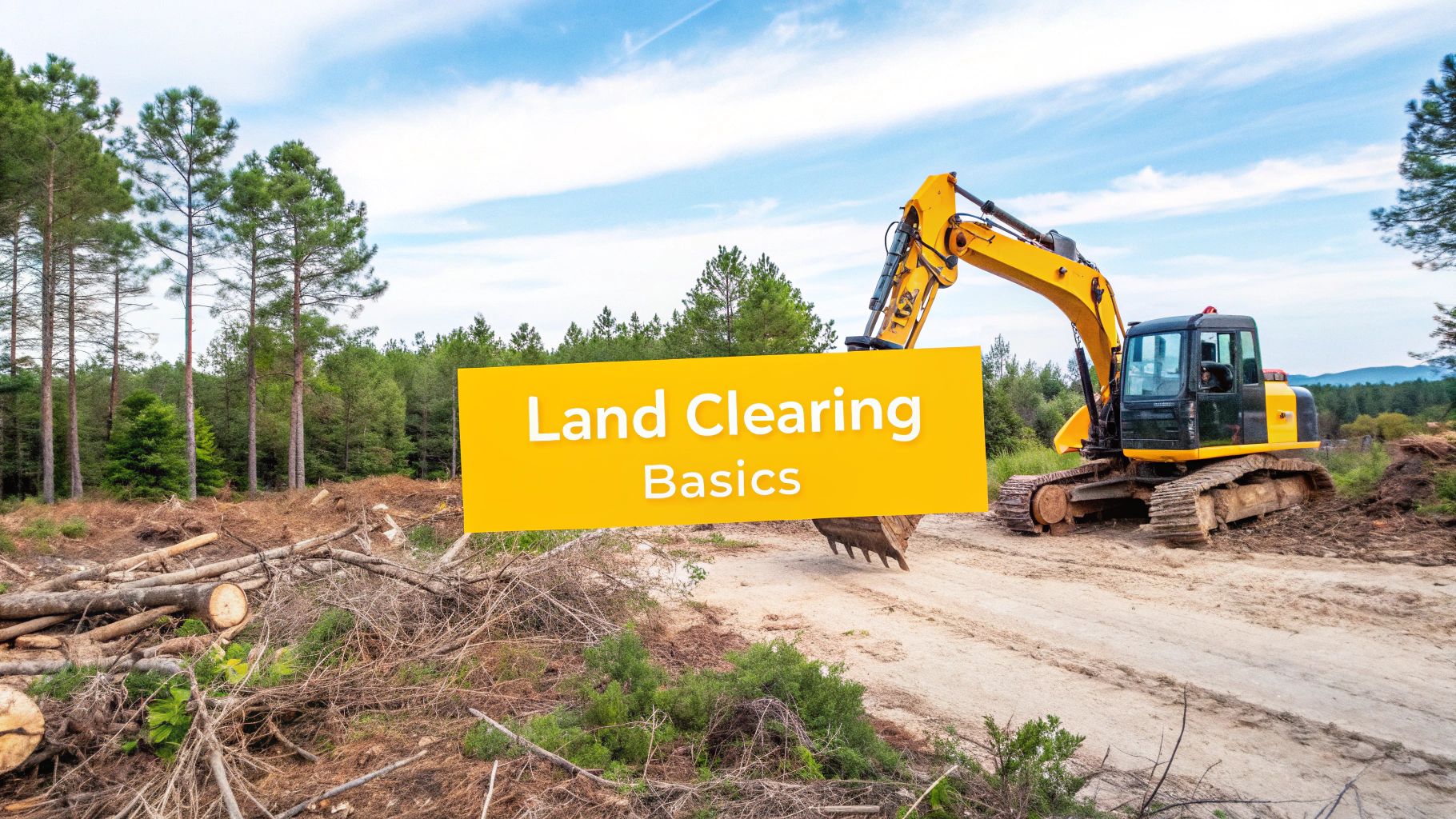
This process is so much more than just running a bulldozer over a block of land. Professional land clearing solutions lay the groundwork for a safe, stable, and compliant build. It’s a calculated process that sets the stage for everything that follows, ensuring your project has the best possible foundation.
Imagine you’ve found the perfect bushy block on the Central Coast for your dream home, or perhaps you’re getting a commercial site ready in Newcastle. Getting the clearing done right from the start ensures the ground is solid and ready for the foundations, services, and everything that follows. This guide will walk you through everything you need to know to plan your project with confidence.
Why You Need a Professional Clearing Service
Tackling land clearing yourself might seem like a decent way to shave a bit off the budget, but it’s a path often riddled with expensive mistakes and serious safety hazards. Turning to a professional service isn’t just about convenience; it’s about getting the job done safely, efficiently, and legally, especially here in NSW.
We bring in specialised machinery like excavators and forestry mulchers that are built to handle large trees and stubborn stumps without incident. More importantly, we operate under strict protocols from SafeWork NSW to manage every conceivable risk on site. Anyone can hire a machine, but it takes real training to operate it safely and to spot hidden dangers like underground services or unstable ground.
Safety and Efficiency on Site
Let’s say you have a sloping block in Terrigal with a great view of the water. An experienced operator knows exactly how to clear that land without causing soil erosion or destabilising the whole site—a mistake that could have disastrous consequences for your build and your neighbours. They’ll also have the job done in a fraction of the time it would take with rented gear, saving you from weeks of back-breaking labour.
That kind of efficiency is what keeps a project timeline from blowing out. Delays in clearing can create a domino effect, holding up every trade that follows, from the concreters to the carpenters.
A professional service doesn’t just clear the land; they prepare it correctly for the next stage. This foresight is the difference between a smooth project and one plagued by expensive setbacks and rework.
Navigating Council Compliance
Beyond the physical work, professionals are fluent in the complex language of regulations from local bodies like Central Coast Council or Lake Macquarie Council. They know which vegetation is protected, what permits you’ll need, and how to cut through the red tape to avoid hefty fines and stop-work orders. Trying to navigate this on your own without the right knowledge is a huge gamble.
Proper site preparation and excavation is foundational, and that starts with making sure every council requirement is ticked off before a single tree is touched.
Ultimately, bringing in an experienced team like Booms Up Civil is about ensuring the job is done right, the first time. It saves you time, protects you from liability, and prevents the kind of stress that can derail a project before it even gets off the ground.
Choosing the Right Land Clearing Method
There’s no single ‘best’ way to clear a block of land. The right method for your project always comes down to a few key factors: your end goal, the specific conditions of your site, and any environmental or council requirements you need to meet. It’s critical to get this right from the start, because selecting the wrong approach can lead to budget blowouts, project delays, or even damage to your property.
The most common method we use is mechanical clearing. This is where we bring in the heavy machinery—excavators, bulldozers, and specialised forestry mulchers—to remove trees, stumps, and vegetation quickly and efficiently. It’s the go-to choice for most residential and commercial projects, from a new home build in Kariong to a larger subdivision in the Hunter Valley.
Matching the Method to Your Project
Think about a typical residential block on the Central Coast. For a job like that, a combination of an excavator for the larger trees and a forestry mulcher for the undergrowth is often the perfect balance of speed and precision. The mulcher shreds vegetation where it stands, turning it into a protective layer of organic material that helps prevent soil erosion—a huge plus on our sandy coastal soils.
Now, consider this scenario: a sprawling rural property out past Cessnock that’s destined for agriculture. Here, a more broadscale approach with bulldozers might be more suitable for clearing large tracts of land for pasture. It’s a faster, more powerful method for large-scale work, but it’s certainly less selective than other options.
This infographic helps visualise that initial, crucial decision: should you even attempt this yourself, or is it time to call in the professionals?
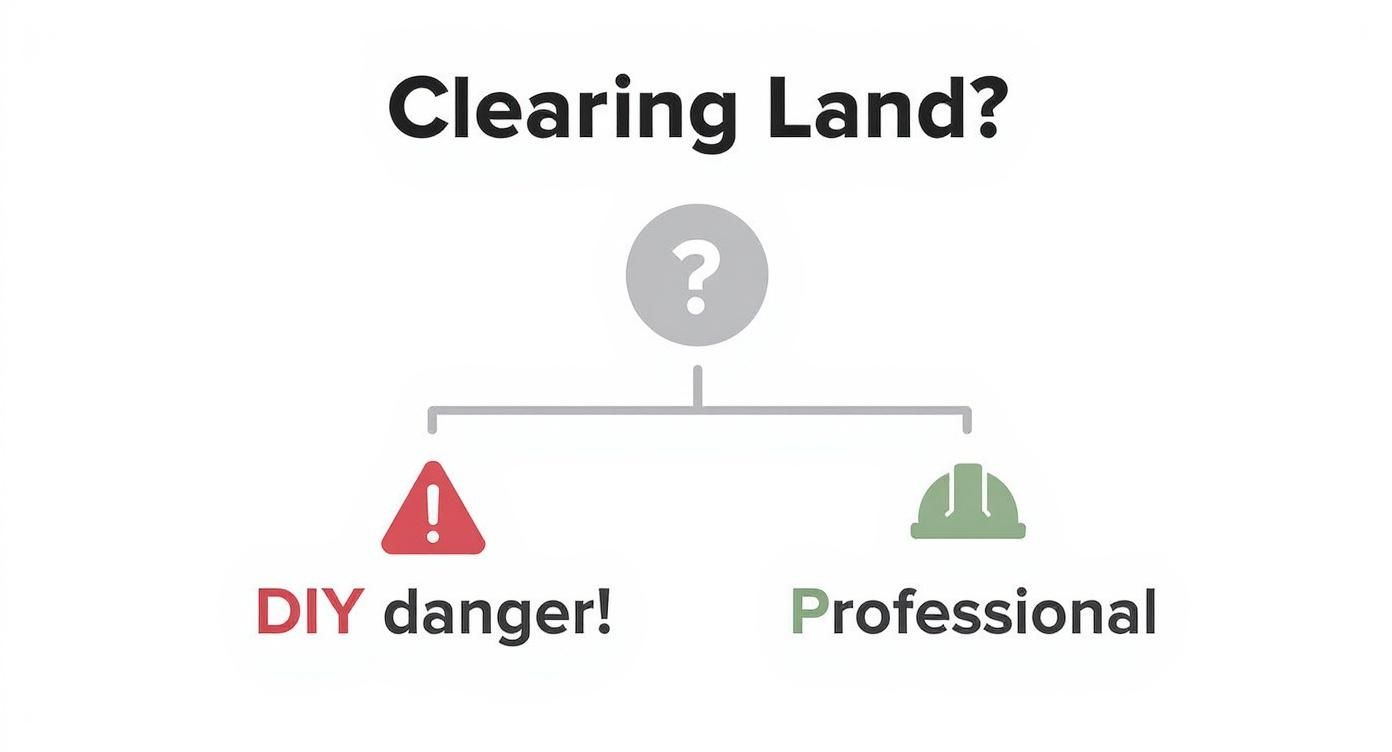
As the graphic clearly shows, while a DIY approach might seem tempting for the smallest jobs, the risks and complexities quickly point towards the safety, efficiency, and compliance that only a professional service can guarantee.
Specialised and Sensitive Approaches
But what about sites with specific challenges? For environmentally sensitive areas, or for jobs that require a more delicate touch, manual clearing is the answer. Using chainsaws, brush cutters, and hand tools allows our team to be extremely selective, carefully removing unwanted undergrowth while preserving significant trees and minimising disturbance to the surrounding ecosystem. This surgical approach is often required when working near protected waterways or on sites with strict Vegetation Management Plans.
Similarly, properties with very steep slopes or narrow entry points present a unique challenge. These jobs demand careful planning and specialised equipment. For a deeper dive into how we handle these tricky sites, you can learn more about our approach to difficult access excavation.
The key takeaway is that a professional assessment is crucial. An expert will evaluate your site’s topography, soil type, vegetation density, and accessibility to recommend the land clearing services that deliver the best result safely and efficiently.
Navigating NSW Council and Environmental Rules
Before you even think about firing up a chainsaw or getting an excavator on site, there’s a critical reality you must face: in NSW, you can’t just start clearing land whenever you feel like it. A web of state legislation and local council rules is in place to protect native vegetation, wildlife habitats, and the broader environment. Trying to sidestep these regulations is one of the fastest ways to get slapped with a stop-work order and some seriously painful penalties.
Getting your head around these rules isn’t just a box-ticking exercise—it’s the absolute foundation of your project plan. The state’s Biodiversity Conservation Act is the main piece of legislation that governs any clearing of native vegetation, and most work will need some form of approval. Make no mistake, non-compliance isn’t a minor hiccup; it can lead to fines that make the cost of the clearing work look like pocket change.
Checking Your Local Council Rules
Your first port of call should always be your local council. It doesn’t matter if you’re under the Central Coast Council, Newcastle Council, or another jurisdiction; you need to get familiar with their specific Development Control Plan (DCP). This is the document that spells out exactly what you can and can’t do on your property without lodging a full Development Application (DA).
On top of that, many properties have specific zoning or overlays that add another layer of restrictions. A vegetation protection overlay or an environmentally sensitive area classification, for instance, means you’re going to face much tighter controls. An experienced contractor can help you navigate your property’s zoning maps and decipher what these restrictions actually mean for your project. To get a solid start, it’s also worth understanding the fundamentals of residential land clearing requirements and what’s involved.
When Do You Need an Expert Report?
In many cases, particularly on blocks with a lot of native trees, the council won’t even look at an application without a professional report attached.
- Arborist Report: If you’re removing or even working near significant trees, an arborist report is often non-negotiable. It provides a detailed assessment of the trees’ health, species, and ecological value, and lays out a plan to protect any that are being kept.
- Ecological Assessment: For larger sites or properties in sensitive locations, an ecologist might need to do a full survey. Their job is to identify any protected plants or animals and create a management plan to ensure they aren’t harmed.
Don’t guess, always check. Assuming your land is exempt from these rules is a risky and expensive gamble. Engaging with the council and getting professionals involved early on ensures your project is fully compliant from day one, saving you from major headaches, delays, and legal dramas down the track.
The scale of clearing across the state is something councils take very seriously. After policy changes, data revealed that native woody vegetation clearing in NSW shot up by 31% between 2018–2021, mostly driven by agriculture. You can explore the full details of NSW land clearing data to get a sense of the bigger picture. It’s a stark reminder of why councils are so strict about compliance for every single project, no matter how big or small.
Understanding Why Land Is Cleared
Land gets cleared for a whole host of reasons, but they nearly all boil down to a couple of major drivers. Getting a handle on these motivations is key to understanding the scale of land clearing services across Australia, from sprawling farms out west to brand-new suburbs popping up on the city fringe. The ‘why’ behind the clearing project nearly always sets the rules for the methods we use and the regulations we have to follow.
By a long shot, the biggest player in the land clearing game is the agricultural sector. Huge tracts of land, especially across Queensland and rural NSW, are cleared to either create new pasture for livestock or expand existing grazing areas. It’s a practice with a deep history in Australia, often driven by the need to boost the nation’s powerhouse beef industry and support regional economies.
Agriculture as a Primary Driver
The sheer scale of clearing for agriculture is staggering. Between 2000 and 2017, Australia lost over 7.7 million hectares of forest and bushland – an area roughly the size of Ireland. A huge portion of that was to make more room for cattle. This really shines a light on the economic pressures that shape how we use our land and the constant balancing act between agricultural output and environmental conservation. You can read more about the history of land clearing in Australia and what’s behind it.
The reality is that a huge portion of clearing work is directly tied to food production. It’s a complex issue where economic needs and environmental responsibilities must be carefully managed.
Urban and Infrastructure Development
The other major force behind land clearing is the relentless expansion of our towns and cities. As major centres like Sydney keep growing and regional hubs like Newcastle and the Central Coast boom, we need to prepare the ground for new communities.
This kind of clearing makes way for all the essentials:
- New housing estates and subdivisions.
- Commercial buildings and industrial parks.
- Critical infrastructure like roads, carparks, schools, and utilities.
Take a new residential development in a growth area like Warnervale, for example. The clearing work isn’t just for the house blocks themselves; it’s for all the connecting roads, pipes, and services that turn a piece of land into a functioning community. While this type of clearing is vital for progress, it comes with a heavy dose of council regulations to make sure the impact is managed properly.
Managing the Environmental Impact of Land Clearing
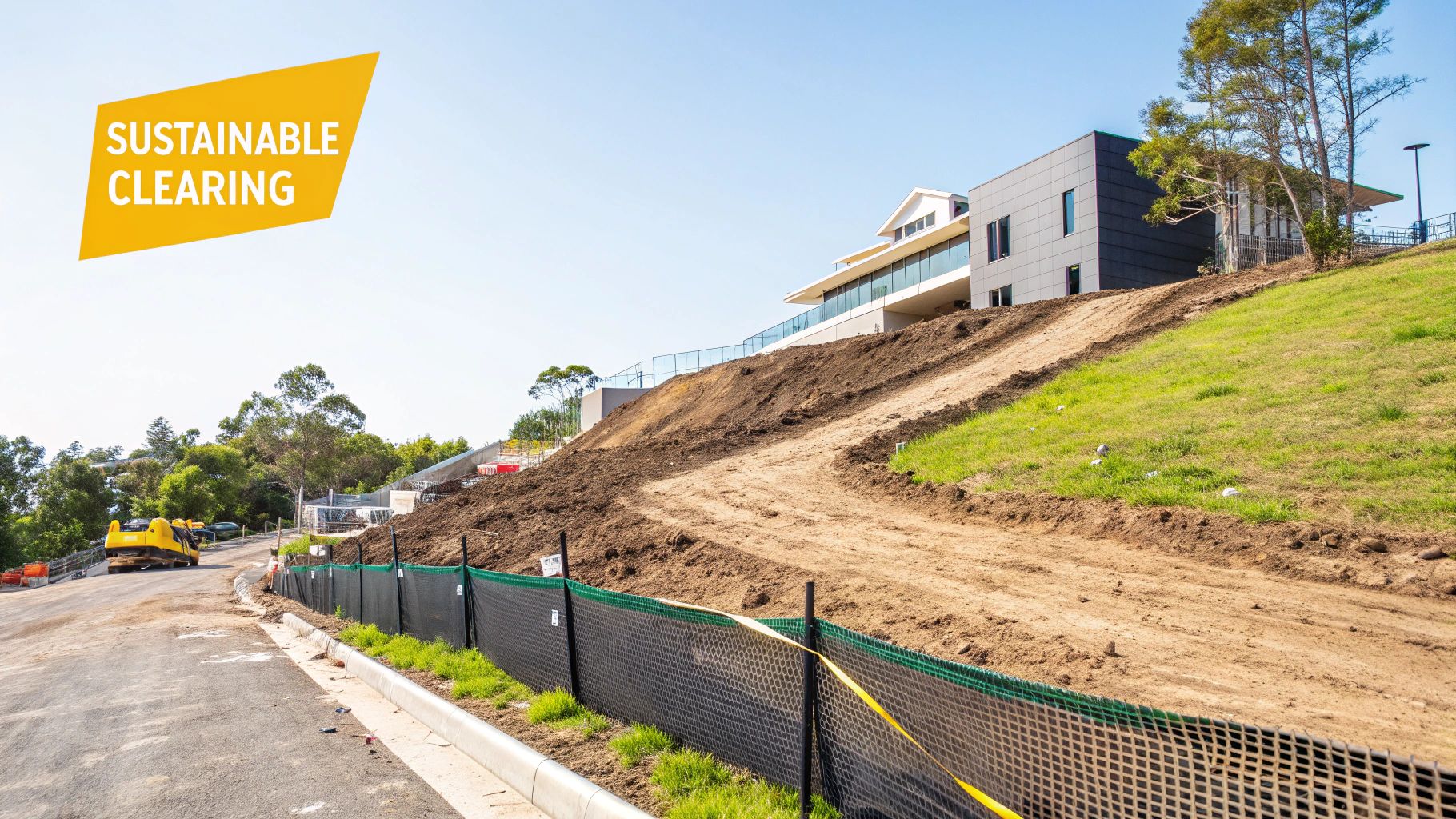
While land clearing is often a necessary first step for progress, every project has real environmental consequences that need to be managed responsibly. The most immediate and obvious impact is on our native wildlife. When you remove trees, shrubs, and undergrowth, you’re taking away the homes and food sources for countless animals—a critical issue that feeds into Australia’s broader biodiversity challenges.
Beyond the fauna, clearing has a direct effect on the land itself, especially the soil and water systems. You can think of tree roots as nature’s rebar, holding the soil together. Once they’re gone, the risk of soil erosion skyrockets. This is a big deal on the sloping sites common around the Central Coast.
When we get heavy coastal downpours, this loose topsoil gets washed straight into local creeks and waterways, which can seriously degrade water quality and harm aquatic life. The scale of this issue is massive; nationwide, about 500,000 hectares of land are cleared every single year, leading to profound biodiversity losses. For every 100 hectares of woodland cleared, it’s estimated that thousands of birds, reptiles, and mammals are lost or displaced.
Sustainable Practices We Can Implement
The good news is that a responsible contractor won’t just bulldoze everything. There are smart, practical steps we can take to minimise these negative effects. Instead of a blanket approach, selective clearing that preserves mature, healthy trees can maintain vital pockets of local habitat.
When it comes to the soil, implementing effective erosion controls is non-negotiable. This could be as simple as installing sediment fences or using the mulched vegetation from the clearing process to create a protective ground cover. It’s a straightforward step that helps hold the soil in place and prevents runoff.
Responsible waste disposal is key. Rather than sending all the green waste to landfill, we can chip or mulch it right on-site. It can then be reused in landscaping or taken to a proper green waste facility. This approach turns a potential problem into a valuable resource.
By focusing on these sustainable practices, we can make sure your project moves forward while still respecting and protecting our unique natural environment for years to come.
How to Choose the Right Clearing Contractor
Picking the right contractor for your land clearing services is easily the most critical decision you’ll make for your project’s success. It’s not just about finding someone with a machine; it’s about partnering with a team that has deep local experience and understands the unique challenges of our region.
A contractor who has spent years working on the Central Coast knows the difference between our sandy coastal soils and the reactive clay you find further inland. This kind of hands-on knowledge directly impacts how they approach the job, ensuring stability and proper site management from day one.
What to Look for in a Professional
First and foremost, your chosen contractor must be fully licensed and insured. Don’t be afraid to ask for proof of their public liability insurance and any relevant machinery operator tickets. A professional will have these documents ready and will be transparent about their safety procedures and compliance with SafeWork NSW standards. If they get defensive or can’t provide this information, that’s a huge red flag.
When you’re getting quotes, you need to look beyond the bottom-line price. A detailed quote should break down the entire process.
- What specific machinery do they plan to use for your block?
- How will they manage all the green waste and debris?
- What’s their strategy for environmental protection and erosion control?
A reputable team will confidently answer these questions and explain their methods in plain English. For example, understanding the finer points of excavation work in Newcastle requires specific expertise that a qualified contractor will be happy to walk you through.
The right contractor sees themselves as a partner in your project. Their goal is to set you up for success by doing the job safely, legally, and to the highest possible standard, getting it right the first time.
When you’re checking out potential contractors, pay attention to those who effectively showcase their past work and expertise. Things like professional video production for construction services can be a strong indicator of a contractor’s commitment to transparency and quality. This level of professionalism often reflects how they perform on-site.
Common Land Clearing Questions
We get asked a lot about land clearing services, and it’s completely understandable—it’s a massive first step for any project. To help give you a clearer picture, we’ve put together straight answers to the questions we hear most often from clients across the Central Coast, Newcastle, and Sydney.
How Much Does Land Clearing Cost in NSW?
This is always the first question, but the truth is, there’s no simple, one-size-fits-all answer. The final cost to clear a block of land comes down to a handful of key factors: the sheer size of the property, how thick the vegetation is, the steepness of the terrain, and how easily we can get our machinery on-site.
A small, flat residential block in Gosford with just light scrub is going to be a different ball game compared to clearing large, steep acreage in the Hunter Valley covered in mature gum trees. The only way to get a truly accurate figure is to have a professional come out and give you a detailed, on-site quote.
Do I Need Council Approval to Clear My Land?
In almost every situation, yes, you will need some form of approval. The vast majority of land clearing in NSW, especially when it involves touching any native vegetation, requires a green light from your local council.
While there might be some minor exemptions for things like maintaining existing fire breaks, you absolutely must check your local Development Control Plan (DCP) first. Talking to your council or a professional contractor before you start is the only way to sidestep the risk of some seriously heavy fines.
How Long Does the Land Clearing Process Take?
The timeline is tied directly to how complex the job is. We could potentially clear a standard suburban block in a Newcastle suburb in just a day or two. On the other hand, a multi-hectare commercial site choked with dense bushland could take several weeks to finish safely and correctly.
The type of vegetation we’re dealing with, the weather on the day, and the specific machinery needed all have a say in the schedule. Any reputable contractor will give you a realistic and transparent timeframe right alongside their quote.
Ready to get your project started on solid ground? The team at Booms Up Civil Group has the local know-how and professional gear to handle your land clearing needs safely and efficiently.