
Subdivision contractors are the specialists who lay the essential groundwork, turning huge, raw parcels of land into multiple, fully-serviced lots ready for builders to move in. It’s about much more than just moving dirt around. Our job covers everything from the initial land clearing and detailed earthworks to installing crucial underground services like drainage, water, and power, setting the entire stage for new homes and infrastructure.
Your Partner in Groundwork and Civil Construction
Picture a raw block of land as a blank canvas. Before a single house frame can go up, that canvas needs to be perfectly prepared. That’s where we come in. As subdivision contractors, we’re the vital partner for developers and builders, handling the critical civil works that transform a vision into a viable development.
Our work begins long before the first slab is poured. We step onto the site after the surveyors have mapped out the land and the engineers have finalised the design. Our team takes those plans off the paper and brings them to life on the ground, making sure every single lot is stable, properly serviced, and ready for construction to begin. This foundational work is absolutely non-negotiable for the success and long-term stability of the whole project.
Key Responsibilities of a Subdivision Contractor
The scope of our work is massive and calls for a wide range of skills and specialised machinery. We’re not just digging trenches; we’re building the very skeleton of a new community. Here’s a rundown of what that typically involves:
- Site Preparation and Clearing: This is the first step, where we clear the site of trees, rocks, and any old structures to create a clean slate. It’s the essential starting point for everything that follows.
- Bulk and Detailed Earthworks: We completely reshape the landscape according to the engineering plans. This means cutting and filling land to create level building pads, roads, and the right slopes for drainage—a process at the heart of any subdivision. To get a better handle on this, understanding the role of earthmoving contractors near me can give you a much deeper insight.
- Service Installation: We dig the trenches and lay all the essential underground infrastructure. This covers stormwater drainage, sewer lines, water mains, and the conduits for electricity and communications like the NBN.
- Road and Pavement Construction: Our team builds the access roads that will eventually service all the new lots, from laying the road base right through to preparing it for the final asphalt or concrete surface.
- Kerb and Guttering: This isn't just about looks. It’s a critical piece of the stormwater management system, designed to channel water runoff into the drainage network and safely away from the properties.
In short, we handle everything "out of the ground" so that builders can get on with what they do best: building "up from the ground." Getting these early stages spot-on is essential for a smooth, compliant, and ultimately successful subdivision project.
The Subdivision Journey from Paddock to Paved Street
Transforming a raw block of land into a street of build-ready lots is a carefully choreographed dance of earthmoving, engineering, and infrastructure. To bring this to life, let’s walk through a typical project – say, turning a large, unused paddock in a growth area like Warnervale on the Central Coast into 20 fully serviced lots.
This is a common scenario for subdivision contractors in developing regions, and it’s a process where each phase builds directly on the last. It’s a journey that demands precision, coordination, and a deep understanding of civil construction. Every stage is critical to making sure the final lots are safe, stable, and ready for council sign-off.
Initial Site Clearing and Setup
Before the big machines start reshaping the earth, the first job is to get the site ready. This means establishing clear access for trucks and equipment, putting up sediment and erosion controls to protect local waterways, and marking out the project boundaries precisely according to the surveyor’s plans.
Then, the physical clearing starts. For our hypothetical Warnervale site, this would involve removing unwanted trees, scrub, and any old farm fencing. It’s not just about making space; it’s about creating a clean slate for the major earthworks that are about to begin. You can get a deeper look at this foundational phase in our guide on the essentials of site preparation and excavation.
Bulk Earthworks and Shaping the Land
With the site cleared, the bulk earthworks kick off. This is where we really start to carve out the shape of the future community. Using a fleet of excavators, dozers, and graders, we perform the classic "cut and fill" – taking soil from high spots and using it to build up the low areas. This process creates the level building pads for each of the 20 lots and sets the correct grades for the new roads.
This whole stage is governed by the geotechnical report and engineering designs. These documents tell us exactly how much the soil needs to be compacted to guarantee long-term stability. On the Central Coast, where soil can range from sandy loam to highly reactive clay, getting this right is non-negotiable. It’s what stops future homeowners from facing serious structural problems down the track.
Installing Drainage and Essential Services
Once the land has its new shape, the focus shifts to what’s happening underground. This is arguably the most complex and critical part of the job, as we start laying all the essential services. We meticulously dig trenches to the exact depths and grades needed for:
- Stormwater Drainage: Laying the large pipes and pits that will manage rainwater runoff – a non-negotiable requirement from Central Coast Council to prevent local flooding.
- Sewer and Water Mains: Tapping into the mains supply so that every future home has reliable services.
- Utility Conduits: Installing the protective piping for electricity, NBN, and other communication cables.
Before any trench is backfilled, every connection is pressure-tested and inspected to ensure it meets tough Australian Standards. It’s painstaking work, but any mistakes here are incredibly expensive and disruptive to fix once the roads are down.
The diagram below gives you a high-level view of this progression, showing how a subdivision contractor turns raw land into serviced lots.
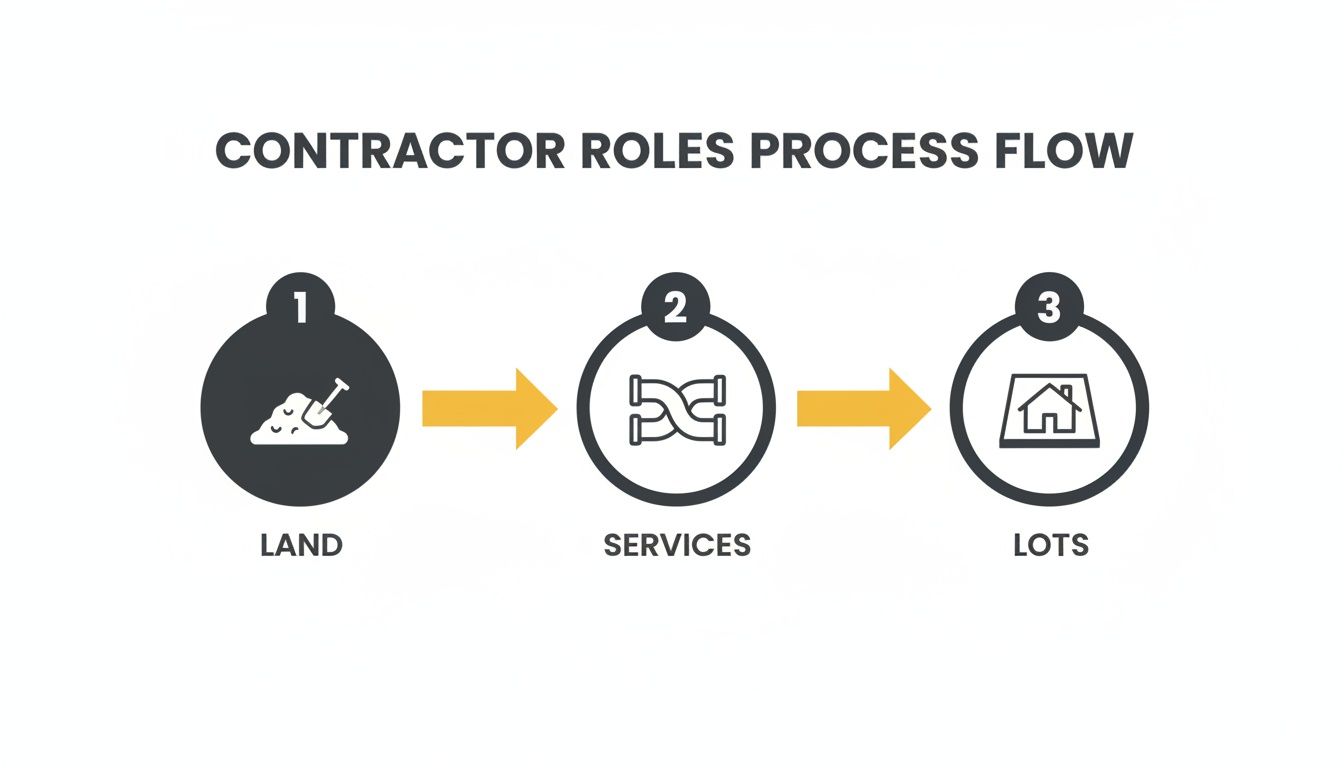
As you can see, the foundational land prep makes the service installation possible, which in turn creates the viable, ready-to-build lots that developers need.
Roads, Kerbs and Finishing Touches
With the underground work signed off, we move to the final construction phase: building the internal roads. We lay and compact multiple layers of road base material to create a tough, durable foundation before installing the concrete kerb and guttering.
The kerbing isn't just there for looks; it’s a crucial part of the stormwater system, designed to channel surface water directly into the underground drains. After the kerbs are poured and have had time to cure, the road surface gets its final layer of asphalt, and any footpaths or driveways are formed.
The last step is to bring in topsoil and lay turf in the public areas. This completes the transformation from a rough paddock into a fully-serviced, welcoming street.
The scale of this work across the country is immense. In the 2023-24 financial year, Australia's construction industry generated $633.6 billion in income. The Construction Services subdivision, which covers the core work of subdivision contractors, was responsible for $276.1 billion of that total. It really shows the massive role contractors play in building our communities from the ground up.
Navigating Council Approvals and NSW Compliance
Tackling the mountain of paperwork and red tape that comes with any development can feel overwhelming. It’s exactly here, in the thick of compliance, that an experienced subdivision contractor really proves their worth. We don’t see regulations as a hurdle; we see them as the blueprint for getting the job done right the first time. It's our job to take your approved plans and turn them into a physical reality that ticks every single box.
Your journey through this regulatory maze kicks off with your Development Application (DA), which lays out the specific conditions you need to meet. Once your DA gets the green light from your local council—whether that’s Central Coast Council, Newcastle City Council, or Hornsby Shire Council—we start working hand-in-glove with your surveyor and engineer. Our goal is to ensure every single one of those conditions is satisfied before a Construction Certificate can be issued. That certificate is the official go-ahead for us to finally break ground.
Key Compliance Areas for Every NSW Site
Getting the physical work done is only half the battle. It has to be done safely, responsibly, and with everything documented along the way. A professional subdivision contractor manages these non-negotiables day in and day out, shielding your project from the risk of costly fines, delays, or even stop-work orders.
There are three critical areas we are constantly focused on:
- Erosion and Sediment Control: Before any major earthworks can even begin, we have to install robust measures like silt fences and sediment basins. This isn’t just good practice; it's a legal requirement under the Protection of the Environment Operations Act 1997 and is guided by the industry-standard "Blue Book." It’s all about making sure soil from our worksite doesn’t end up in local waterways, which is absolutely critical in the sensitive coastal catchments of the Central Coast and Newcastle.
- Environmental Protections: This goes well beyond just sediment control. We're talking about protecting native plants and animals, managing all waste responsibly, and keeping dust and noise under control. Every site has its own unique environmental factors, and our job is to develop specific plans to manage them according to both council and NSW EPA requirements.
- Workplace Health and Safety (WHS): A safe site is a productive site. Period. We develop and strictly enforce a comprehensive WHS Management Plan for every single project, all in line with SafeWork NSW regulations. This includes creating detailed Safe Work Method Statements (SWMS) for all high-risk activities, from deep excavation to operating heavy machinery.
A common mistake is treating compliance as just another box to tick. For us, it’s about proactive management. It’s about knowing the specific quirks of the local council and seeing potential problems long before they have a chance to cause delays or blow out the budget.
Meeting Local Council Specifications
While state-level regulations provide the overall framework, each local council has its own detailed engineering standards for new subdivisions. These standards can dictate everything from the required thickness of the road base and the type of concrete for kerbing, right down to the exact specifications for stormwater pits and pipes.
For instance, a project in a dense Sydney suburb might have incredibly strict rules around traffic management, while a subdivision out in the Hunter Valley could have specific requirements for managing overland water flow. Part of our job is knowing these local variations inside and out. It’s this deep local knowledge that ensures a smooth inspection and sign-off process, which is absolutely essential for getting your new lots registered and ready to sell.
Many related structures also fall under strict rules. For a deeper dive, you can explore our detailed guide on retaining wall regulations in NSW. This knowledge helps prevent costly rebuilds and makes certain every element of the subdivision meets the required standard from day one.
Key Challenges in NSW Subdivision Projects
Even the most meticulously planned subdivision can run into serious roadblocks. At Booms Up Civil, we’re straight-up about these real-world challenges. It’s not about whether things go wrong; it’s about how your contractor anticipates and manages those risks to keep your project moving and your budget intact.
An experienced team sees the potential hurdles long before they appear and has a game plan ready. It's this foresight, from navigating tricky ground conditions to securing materials, that turns a potential disaster into a managed hiccup.
Unforeseen Site Conditions
You simply can't know what’s hiding a metre under the soil until the bucket hits the ground. This is, without a doubt, one of the biggest variables in any earthworks project. A great subdivision contractor will know the local geology and plan for it, but surprises are always part of the job.
Imagine you're developing a block in Sydney's northern suburbs. It's not uncommon to hit unexpected sandstone rock shelves that the initial geotechnical survey missed. This immediately calls for specialised rock breakers and saws, which can throw both the timeline and budget out of whack if not managed swiftly.
Or, maybe you’re working on a project inland from the Central Coast and uncover a massive patch of highly reactive clay. This soil swells and shrinks dramatically with moisture, demanding specific engineering solutions like deeper foundations or soil stabilisation to guarantee the future integrity of roads and building pads. Even a seemingly simple site can hide complexity; our guide on handling tight access excavations shows how we get creative with these constraints.
Skilled Labour and Material Supply
The construction industry across Australia is feeling the squeeze, and subdivision projects are right in the thick of it. The two biggest headaches we are constantly managing are the shortage of skilled operators and disruptions in the supply of essential materials.
Finding skilled labour is a massive issue for contractors, especially in fast-growing areas. According to Infrastructure Australia, the nation is staring down a peak worker deficit of 300,000 by 2027. This shortage is expected to be four times worse in places like the Central Coast and Hunter Valley between 2025 and 2027. This really underlines the importance of working with a contractor who has a reliable, in-house team. You can read more in the 2025 Infrastructure Market Capacity Report.
Having our own skilled operators and a well-maintained fleet of machinery means we have greater control over project timelines. We aren't left scrambling for subcontractors, which provides you with certainty and helps avoid costly delays.
On top of that, getting a consistent supply of materials like concrete, drainage pipes, and road base is absolutely critical. Global events can throw supply chains into chaos, leading to long waits and volatile prices. We tackle this risk head-on by building strong, long-term relationships with local suppliers across the Central Coast, Newcastle, and Sydney. By ordering materials well ahead of schedule and having backup options, we can shield your project from these market shocks.
How to Choose the Right Subdivision Contractor

Getting your subdivision project off the ground successfully hinges on one single decision: hiring the right team. Think of your subdivision contractor as your partner on the ground. They’re the ones who turn the plans into reality, navigating the inevitable risks and compliance hurdles along the way.
Making a smart, confident choice right from the start is the best way to prevent a world of costly headaches down the track. This decision should never be about the cheapest price tag. You need to dig much deeper, looking into their track record, safety culture, and intimate knowledge of the local area.
After all, a contractor who understands the specific challenges of your region—whether it’s the Central Coast’s sandy soils or Sydney’s notoriously tight-access sites—is simply invaluable.
Verifying Licences, Insurance and Safety Compliance
First things first, let's cover the absolute non-negotiables. Any contractor you’re seriously considering must be able to provide clear proof of their qualifications and protections. This isn’t just red tape; it's what directly shields you from serious liability.
Before you even start talking numbers, ask to see their:
- Contractor's Licence: Check that it’s current and appropriate for the scale of civil works your project demands.
- Public Liability Insurance: This is crucial. It should cover at least $20 million to protect against any property damage or injury.
- Workers Compensation Insurance: This proves they are properly looking after their team, which is a sign of a professional operation.
- Safety Record: Don't be shy about asking for their safety history. A reputable contractor will also have a WHS Management Plan they can share.
A professional outfit will have all this documentation ready to go and won't hesitate to be transparent about their safety procedures. This includes providing detailed Safe Work Method Statements (SWMS) for any high-risk activities on site.
Assessing Experience and Local Knowledge
Local experience is a true game-changer in this industry. A contractor with a long history in your region, be it the Hunter Valley, Newcastle, or the Central Coast, brings a lot more than just machinery to your site. They bring a deep understanding of the local councils, the unique soil types, and the unpredictable weather patterns.
For instance, a team that’s worked extensively on the Central Coast (postcodes 2250-2264) knows precisely how to manage excavation in the sandy, water-charged ground near the coast. That’s a completely different beast to breaking through the tough sandstone bedrock common in parts of Sydney.
When you’re vetting a contractor, ask to see a portfolio of completed projects that are similar in scale and location to yours. Their visibility in local search results can also be a good indicator of their market presence. Understanding Local SEO strategies for home service contractors can offer insight into how the most reputable companies ensure they are found by clients like you.
Evaluating Their Fleet and Team
The machinery a contractor owns speaks volumes about their capabilities. A well-maintained, modern fleet means a lower risk of breakdowns and frustrating delays. It also signals they have the right tool for every stage of the job, from the initial bulk earthworks to the final detailed trimming.
Ask about the size and type of their fleet. Do they actually own the range of excavators, dozers, and graders your project will need? Just as important is the team behind the controls. A contractor with a dedicated, in-house crew of skilled operators offers far more reliability than one scrambling to find subcontractors, especially with the skilled labour shortages we’re seeing.
The right equipment in the hands of an experienced operator is the difference between a project that runs smoothly and one that’s plagued by delays and costly errors. Always ensure your chosen contractor has both.
Demanding a Transparent Quote
Finally, let's talk about the quote. A professional quote should be much more than a single figure scrawled on a page. A detailed, transparent quote is the mark of an operator who knows their stuff. It should clearly break down every part of the project, including the costs for labour, machinery hire, materials, and waste disposal.
Make sure the quote clearly spells out all inclusions and exclusions. This simple step helps you dodge surprise costs later on and ensures everyone is on the same page from day one. If you're comparing multiple quotes, this level of detail is what allows you to make a genuine like-for-like comparison, a vital step when trying to find the best excavation contractors near me for your project's specific needs.
To help you compare apples with apples, we’ve put together a simple checklist to guide your evaluation process.
Subdivision Contractor Evaluation Checklist
Use this table to methodically assess and compare the contractors you're considering. It ensures you don't overlook critical details that could impact your project's success.
| Criteria | What to Look For | Why It Matters |
|---|---|---|
| Licensing & Insurance | Current Contractor's Licence, Public Liability (min. $20M), Workers Comp. | Protects you from liability and ensures they are legally compliant. |
| Local Experience | Portfolio of similar projects in your council area (e.g., Central Coast, Hunter). | Local knowledge means familiarity with council rules, soil types, and logistics. |
| Safety Record | A clear WHS Management Plan, history of safe operations, detailed SWMS. | A strong safety culture reduces risks, delays, and potential legal issues. |
| Fleet & Equipment | Owns a modern, well-maintained fleet suitable for your project scale. | Reduces the risk of breakdowns and ensures the right tool is available for the job. |
| Team Structure | In-house team of skilled, experienced operators vs. heavy reliance on subs. | A dedicated team offers greater reliability, consistency, and accountability. |
| Quote Transparency | Detailed breakdown of costs (labour, plant, materials), clear inclusions/exclusions. | Prevents hidden costs and allows for a fair, accurate comparison between bids. |
| References & Reviews | Positive feedback from previous clients, especially on similar projects. | Real-world feedback is the best indicator of their professionalism and quality of work. |
| Communication | Clear, responsive communication from the initial enquiry. | Good communication is key to a smooth project and resolving issues quickly. |
By taking a structured approach to your hiring decision, you move beyond just comparing prices. You’ll be choosing a genuine project partner who has the experience, resources, and professionalism to deliver your subdivision on time and on budget.
Understanding Project Viability in the Current Market
A successful subdivision is about much more than just moving dirt and laying pipes. It's about knowing the market you're stepping into. For anyone developing land in NSW, having a real-world understanding of the current landscape is non-negotiable for smart planning, managing risk, and ultimately, making sure your project is a commercial success.
Across the Central Coast, Newcastle, and Sydney, the demand for new housing is still running hot, creating genuine opportunities for developers. But there’s a bottleneck. We’re seeing a critical gap between the number of lots getting council approval and the finished, serviced land that builders are waiting for. This is precisely where efficient subdivision contractors prove their worth, bridging that gap and bringing ready-to-build lots to market much faster.
Seizing Development Opportunities
The smartest developments often ride the wave of major infrastructure investment. Think about it: significant road upgrades in the Hunter Valley or the expansion of shops and schools around Warnervale on the Central Coast aren't just great for locals. For a developer, they’re a massive green light, signalling a prime opportunity to turn a large parcel of land into a thriving new community.
Keeping your finger on the pulse of these regional trends allows you to position your project for success before a single sod is turned. An experienced local contractor can offer invaluable, on-the-ground insights into how these bigger market forces might play out for your specific site.
The Approval Versus Delivery Gap
You only need to look at the numbers to see the demand for skilled subdivision work. Australia's Land Development and Subdivision industry is made up of around 12,636 businesses, all trying to get new lots market-ready. You can find more details on the industry's makeup in IBISWorld's industry report.
Despite this, there’s a persistent lag. In the year to May 2025, NSW saw 24,716 units approved, yet there's a huge backlog of work to be done. In Western Sydney alone, over 35,000 approved homes are still waiting to be built.
This gap is where the real opportunity lies. Efficient, professionally managed civil works are the key to unlocking these approved-but-unbuilt lots and turning planning permits into tangible, valuable assets. This is the direct value a skilled subdivision contractor delivers.
To make sure your project is viable from the start, accurate cost forecasting is essential. This is where professional quantity surveying services become invaluable for getting your numbers right. When you combine robust financial planning with sharp market awareness, you set your subdivision up to be not just physically sound, but a commercial winner. In today's dynamic property market, that forward-thinking approach is everything.
Your Subdivision Questions, Answered
Over the years, we’ve fielded plenty of questions from developers and landowners about the nuts and bolts of the subdivision process. Here are some of the most common queries we get, with straight-up answers to help you see the path forward.
How Long Does the Civil Works Part of a Subdivision Take?
This is the classic "how long is a piece of string?" question, but the answer really boils down to your project's size, complexity, and what the ground is like on-site. A simple two-lot subdivision on a nice, flat block might only take a few weeks for the actual civil works. Easy.
But a large, multi-stage estate with serious earthworks? That’s a different story. We could be looking at many months.
Weather is the big wildcard, especially on the Central Coast where a week of heavy rain can bring everything to a standstill. You’ve also got to factor in council inspection schedules and the availability of materials like concrete and pipes. We always build our timelines based on a thorough site assessment, giving you a realistic picture, not just the best-case scenario.
What Are the Biggest Hidden Costs in a Subdivision?
Unforeseen ground conditions are, without a doubt, the number one source of budget blowouts for subdivision contractors. Hitting a massive shelf of rock that needs hours of breaking or discovering contaminated soil will definitely throw a spanner in the works and the budget. This is exactly why a solid geotechnical report is worth its weight in gold during the planning phase.
Other costs can sneak up on you through delays in council approvals or getting connections sorted with utility providers. This is where leaning on an experienced local contractor pays dividends. We’ve been around the block with Central Coast Council and Newcastle Council enough times to anticipate and navigate these common hurdles before they become major problems.
Can I Manage the Subdivision Project Myself to Save Money?
While it’s tempting to think about project managing the civil works yourself to cut costs, it's an incredibly complex beast. You’re not just digging a hole; you’re orchestrating surveyors, engineers, councils, and multiple trades, all of whom need to do their part in a very specific sequence. A professional subdivision contractor is the conductor of this entire groundwork orchestra.
We make sure everything is done correctly, to strict Australian Standards, and in lockstep with all council requirements. Honestly, that expertise ends up saving you a huge amount of time, money, and stress by ensuring it’s done right the first time.
Ready to get your subdivision project moving with a team that knows the Central Coast, Sydney, and the Hunter inside and out? For a clear, no-obligation discussion about your site, get in touch with Booms Up Civil Group. Let's talk about turning your plans into build-ready lots. Contact us online or call us today.