
In Sydney, a standard house demolition often falls within A$12,000 to A$40,000. That range is only a starting point, because access, asbestos, structure type, and site conditions can shift the final price fast.
If you're standing on an older block in places like Ryde, the Inner West, the Northern Beaches or the Sutherland Shire, you're probably already thinking past the old house and toward the new one. That's normal. What catches many owners out is that demolition isn't just “remove house, load bins, done”. In Sydney, the hard part is usually what surrounds the house, what's inside the materials, and how safely the crew can get the job done.
A rough square metre rate can be useful for a first conversation, but it's not how experienced contractors judge a real job. A small house on a tight lane in Newtown can cost more to demolish than a larger home on a clear block in Kellyville. That's why good quoting starts with the property, not just the floor area.
Planning a Sydney Knockdown Rebuild? Let's Talk Cost
A Sydney owner in Newtown can be quoted more for demolishing a small weatherboard cottage than an owner in Kellyville pays to remove a much larger brick house. Size matters, but it rarely decides the final number on its own. Access, asbestos, slope, retaining walls, overhead wires, neighbour proximity, and the way the house was built usually matter more.
That is the first point to get clear before setting a knockdown rebuild budget.
Demolition sits right at the front of the rebuild program, and delays here tend to flow into everything after it. The Australian Bureau of Statistics found the average approval value for detached houses in knock-down rebuilds was A$729,121, compared with A$355,478 for other detached houses, and the average time between demolition and building approval was 5.7 months, improving to 5.24 months in 2021/22, as outlined in the ABS knock-down rebuild approvals data. For owners, that means demolition is part of a larger approval and construction sequence, not a stand-alone cleanup job.
Why the first price you hear is rarely the real budget
Owners often ask for a square metre rate because it feels like a quick way to compare contractors. On real Sydney jobs, that method is only a rough screening tool. A contractor is pricing the risk on the block, the handling required, the likely waste streams, machine time, labour, permit conditions, and how safely the crew can work in that street.
A narrow frontage in the Inner West, a steep driveway in the Hills District, or an older fibro extension at the back of a house in Ryde can each shift the cost more than another 20 or 30 square metres of floor area.
If you are still at the planning stage, read what property owners should know before building for demolition. Better preparation usually saves more money than pushing for the cheapest headline quote.
The practical way to budget demolition is to treat it as an early construction package tied to approvals, site conditions, and the rebuild program.
Where Sydney owners get caught out on price
Sydney generally sits at the higher end of residential demolition costs because disposal, labour, compliance, and access constraints are tougher than in many regional areas. The problem is not that contractors are hiding the price. The problem is that two houses with the same footprint can be completely different demolition jobs once the site inspection starts.
A clean brick veneer house on a clear, level block is one type of job. An older home with suspected asbestos eaves, poor side access, a shared boundary close by, and services that need careful disconnection is another. Both might look similar from the street. The cost profile is not similar at all.
That is why experienced demolition contractors inspect the property before they put real weight on a number. A square metre figure can start the conversation, but it should never be the basis of your budget on its own.
What a Standard Demolition Quote Actually Includes
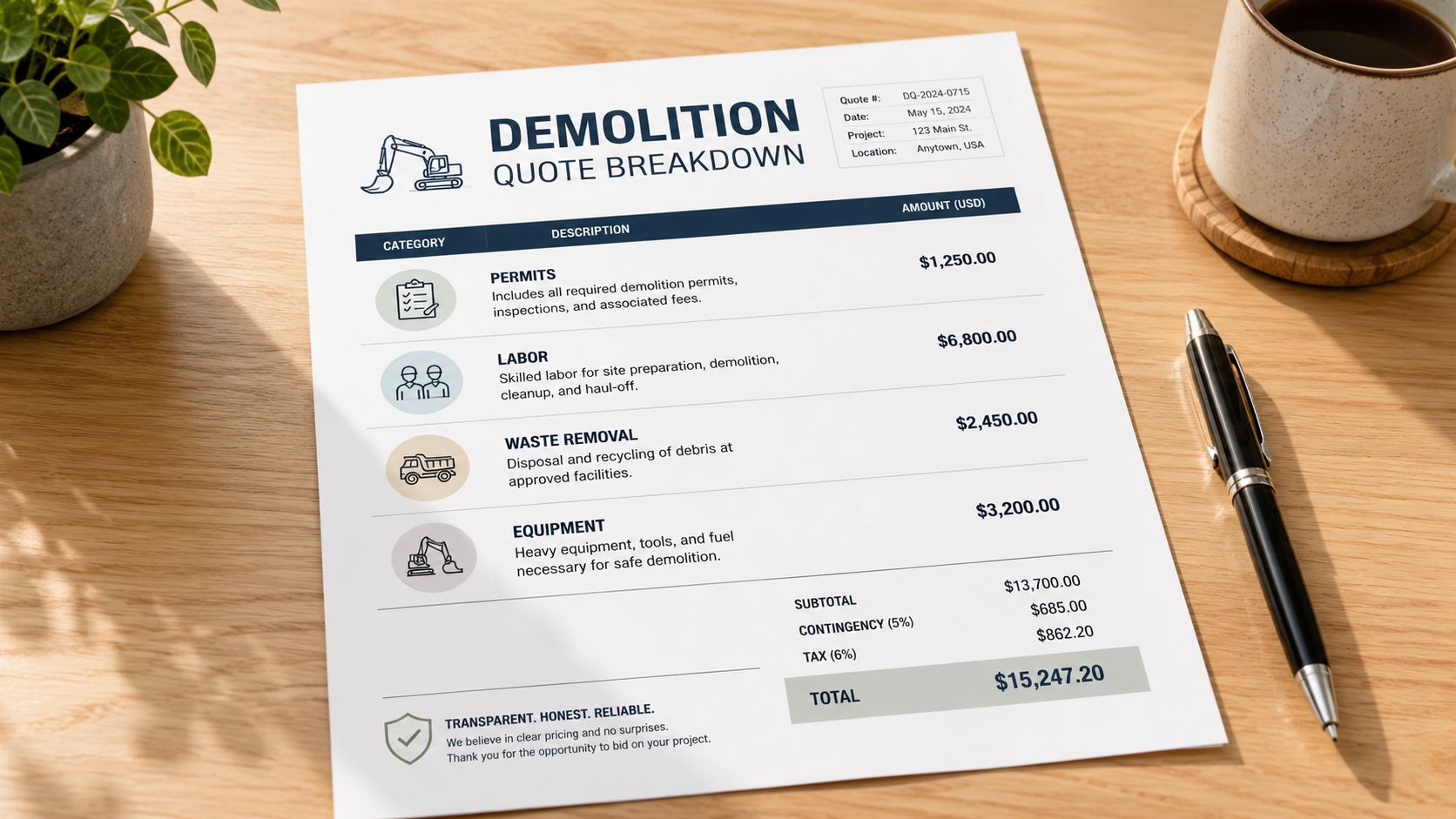
A proper demolition quote should read like a scope of works, not a single lump sum with no explanation. If you can't tell what's included, you can't tell what might become a variation later.
The usual inclusions on a clean residential knockdown
On a standard house demolition, the quote will usually cover site establishment first. That means temporary fencing, safety controls, signage, machine access setup, and the practical steps needed to make the site safe before anything comes down. If the block fronts a busy suburban road, traffic and neighbour protection measures may also need to be addressed.
Then comes the physical demolition itself. That includes the excavator work, labour to strip and separate materials where needed, loading debris, and hauling waste to the correct facilities. Good operators don't just crush everything into mixed loads if they can avoid it. Sorting concrete, brick, metal and timber can make disposal smoother and support recycling where the site allows.
What “site clean-up” usually means
Owners sometimes hear “leave the site clean” and assume that means the block is fully build-ready. It often means the structure is removed, debris is taken away, and the site is left in a generally tidy, safe condition for the next contractor. It doesn't always mean detailed excavation, compaction, retaining solutions, or finished levels for your new slab.
A quick way to test a quote is to ask whether it includes the following:
- Site setup and protection so the work area is secure and compliant
- Machine demolition and labour for the house and nominated structures
- Waste loading and transport to licensed disposal or recycling facilities
- Basic final tidy-up so the site is safe and clear of demolition debris
Common exclusions that catch owners out
The extras are where a cheap quote can become expensive. Asbestos removal, contaminated materials, major vegetation clearing, tree works, pool removal, deep footing extraction, rock, and significant cut-and-fill work are often outside a basic demolition allowance.
That's why it helps to compare quotes against a planning tool like this Australian demolition cost calculator guide. It gives you a better sense of which items are standard and which ones should be listed separately.
Practical rule: If a quote doesn't spell out inclusions, exclusions, waste handling, and site finish, assume you're missing part of the picture.
The Four Biggest Factors Driving Your Demolition Bill
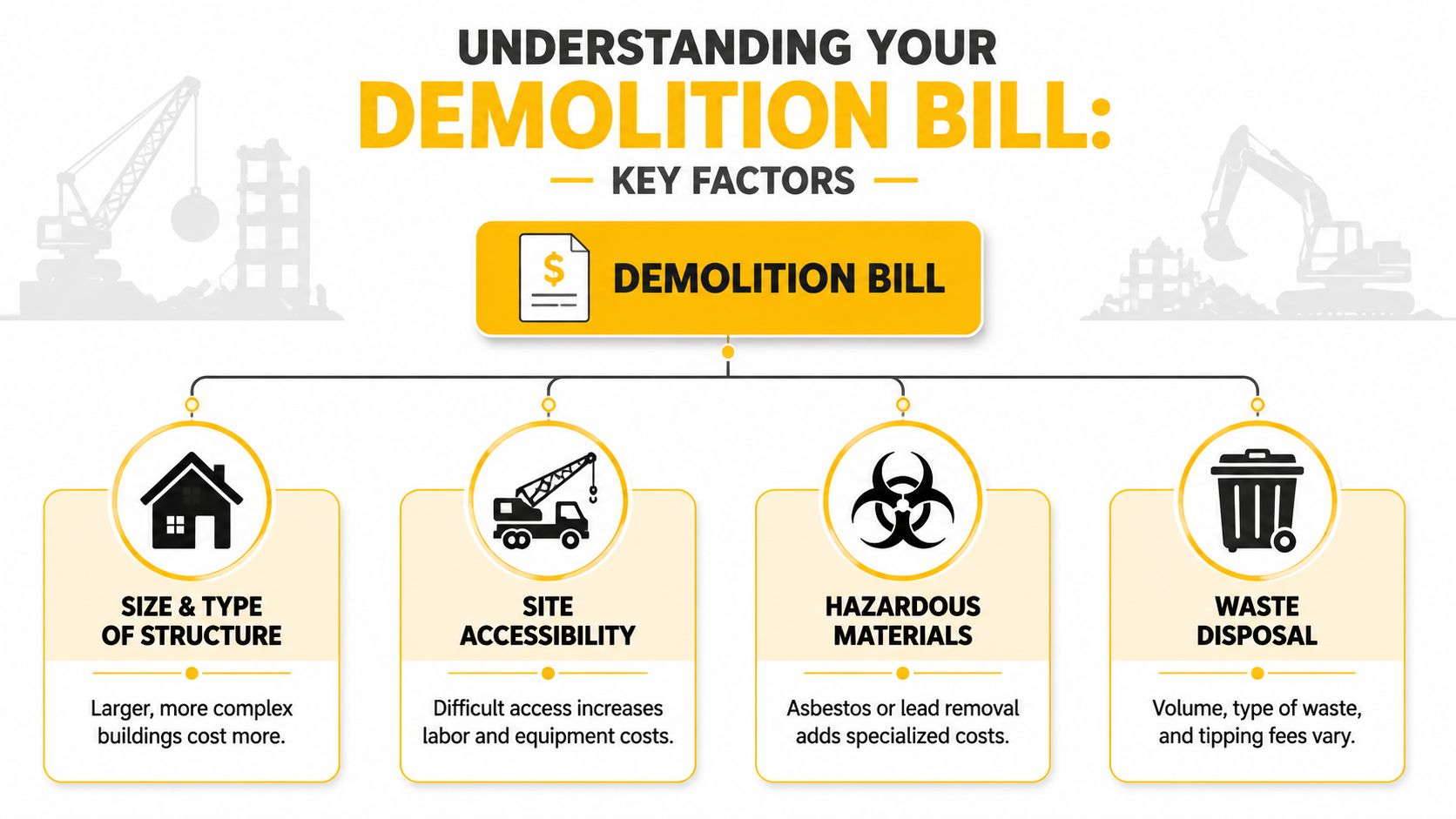
The biggest mistake people make with demolition cost Sydney estimates is assuming floor area tells the whole story. It doesn't. Size matters, but complexity usually decides where your final number lands.
Some Australian guides suggest a base rate of $40 to $65 per square metre, while Sydney guidance also shows standard brick homes closer to $80/sqm in market conditions referenced there. That gap is the point. Complexity, access and materials push cost more than simple floor area, as noted in this Hipages guide to house demolition costs.
Access changes everything
A house on a wide, level block with good street frontage is cheaper to work on than a house boxed in by fences, overhead constraints, narrow driveways, and close neighbours. In outer suburban areas like parts of the Hills District, a machine may be able to work efficiently with straightforward truck movements. In Paddington, Balmain, or a tight pocket of Marrickville, the same machine may not physically fit, or it may need support from smaller equipment and more hands-on strip-out.
That affects labour, duration, safety controls and haulage. Every extra handling step costs money.
The video below gives a useful visual sense of how demolition conditions can vary on site.
Structure and materials decide the workload
Not all houses come down the same way. A light timber cottage is one thing. A two-storey brick and tile house with heavy slab sections, substantial footings, and attached structures is another.
The material affects machine time, break-up effort, waste tonnage, and disposal method. Brick, masonry and concrete generally mean more resistance, more crushing, and heavier loads. Split-level homes can also create awkward working stages, especially on sloping land around the North Shore or the Northern Beaches.
Hazardous materials aren't optional extras
Asbestos is one of the biggest price variables on older Sydney homes. Once it's identified, it has to be removed lawfully, with the right controls, the right licence class where required, and the right disposal pathway. It can't be treated like general demolition waste.
If your house was built in an era where fibro sheeting, eaves, wet area linings or roofing products may contain asbestos, get clarity early. This guide on friable and non-friable asbestos differences is useful because the handling method affects both cost and sequencing.
If asbestos is present, the cheapest approach is rarely the safest one, and the safest one is the only acceptable one.
Site conditions add hidden work
A block can look simple from the street and still be expensive once work starts. Steep ground, poor access around the rear, retaining walls that need protection, mature trees, sandstone, old fill, and tight neighbour interfaces all slow the process and change the method.
In Sydney, this is common. A house perched on a sloping block near bush edges or on sandstone country won't be priced the same way as a flat, open suburban site. The demolition method has to suit the land, not just the building footprint.
Navigating Council Permits and NSW Safety Rules
The demolition itself is only one part of the job. Paperwork, approvals and safety controls shape both timing and cost, and they matter just as much as machinery.
Council approval comes first
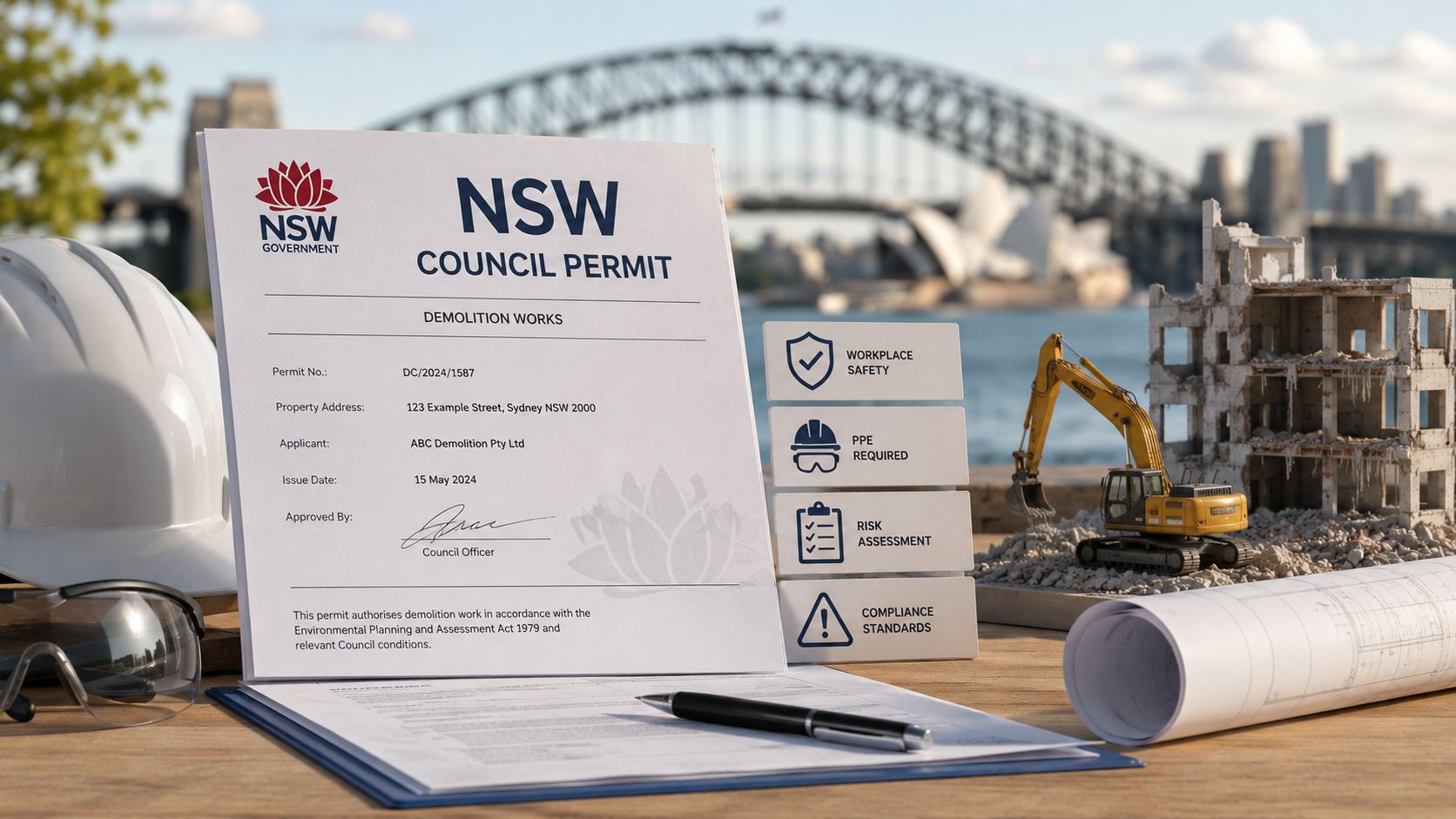
In Sydney, the approval pathway depends on the property and the work proposed. Some jobs move through a private certifier pathway, others need direct council involvement, and some sites carry extra planning controls because of heritage, trees, stormwater, or neighbourhood constraints. Parramatta Council, Northern Beaches Council, Inner West Council and others can each have their own expectations around documentation and site management.
Owners don't need to become planning specialists, but they do need to make sure the contractor understands the approval process. A good starting point is checking the NSW demolition licence requirements explained here, then confirming who is handling each part of the application and site compliance.
Safety obligations are not negotiable
SafeWork NSW requirements affect exclusion zones, high-risk work planning, asbestos controls, and how the site is secured from the public. That includes workers, neighbours, pedestrians, and anyone passing the frontage while machines are operating.
Security matters here too. Vacant structures can attract trespass, theft and unsafe access before work starts. If you're planning a demolition on a site that may sit empty for a period, this analysis of upcoming site security regulations is worth a look because it highlights practical obligations around securing active and pre-start construction sites.
What to confirm before demolition starts
Before the first bucket touches the building, make sure these basics are clear:
- Approval pathway with council or certifier confirmed in writing
- Service disconnections organised and documented properly
- Hazard checks completed where older materials may be present
- Public protection measures in place for fencing, signage, and neighbour interface
A compliant demolition job protects you twice. It reduces site risk on the day, and it reduces the chance of delays, notices, and disputes later.
Sample Sydney Demolition Scenarios and Price Ranges
A quote for a 90 sqm house can come in higher than a quote for a 140 sqm house in the same city. That happens in Sydney all the time. Access, asbestos, slope, and structure type usually shift the number more than floor area on its own.
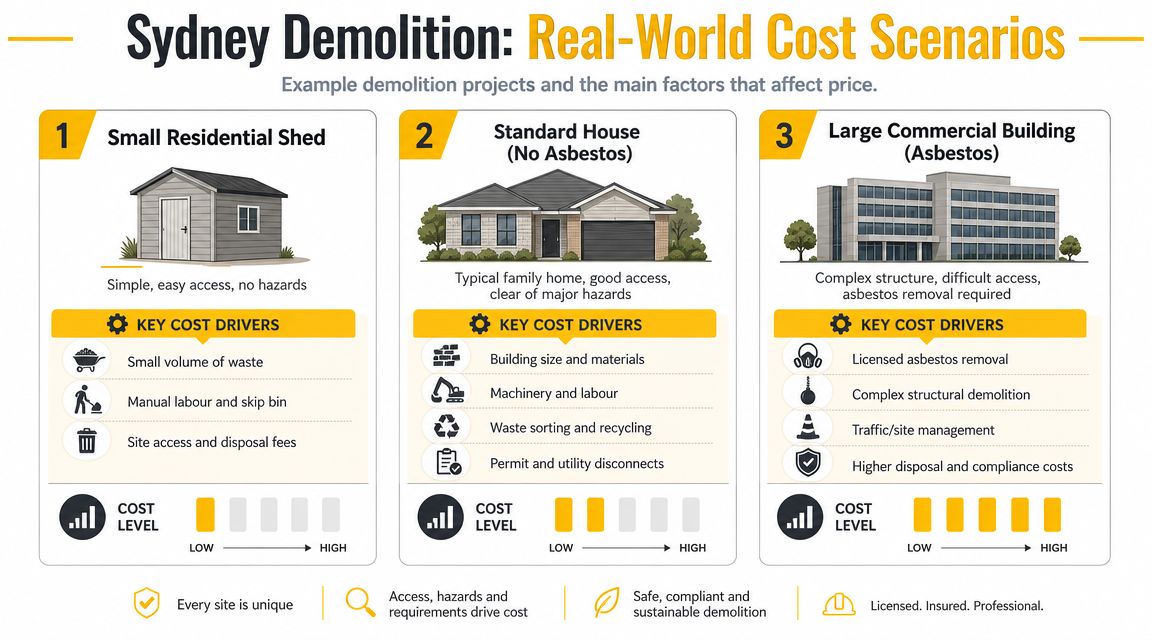
Small house with older materials in Western Sydney
A small fibro cottage in Blacktown or Penrith often looks like a budget job at first glance. The block may be flat, the driveway may be usable, and there may be enough room for bins and machinery. On paper, the size helps.
Older materials can wipe out that advantage. If the house has asbestos in wall sheeting, eaves, wet areas, or old outbuildings, the demolition method changes and so does the disposal cost. A small house with confirmed asbestos often costs more than owners expect because part of the job stops being straight machine demolition and becomes controlled removal, clearance, and separate waste handling. For smaller Sydney homes, this Sydney house demolition cost breakdown gives a useful starting range, but the material risk is usually what decides whether the final figure stays near the low end.
Standard brick veneer home with good access
A single-storey brick veneer home in the Sutherland Shire with clear side access is closer to the job owners usually have in mind when they ask for a typical demolition price. Machines can work efficiently, trucks can load without too much double handling, and the waste stream is easier to sort.
These jobs tend to quote more cleanly because there are fewer hidden cost drivers. Even then, I would not treat a broad Sydney price range as a fixed rate. Two brick veneer homes of similar size can still price differently if one has a detached garage, heavy footings, poor rear access, or a tighter street for truck movements. If you want a better baseline before a site visit, this guide to the demolition cost of a house is useful for understanding how contractors break up the scope.
Larger home on a steep Northern Beaches block
A larger multi-level brick home on a sloping Northern Beaches site is where the per-square-metre shortcut usually fails. The expensive part is often not the extra floor area. It is the method needed to bring the structure down safely and remove waste without damaging retaining walls, neighbouring property, or the access point itself.
Steep ground can mean smaller machines, staged demolition, extra traffic control, and more labour to separate material before it can be loaded out. Narrow frontage or limited truck standing room can slow the whole sequence. If sandstone, shared boundaries, or retaining concerns are involved, the job can move into a different pricing bracket even before hazardous materials are considered.
| Scenario | Likely pricing logic | Main cost pressure |
|---|---|---|
| Small older cottage | Can start low, then rise fast | Asbestos and hazardous material handling |
| Standard brick veneer | Usually sits in the middle of the market | Waste volume, footings, and access efficiency |
| Large steep-site home | Moves into the upper range quickly | Slope, restricted machinery access, and staging |
The practical question is simple. What on this site makes demolition slower, riskier, or harder to clear? In Sydney, that usually gives a more accurate cost picture than square metres alone.
How to Choose the Right Sydney Demolition Contractor
Price matters, but a clear method matters more. The right contractor gives you a quote you are able to assess, not a number that looks good until exclusions start surfacing.
Start by checking licences, insurance and scope. If asbestos may be present, ask who handles identification, removal coordination, clearance requirements and waste documentation. Ask who manages approvals, service disconnections and neighbour protection. If those answers are vague, the quote is vague too.
What a good contractor should be willing to show you
A reliable contractor should be comfortable providing:
- A detailed written scope that lists inclusions, exclusions, waste handling and site finish
- Current licence and insurance details relevant to demolition and any hazardous materials work
- A practical site methodology that suits access, structure, and local conditions
- Local experience with Sydney traffic, councils, tight sites, and compliance expectations
Local knowledge counts for a lot. A contractor working across Sydney and nearby regions should understand what changes between a flat block in Campbelltown, a narrow frontage in the Inner West, and a sloping site above sandstone on the Northern Beaches. Booms Up Civil Group is one option for owners who need demolition tied into broader site preparation, excavation, haulage and handover planning.
The best way to compare quotes is to slow the conversation down. Ask what's included. Ask what isn't. Ask what could trigger a variation. That's usually where the true value sits.
If you're planning a knockdown rebuild or need straight answers on demolition cost in Sydney, Booms Up Civil Group can help with a practical site assessment and a transparent quote. You can get in touch by phone, email or the website enquiry form to talk through access, compliance, waste removal and what your block will need before the rebuild begins.