
Planning a knockdown rebuild on the Central Coast, Sydney, or in the Hunter Valley always kicks off with one big question: what's the real cost to demolish a house?
While a final figure needs a proper site assessment, a good starting point for your budget is $15,000 to $40,000+ for a standard single-storey home. That's before you factor in tricky jobs like extensive asbestos removal or complex site access.
Your Guide to House Demolition Costs in NSW
Thinking about a knockdown rebuild is an exciting first step towards the home you've always wanted. Whether you’re on a suburban block in Newcastle or have a coastal property near Gosford, the first major hurdle is getting your head around the costs of clearing the old structure.
It's a common mistake to think demolition is just about bringing in an excavator and knocking everything down. A professional job is actually a carefully planned process.
A proper demolition involves everything from council approvals and disconnecting utilities to safely handling hazardous materials and getting rid of all the waste responsibly. The price you see on a quote isn't just for the labour and machinery; it reflects the expertise needed to get your site ready for construction—legally and correctly. A properly cleared block is the only foundation for a successful build.
This guide is here to give you a clear, honest overview of what goes into the final demolition cost of a house. We’ll break down the key variables that can swing your quote one way or the other, including:
- Property size and materials: A small fibro cottage in Wyong is a completely different job to a double-brick home in a packed Sydney suburb, and the price will reflect that.
- Site access and location: A flat, easy-to-reach block is worlds away from a steep, narrow site in Terrigal with tight street access.
- The hidden-but-critical costs: This is where things like asbestos testing and removal, council permit fees, and the cost of ripping out old concrete slabs or swimming pools come in.
Our goal is to pull back the curtain on the whole process. When you understand what’s involved, you can budget better and see why a detailed, all-in quote from an experienced local team like Booms Up Civil Group is the best way to start your project on the right foot.
Breaking Down The Average House Demolition Cost
When you’re planning a knockdown-rebuild, one of the first questions is always about the numbers. Getting a realistic handle on the demolition cost is the first step in building a solid budget. While every single project is different, we can definitely give you some solid benchmarks to work from. At the end of the day, the final price really boils down to your property's size and what it’s built from.
It’s easier to think of it in real-world terms. A small, two-bedroom fibro cottage on the Central Coast is a relatively simple job—it’s lighter, smaller, and easier to dismantle. Now, contrast that with a sprawling double-brick home in a tight Sydney suburb. That’s a whole different ball game, involving heavier machinery, more labour, and a much bigger pile of waste to haul away.
Typical Cost Ranges By House Size
To give you a general idea, house demolition jobs in NSW are often priced by their footprint. For a small home under 150m², you’re typically looking at a cost between $15,000 and $25,000. This ballpark figure usually covers the demolition itself, removing all the debris, and a basic site clean-up to get you ready for the next stage.
As the house gets bigger, so do the demands for labour, machinery, and waste disposal. Medium-sized homes, those between 150m² and 250m², can see the price tag climb into the $25,000 to $40,000 range. For larger properties over 250m², the costs can easily push past $40,000 to $55,000, sometimes more if there are tricky access issues in a built-up area.
This infographic does a great job of showing how the different factors contribute to the total cost.
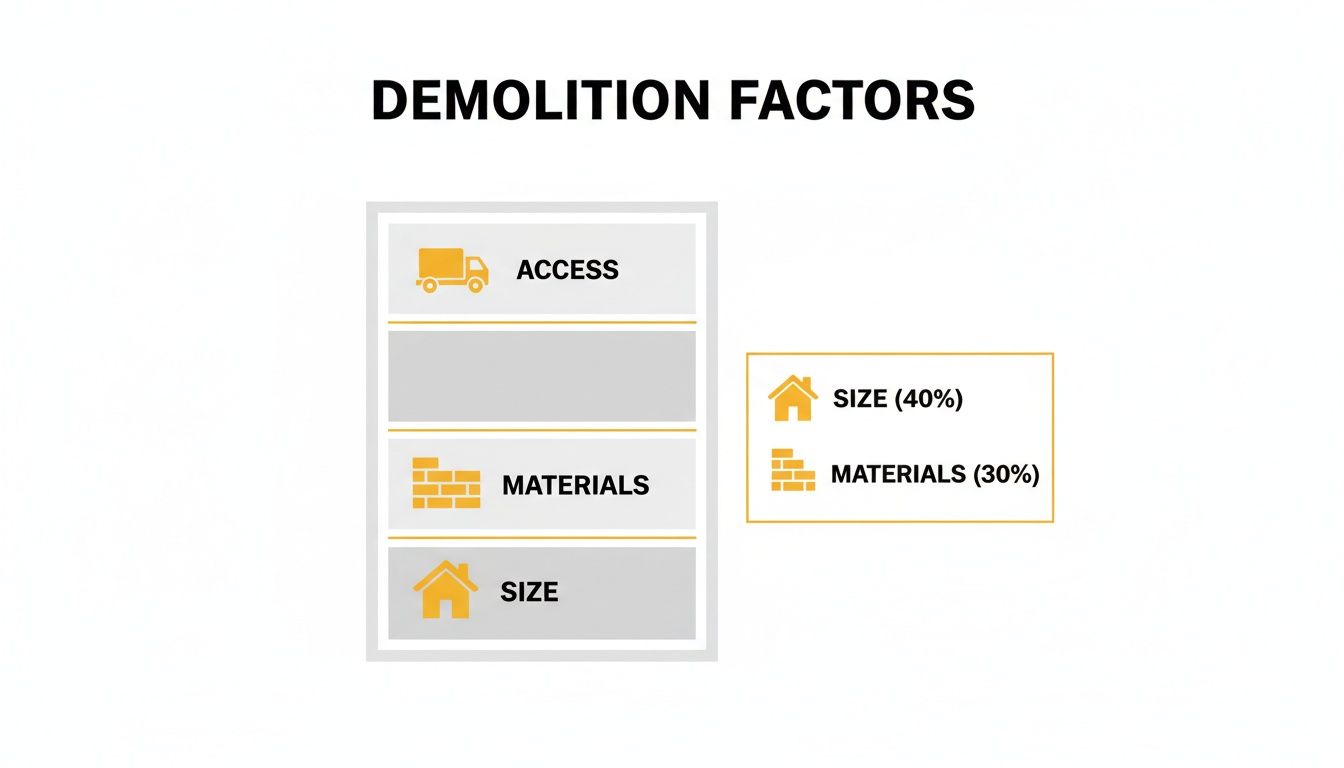
As you can see, the size of the house sets the foundation for the price, but the building materials and site access play a huge role in the final quote.
Estimated House Demolition Costs By Size And Type In NSW
This table offers a comparative look at typical demolition cost ranges for standard residential properties across NSW, helping homeowners budget for their project.
| House Size & Type | Typical Demolition Cost Range (Excluding Asbestos) | Common Property Examples |
|---|---|---|
| Small (Under 150m²) | $15,000 – $25,000 | 2-bedroom fibro cottage, small weatherboard house, single-storey brick veneer unit. |
| Medium (150m² – 250m²) | $25,000 – $40,000 | 3-4 bedroom single-storey brick home, older double-brick house, two-storey timber home. |
| Large (Over 250m²) | $40,000 – $55,000+ | Large two-storey brick residence, architecturally complex homes, properties with extensive paving. |
These figures give you a solid starting point for your budget, but they are just that—a starting point. The specific construction of your home will have a major say in the final price.
Comparing Costs For Different Property Types
The type of construction is just as critical as the square meterage. Heavier materials like double brick and concrete slabs demand more powerful machinery and take a lot longer to break down and haul away, which naturally pushes up the cost. On the other hand, timber-framed homes are usually quicker and cheaper to demolish. Getting these estimates right involves precise calculations, which is why many professionals in the industry use specialised tools like the Exayard construction takeoff software to accurately break down all the material and labour costs involved.
To really put it in perspective, here’s how different property types tend to compare.
Key Takeaway: The material of your home is a major cost driver. A heavier, more robust structure like a double-brick house will almost always cost more to demolish than a lighter timber-frame or fibro cottage of the same size due to increased labour, machinery requirements, and disposal fees.
For a more personalised estimate, you might find our guide on how to use a demolition cost calculator for Australian properties helpful. It's a great tool for plugging in your specific details to get a closer approximation.
Just remember, these figures are a launchpad for your budget. They generally don’t factor in significant extras like removing a large concrete slab, a swimming pool, or dealing with extensive asbestos—all things we’ll dive into next. The only way to get a rock-solid quote is with a detailed, on-site inspection that accounts for every little detail of your project.
What Really Influences the Final Price
The size and materials of your house give you a starting point for the demolition cost, but the final number on your invoice is shaped by a host of other critical factors. These are often the "hidden" costs that can take a budget by surprise if they aren't properly accounted for from the very beginning.
Getting a handle on these variables is the key to seeing the full picture of your project's expenses. From navigating council red tape to dealing with hazardous materials, each element adds another layer of complexity and cost. A professional demolition contractor doesn’t just see a house; they see a project with unique challenges that require specific solutions, equipment, and safety protocols.
The Asbestos Factor
If your home was built or renovated before 1990, it's highly likely it contains asbestos. This isn't just a minor inconvenience; it's a major safety and compliance issue that must be handled by licenced professionals according to strict SafeWork NSW guidelines. This part is completely non-negotiable.
Asbestos can be hiding in roofing, wall sheeting (fibro), insulation, old vinyl flooring, and even pipes. Before any real demolition can begin, a hazardous materials survey is needed to see if it's there. If asbestos is found, it demands careful removal and disposal by a specialised team, which is a separate and significant cost.
This is a huge variable. Asbestos is found in a large percentage of pre-1990 homes and can easily add $3,000 to $15,000 or more to the final bill, depending on the extent of the contamination.
Site Access and Location Challenges
How easily can we get our machinery onto your property? This is one of the first questions we ask. A wide, flat block in a new Hunter Valley estate with plenty of street parking is pretty straightforward. But a steep, narrow block on a tight street in Copacabana or a dense Sydney suburb presents a completely different set of logistical puzzles.
Limited access might mean we have to bring in smaller, specialised machinery, which can take longer to do the same job. It could also force us to create traffic management plans, organise road closures, or use extra labour to move materials by hand. These factors all add time and money to the project.
Consider this scenario: A project in a busy Newcastle suburb might require a detailed traffic management plan approved by Newcastle Council, flagmen to direct traffic, and specific work hours. This ensures public safety but adds a layer of coordination and cost that just wouldn't exist on a quiet, rural property.
Council Permits and Utility Disconnections
Before a single wall comes down, there's a checklist of admin tasks that need to be ticked off. Every demolition in NSW requires council approval, either through a Development Application (DA) or a Complying Development Certificate (CDC). The fees and the time it takes to get these permits can vary wildly between councils, from Central Coast Council to those in Greater Sydney.
On top of that, all utilities—electricity, gas, water, and NBN—must be professionally and safely disconnected. This means coordinating with multiple service providers and getting clearance certificates to prove the site is safe. A good demolition contractor will manage this process for you, but the costs are still part of the overall project budget.
Failing to manage this correctly can lead to serious delays and safety hazards. For instance, an improperly prepared site can cause issues later on, like poor ground stability. You can check out our guide on what soil compaction is and why it matters to understand more about getting your land ready for the build ahead.
These factors—asbestos, access, and administration—are precisely why a cheap, back-of-the-envelope quote is often a red flag. A thorough, on-site assessment is the only way to accurately price a job and ensure there are no costly surprises down the track.
Preparing Your Site After Demolition
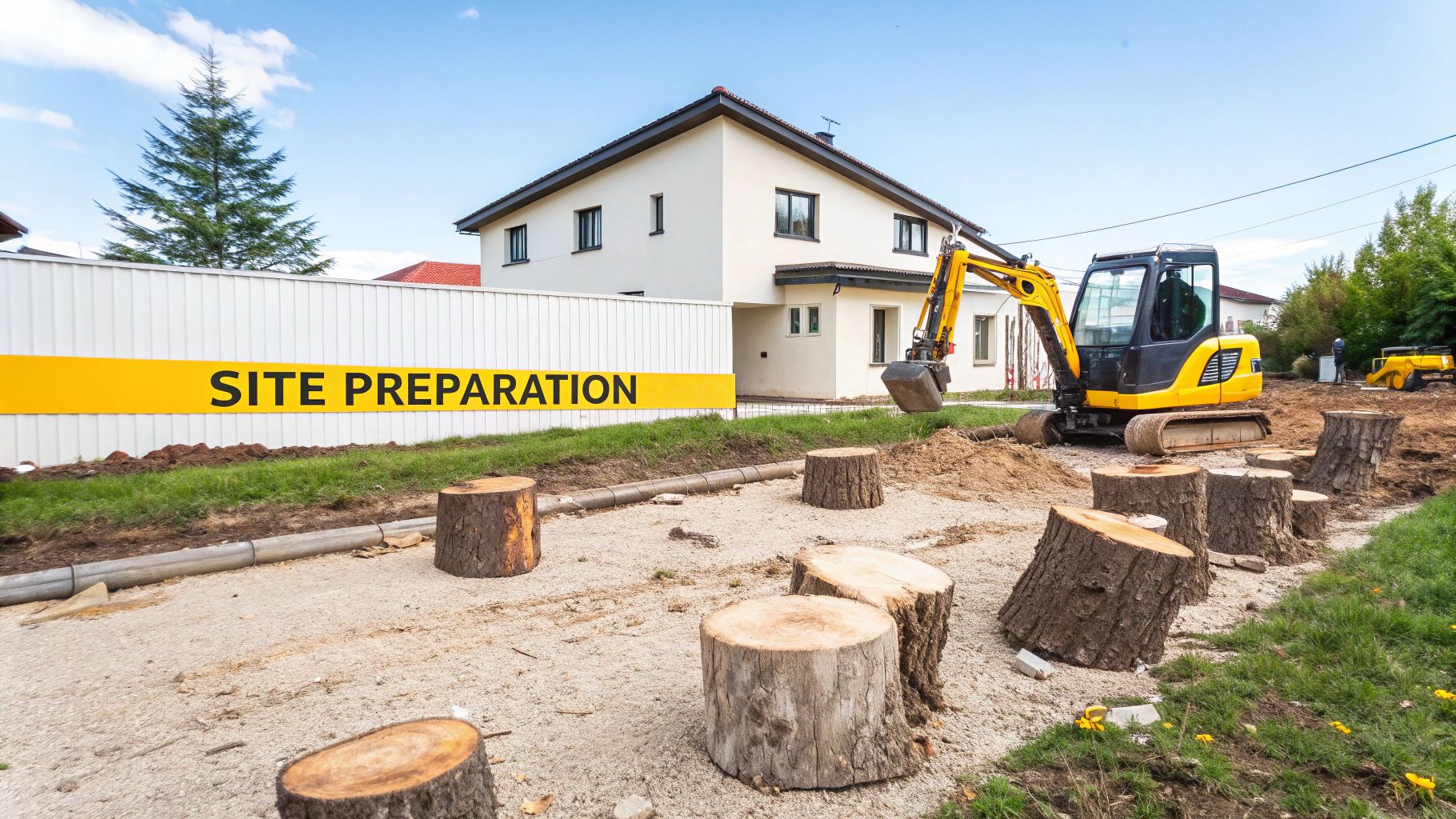
Once the old house is gone, your block might look empty, but it’s rarely ready for the builders to just move in. The demolition itself is just one part of a much bigger site preparation puzzle. What’s left behind—concrete slabs, old footings, swimming pools, and stubborn landscaping—all need to be dealt with, and these are almost always quoted as separate line items in your overall project cost.
Knowing this from the get-go helps you budget accurately for the entire scope of work. These follow-up services are absolutely critical for creating a clean, stable, and perfectly graded foundation for your new build. Think of it like preparing a canvas for painting; a lumpy, uneven surface is going to ruin the final masterpiece. It’s exactly the same with construction—the ground needs to be perfect.
Removing Old Concrete Slabs and Footings
One of the most common jobs we tackle after the main demolition is dealing with the old concrete slab. This isn't a simple cleanup; it's a heavy-duty task that demands specialised machinery and definitely adds to the overall demolition cost of a house.
A typical house slab, especially an older one, is often thick and reinforced with steel mesh. It needs to be smashed into manageable pieces with powerful hydraulic hammers attached to our excavators, then loaded up and hauled away for recycling. This process is far more intensive than clearing away timber frames or brickwork, which is exactly why it’s priced separately.
The same goes for old footings buried deep in the ground. These concrete foundations have to be fully excavated and removed to guarantee the new foundations for your home are being laid on solid, undisturbed earth. Leaving them in can cause serious structural problems down the track.
Tackling Swimming Pools and Landscaping
That old, unwanted swimming pool can be a massive obstacle. Demolishing an in-ground concrete or fibreglass pool involves breaking up the entire shell, removing all the debris, and then carefully backfilling the massive hole with clean, certified fill.
Important Note: Simply pushing the broken concrete into the hole and covering it with dirt is not a compliant or safe method. This creates unstable ground that will subside over time, potentially damaging your new home or landscaping. Proper backfilling, done in compacted layers according to Australian Standards, is essential.
Beyond pools, we often need to clear out established landscaping. This can include:
- Removing large, mature trees and their extensive root systems.
- Grinding down stubborn stumps that would interfere with new service trenches or foundations.
- Demolishing old block or timber retaining walls that are failing or simply in the wrong spot for the new design.
Each of these tasks requires specific equipment and techniques, from tree loppers and stump grinders to excavators for ripping out old walls. It's all part of transforming the site into a truly blank slate. If you want to dive deeper into how these two critical services work together, we have a great article on the relationship between demolition and excavation.
Bundling Services for Efficiency and Savings
This is where working with a full-service civil contractor like Booms Up Civil Group really pays off. Instead of you having to find and coordinate a demolition company, then a tree remover, then an earthworks contractor, we handle it all seamlessly. By bundling these services, we can plan the project logically, using the right machine at the right time.
For instance, the same excavator used to pull out a concrete slab can then be used to clear old retaining walls and level the block for the new build. This overlap creates major efficiencies, saving you a significant amount of time, hassle, and money. We see the big picture—from the initial knockdown to the final site levelling—ensuring your Central Coast, Sydney, or Newcastle property is perfectly prepared for whatever comes next.
Navigating Council Approvals and NSW Regulations
Before a single excavator bucket hits the dirt, there's a crucial phase of behind-the-scenes work that needs to happen. Successfully and legally demolishing a house in NSW means carefully navigating the maze of both local council and state government regulations. This isn't just about ticking boxes; it's a fundamental part of making sure your project is safe, compliant, and won't get bogged down in costly delays later on.
The whole process is wrapped in a framework designed to protect you, your neighbours, and the local environment. Getting this right from day one is non-negotiable and a huge part of what you're paying for when you bring in a professional demolition contractor.
Getting The Green Light From Your Local Council
Your first big hurdle is getting a demolition permit from your local council. Depending on the specifics of your site and the scope of your project, this will usually be one of two things: a Development Application (DA) or a Complying Development Certificate (CDC). A DA is the more detailed route, often needed for complex sites, while a CDC can be a much faster, streamlined option for straightforward jobs that meet a pre-approved set of state criteria.
Every council, whether it's the Central Coast Council or the Northern Beaches Council in Sydney, has its own unique set of requirements and processing times. This is where having local experience really pays off. A contractor who works in your area day-in, day-out will know the local planning controls, understand exactly what paperwork is needed, and know how to put together an application that sails through without any unnecessary back-and-forth.
State-Level Rules and SafeWork NSW
Looking beyond your local council, demolition work in NSW is strictly monitored by state bodies like SafeWork NSW and the Environmental Protection Authority (EPA). These are the organisations that set the standards for site safety, traffic management, noise control, and critically, the proper handling and disposal of hazardous materials like asbestos.
Your demolition contractor must hold the right demolition licence and be completely across the Work Health and Safety Regulation 2017. This involves everything from preparing a detailed, site-specific safety plan and notifying SafeWork NSW before work starts, to ensuring every scrap of waste—especially asbestos—is tracked and transported to a fully licenced facility.
The consequences of getting this wrong are serious. Cutting corners can quickly lead to stop-work orders from SafeWork NSW, massive fines from the EPA for illegal dumping, and project delays that can completely derail your entire building schedule. It’s a risk that's simply not worth taking.
At Booms Up Civil Group, we take all this off your plate. With over 15 years of hands-on experience across the Central Coast, Sydney, and Newcastle, we have the battle-tested processes and local relationships to manage every council application and ensure your demolition ticks every box under NSW law. We're all about getting the job done right the first time, giving you total peace of mind.
How to Choose the Right Demolition Contractor
Picking the right contractor for your demolition is probably the single most critical decision you'll make. The right team doesn't just knock down a house; they manage risk, navigate council regulations, and deliver a clean, build-ready site—safely and on schedule.
Getting this choice wrong can lead to a world of pain: budget blowouts, dangerous mistakes, and some serious legal headaches. A professional, experienced contractor, on the other hand, acts more like a project partner, guiding you through the messy bits and making sure every detail is handled correctly from day one.
Verifying Licences and Insurance
Before you even think about comparing quotes, your first job is to check the contractor's credentials. This is non-negotiable.
In NSW, a demolition contractor must hold the right licences issued by SafeWork NSW. And if there's any chance of asbestos on your property, they absolutely must have a specific asbestos removal licence. It’s that simple.
Just as important is their insurance. Ask to see a Certificate of Currency for their Public Liability insurance, and make sure it covers at least $20 million. This is what protects you financially if something goes wrong, like accidental damage to a neighbour's property. Don't be shy about asking for this paperwork; any reputable contractor will have it ready to go.
Interpreting Quotes and Spotting Red Flags
When the quotes start rolling in, it’s tempting to grab the cheapest one and run. But that’s often a recipe for disaster. A cheap quote is usually an incomplete one, leaving out critical costs that will pop up later as expensive "variations."
A professional quote should be detailed and totally transparent. Look for specific line items covering things like:
- Council permit applications and all the associated fees.
- Managing the disconnection of utilities.
- Asbestos testing and a clear cost for removal if it's found.
- All labour, machinery hire, and transport costs.
- Waste disposal and recycling fees (tip fees).
- The final site cleanup and levelling.
If you get a quote that’s just a single lump-sum figure with no breakdown, treat it as a massive red flag. It suggests the contractor hasn't assessed the job properly or, worse, is planning to cut corners. Many of the same principles for spotting a good operator apply to other earthworks, too. For more on this, check out our guide on finding the best excavation contractors near you. When you're making your choice, it's also worth understanding different companies' approaches to see why you should hire Firm Foundations to do your demolition work.
The Value of Local Experience
Finally, never underestimate the power of local knowledge. A contractor with years of experience working on the Central Coast, in Newcastle, or across the trickier suburbs of Sydney will have a deep understanding of local soil conditions, council quirks, and the logistical nightmares specific to the region.
At Booms Up Civil Group, our 15+ years on the ground mean we've seen it all. We know how to get your project approved and completed without the frustrating delays, because we get it right the first time.
Still Have a Few Questions? We’ve Got Answers
Even after walking through the costs and steps, it’s completely normal to have a few more things on your mind. Demolition is a big undertaking. To help clear things up, here are our answers to the most common questions we get from clients across the Central Coast and beyond.
How Long Does It Take to Demolish a House in NSW?
This is probably the number one question we get asked. While the actual knockdown of a standard, single-storey house might only take a couple of days, the entire process from start to finish is much longer. You should realistically budget for a timeline of two to six weeks.
The biggest hold-ups are almost always administrative. Just getting a Development Application (DA) through your local council can take several weeks on its own. When you add in the time needed for asbestos clearance or coordinating utility disconnections, you can see why it’s so important to build this planning phase into your project timeline.
Can I Save Money By Doing Some of the Demolition Myself?
It’s tempting to look at the quote and think about where you could trim costs by getting on the tools yourself. We get it, but we strongly advise against it. In NSW, any structural demolition is classified as a high-risk activity, and the law requires licenced professionals who follow strict SafeWork NSW regulations.
The risk of serious injury, causing damage to a neighbour's property, or mishandling hazardous materials like asbestos is incredibly high. Any money you think you're saving can vanish in an instant with fines, massive repair bills, or medical costs. The safest, smartest, and ultimately most cost-effective path is always to hire a qualified contractor to get the job done right the first time.
What Happens to All the Waste From My Demolished House?
A professional demolition contractor doesn't just knock things down; we're legally responsible for managing every scrap of waste in an environmentally sound way. On-site, everything is carefully sorted to recycle as much as possible and keep landfill to a minimum.
Here's a quick look at how it works:
- Concrete and bricks are usually crushed down and get a second life as road base or construction aggregate.
- Metals, like steel beams and copper pipes, are separated and sent off to scrap metal recyclers.
- Timber and green waste can be mulched or repurposed for other uses.
Of course, anything hazardous—especially asbestos—is handled with extreme care. It must be wrapped, transported, and disposed of at a specially licenced facility, with a paper trail tracking its every move. We take our environmental responsibilities seriously and will provide you with all the necessary paperwork to prove your site's waste was managed in full compliance with NSW EPA guidelines.
Ready to get a clear, comprehensive quote for your demolition project? The team at Booms Up Civil Group is here to help. With over 15 years of experience on the Central Coast, Sydney, and in the Hunter Valley, we manage the entire process—from council approvals to final site clearance—ensuring a safe, compliant, and build-ready result.
Get Your Free Demolition Quote Today or call us to discuss your project.