
Every great build, whether it's a new home looking out over the Central Coast or a commercial carpark in Newcastle, is built on two things you'll probably never see again: excavation and foundation. Think of excavation as the crucial prep work—clearing the stage and shaping the ground—while the foundation is the engineered anchor that guarantees a lifetime of stability. Getting these two steps right from the start is the most important part of any construction project.
The Unseen Workhorse of Every Great Build
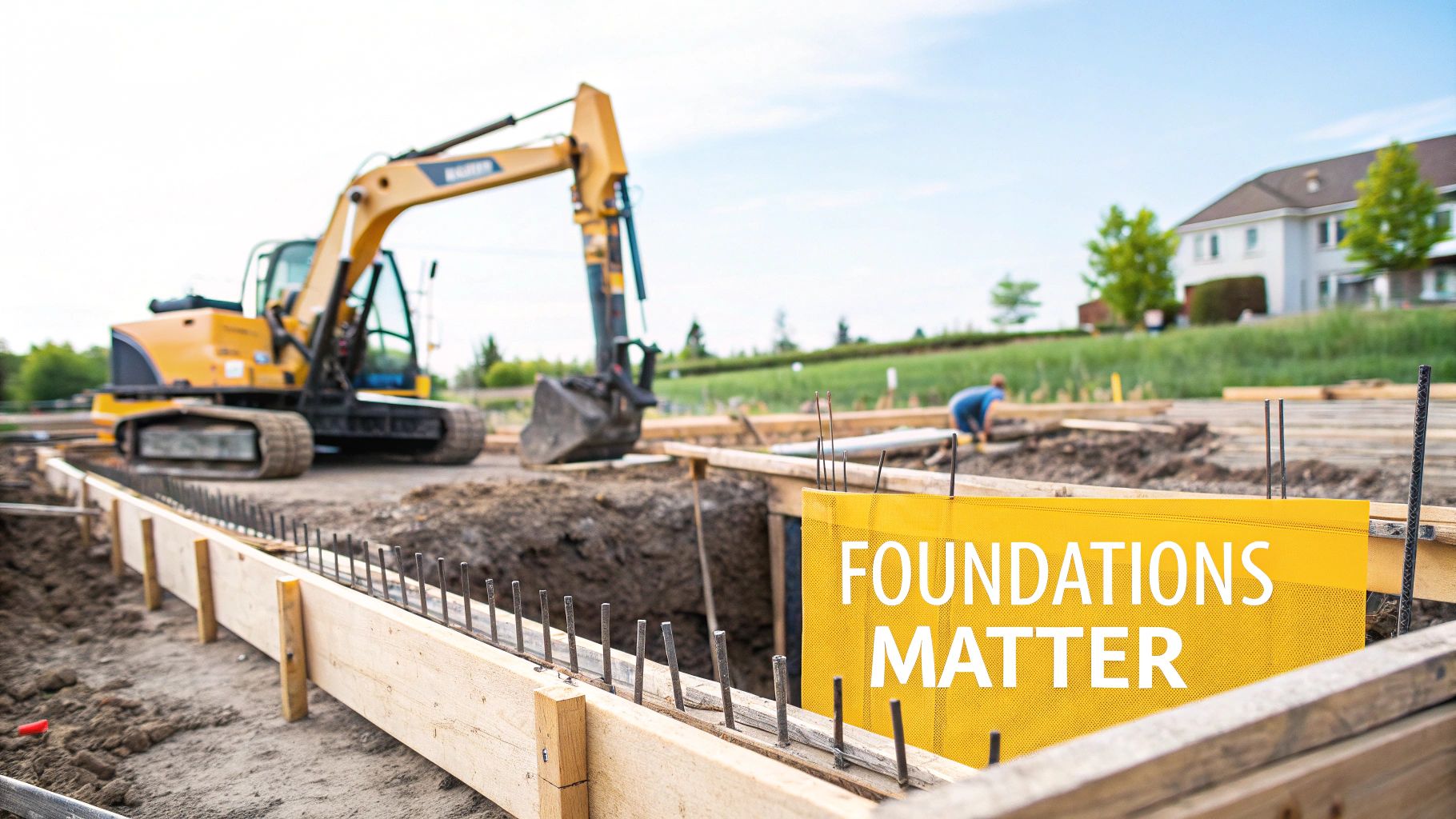
Excavation is the process of moving earth, rock, and anything else in the way to perfectly shape a site for what’s to come. This isn't just about digging a hole; it's a precise, surgical operation that creates the perfect canvas for your structure. Only once the site is perfectly prepared can the foundation work begin.
The foundation is like the roots of a mighty tree. It’s completely hidden once the project is finished, but it’s responsible for transferring the entire weight of the structure safely and evenly into the ground. If you get this right, your building will stand firm for decades.
Why Getting It Right Matters
Getting this stage absolutely right is non-negotiable. A small error during excavation or foundation work can snowball into massive, costly problems down the track.
We've seen it all before. Poor groundwork is almost always the culprit behind issues like:
- Cracking walls and ceilings as the ground settles unevenly.
- Sinking or sloping floors that throw the whole building out of alignment.
- Persistent water damage and damp issues in basements or lower levels.
- Doors and windows that stick or refuse to close properly because the frame has shifted.
Trying to fix these problems after the fact is disruptive, incredibly expensive, and often a losing battle. That’s why at Booms Up Civil, we live by a "measure twice, cut once" philosophy. Proper planning and expert execution from day one will save you a world of money and stress in the long run.
A solid start is everything. For a closer look at these first critical steps, you can check out our detailed guide on the essentials of site preparation and excavation.
In this guide, we'll walk you through everything you need to know about excavation and foundation works. From understanding the unique soil conditions around Sydney to navigating Central Coast Council approvals, we'll give you the knowledge to get your project started with complete confidence.
What Lies Beneath Your NSW Property
Before a single bucket of dirt gets moved, the most important question is, what’s already there? The ground beneath your feet across the Central Coast, Sydney, and the Hunter Valley varies dramatically, and understanding its unique character is the absolute key to a successful project. An experienced contractor knows that the soil dictates the entire approach to excavation and foundation work.
Consider this scenario: if you're building in a coastal suburb like Terrigal or Wamberal, you're almost certainly dealing with sandy soils. These are generally easy to dig, but they come with their own set of problems. Sandy ground can be frustratingly unstable and requires careful shoring during the dig to prevent collapse, especially after a good downpour.
Understanding Your Local Ground Conditions
Head just a few kilometres inland towards Kariong, or into parts of Western Sydney, and the landscape changes completely. Here, you'll likely run into reactive clays. This type of soil is notorious for swelling with moisture during wet seasons and shrinking dramatically when it's dry, placing immense stress on any foundation built on top of it.
Then there’s Sydney's infamous sandstone bedrock. While it provides an incredibly solid base for a structure, actually breaking through and excavating it can be a slow, machinery-intensive—and therefore more expensive—process. This is exactly why a geotechnical report is often the most valuable investment you can make at the very start of your project.
A geotechnical report is a detailed scientific analysis of your site's ground conditions. It’s the essential blueprint engineers need to design an excavation plan and foundation that’s perfectly suited to your specific block, preventing costly surprises and long-term structural problems down the track.
This professional assessment takes all the guesswork out of the equation. It identifies the soil composition, rock depth, and any potential headaches like groundwater, giving us the hard data we need to get the footings and foundation design right from the very beginning. For a deeper dive into this crucial first step, feel free to explore our guide on planning for footings excavation.
To give you a clearer picture of what we're often up against, here’s a quick rundown of common soil types you'll find across our service areas and what they mean for your build.
Common NSW Soil Types and Their Impact on Foundations
| Soil Type | Common Locations (Examples) | Key Challenge | Foundation Consideration |
|---|---|---|---|
| Sandy Soil | Coastal areas: Terrigal, Newcastle Beach, Cronulla | Low stability, prone to collapse, poor load-bearing capacity | Deeper footings, screw piles, or raft slabs are often needed to reach stable ground. Shoring during excavation is critical. |
| Reactive Clay | Western Sydney, Hunter Valley, parts of Central Coast | Swells when wet, shrinks and cracks when dry, causing significant ground movement | Waffle pod slabs, screw piles, or pier and beam foundations are designed to accommodate or bypass this movement. |
| Silt/Alluvium | Near rivers and floodplains: Hawkesbury-Nepean, Hunter River | Can liquefy under pressure (like earthquakes), poor drainage | Requires deep piling to transfer loads to more stable layers below; robust drainage solutions are essential. |
| Sandstone Bedrock | Sydney Basin, parts of the Blue Mountains, Hornsby Plateau | Extremely hard and difficult to excavate, increasing time and cost | An excellent base once reached. Rock breakers and grinders are often required. Foundations can be anchored directly to the rock. |
Understanding these local nuances isn't just an academic exercise—it's fundamental to building a structure that will stand the test of time without costing you a fortune in unexpected earthworks or future repairs.
The Growing Importance of Geotechnical Insight
The complexity of our local terrain is driving real changes in the construction industry. The geotechnics market is expanding rapidly, shaped by the unique challenges of building in our region. For areas like Sydney, the Central Coast, and Newcastle—where steep sites, cut-and-fill driveways, and basement garages are common—this translates into a rising demand for expert geotechnical investigations and engineered foundations that can manage our diverse ground conditions. You can learn more about these market trends and their impact on construction.
By investing in this upfront analysis, we ensure your foundation is built to last, no matter what lies beneath the surface.
Matching the Right Method to Your Project
Once we have a clear picture of what’s happening beneath your site, we can roll out the right tools and techniques for the job. Not all excavation is created equal, and matching the method to the project is a critical part of making sure your excavation and foundation work is efficient, safe, and cost-effective.
Think of it like a sculptor choosing their tools. You wouldn't use a sledgehammer for the fine details, and you wouldn't use a tiny chisel to carve out a massive block of stone. The same logic applies here. Every decision, from the machinery we bring on-site to the type of foundation we recommend, is based on the specific challenges and goals of your project.
Bulk vs Detailed Excavation
The two main categories we work with are bulk excavation and detailed excavation. For the big jobs, like digging out a basement for a new home in Killcare or clearing an entire block for a commercial development near Tuggerah, we start with bulk excavation. This is all about moving large volumes of soil and rock efficiently to get the general shape of the final design.
Once the heavy lifting is done, we switch gears to detailed excavation. This is the fine-tuning stage, where precision is everything and smaller machinery is essential. This could be anything from digging narrow trenches for plumbing and electrical services, shaping the precise footings for a foundation, or prepping the ground for a new driveway slab. For a closer look at the specifics, our guide on trenching and shoring techniques dives deeper into the safety and best practices for this kind of work.
Cut and Fill for Sloping Sites
Here on the Central Coast and in parts of Sydney, we see a lot of sloping blocks. For these projects, a ‘cut and fill’ approach is often the smartest and most practical solution. The technique is simple in concept: we excavate, or 'cut', earth from the higher sections of the block and move it to the lower areas to 'fill' them, creating a perfectly level and stable platform for building.
This method is so effective because it minimises the need to haul truckloads of soil off-site, which can save you a significant amount of time and money on disposal fees. When it's done right, you get a beautifully engineered building pad that works with the natural contour of the land, not against it.
Choosing the Right Foundation for Your Soil
The excavation method is only half the story; the foundation type is just as crucial. And honestly, that choice is almost entirely dictated by the soil conditions we talked about earlier. A straightforward slab-on-ground foundation might be perfect for a flat, stable block in a Hunter Valley estate where the soil is predictable and well-behaved. It's a common and cost-effective solution for these kinds of sites.
This decision tree gives you a simple idea of how soil type influences that choice.
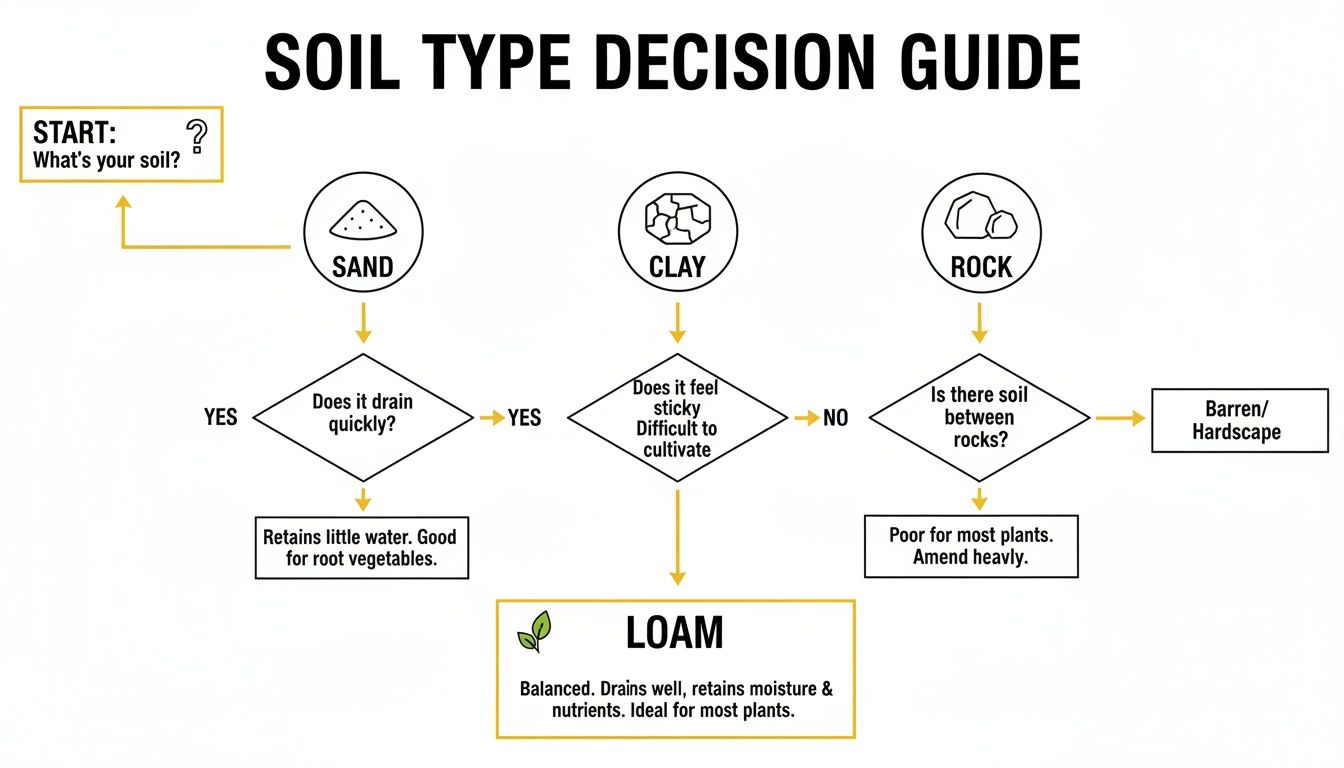
As you can see, what works on stable ground is completely unsuitable for reactive or unstable soils.
Now, imagine a waterfront build in Copacabana with sandy, reactive soil, or a tricky site in the Newcastle hills. In those situations, a standard slab would be at risk of shifting and cracking down the line. Here, we’d look at a much more robust system, such as:
- Pier and Beam Foundations: We drill concrete piers deep into stable ground, then construct beams on top to support the structure, effectively elevating it above the problematic soil.
- Screw Piles: These are essentially giant steel screws that are drilled deep into the earth until they hit solid, load-bearing ground. The building's foundation is then anchored securely to these piles.
At Booms Up Civil, we bring over 15 years of hands-on experience to challenging sites across the Central Coast. We pride ourselves on finding solutions where others might only see roadblocks. Our commitment is to always match the excavation method and foundation design to your site's unique needs, ensuring a safe, compliant, and durable result that will stand the test of time.
Your Project Journey: From First Call to Final Groundwork
Starting an excavation and foundation project can feel like a massive undertaking. We get it. That’s why we believe a clear, transparent process makes all the difference—you should always know what’s happening, from the first phone call right through to the final site cleanup. A well-managed journey keeps your project on track, on budget, and free from unnecessary stress.
Every project we take on, whether it's in Sydney, Newcastle, or right here on the Central Coast, kicks off with an initial consultation. This is where we sit down with you, go over your architectural drawings, and really get to grips with the unique challenges and opportunities of your site. This deep dive allows us to provide a detailed, accurate quote that covers the full scope of work, with no nasty surprises.
The Initial Steps On-Site
Once you give us the green light, our team moves into the site establishment phase. This is much more than just parking an excavator; it’s a critical safety and compliance step. We set up temporary fencing to secure the site perimeter and put sediment and erosion controls in place, just as local authorities like Central Coast Council require. It’s all about protecting your property, your neighbours, and the public.
With the site properly secured, the main event begins: the excavation. Using the right machinery for your specific site, we begin the careful process of shaping the ground precisely to the engineering plans. This is immediately followed by spoil removal, where we responsibly transport and dispose of all the excavated material, keeping the site clean, organised, and ready for the next stage.
From Bare Earth to a Solid Foundation
After the excavation is complete and certified, the site is ready for the foundation phase—a multi-step process that demands precision and an eye for detail.
- Formwork: First, we build the temporary moulds that will hold the wet concrete in the exact shape required for your footings, slab, or walls.
- Steel Reinforcement: Our team then carefully places and ties the steel reinforcement bars (rebar), which give your concrete foundation the tensile strength it needs to last.
- Inspections: Before a single drop of concrete is poured, a structural engineer or a private certifier must inspect the formwork and steel to ensure it all meets strict Australian Standards.
The final major step is the concrete pour. We coordinate the delivery and pour, ensuring it’s done efficiently and finished to the required standard. This creates the solid base your entire structure will rely on for decades to come.
Throughout this entire journey, clear and consistent communication is our top priority. We provide you with regular updates on progress and are always on hand to answer any questions you might have.
We know that unforeseen challenges can pop up—hitting unexpected rock or dealing with a week of heavy rain can affect timelines. Our promise is to manage these situations proactively, discussing solutions with you and keeping you fully informed every step of the way. Choosing the right team is essential, and our guide on what to look for when hiring excavation contractors near you can help you make a confident decision.
Across Australia, excavation and foundation works are a cornerstone of the construction market. For projects across the Central Coast, Newcastle, and Sydney, this means homeowners and developers are working within a mature industry where experienced contractors are key to delivering compliant, engineered building platforms. Our structured process ensures your project benefits from this experience, delivering a result that's built right, the first time.
Navigating Council Rules and Australian Standards
Getting the groundwork right for your excavation and foundation involves much more than just digging. It's about meeting a strict set of legal and safety requirements that ensure your project is built to last—and won’t cause headaches for you or your neighbours down the track.
Here in NSW, that means working hand-in-glove with local authorities like the Central Coast Council or the City of Newcastle.
Before we can even think about firing up an excavator, your project will almost certainly need a Development Application (DA) approval, which is then followed by a Construction Certificate (CC). These aren't just bureaucratic hurdles; they are critical checks and balances. They make sure the work is planned correctly, considers environmental impacts, and meets community standards for everything from drainage to site access.
Your Safety and Compliance Obligations
Beyond council paperwork, every single thing we do on-site is governed by SafeWork NSW regulations. These rules are non-negotiable. They cover everything from how deep excavations must be secured with shoring to prevent collapse, to managing silica dust and keeping the public safe around the worksite. Following these rules to the letter is a core part of our promise to run a safe project for our team, your family, and the community.
On top of that, all our foundation work strictly follows the relevant Australian Standards. For most residential projects, this means adhering to AS 2870—Residential slabs and footings. You can think of this standard as the official industry rulebook. It provides the engineering blueprints to ensure your foundation can handle local soil conditions, whether it's the reactive clays of the Hunter Valley or the sandy soils of the Central Coast.
Navigating this world of permits, regulations, and standards can feel overwhelming and time-consuming. As experienced local contractors, we handle these compliance details for you, ensuring your project is fully approved and built correctly right from day one.
From Paperwork to Practical Application
Making sure we understand and stick to the various council rules and Australian Standards is absolutely essential. This often involves ongoing regulatory compliance training to stay on top of any changes, ensuring that every step—from the initial site cut to the final concrete pour—is documented, inspected, and signed off as required.
For example, a certifier will need to inspect the steel reinforcement in your slab before any concrete can be poured. This inspection confirms that the placement and amount of steel perfectly match the engineer's design and comply with AS 2870. Skipping this step wouldn’t just result in a non-compliant building; it could also void your home insurance.
This rigorous process ensures every part of your foundation is built to withstand the specific pressures of your site for decades. When you're planning a project with significant site works, it really helps to understand the full picture. For a deeper dive, check out our guide on the relationship between demolition and excavation. We manage the complexities of compliance so you can focus on bringing your vision to life.
The Big Question: What's Driving the Cost?
Every excavation and foundation project has its own unique fingerprint, and so does its price tag. When you look at a quote, you're seeing a breakdown of several key factors that shape the final number. Understanding these variables is crucial, as it helps you appreciate a detailed estimate that truly reflects the full scope of work, ensuring there are no nasty surprises down the track.
Without a doubt, the single biggest driver of cost is the volume and type of material we need to shift. Digging out 200 cubic metres of soft, sandy soil is a world away from breaking through the same amount of solid Sydney sandstone. The sandstone requires heavy-duty gear like rock hammers and grinders, which adds a significant amount of time, fuel, and labour to the project.
Getting In and Getting Complex
Site access is another massive piece of the puzzle. Let's say you’re on a tight block in a dense Newcastle suburb with barely any street frontage. Just getting our machinery in and out safely takes a lot more planning and often means using smaller, more specialised (and sometimes more expensive) equipment. It stands to reason that a steep, tricky-to-reach site will take longer and cost more than a wide-open, flat block.
The complexity of the engineer's foundation design also plays a huge part. A simple rectangular slab on a flat site is pretty straightforward. Compare that to a complex, multi-level foundation with deep piers and heavy-duty reinforcement, all designed for a sloping block with reactive clay. More complexity means more hands-on labour, more materials, and more time on the clock.
We believe in being completely transparent about these variables right from the start. It's how we help you understand exactly what’s behind every line item in your quote. This kind of clear communication and honest costing is the bedrock of a successful project.
What to Do With the Spoil?
Finally, you've got the cost of spoil disposal. Shifting clean, uncontaminated soil (what we call Virgin Excavated Natural Material, or VENM) off a site is relatively simple. But if we dig up contaminated material—think soil mixed with old building rubble, asbestos, or other pollutants—getting rid of it becomes a much more complex and expensive task, governed by strict environmental rules.
The amount of excavation happening in Australia right now is directly linked to the massive pipeline of infrastructure and building projects. Infrastructure Australia has pegged construction demand at over AUD $1.14 trillion nationally for the five years starting from 2024-25. For the NSW coastal corridor, this boom means there’s huge demand for reliable contractors who can manage every part of a job, from the initial dig to the final haul, all on a tight schedule. You can read the full industry forecast in Infrastructure Australia's 2025 Market Capacity Report.
Keeping a tight grip on these financial moving parts is what makes or breaks a project. For a deeper look into managing project finances from a contractor's perspective, check out this excellent guide to job costing in construction. Here at Booms Up Civil, we make it simple by providing clear, itemised quotes so you can see exactly where every dollar of your investment is going.
Frequently Asked Questions
After 15+ years in the game, you get to hear a lot of the same questions. Excavation and foundation work can seem complex from the outside, so we've put together some straightforward answers to the queries we hear most often from clients across the Central Coast, Sydney, and Newcastle.
We find that once people have a clear picture of the process, they can plan their project with a lot more confidence. Let's dig in.
How Long Will My Project Take?
This is always the first question, and the honest-to-goodness answer is: it depends. The timeline for any excavation job is shaped by a few key things: the sheer size of the project, how easy it is to get machinery onto your site, the soil we’re dealing with, and—of course—the weather.
A simple slab preparation on a flat, clear block might only take a few days. But if we're digging a large basement on a steep, rocky site somewhere in the Sydney hills, that could easily take several weeks to complete safely and properly. When we put a quote together for you, we’ll always give you a realistic schedule based on a proper assessment of your specific site.
Do I Really Need a Geotechnical Report?
Look, for many projects, especially those on sloping sites, land with reactive clay, or any property where the ground conditions are a mystery, a geotechnical report is a crucial investment. Think of it as cheap insurance against very expensive future foundation failure.
It’s all about spotting potential headaches like unstable soil or shallow rock before they become big problems during the build. This information allows your engineer to design a foundation that is safe, compliant, and perfectly suited to the ground it's actually sitting on.
What Happens if You Find Rock or Contaminated Soil?
Discovering unexpected rock or contaminated materials is always a possibility in this line of work. If it happens, our first step is to down tools immediately and get in touch with you. There are no surprises on our watch.
We'll walk you through exactly what we've found and clearly lay out your options. This might involve bringing in specialised rock-breaking equipment or arranging for certified disposal methods for contaminated soil. Before we proceed an inch further, we'll provide a clear cost variation for you to approve, so you're always in control.
Ready to get your project started on solid ground? The team at Booms Up Civil Group has the experience to handle even the most challenging sites across the Central Coast and beyond.
For an obligation-free chat and a detailed quote, get in touch with us today.