
You've probably landed here because you're staring at an older house, a redevelopment block, or a commercial site and thinking the hard part is getting an excavator on site. It isn't. In Victoria, demolition is one of those jobs that looks simple from the street and turns into a paperwork, safety, and sequencing exercise the moment you touch the structure.
That catches out both homeowners and builders. One person thinks the demolition contractor handles everything. Another assumes a building permit is the same thing as a demolition licence. Someone else books machinery before the council consent is in place. That's where jobs stall, neighbours complain, and costs start drifting.
The practical reality is this. A proper demolition job in Victoria sits across several authorities, and each one has a different role. The VBA deals with practitioner registration. Council often sits at the front of the process through consent requirements. The building surveyor issues the permit. WorkSafe Victoria focuses on site risk and demolition safety. EPA-related obligations come into play through waste, dust, transport, and disposal. If you treat it like “just knock it down”, you'll get burned.
Before You Swing the Wrecking Ball
Let's say you've bought an old weatherboard in Brunswick, or you've picked up a bigger block in Bendigo for a knockdown-rebuild. From the outside, it feels straightforward. Disconnect services, fence the site, pull the house down, cart the waste away, and get ready for the new slab.
That's not how it works in practice.
Victoria deals with demolition work all the time. The Australian Bureau of Statistics reported 37,102 dwellings approved to be demolished over the five years to the March 2021 quarter, making Victoria the largest state by volume for demolition approvals in that period, according to the ABS demolition approvals data. That matters because it tells you demolition isn't unusual. It's common, but it's regulated because it carries real risk.
Demolition is a system, not a single approval
A lot of people search for “demolition licence Victoria” when what they need is one of two things. Either they need a suitably registered demolition practitioner to do the work, or they need the project-specific permit path sorted before work starts.
The confusion usually starts because four different players are involved:
- The VBA decides who is properly registered to carry out demolition work in the relevant class.
- Council may need to give consent before a permit can even be issued.
- The building surveyor issues the demolition permit for the job.
- WorkSafe Victoria expects demolition risk to be managed properly on site.
If you're still at the planning stage, it helps to understand the site-prep side as well. This guide on building for demolition is useful if you're trying to line demolition up with the next stage of excavation and construction.
Practical rule: The safest way to think about demolition is this. Registration qualifies the contractor. Permits authorise the project. Safety documents control the work. Waste and environmental obligations follow the material off site.
Where jobs usually go wrong
The biggest mistakes happen before any structure comes down. Builders lock in a programme too early. Homeowners rely on a quote that excludes approvals. Owner-builders assume their new home permit somehow covers demolition. It doesn't.
A clean project starts with the right sequence. Once you understand that sequence, the bureaucracy stops feeling random and starts feeling manageable.
Do You Actually Need a Demolition Licence in Victoria
The short answer is yes, if you're the practitioner carrying out demolition work that requires the relevant registration. If you're the property owner, you usually won't hold the demolition registration yourself. You'll engage someone who does, and you'll still need the project approvals attached to the specific site.
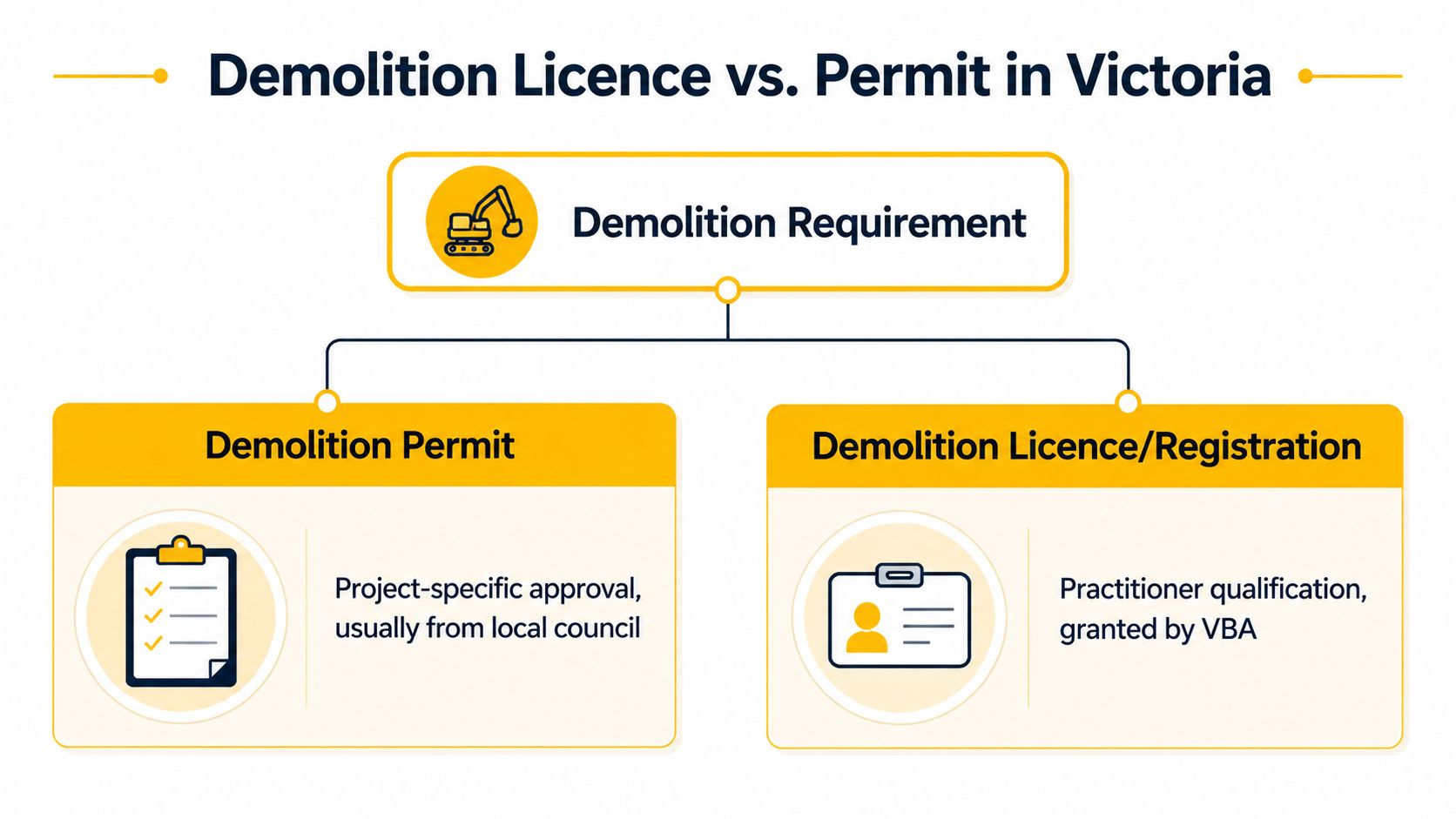
That distinction matters because people often mix up a demolition permit with a demolition licence or registration. They're not interchangeable.
Permit versus registration
A permit is tied to the site and the scope of works. Registration is tied to the person or business carrying out the work. One approves the job. The other proves competency.
If you're a builder hiring a demolition contractor, ask for their VBA registration details early. If you're a homeowner comparing quotes, don't stop at “fully insured and licensed” in the marketing copy. Ask what class of demolition work they're registered for and whether that class matches your structure.
For readers dealing with work across state lines, this comparison with a demolition licence in NSW helps show how different the systems can be.
The class of registration matters
Victoria separates demolition registration into classes. In practice, that means not every demolisher is authorised for every building type. A low-rise domestic knockdown is one thing. Multi-storey commercial demolition is another world altogether.
Here's the practical view:
| Registration issue | Why it matters on site |
|---|---|
| Building height and complexity | The higher and more complex the structure, the more sequencing, engineering control, and exclusion planning it needs |
| Location | Tight urban sites near footpaths, adjoining buildings, or live traffic need stronger planning and supervision |
| Construction type | Masonry, steel, reinforced concrete, and mixed-material structures each change the demolition method |
| Public exposure | A site near neighbours or public areas raises the standard for fencing, overhead protection, and traffic control |
Higher registration classes aren't just administrative labels. They reflect whether the contractor has handled the sort of risks your project creates.
Why the VBA sets a high bar
Victoria's regulator doesn't treat demolition as simple plant operation. It treats it as safety-critical work that has to be done by people with proven experience. For certain classes of commercial work, the Victorian Building Authority requires a builder to show substantial prior experience, including at least 3 projects involving the complete demolition of a commercial building over 5 storeys in height, as set out by the Victorian Building Authority demolition work requirements.
That tells you something important. The VBA is looking past machinery ownership. It wants evidence that the contractor understands sequencing, structural behaviour, protection of adjoining property, and controlled demolition methods.
If a contractor can't explain the difference between being registered to demolish and merely being willing to quote the job, keep looking.
For homeowners, the practical takeaway is simple. You don't need to become an expert in registration classes, but you do need to verify that the person taking your deposit is properly matched to the building they're removing.
Your Application Pack Qualifications and Paperwork
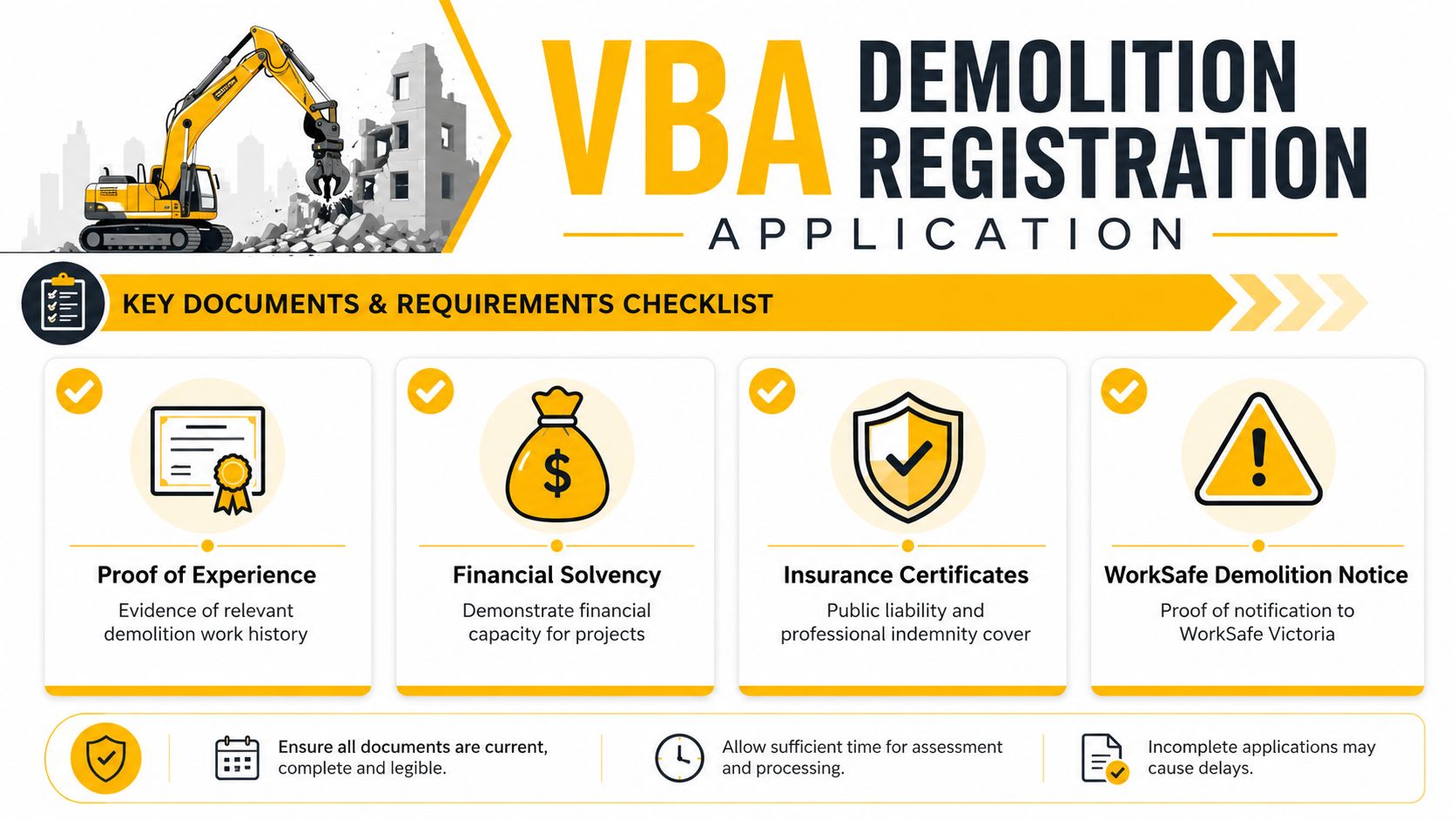
If you're applying for demolition registration, treat the application like a competency file, not a form-filling exercise. The VBA isn't just checking whether you've uploaded enough documents. It's trying to work out whether you can safely manage demolition work without putting workers, neighbours, or the public at risk.
That changes how you prepare.
Build a proof file, not a paper stack
A weak application usually has plenty of documents and very little usable evidence. A strong one shows a clear line between your qualifications, your site experience, the kinds of buildings you've worked on, and the level of responsibility you held on those projects.
That means your paperwork should answer practical questions such as:
- What did you do on demolition jobs, rather than what company you happened to work for?
- Which structures were involved, and were they comparable to the class you're applying for?
- Who can verify your role and the quality of your work?
- How do you manage risk, documentation, and compliance obligations?
If your evidence is vague, the regulator has to guess. That's never a good position to put yourself in.
The referee report can carry your application
The technical referee side often gets left too late. That's a mistake. Your referee isn't there to do you a favour with a generic character reference. They need to confirm that you've performed relevant demolition work and that you did it competently.
Choose someone who knows your work firsthand. A person who supervised you on live jobs, reviewed your methods, or dealt with your demolition planning carries more weight than someone senior who barely saw you on site.
A good referee report usually lines up with the rest of your application. If your project history says you managed staged structural demolition in occupied or constrained environments, the referee should be able to speak to that directly. If they can't, the application starts wobbling.
Site reality: A polished application with thin experience usually fails under scrutiny faster than a rough-looking application backed by solid, verifiable project history.
What applicants often overlook
People tend to focus on the “headline” qualification and forget the support documents. But registration decisions are built on the whole picture. The regulator wants confidence that you're a fit and proper operator, not just a person with tickets.
In practical terms, your pack may need to show:
- Relevant qualifications: Formal demolition training should match the scope of work you want to undertake.
- Experience records: Keep project summaries, role descriptions, and any records that show demolition method, structure type, and your level of control.
- Insurance readiness: Even before project mobilisation, you need to understand what cover the market expects for demolition work.
- Business credibility: Financial and identity checks matter because demolition contracts carry risk and downstream liabilities.
Don't confuse registration with project approval
Applicants and clients frequently misunderstand this distinction. VBA registration lets a practitioner lawfully operate in the appropriate class. It does not give permission to start knocking over a structure on a particular block next week.
That second part still depends on the site, the permit path, the asbestos position, the service disconnections, and the safety controls. In other words, registration opens the gate. It doesn't replace the rest of the process.
If you're a contractor building your paperwork, organise it like a job file. Separate qualifications, experience evidence, referee material, business records, and insurance records into clean sections. That sounds basic, but a readable application is easier to assess and much harder to challenge.
Beyond the VBA Council Permits Asbestos and Notifications
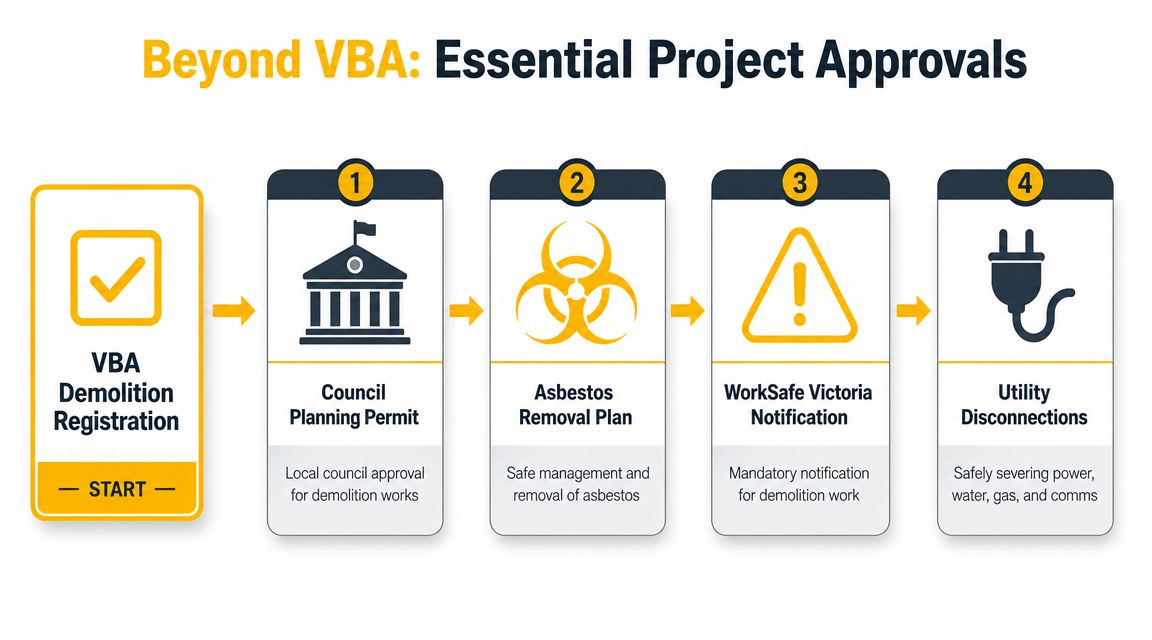
A VBA registration gets you recognised as a qualified practitioner. It does not switch the site to “ready for demolition”. The project still has to move through council, the building surveyor, and safety and environmental obligations before machines should roll in.
That's the part that causes the most confusion.
The order matters more than most people think
Take a typical older house in Geelong. The owner wants it gone so a new dwelling can start as soon as possible. The builder is keen to lock in programme dates. The demolition contractor is ready to quote.
The first question isn't “when can you start?”. It's “what approvals are needed for this exact structure and this exact site?”
In Victoria, a Building Permit for Demolition is typically needed if the structure is masonry, over 40 m², could affect public safety, or is heritage listed. Applicants usually must first get s29A Report and Consent from the local council before a building surveyor can issue the permit, as outlined in this guide to building demolition in Victoria.
That sequence trips people up all the time. They contact a surveyor expecting a permit straight away, but the surveyor can't finalise things if the council consent step hasn't been dealt with.
A practical sequence that works
On a normal residential knockdown, the flow usually looks something like this:
- Scope the building properly. Confirm what's being demolished, what stays, whether there are shared walls, and whether the structure raises heritage or public safety concerns.
- Check council requirements early. Don't assume the permit pathway is identical from one municipality to the next.
- Obtain the relevant consent if the site triggers it.
- Lodge with the building surveyor using complete plans and supporting documents.
- Resolve asbestos, service disconnections, and site protection details before physical work begins.
A rushed job usually ignores step two and pays for it later in delays.
Asbestos changes everything on older sites
If the structure is older, asbestos has to be treated as a live issue until proven otherwise. That affects demolition method, labour sequencing, waste handling, transport, and when the main plant can begin structural demolition.
Cheap quotes often hide risk. Some contractors price the job as if asbestos is a side note. It isn't. Once asbestos-containing material is identified, the work has to be handled correctly, removed lawfully where required, and cleared before the rest of the demolition can move safely.
If you want a plain-English look at why asbestos records and identification matter before any strip-out or demolition planning, this piece on the asbestos register is a useful companion read.
A demolition programme that ignores asbestos doesn't stay fast. It just gets interrupted later, usually when labour, machinery, and disposal bookings are already committed.
WorkSafe, EPA, and services are not side issues
Once permit and hazardous-material issues are being handled, attention shifts to site controls. WorkSafe Victoria is concerned with how the demolition is carried out, how risks are identified, and how workers and the public are protected. That means documented planning, exclusion zones, method statements, supervision, and disciplined sequencing.
EPA-related obligations come through waste classification, transport, dust suppression, containment, and lawful disposal. You can't treat spoil, rubble, contaminated material, and strip-out waste as one generic pile and hope the paperwork sorts itself out later.
Then there are the service authorities. Power, gas, water, sewer, and communications have to be properly identified and disconnected or protected. A surprisingly high number of near-misses happen because someone assumes a service is dead when it isn't.
Why homeowners and builders get frustrated
The system feels fragmented because each authority is looking at a different risk. Council is thinking about the built environment and statutory approval. The surveyor is thinking permit compliance. WorkSafe is thinking worker and public safety. EPA obligations deal with environmental harm and disposal. Service providers care about infrastructure safety.
Once you stop expecting one form to satisfy everyone, the process makes more sense. The contractor who understands that ecosystem is usually the one who keeps the job moving.
On-Site Obligations Safety Insurance and Records
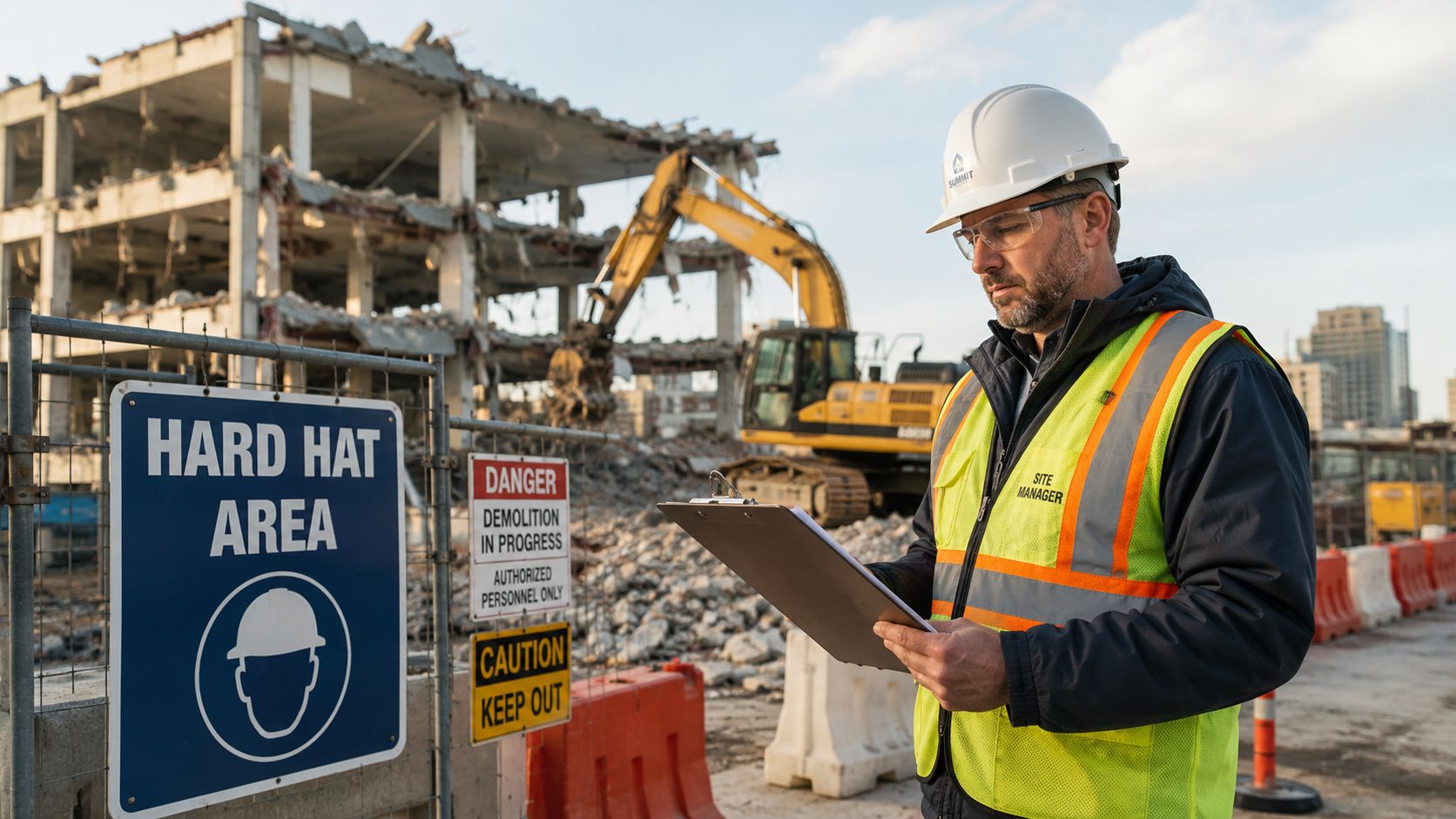
The permit doesn't make a site safe. It only means the job can proceed if the work is done in line with the approved documents and the law. The practical test starts once fencing goes up, plant arrives, and the first structural elements are touched.
Safety paperwork only matters if it matches the site
Demolition is high-risk construction work. That means the site documentation has to reflect the actual hazards present, not a recycled folder from the last job. A proper Safe Work Method Statement should deal with the actual sequence of demolition, plant movements, overhead and underground risks, adjacent structures, exclusion zones, and emergency controls.
A copied SWMS is one of the easiest ways to tell a contractor is going through the motions. If the document says one thing and the excavator operator, labourer, and supervisor are doing another, the paperwork is worthless.
For broader context on how building demolition should be approached as a controlled process rather than a smash-and-grab exercise, this article on the demolition of buildings is worth reading.
Insurance protects more than the contractor
Insurance often gets treated like a box-tick, but on demolition sites it's part of real risk allocation. If a boundary fence is damaged, debris affects a neighbouring property, or a public area is impacted, inadequate cover becomes everyone's problem very quickly.
When clients want a plain-English starting point on public liability cover, Cover Club's insurance comparison guide is a useful reference because it helps explain the differences between policy options without drowning you in jargon.
Here's what matters in practical terms:
- Public liability: This is the cover clients ask about first, and for good reason. Demolition creates third-party risk the moment debris, vibration, dust, or plant movement can affect someone outside the crew.
- Plant and equipment cover: If major gear goes down mid-job, programme and exposure can shift fast.
- Workers compensation and contractor arrangements: Everyone on site needs to be covered correctly and engaged correctly.
Worth remembering: The cheapest contractor often looks competitive because they've left risk sitting with the client, not because they've found a smarter way to demolish the building.
Records, fencing, and housekeeping save jobs
Good operators keep records because memory is unreliable once a dispute starts. Site diaries, photographs, waste dockets, service confirmations, asbestos clearance records, permit copies, and induction records all matter if a question comes up later.
Physical controls matter just as much. Secure fencing, clear pedestrian separation, traffic management where needed, dust suppression, and protection of gutters and drains are basic, but they're where poor sites unravel first. In tighter suburbs, one messy day can trigger neighbour complaints and regulator attention that hangs over the rest of the job.
Timelines Costs and Finding the Right Contractor
The honest answer on timing is that demolition moves in phases, not in one clean block of days. The approvals phase can drag if council consent, asbestos findings, or missing documents slow things down. The physical demolition itself may be quick by comparison, but clearance, disposal, and final site readiness still need proper coordination.
Costs follow the same pattern. The machine on site is only part of the bill. Permit-related fees, surveyor involvement, asbestos inspection and removal, labour, traffic control, waste disposal, haulage, environmental controls, and any specialist reporting can all shift the final figure. If you're trying to budget the broader site-prep side of a project, this guide to a demolition cost calculator in Australia is a useful starting point.
When you're choosing a contractor, ask direct questions and listen to how they answer. Not just what they say, but whether they understand the order of the process.
A contractor worth hiring should be comfortable answering questions like these:
- What VBA registration do you hold, and does it match this structure?
- Who is handling council consent and the building surveyor process?
- How will asbestos be identified and managed before demolition starts?
- What notifications, site safety documents, and records will be in place?
- How are waste, dust, and disposal handled once material leaves the site?
If the answers are vague, the quote probably is too. In demolition, clear paperwork usually points to clear site control. That's what keeps the project legal, safe, and on programme.
If you're planning demolition, excavation, or full site preparation and want practical advice before you commit, Booms Up Civil Group can help you work through the sequencing, approvals, and on-site requirements. Reach out for a straightforward discussion about your block, your timeline, and what it'll take to get the job done properly the first time.