
Imagine trying to build a house on a grassy hill. You can’t just start framing on a slope, right? A site cut excavation is the essential first step that carves a flat, stable platform into that hill, creating the perfect base for your new home. It’s a precise earthmoving process that transforms an uneven block into a safe, level foundation ready for construction.
What Is a Site Cut and Why Do You Need One?
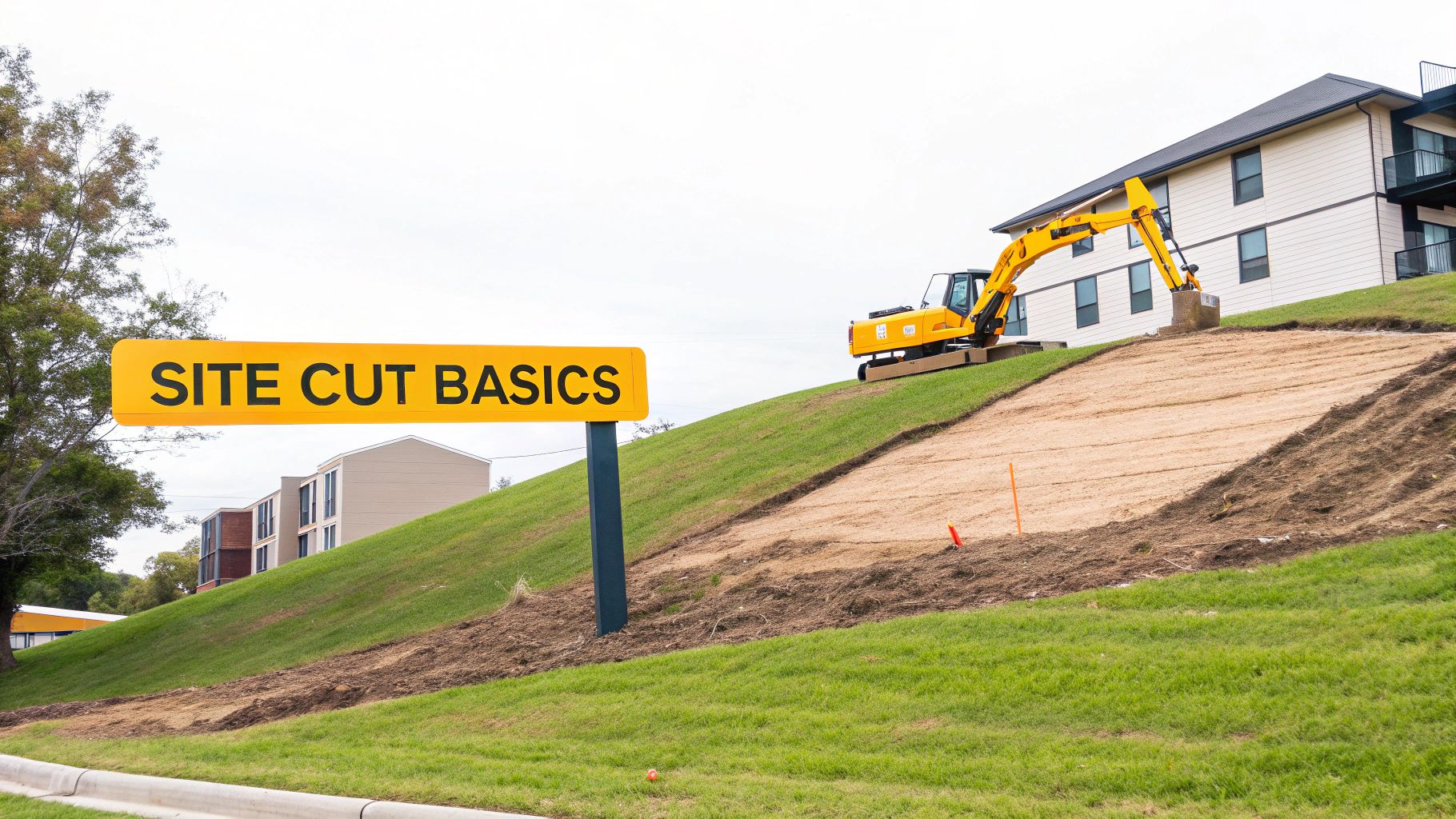
At its heart, a site cut is all about strategically moving soil. We dig into the high side of your property (the 'cut') and use that same earth to build up the low side (the 'fill'). This method, known in the industry as a 'cut and fill', is the smartest and most efficient way to create a level building pad on sloping land.
For anyone building across the Central Coast, Sydney, or Newcastle, where sloping blocks are the norm rather than the exception, a professional site cut isn't just a good idea—it’s the first critical move. It’s what makes your entire construction project possible and safe for the long haul. Without it, you'd be fighting a losing battle against foundation instability and drainage nightmares.
The Goal of a Balanced Site
The ideal outcome for any site cut is to achieve what we call a balanced site. This is the sweet spot where the amount of soil we 'cut' is almost exactly what we need for the 'fill'. Hitting this balance is a huge win for several reasons:
- Reduced Costs: It means you don't have to pay for truckloads of clean fill to be brought in, nor do you have to cover the hefty fees for hauling excess soil to a tip.
- Faster Timelines: Reusing the soil that’s already there is far quicker than coordinating deliveries and disposals. It keeps your project moving forward without unnecessary delays.
- Environmental Responsibility: Fewer truck movements and less landfill usage directly lower your project’s carbon footprint. It’s the smarter, greener way to build.
A site cut does more than just level the ground; it’s also your first line of defence against water damage. Properly grading the land prevents water from pooling against your future home's foundation, which is absolutely vital for its long-term structural health. For a deeper dive into this, you can find great tips on how to flatten your yard and ensure proper drainage.
Why a Site Cut Unlocks Your Land's Potential
So, why bother with a professional site cut on a sloping block? It's about so much more than just levelling out a patch of dirt. A properly engineered site cut excavation is what gives your home a solid, stable foundation, preventing it from shifting or settling unevenly over the years. Think of it as the critical first step in protecting the long-term structural integrity of your biggest investment.
Beyond just creating a stable base, a well-planned site cut is your first line of defence against one of nature’s most persistent forces: water. By grading the land with precision, we can actually steer rainfall away from your foundation. This is a proactive move that stops drainage nightmares—the kind that lead to costly water damage, damp, and foundation erosion—before they even have a chance to start.
Maximising Every Square Metre of Your Block
Picture this common scenario on the Central Coast. You’ve found a fantastic block of land in a suburb like Kariong or Terrigal, but it’s on a steep hill. Trying to build on that slope without a site cut would be a nightmare—incredibly complex, eye-wateringly expensive, and in some cases, just not possible. The natural slope would hamstring your design options and leave you with almost no usable outdoor space.
This is where a site cut completely changes the game.
By turning an unusable slope into a prime, level building platform, you instantly unlock the full potential of your property. All of a sudden, you have plenty of room not just for the house itself, but for a functional driveway, a safe area for the kids to play, or that garden you've always dreamed of. It literally increases the functional size and, therefore, the value of your land.
The Foundation for Everything That Follows
At the end of the day, a site cut is the bedrock of your entire construction project. When you get this part right, you’re setting up every other stage for success. From pouring the slab to framing the walls, everything that follows will happen on a secure and reliable base. It makes life easier for every trade on site and dramatically cuts the risk of expensive headaches down the line.
Trying to build on an improperly prepared slope is just asking for trouble. It's a direct path to potential structural failures, chronic drainage problems, and a future filled with significant repair bills. Investing in a professional site cut isn't just another upfront cost; it's the foundational decision that secures the safety, longevity, and value of your home for decades. It’s what turns a challenging piece of land into a valuable, buildable asset.
The Site Cut Excavation Journey From Start to Finish
It helps to understand the sequence of a site cut excavation to really get a picture of what happens on your property. From a homeowner’s point of view, it’s not just a day of digging; it’s a carefully managed journey with distinct phases, each one absolutely critical for the success of your build. Think of it as a choreographed performance where every step, from the paperwork to the final clean-up, is planned and executed with precision.
The whole process kicks off long before any machinery arrives. It all begins with a detailed site assessment and survey, which lays the groundwork for the entire operation.
Phase 1: Initial Planning and Approvals
The first practical step is a topographic survey. A qualified surveyor will visit your block to map out the existing ground levels, property boundaries, and any key features. This creates a detailed digital model of your land, which is essential for our engineers to design the most efficient cut and fill plan.
With the survey data in hand, we move to the critical approvals stage. This involves submitting plans to your local council, whether it's the Central Coast Council or Newcastle City Council, for development approval. At the same time, we perform a mandatory Dial Before You Dig search to locate any underground services like water, gas, power, or comms cables. Safety and compliance are non-negotiable, and these checks ensure we work safely around existing infrastructure.
Phase 2: Site Preparation and Clearing
Once we have the green light from the council, the physical work can begin. The first stage on-site is the site preparation and clearing. Our team will remove any vegetation, trees, rocks, or old debris from the designated building area, making sure we have a clean slate to work from.
Following that, we perform a topsoil strip. We carefully remove the nutrient-rich topsoil and stockpile it somewhere else on your property. This valuable soil can be reused later for your landscaping and garden beds, which saves you money and reduces waste. For a deeper dive into this stage, our guide on comprehensive site preparation for excavation provides more detail.
Phase 3: Bulk Excavation and Compaction
This is the main event: the bulk excavation. Using heavy machinery like excavators and dozers, we start the 'cut', meticulously removing soil from the high side of the block according to the engineered plans. Our operators work with laser-guided precision to make sure every level is exact.
The excavated material is then moved to the lower side of the block to create the 'fill'. This isn't as simple as just dumping the soil. We build up the fill area in thin, controlled layers, typically around 300mm at a time. Each layer is then systematically compacted using heavy rollers to achieve a specific density, a process governed by Australian Standards (AS 3798-2007).
Proper compaction is non-negotiable. It’s what transforms loose soil into a solid, stable platform capable of supporting your home's foundation for decades. Skipping or rushing this step is a recipe for future subsidence and structural failure.
Phase 4: Final Trim and Site Handover
With the bulk earthworks done, we move to the final trim and grading. Using smaller, more agile machinery, we grade the entire building pad to its final, precise levels. This guarantees a perfectly flat and accurate surface for your concreters to come in and pour the slab.
We also make sure the surrounding areas are graded correctly to manage stormwater runoff, directing water away from your new foundation. The last step is a thorough site clean-up. We remove any remaining debris, leaving you with a perfectly prepared building platform, ready for the next stage of your construction journey. Your block is now officially transformed from a challenging slope into a build-ready asset.
The following infographic illustrates the core benefits achieved through this detailed site cut excavation process.
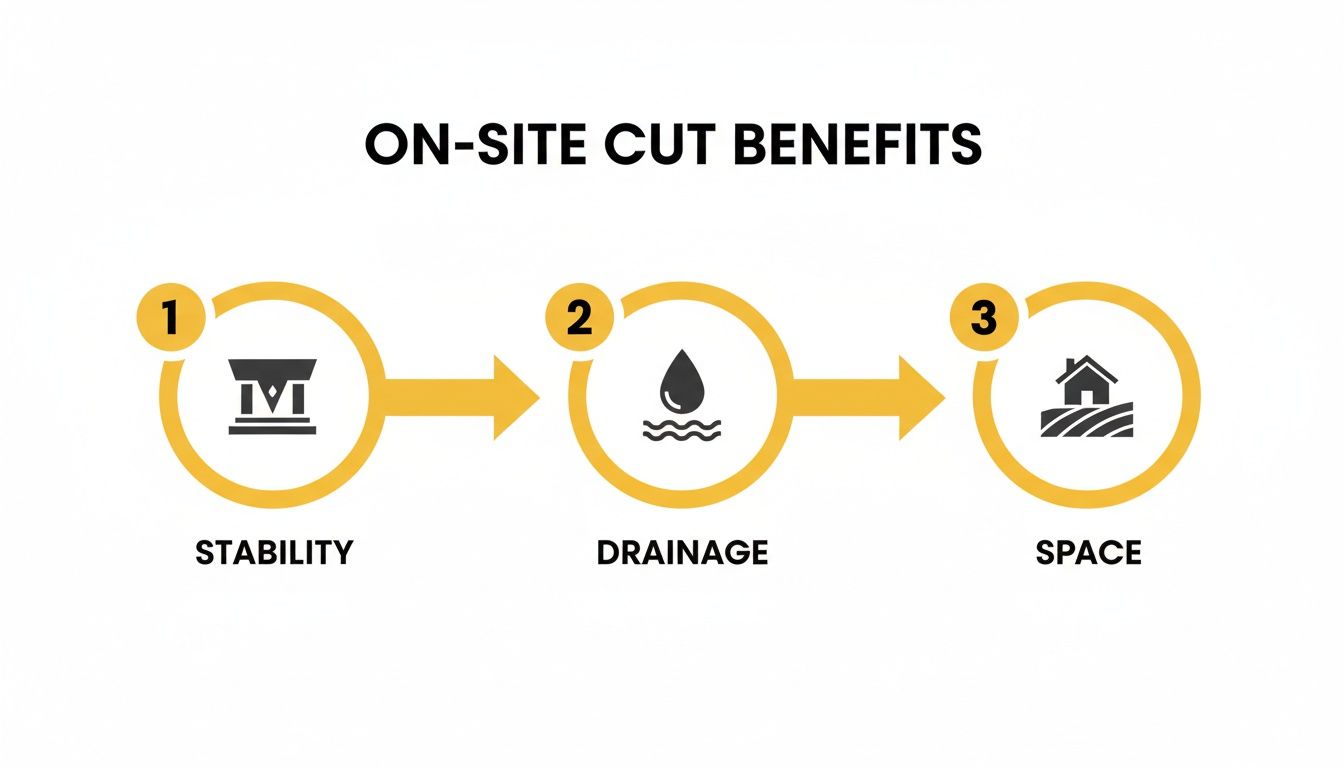
As the visual shows, the key outcomes of a professional site cut are enhanced stability for your foundation, improved drainage to protect your home, and maximised usable space on your property.
Navigating Council Rules and NSW Compliance
Before a single scoop of soil is turned, every successful site cut excavation project starts with sorting out the paperwork. This isn't just about ticking boxes; it's about making sure your project is legal, safe, and built to stand the test of time. While council rules and NSW regulations can feel like a maze, getting a handle on them from the start protects your investment and prevents a world of headaches down the line.
Getting this part right from the get-go means avoiding costly delays, council fines, and the stress of having to redo work. Think of it as the professional foundation upon which your physical foundation will be built.
Your Development Application and Local Council
For most significant site cuts, the first stop is lodging a Development Application (DA) with your local council. It doesn’t matter if you're dealing with the Central Coast Council, Lake Macquarie City Council, or another authority in the Sydney basin—the DA is your formal request for permission to get the job done.
This isn't just a simple form. Your application needs to be backed by detailed documents, including professional engineering plans and site surveys. These plans spell out for the council exactly what you want to do, how it will affect the land, and how you’ll stick to all the local environmental and building codes. We handle this process day in and day out, so we know what councils look for and can help make sure your application is spot-on to avoid any unnecessary back-and-forth.
The Importance of a Geotechnical Report
One of the first things a council or engineer will ask for is a geotechnical report. You can think of this as a health check for your soil, carried out by a specialised engineer. They take soil samples from your block to figure out its composition and how it's likely to behave.
So, why does this matter so much?
- Reactive Clay: Common in parts of Western Sydney and the Hunter Valley, this type of soil expands when it’s wet and shrinks when it’s dry. If you don't account for that movement, it can crack your foundations.
- Sandy Soil: Found all along the Central Coast, sandy soil has completely different stability and drainage properties that have to be factored into the engineering design.
- Sandstone Bedrock: A familiar challenge across Sydney. Hitting rock requires different excavation techniques and machinery, which has a real impact on the project's timeline and budget.
The geotechnical report gives us the hard data we need to design the right foundation and drainage systems for your specific site, ticking a major box for the council and ensuring a safe, durable build.
Essential Pre-Excavation Safety Checks
With the approvals in motion, a series of mandatory safety and environmental checks have to be done before any machinery rolls onto your property. These are not optional—they are legal requirements under NSW law designed to keep workers and the community safe.
A critical first step is lodging a Dial Before You Dig enquiry. This free national service gives you maps of all the recorded underground utilities—think gas pipes, water mains, and internet cables—on your property. Hitting one of these is not only incredibly dangerous but can also lead to massive repair bills and bring your entire project to a screeching halt.
We also install sediment control measures, like silt fences, around the entire work area. This is a non-negotiable requirement from the Environmental Protection Authority (EPA) to stop soil, sand, and other debris from washing off your site and into public stormwater drains when it rains.
Finally, a site cut almost always needs engineered retaining walls to support the excavated earth. These structures have their own set of compliance rules, and understanding NSW retaining wall regulations is vital for ensuring your entire project is compliant from the ground up. Managing these details properly is the key to a project that runs smoothly, safely, and without any unwelcome surprises from council inspectors.
Prioritising Safety on Your Excavation Site
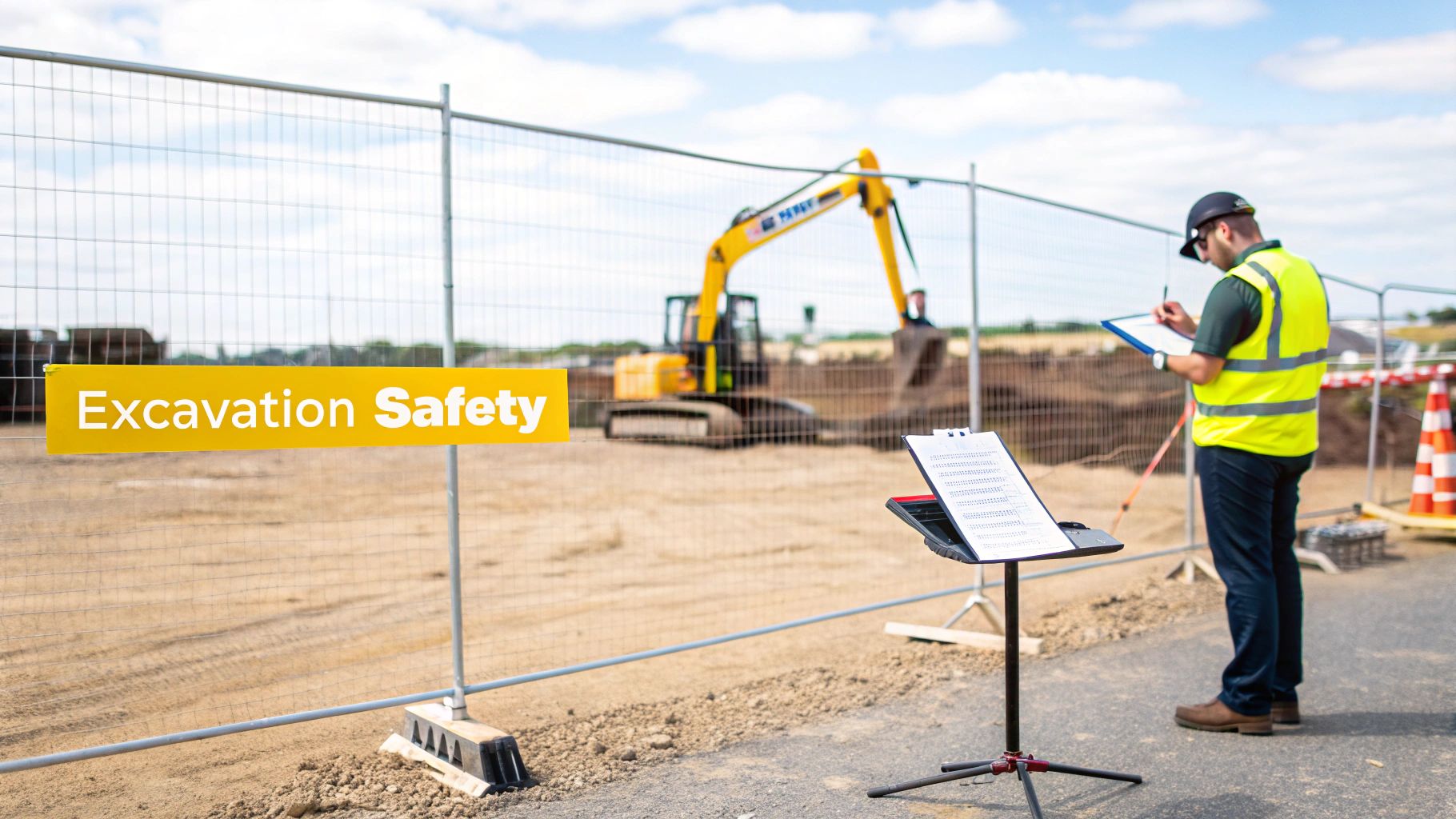
A site cut excavation reshapes your land, but let's be frank: it also temporarily turns it into a high-risk environment. At Booms Up Civil, we don't just see safety as a priority—it's the absolute bedrock of everything we do on your property. There are no shortcuts. Ever.
The hazards are real, from the potential for a trench to collapse to the risk of striking an unseen pipe or cable. Not to mention, we’re operating powerful, heavy machinery. This is exactly why every single job we tackle is guided by a detailed Safe Work Method Statement (SWMS). This isn't just bureaucratic paperwork; it’s our operational playbook that maps out every conceivable risk and the specific controls we’ll use to manage it.
Practical Safety Measures You Will See
When we’re on your site, our commitment to safety won't just be something we talk about—it will be visible and active.
It starts with clear exclusion zones around machinery and active digging areas. These are non-negotiable boundaries, enforced to protect our team, your family, and any other tradies on site. You'll also see dedicated machinery spotters acting as a second set of eyes for our operators, which is especially critical when we're working near existing structures or in tight spots.
On top of that, every person behind the controls of our equipment is fully licenced, insured, and brings years of real-world experience to the job. This isn't just a preference; it's a non-negotiable standard for us.
Compliance with SafeWork NSW
Our safety protocols aren't just our own idea—they're designed to meet and exceed the standards set by SafeWork NSW. Across Australia, site preparation and excavation are, statistically, among the most hazardous phases of any project. It’s why professionals on the Central Coast and in the Hunter Valley put such a massive emphasis on planning and constant supervision.
A Safe Work Australia report revealed that the "site preparation services" industry class had the highest number of construction-related deaths over a decade. That sobering fact underscores why rigorous safety is so critical.
A safe site is an efficient site. Our unwavering focus on safety isn't just about preventing accidents; it's about protecting your investment, your property, and everyone involved in bringing your project to life.
Managing Specific Site Hazards
No two sites are the same, and each comes with its own set of challenges. When we’re breaking up Sydney sandstone, for instance, dust control is a huge deal. Managing the risks and prevention of respirable crystalline silica is essential for worker health, which means we’re using methods like water suppression to keep dust out of the air.
Trench safety is another major focus. Any excavation deeper than 1.5 metres legally requires protective systems to prevent collapse. We use engineered solutions like shoring or benching to secure trench walls, making it a safe place for our team to work. For a deeper dive into these critical systems, check out our guide on trenching and shoring techniques.
This proactive approach to every potential hazard means your project can move forward smoothly and, most importantly, safely from day one.
Understanding the Factors That Shape Your Project's Cost
When you're planning a site cut excavation, one of the first questions you'll have is, "What's this going to cost me?" It's a fair question, but there’s no simple, off-the-shelf answer. Every block of land tells a different story. The final number on any quote is shaped by a handful of key factors, and getting your head around them helps you see exactly what you’re paying for.
The biggest driver, without a doubt, is the complexity of your site. A gently sloping block is a relatively straightforward job. A steep hillside in a suburb like Terrigal? That's a different beast entirely. The more dramatic the slope, the more soil we have to move, which directly ramps up machine hours and labour costs.
Site Accessibility and Ground Conditions
Next up, how easily can we get our heavy machinery onto your property? A wide-open block with direct street access is the dream scenario. But a battle-axe block tucked away in a dense Sydney suburb or a site with narrow access points forces us to use smaller machines and move more carefully, which can stretch out the project timeline.
The ground itself is another massive variable. What we're digging into can make or break a budget.
- Sandy Loam: Pretty common on the Central Coast, this stuff is relatively easy and quick to excavate.
- Reactive Clay: Often found in Western Sydney, this soil needs a specific approach to compaction to make sure everything stays stable.
- Sandstone Bedrock: Hitting rock is a common occurrence in many Sydney and Newcastle areas. This isn't a job for a bucket—it calls for specialised gear like hydraulic rock hammers or saws, adding a significant cost compared to just digging in soil.
The Volume of Soil and Disposal Costs
The sheer volume of material we need to shift is a fundamental part of the calculation. A bigger building footprint or a steeper slope means more cubic metres of earth to cut and fill. The ultimate goal is always to achieve a 'balanced site'—where the soil we cut from one area is used to fill another, keeping waste to an absolute minimum.
But often, there's excess spoil that has to be trucked off-site. This is where disposal costs, or 'tipping fees', come in, and they can be substantial. Inefficient spoil management is a huge, costly issue in the construction industry. A recent report even highlighted that Australian building projects generate enormous waste, with excavated soil being a major culprit. You can read the full report from the Green Building Council of Australia to get a sense of the scale of the challenge.
Smart soil management is key to controlling your budget. Planning for efficient reuse of on-site material avoids the double cost of paying to haul soil away and then paying to bring new fill in.
Getting this process right is critical. For a much deeper dive into this specific cost factor, check out our guide on effective soil removal strategies. By thinking through all these elements—the slope, access, soil type, and volume—you get a much clearer picture of the real costs involved in preparing your land for construction.
How to Choose the Right Excavation Contractor in NSW
Picking the right partner for your site cut excavation is hands down one of the most critical decisions you'll make at the start of your project. The quality of this groundwork sets the tone for everything that follows, so it really pays to look beyond the cheapest quote and dig a little deeper. A great contractor is more than just someone with a machine; they are your project partner.
When you're weighing up your options, don't be shy about asking for the non-negotiables. Can they show you proof of their current contractor licence and all the necessary insurances, especially Public Liability? A true professional will have these documents ready to go without a second thought. This isn't just about ticking boxes; it's your shield against liability if something goes wrong on your property.
Experience That Counts
Look for a contractor with a solid portfolio of projects similar to yours, particularly if you're dealing with sloping blocks in your specific area. Someone who has spent years working on the Central Coast will have an intuitive grasp of sandy coastal soils, whereas a contractor from Sydney will be an old hand at tackling sandstone. That kind of local knowledge is priceless.
A reputable contractor will also have a well-maintained fleet. Clean, modern equipment isn't just for appearances; it signals reliability and a much lower risk of breakdowns that can bring your project to a grinding, expensive halt. It shows they invest back into their business and take real pride in their work.
Communication and Clarity are Key
Perhaps the most important thing to watch for is how they communicate. A good contractor listens to what you're trying to achieve, answers your questions clearly, and offers practical, honest advice. They should provide a detailed written quote that breaks down exactly what's included in the price—and just as importantly, what isn't. Vague quotes are a massive red flag. For more tips on what to look for, our guide to finding the best excavation contractors near you offers some extra insights.
Choosing a contractor who is experienced, fully compliant, and communicates transparently is the best way to ensure your project starts on a solid foundation of trust and quality. It’s the first step to getting the job done right, the first time.
Common Site Cut Questions Answered
If you're new to the building game, it's natural to have a few questions. We get asked similar things all the time by homeowners starting their journey, so here are some quick answers to the most common queries.
How Long Does a Typical Site Cut Take?
For a standard residential block here on the Central Coast, the actual site cut excavation usually takes anywhere from a couple of days to a week or more. It really depends on the block. The steepness of the slope, the type of soil we're digging into, and—of course—the weather all play a big part. An unexpected downpour can halt work, both for safety and to avoid turning your future home into a mud pit.
What Happens if You Hit Rock During Excavation?
Finding rock is pretty common, especially in parts of Sydney and the Hunter Valley. It’s not a showstopper. When we hit rock, we simply bring in the heavy-duty gear like hydraulic rock hammers or saws to break it up and get it out of the way. While it's a completely manageable part of the job, discovering a lot of rock can add a bit of time and cost to the project.
Are Retaining Walls Necessary After a Site Cut?
Almost always, yes. Once a cut and fill is done, retaining walls aren't just a nice-to-have; they're engineered structures crucial for safety and stability. They’re built to hold back the excavated 'cut' bank and properly contain the newly compacted 'fill' area. This is a non-negotiable step for safety and compliance, and it’s a standard requirement from just about every local council in NSW.