

Staring at a rocky building site can feel daunting, but rock excavation is simply the process of breaking, removing, and shaping that rock to create a solid, level base for your project. Think of it like a dentist preparing a tooth for a crown—you have to perfectly shape the foundation before you can build anything on top. With over 15 years of experience on the Central Coast and beyond, we've seen it all, and there's no rocky site we can't handle.
Understanding Rock Excavation and When You Need It
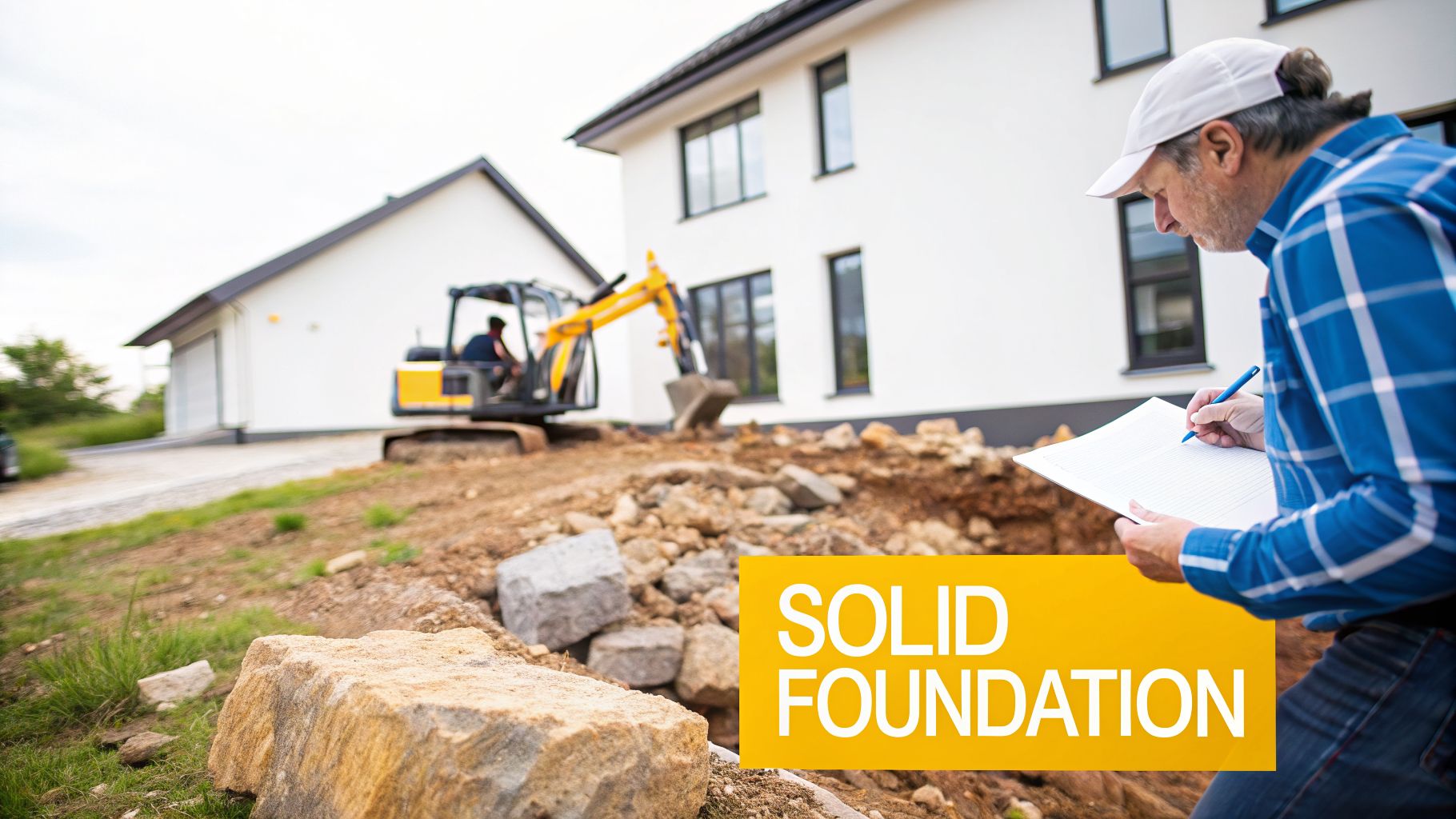
Rock excavation is a critical first step for countless construction jobs across the Central Coast, Sydney, Newcastle, and the Hunter Valley. It’s not just about digging a hole; it's a specialised service that guarantees the long-term stability and safety of your structure. Get it wrong, and foundations can shift, pools can crack, and retaining walls can fail.
Many parts of NSW are known for their challenging ground conditions, especially the dense Hawkesbury sandstone that defines so much of the Sydney basin and surrounding areas. This makes professional rock excavation a non-negotiable part of the building process for a huge number of projects.
Common Scenarios Requiring Rock Excavation
You will almost certainly need professional rock excavation services if your project involves:
- New Home Foundations: If you’re building on a steep Terrigal block or a rocky outcrop in the Hunter Valley, we need to cut into the rock to create a perfectly level building pad for your concrete slab or footings.
- Basements and Underground Carparks: Creating space below ground, especially for something like a basement carpark in a dense commercial area of Newcastle, requires significant and precise rock removal.
- In-ground Swimming Pools: That dream pool won't build itself. We have to excavate the site to the exact shape and depth required, which often means breaking through layers of solid rock to get there.
- Retaining Walls: To properly anchor a retaining wall on a difficult site, like those found all around Kariong, we first need to excavate a solid, stable footing into the bedrock.
- Trenching for Utilities: Laying pipes for plumbing, electrical conduits, or new drainage systems often involves cutting narrow trenches through whatever lies beneath the surface—including solid rock.
At the end of the day, rock excavation isn’t a hurdle; it’s a solvable puzzle. With the right team and equipment, that challenging, rocky site becomes the perfect solid ground to start building on.
The Different Methods for Rock Excavation
Breaking through solid rock isn’t a matter of just bringing in a bigger digger and digging harder. It's a science. Professional rock excavation is all about using specific techniques and powerful, specialised machinery to get the job done safely, efficiently, and on budget. The key is choosing the right method for the job.
At Booms Up Civil, we primarily use three distinct methods: mechanical hammering, chemical splitting, and controlled blasting. The one we recommend is never a one-size-fits-all solution; it’s a decision based entirely on your site’s unique geology, the scale of your project, and just as importantly, the local council regulations and neighbourhood setting. An approach that works perfectly for a large civil project in the Hunter Valley simply won’t be suitable for a backyard pool dig on a quiet Copacabana street.
Mechanical Hammering
Mechanical hammering is far and away the most common method we use for residential and smaller commercial projects. It’s exactly what it sounds like: we attach a powerful hydraulic hammer to one of our excavators. This attachment acts like a giant, relentless jackhammer, delivering thousands of high-impact blows per minute to fracture the rock into smaller, manageable chunks that we can then easily scoop out and remove.
This technique is our go-to for most jobs on the Central Coast and in the tighter suburbs of Sydney. Let's say you're excavating for a new home foundation in a residential spot like Gosford—a hammer strikes the perfect balance between raw power and precision control. It lets us be precise, which helps minimise ground vibration and keeps noise to a more manageable level compared to other methods—something your neighbours will definitely appreciate. You can see how these tools fit into our fleet by exploring our guide to excavator attachments.
Chemical Splitting
When you’re in a situation where vibration and noise are absolute deal-breakers, chemical splitting provides a brilliantly quiet and controlled alternative. This non-explosive method involves drilling a precise pattern of holes into the rock, which are then filled with a special demolition agent. Once mixed with water, this powder expands with immense, silent force over several hours, literally cracking the rock from the inside out without any of the noise, dust, or ground shock of a hammer.
Consider this scenario: you’re looking to put a basement under your heritage-listed home in a dense inner-city Newcastle suburb, right up against a neighbour’s wall. The sandstone is tough, but hammering could risk causing structural damage through vibration. Chemical splitting becomes the perfect solution, precisely breaking the rock without the percussive force.
Controlled Blasting
For truly large-scale civil and commercial projects facing massive volumes of extremely hard rock, controlled blasting is often the most efficient and practical path forward. This is a highly specialised discipline that involves strategically placing small, precisely calculated explosive charges in a series of drilled holes. The resulting blast fractures the entire rock mass, allowing for rapid and large-scale removal.
This method isn’t something you see in residential settings. It requires extensive planning, highly specialised licensing, and a raft of approvals from authorities like SafeWork NSW. The stringent safety protocols, mandatory exclusion zones, and potential disruption make it unsuitable for built-up areas. However, for a major new road cutting or a large commercial development in a more remote part of the Hunter Valley, it’s often the only feasible way to move that much rock in a realistic timeframe.
Comparing Rock Excavation Methods
To help you get a clearer picture of how these methods stack up, we've put together a simple comparison. Each technique has its place, and understanding their core strengths and limitations is the first step in planning a successful excavation project.
| Method | Best For | Key Advantage | Key Consideration |
|---|---|---|---|
| Mechanical Hammering | Residential, tight access, most rock types | Balance of speed, cost, and control | Creates noise and moderate vibration |
| Chemical Splitting | Sensitive sites, low-vibration needs | Virtually silent and vibration-free | Slower process than hammering |
| Controlled Blasting | Large-scale civil works, very hard rock | Fastest for huge volumes of rock | Highly regulated, requires extensive permits |
Ultimately, the right choice depends on a professional assessment of your site's specific geology, project goals, and surrounding environment. By matching the right method to the right job, we ensure the work is done not just effectively, but also safely and with minimal disruption.
Upholding Safety and Compliance in NSW Rock Excavation
When you're dealing with the immense power involved in rock excavation, safety isn't just another item on a checklist. It's the absolute foundation of every successful project. For us, a job isn’t done well unless it’s done safely. That means protecting you, your property, your neighbours, and our team from start to finish.
Managing risk is a non-negotiable part of our daily work here in NSW. To do it right, we need a solid grasp of effective workplace safety procedures that meet and exceed the legal expectations set by authorities like SafeWork NSW. This isn't just about ticking boxes; it's the core of how we operate.
Key Risks and How We Manage Them
The main risks in any rock excavation project are pretty clear: ground instability, rock falls, excessive vibration, dust, and noise. A professional contractor doesn’t just wait for these problems to pop up; we plan for them meticulously. Before we even think about starting an engine, we develop a Safe Work Method Statement (SWMS). This is an incredibly detailed document that identifies every potential hazard on your site and outlines the specific control measures we'll use to manage them.
For instance, a geotechnical report is often our first port of call. It gives us a blueprint of the ground beneath your feet, telling us about the rock’s stability and flagging potential issues. This report helps us plan for things like temporary ground support, which is often crucial. Our guide on shoring in excavation explains just how critical this can be. We also set up clear exclusion zones to keep everyone safely away from the immediate work area.
This flowchart shows a simplified version of how we decide on the right excavation method, based on the specific conditions of a site.
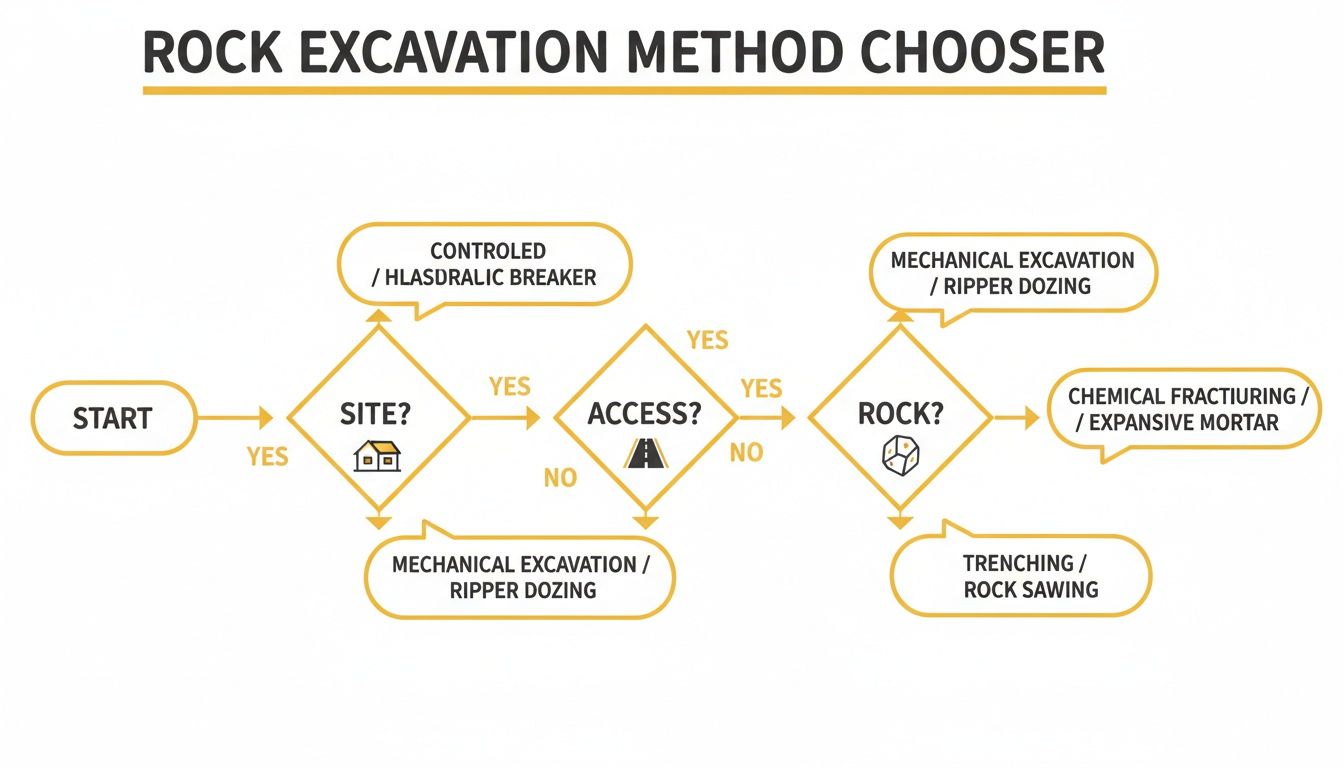
As you can see, factors like site access, how close and sensitive the neighbours are, and the exact type of rock all directly influence which method is the safest and most compliant choice.
The Importance of Modern Protocols
The intense focus on safety in Australian civil works has had a massive impact. Historically, rock falls were a major cause of worksite incidents, but the strict protocols we use today have completely changed the game. Safety in high-risk Australian industries has improved dramatically; fatalities in mining, which heavily influences our civil practices, dropped significantly in recent decades. That's a powerful testament to how effective modern safety measures are.
This commitment to safety is non-negotiable for us, whether we're working on a simple retaining wall in Kariong or a major commercial build in the Hunter Valley.
Our Commitment to Safety: We don't see safety compliance as red tape—it's a core responsibility. It means using modern, regularly serviced equipment, providing constant training for our team, and maintaining open communication with you and your neighbours about managing dust, noise, and vibration. Getting this right is how we ensure your project runs smoothly, on schedule, and without a single incident.
Navigating Council Permits and Local Regulations
Let’s be honest—dealing with council paperwork can feel like the most daunting part of any construction project. The good news is that for most significant rock excavation work, the path to getting the green light is actually quite clear, even if it seems complicated at first.
Getting a handle on these requirements from day one is the secret to keeping your project on schedule and on budget.
Pretty much any excavation that changes the natural ground level—especially for new foundations, pools, or retaining walls—is going to need council approval. This is almost always handled through a Development Application (DA), which we submit to your local council, whether that’s the Central Coast Council, City of Newcastle, or another authority in your area.
Why Councils Require Documentation
These rules aren't just red tape for the sake of it. They exist to guarantee the safety and structural integrity of your build and, just as importantly, the properties surrounding you. When we put together a DA for rock excavation, councils will ask for specific expert reports to back it up. The two most common are a geotechnical report and a vibration management plan.
Imagine you're planning a big dig on a tight block in a built-up area like Gosford. The council needs absolute certainty that the work won’t cause the ground to shift or damage your neighbour’s home. This is where a geotechnical report comes in. Prepared by a specialist engineer, it gives everyone—us, you, and the council—a precise map of the ground conditions, identifying the rock type, its stability, and any potential risks.
A geotechnical report might seem like just another expense, but it's one of the best investments you can make. It tells us exactly what we're dealing with underground, preventing costly surprises, unexpected delays, and potential disputes down the track.
Common Council Requirements
A vibration management plan is another critical piece of the puzzle, particularly when we need to use methods like rock hammering. This document details exactly how we will monitor and manage ground vibrations to ensure they stay well within the strict limits set by Australian Standards. It’s all about protecting nearby structures, from your neighbour's fence and pool right down to the foundations of their house.
Navigating these requirements is a core part of what we do as professional contractors. With over 15 years of hands-on experience across the Central Coast and surrounding regions, we manage this process daily. We’ll guide you in getting the necessary reports and make sure your application ticks every box the council has, ensuring a compliant and stress-free start to your project. To see how this fits into the bigger picture, you can learn more about our approach to professional site preparation and excavation.
What Influences Rock Excavation Costs and Timelines
When it comes to any construction project, two questions always come first: "How much will it cost?" and "How long is it going to take?" For rock excavation, the answers aren't on a simple price list. The final quote and schedule are actually shaped by a handful of critical factors unique to your site.
Getting your head around these key drivers is the best way to set a realistic budget and timeline. It helps you understand what goes into a professional, accurate estimate and ensures there are no nasty surprises once work kicks off.
Core Factors Driving Project Costs
Several key elements have a direct say in the cost of rock excavation. A professional quote will always be based on a thorough site assessment, not some generic per-metre rate. Here’s what we look at:
- Rock Type and Hardness: This is the single biggest factor. Breaking through the tough, dense Hawkesbury sandstone common around Sydney is a completely different ball game than excavating softer shale or fragmented rock found in other areas. Harder rock demands more powerful equipment and more labour. It’s just that simple.
- Volume of Rock: The total amount of rock that needs to go, measured in cubic metres (m³), directly impacts the overall cost. A bigger volume means more machine hours, more labour on site, and higher fees for getting rid of it all.
- Site Accessibility: How easily can we get our trucks and excavators to the work area? A tight-access site in a dense Central Coast suburb like Woy Woy might mean we have to bring in smaller machinery. This can sometimes stretch out the project timeline and affect the costs.
- Disposal and Haulage: All that excavated rock has to go somewhere. The cost of loading it, trucking it away (that's the haulage), and legally disposing of it at a licensed facility is a significant chunk of the total price.
What Shapes Your Project Timeline
Just like with costs, several variables can stretch or shrink your project timeline. We always aim to give you a precise schedule, but some factors are simply out of anyone's control.
Our Pro Tip: Always build a small buffer into your project schedule for potential delays. A week of unexpected rain or discovering a different type of rock underground is much easier to manage when you’ve planned for it.
Unexpected geological finds can definitely shift timelines. Even with a solid geotechnical report, we might hit a pocket of extremely hard rock that needs a different approach, adding time to the job.
Weather is another big one. Heavy rainfall, especially the kind we see during a Central Coast summer, can halt work completely and make a site unsafe or inaccessible. A professional contractor will always keep you in the loop and explain exactly how these things are affecting the schedule.
If you’re ready to get into the nitty-gritty of pricing, you can learn more about the cost of excavation per cubic metre in our detailed guide.
How to Choose the Right Rock Excavation Contractor

Choosing the right team for your rock excavation project is without a doubt the most critical decision you'll make. This work literally lays the groundwork for everything else, and getting it right from the start is non-negotiable.
A great contractor delivers a smooth, safe project. The wrong one? You’re looking at costly delays, budget blowouts, and a whole lot of stress.
When you’re comparing quotes, it's easy to be drawn to the lowest price. But in this line of work, the cheapest option is almost never the best value. A true professional does more than just dig; they manage the entire process with skill and foresight, protecting your investment and ensuring the job is done right the first time.
Verifying Licences and Insurance
Before you even think about signing a contract, you need to do your due diligence. It starts with the absolute basics. Any legitimate contractor must hold the correct, current licences for the work they’re performing in NSW. Ask to see their credentials and take the time to check them online.
Just as important is their insurance. Your contractor must have a current Public Liability Insurance policy. This isn't just a piece of paper; it’s your protection if an accident or property damage occurs. Don’t just take their word for it—ask to see their Certificate of Currency.
Asking the Right Questions
A good contractor will welcome your questions and have clear, confident answers. This is your opportunity to gauge their experience, professionalism, and how they handle challenges on-site.
Here are a few essential questions to get the conversation started:
- Can you show me examples of similar rock excavation projects you've completed in my area, like the Central Coast or Newcastle?
- What’s your plan for managing noise, dust, and vibration, especially on a quiet residential street?
- How do you communicate with us and our neighbours during the project?
- Do you own your machinery, and is it regularly serviced and maintained?
Their answers will tell you a lot about their local knowledge and commitment to quality. You can find more tips on what to look for when you're searching for excavation contractors near you in our dedicated guide.
Your Rock Excavation Questions, Answered
Even with a comprehensive guide, it’s natural to have a few more specific questions pop up. Here are the straightforward, no-nonsense answers to the most common queries we hear from homeowners and developers tackling rock excavation across NSW.
Will Rock Excavation Damage My Neighbour's Property?
When you bring in an experienced, professional contractor, the risk to neighbouring properties is incredibly low. We don't just show up and start hammering away; a critical part of our planning phase is developing a vibration management plan to specifically monitor and control any ground shock.
This isn't just good practice—it's about protecting everything from your neighbour's fence to their house foundations by ensuring all vibrations stay well within the safe limits set by Australian Standards. For us, and for councils like the Central Coast Council, it’s a non-negotiable part of getting the job done right.
What Happens to All the Excavated Rock?
The rock we dig out of your site obviously has to go somewhere. Once we’ve broken it up, we load it onto our trucks and cart it away in a process called haulage and disposal. This is a standard, essential line item you should see on any professional excavation quote.
Where it goes depends on the type and quality of the rock. Clean sandstone, for instance, is often taken to a specialised recycling facility. There, it's crushed and repurposed into valuable materials like road base or engineered fill, which is a great outcome for a more sustainable construction cycle.
My Block Has Very Tight Access. Can You Still Work There?
In almost every case, yes. Tight or difficult access is a common challenge, not a deal-breaker. In fact, tackling these tricky sites is one of our specialities, especially in the dense suburbs of Sydney's Northern Beaches or the narrow lots we see all over the Central Coast.
We run a diverse fleet of machines that includes smaller, more nimble excavators and specialised gear designed just for working in confined spaces. Our very first step is always a detailed site assessment where we figure out the safest and most efficient way to access and work on your specific property.
Feeling more confident about tackling that rock on your property? The team at Booms Up Civil brings over 15 years of experience turning challenging NSW sites into solid, build-ready foundations.
If you’re ready for a clear, honest assessment of your project, get in touch with us for an obligation-free quote.
Get Your Free Quote Online or give us a call on [Phone Number].