
When you're searching 'forestry mulching near me', you're probably looking at an overgrown block and thinking there has to be a fast, effective way to deal with it. Put simply, forestry mulching is a land clearing method where one powerful machine grinds up trees, scrub, and undergrowth, turning it all into a layer of natural mulch right where it stands. Think of it as an industrial-strength slasher for reclaiming bushland.
What Is Forestry Mulching and Is It Right for Your Land?
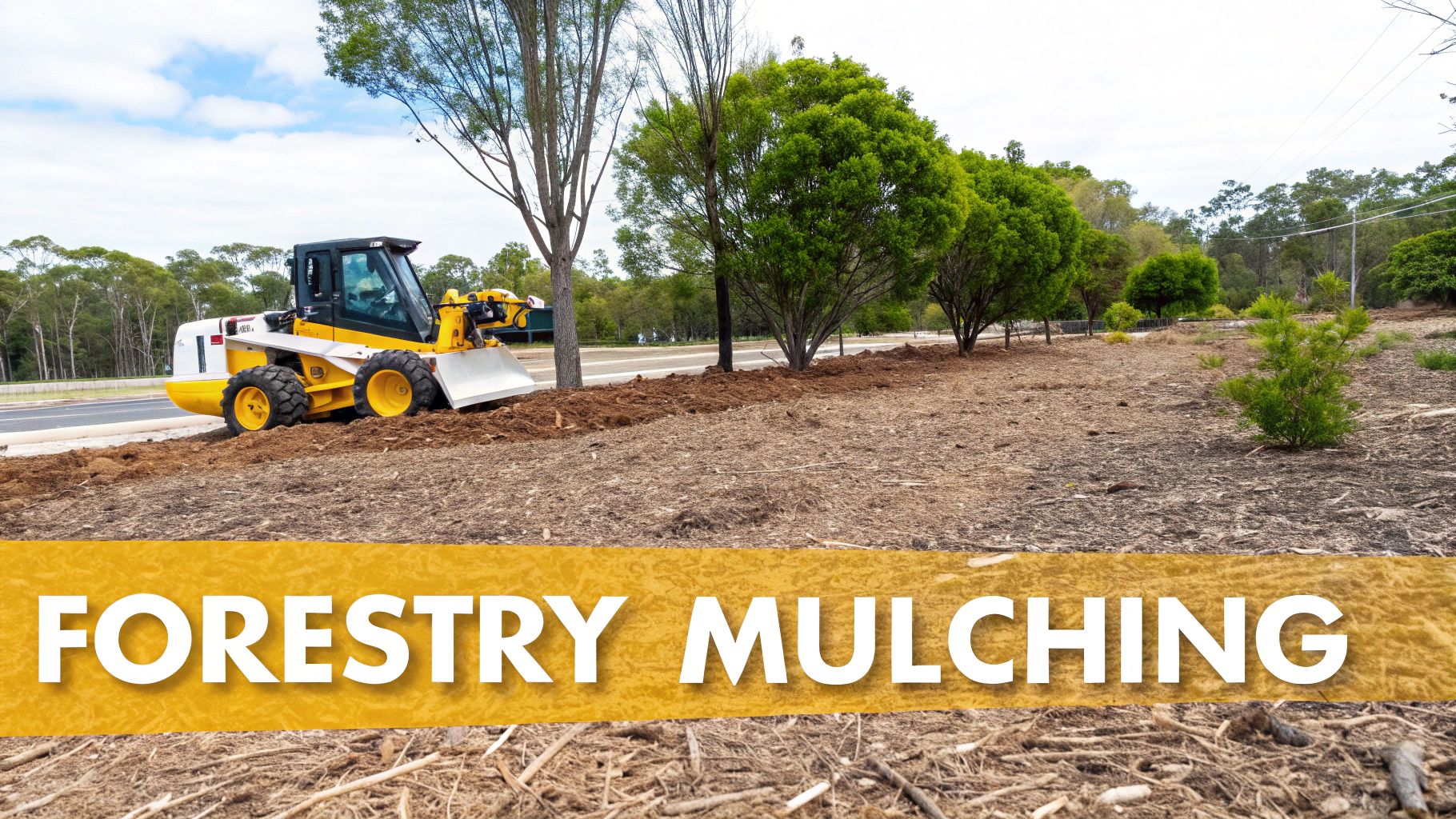
This single-step process is a perfect fit for many common scenarios we see across NSW. You might be preparing a new block for development in a Central Coast suburb like Terrigal, needing to create essential fire breaks on a rural Hunter Valley property, or just wanting to reclaim some acreage that's become completely unusable.
Unlike traditional land clearing—which is a messy, multi-stage affair involving felling, stacking, burning, and hauling—forestry mulching gets it all done in one clean pass. A powerful machine, usually an excavator or a skid steer with a specialised mulching head, moves through the vegetation and instantly processes it into a protective ground cover.
The best part? This method avoids the hassle of getting burn permits from the local council or the Rural Fire Service. It also completely eliminates the cost and headache of trucking green waste offsite. Everything is contained, efficient, and surprisingly low-impact compared to older, more destructive techniques.
When Would You Need Forestry Mulching?
You should be thinking about mulching if you're dealing with a few common situations. For example, it’s the perfect way to reclaim land that's been lost to thick scrub, lantana, or a sea of unwanted saplings.
We also use it for pre-construction site preparation, clearing building envelopes on residential blocks all the way from Gosford (postcode 2250) to Wyong (postcode 2259) before the excavation crew moves in. It's also critical for bushfire hazard reduction, creating defensible spaces around your home and property boundaries – a vital job in fire-prone regions like the Hunter Valley.
Finally, if you need to establish clear access through your property for fences, trails, or utility maintenance, mulching does it without causing major soil disturbance.
Why It’s a Smart Choice for NSW Properties
The key benefit is that everything stays on-site, but not as waste. That layer of mulch left behind is actually a massive asset. It immediately starts to stabilise the soil and prevent erosion, a common headache on the sloped and sandy blocks you find all over the Central Coast.
This natural blanket also helps the ground retain moisture and suppresses weed regrowth, giving the land a real chance to recover.
If you have a challenging block with steep slopes or tricky access, the agility of modern mulching equipment is a game-changer. It means less labour is needed to build temporary access roads, which helps preserve the integrity of your land. Our approach to forestry mulching services is designed to tackle these exact challenges, offering an efficient clearing solution that respects both your property and the local environment.
The Environmental and Practical Benefits of Mulching
When you start comparing different ways to clear land, forestry mulching really stands out. It's a smart, modern approach that neatly sidesteps the headaches and environmental damage tied to older methods. That’s exactly why we find ourselves recommending it so often for properties all over the Central Coast and Hunter Valley.
The biggest win, right off the bat, is that nothing has to leave your property. Think about traditional clearing: vegetation gets bulldozed into massive piles, then it's either burned or hauled away. Burning pumps carbon into the atmosphere, and trucking waste to a tip is expensive and a logistical mess.
Mulching avoids all of that. It turns what was once considered "green waste" into a valuable resource that stays right where it is.
Protecting Your Greatest Asset: Your Soil
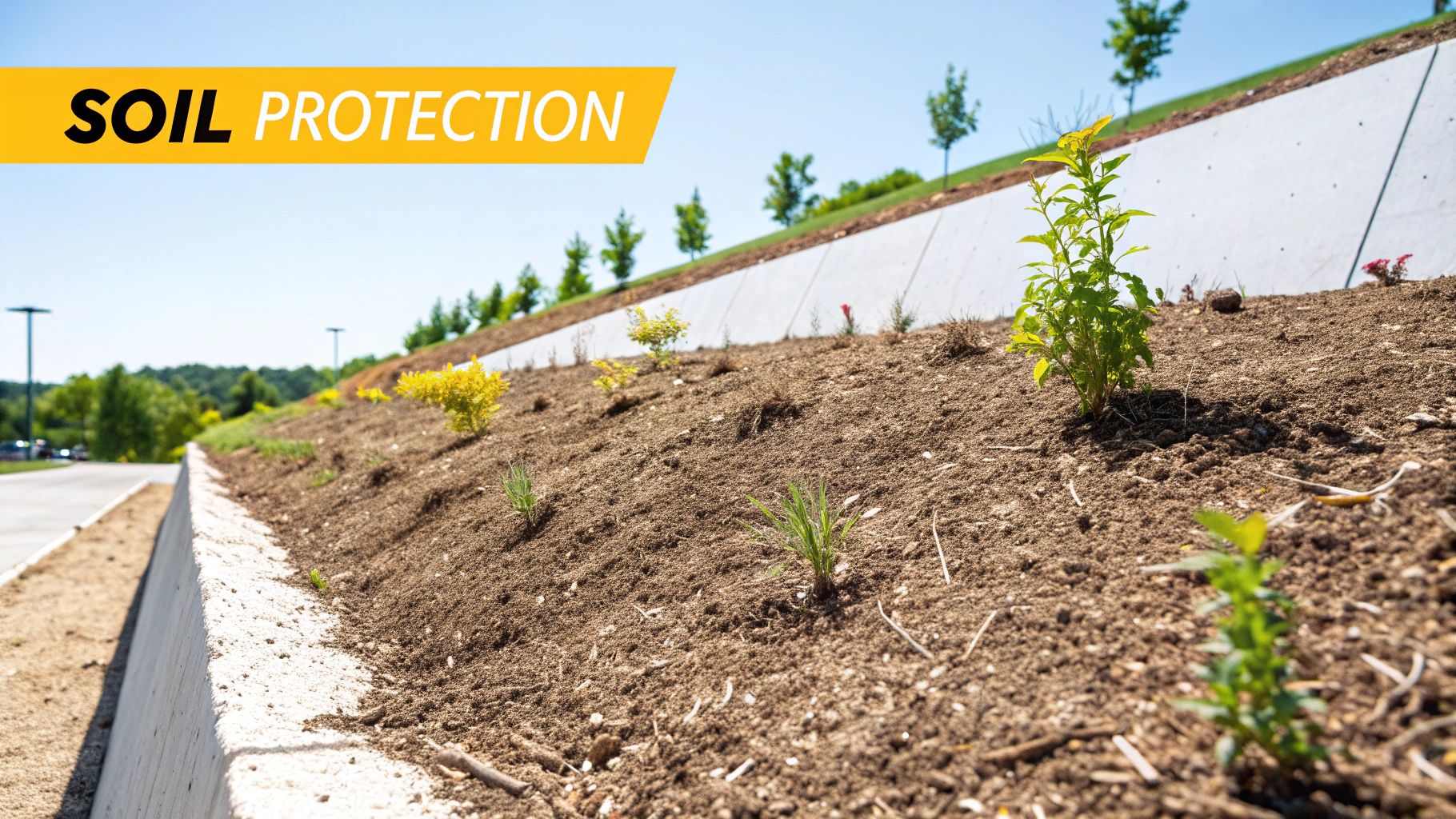
On so many local blocks—especially the sloping sites you see around Kariong or hugging the shores of Lake Macquarie—your topsoil is gold. Forestry mulching instantly creates a protective blanket of organic matter over the ground, acting like a natural shield for this precious resource.
This mulch layer does several crucial jobs all at once. It soaks up the force of heavy rain, stopping your valuable topsoil from washing away downhill, and a thick layer of mulch blocks sunlight, making it incredibly difficult for invasive pests like lantana to get a foothold again.
It also acts like a giant sponge, holding water in the soil and cutting down on the need for irrigation—a massive plus during our long, dry summers. Over time, that mulch slowly breaks down, feeding vital nutrients back into the earth and improving its overall structure and colour.
This isn't just about clearing land; it's about setting it up for a healthy future. This commitment to sustainable, on-site solutions is a thread that runs through all our services, including our approach to rock and dirt recycling.
The Practical Advantages: Speed and Simplicity
From a pure project management standpoint, the efficiency is hard to argue with. Forestry mulching is a single-step, single-machine process.
There's no need to line up separate crews for felling, another for stacking, and then more for loading and hauling. One skilled operator in one machine can move through an area methodically, getting the job done completely and cutting project timelines down significantly.
When you look at the wider context, this matters. Australia faces serious land management challenges, with NSW alone losing over 80,000 hectares to deforestation in 2020. Forestry mulching gives us a much more responsible way to manage vegetation because it recycles everything on-site, which helps slash soil erosion and habitat loss compared to broadscale clear-felling. These realities make low-impact methods more important than ever. You can explore the statistics on Australia’s deforestation challenges to see the full picture.
Ultimately, this all-in-one efficiency means fewer disruptions for you and a much cleaner budget. You're dealing with one process, which simplifies scheduling and eliminates the risk of hidden costs creeping in for waste disposal. It’s a faster, cleaner, and often more cost-effective way to get your property ready for whatever you have planned next.
Forestry Mulching Compared to Traditional Land Clearing
Making the right choice for your land isn't just about getting the job done; it's about what you're left with afterwards. When you start searching for "forestry mulching near me," you're already on the path to a modern, smarter solution. But to really appreciate why it’s such a powerful method, it helps to see how it stacks up against the old-school ways.
For generations, the go-to approach was brute force: bulldozers and fire. A dozer would tear through the bush, pushing trees and scrub into massive piles. These heaps would then be left to dry out before being set alight, or maybe loaded onto trucks and hauled away. While it certainly clears the land, this method comes with some serious baggage that often gets overlooked.
The Old Way: Bulldozing and Burning
The most immediate problem with traditional dozing is the brutal impact on your topsoil. Heavy machinery scrapes away this precious layer and compacts the ground beneath it, destroying the soil’s structure and leaving it defenceless against the elements. This is a massive issue on the Central Coast, where our sandy soils can wash away in the first big downpour, or in the Hunter Valley, where heavy clay turns into a compacted, barren hardpan.
Then there's the aftermath. You're left with enormous piles of green waste that become your problem to manage. Burning them off requires permits from your local council and the RFS, creates a ton of air pollution, and brings a very real fire risk if it's not handled perfectly. Hauling it all away? That's just an expensive, time-consuming logistical headache.
Consider this scenario: you’ve just bought a five-acre block near Cessnock that’s choked with lantana and small ironbark. A traditional clearing job might leave you with exposed, compacted soil and several enormous burn piles that you can’t legally light for months, completely stalling your building schedule.
The Modern Approach: Single-Step Mulching
Forestry mulching is a totally different ball game. It’s a one-machine, one-step process that works with your land, not against it. Instead of scraping, pushing, and piling, our machines process all the vegetation right where it stands, turning a liability into a valuable asset. There’s no destructive soil disturbance, no ugly burn piles, and no fleet of trucks needed to haul waste away.
This approach leaves the delicate topsoil layer completely intact, covering it with a protective blanket of natural mulch. This organic material gets to work immediately, preventing erosion, helping the ground retain moisture, and naturally suppressing weed growth. The final result isn't bare, scarred dirt; it's a clean, tidy landscape that’s perfectly primed for whatever you have planned next.
While the hourly rate for a bulldozer might sometimes look cheaper on paper, the hidden costs of the old way stack up fast. You often need to budget extra for erosion control, waste disposal fees, and soil conditioning just to fix the damage done. For a deeper dive into your options, check out our guide on land clearing services near me.
Ultimately, forestry mulching offers a cleaner, all-in-one solution that gets the job done right the first time, protecting the health and long-term value of your property.
Planning and Compliance for Your Mulching Project
Before any machine even thinks about rolling onto your property, a bit of forward planning is the secret to a project that’s smooth, safe, and completely above board. Getting this stage right is what saves you from future headaches with the council, nasty surprises buried in the ground, and frustrating delays. It's a non-negotiable step for us, and as seasoned Central Coast contractors, we’ve seen what happens when it’s skipped.
First things first: you need to get your head around your local council's rules. You can't just fire up the machines and assume it's all good to go, even on your own land. The regulations can be wildly different from one area to the next, so it's absolutely vital to check directly with bodies like Central Coast Council or Newcastle Council before a single branch is touched.
Navigating Council Rules and Approvals
A lot of councils have what’s known as a Tree Preservation Order (TPO) or a similar vegetation management plan. In simple terms, this means certain trees are legally protected because of their species, size, or local significance. Taking one down without a permit can land you with a seriously hefty fine.
If you’re looking at a larger-scale clearing job, especially one linked to a new build or a subdivision, you might be up for lodging a Development Application (DA). This can be a tricky process, so getting professional advice early on is always the smart move. We can help point you in the right direction and clarify what’s likely needed for your block.
Assessing Your Site for Safety and Access
Once you’re clear on the local laws, the next step is a proper site assessment. This isn’t just about sizing up the trees; it's about spotting every single potential hazard that could throw a spanner in the works. We’re on the lookout for things like steep slopes—a common feature on properties from Terrigal right through to the Hunter Valley—and hidden obstacles like massive old rocks or stubborn stumps lurking just below the surface.
A critical part of this is finding out what’s underground. Before any work begins, getting a "Dial Before You Dig" report is an absolute must. It’s a crucial safety step that maps out any buried pipes and cables for gas, water, electricity, and comms. Hitting one of those isn't just dangerous; it's an incredibly expensive mistake to make. For a deeper dive into all the groundwork that comes before the main event, our guide to effective site preparation and excavation is a fantastic resource.
This infographic helps visualise how your land goals can guide you to the right clearing method.
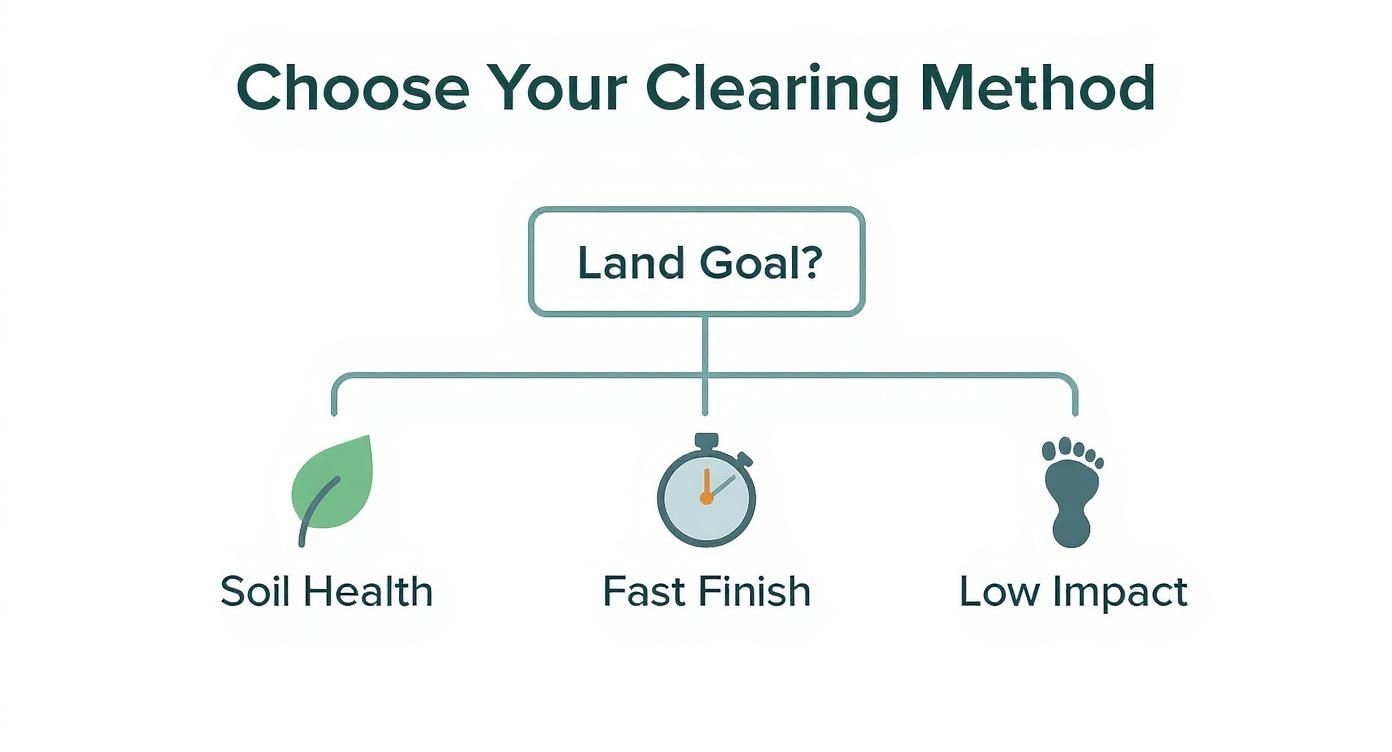
The decision tree highlights that if soil health is a priority, low-impact methods like mulching are often the superior choice over more disruptive techniques.
Environmental and Ecological Considerations
Managing land responsibly in NSW means we have to be mindful of our native flora and fauna. During our site assessment, we're always looking for protected plant species or tell-tale signs of animal habitats. Disturbing these without the right approvals from bodies like the NSW Department of Planning and Environment can stop a project dead in its tracks.
This ecological stewardship is more important than ever. As of 2020, Australia had around 83.9 million hectares of natural forest, but the country lost an estimated 159,000 hectares in that year alone. Smart, responsible practices like forestry mulching are essential for creating fire breaks and tackling invasive species without causing the kind of broadscale damage that contributes to these losses. It’s all about striking a balance between development and conservation. You can explore more data on Australia’s forest trends.
Finally, every single job we do must follow SafeWork NSW guidelines to the letter. This ensures the safety of our crew, you, and your neighbours from start to finish.
How to Choose the Right Forestry Mulching Service
Once you’ve settled on forestry mulching as the right solution for your property, the real work begins: finding the right crew for the job. Not all operators are created equal, and the difference between a seasoned professional and a casual operator can mean the difference between a smooth, successful project and a costly, frustrating mess.
Simply searching for "forestry mulching near me" will throw a lot of names your way, but you need to know how to dig a bit deeper. You're not just hiring someone to run a machine; you're looking for a genuine land management partner.
What to Ask Local Providers About Their Equipment and Experience
The first thing you should always ask about is their gear. A professional outfit will own and maintain a modern fleet, and more importantly, they'll know how to match the right machine to the specific challenges of your site. Are they running a compact skid steer with a mulching head, which is perfect for tight residential blocks? Or do they operate a larger excavator-mounted mulcher, a machine far better suited for the steep terrain and larger trees we often see across the Hunter Valley?
The type of machine really does matter. An excavator, for example, can reach over obstacles and work safely on slopes that would be a no-go for a skid steer. An experienced operator will explain why a certain machine is the best fit for your land, talking you through factors like site access, ground conditions, and the type of vegetation you need cleared.
Don't stop there. Ask them about their experience on jobs similar to yours. Let's say you're looking to clear a tricky, sloping block in a place like Copacabana; you want a team that has a proven track record on similar Central Coast terrain, not someone whose only experience is on flat, open paddocks.
Verify Insurance and Safety Protocols
This part is non-negotiable. Any contractor setting foot on your property must have current, adequate insurance. Ask to see their Public Liability Insurance Certificate of Currency. This is your protection in the unlikely event of an accident. A true professional will have this document ready to go and be happy to share it.
Beyond insurance, safety should be their absolute top priority. Ask them about their safety procedures and their understanding of SafeWork NSW guidelines. A pro team will kick off every job with a site-specific risk assessment and a clear safety plan. This isn't just paperwork; it’s a sign that they are serious about protecting their crew, you, and your property.
Insist on a Detailed, Written Quote
A vague price scribbled on the back of a business card is a massive red flag. A professional operator will provide a detailed, written quote that clearly breaks down the entire scope of work. It needs to specify what’s included and, just as importantly, what’s not.
At a minimum, your quote should clearly outline the area to be mulched, the specific machinery they plan to bring to the job, and an estimated timeframe. It should also have a full breakdown of costs, whether it's an hourly rate, a day rate, or a fixed project price. Professionalism isn't just about the work on the ground; it's also about how efficiently a business is run behind the scenes. Companies that use effective job and cost tracking methods are typically more reliable and transparent.
What to Expect On the Day (And in the Months After)
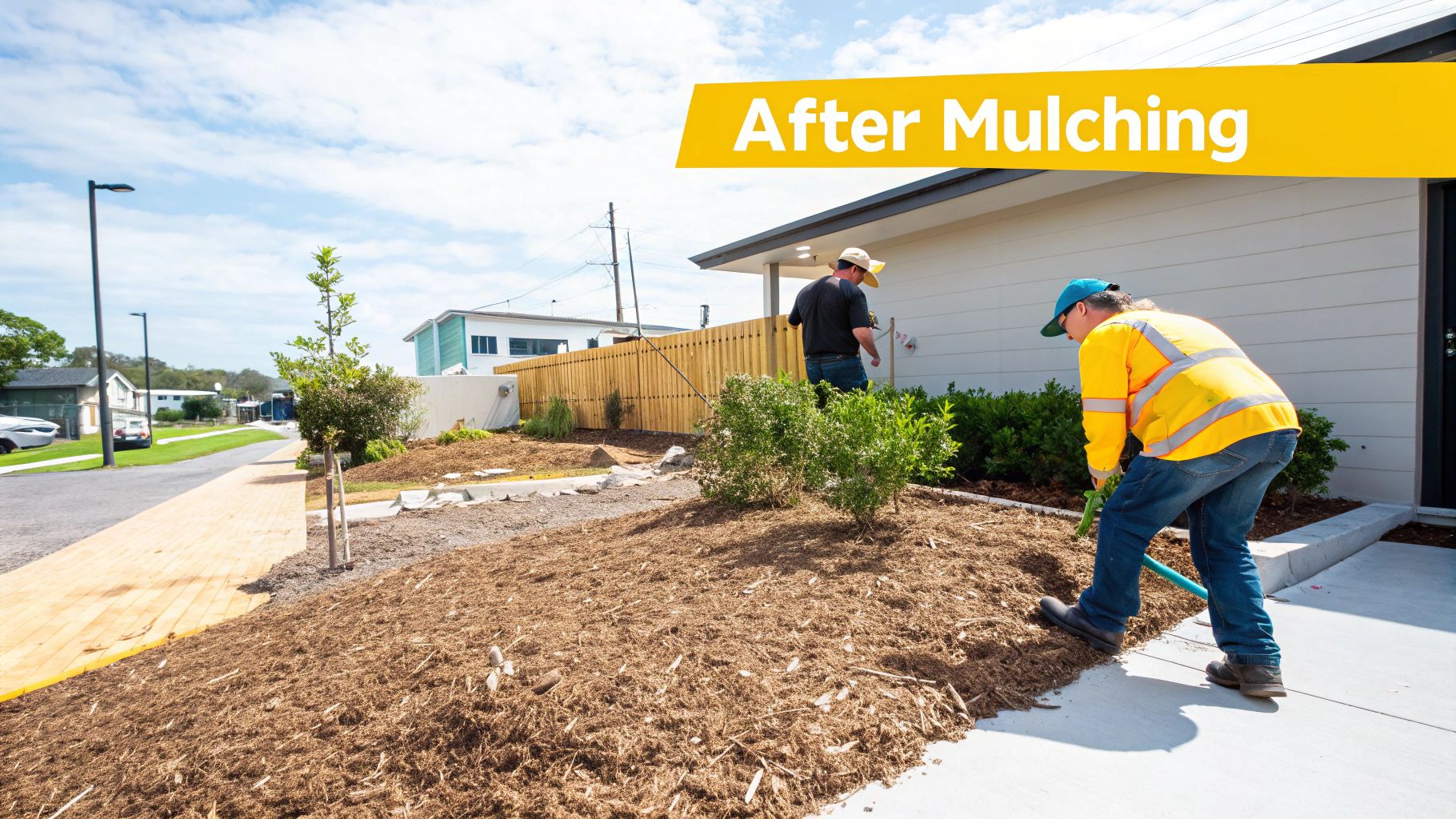
Knowing what a forestry mulching project actually looks like on the ground helps demystify the whole process. When you partner with a professional crew, you can expect a well-organised operation from the moment we arrive to the final walk-through. There are no surprises, just a clear, methodical approach to getting the job done safely and efficiently.
The day always kicks off with a safety briefing and a final site assessment. Our operator will walk the area with you, confirming the boundaries of the work zone and flagging any last-minute hazards. This is our chance to lock in the plan and make sure everyone is on the same page before the machine even starts.
During the Mulching Operation
Once work begins, you can expect a fair bit of noise. The mulching heads are powerful pieces of equipment, and the sound of them processing timber is significant. It’s for this reason we establish clear exclusion zones to ensure the safety of everyone on-site, including you, your family, and any neighbours.
We manage our work methodically, clearing sections in a planned sequence to ensure complete coverage and a consistent finish.
Let's imagine we're clearing a two-acre block in a semi-rural spot like Mangrove Mountain. We’d likely start at the furthest point from the entrance and work our way back. This simple step ensures we don't have to travel over already-mulched ground, which minimises soil disturbance and creates a much tidier, more uniform result.
The Immediate Aftermath and Long-Term Benefits
The moment the machine is switched off, the transformation is immediate. Your once-overgrown property will be covered in a neat, even blanket of coarse, woody mulch. This isn't the fine, decorative stuff you buy in bags; it’s more robust, designed specifically for land rehabilitation. The layer might be several centimetres thick, depending on how dense the original vegetation was.
This mulch blanket is the real prize. It immediately gets to work protecting your topsoil from erosion—a major concern on the Central Coast's sandy, sloping blocks. It also acts as a natural weed suppressant and helps the ground retain precious moisture, which is a huge advantage during our hot, dry summers.
Over the next few months and years, this layer will slowly break down. As it decomposes, it feeds the soil with rich organic matter, improving its structure and fertility without you having to lift a finger. This process naturally enriches your land, turning what was once a problem into a long-term asset for your property’s ecosystem. It also completely avoids creating waste piles, unlike projects that generate excess fill and require careful disposal. If you’re ever dealing with leftover earth from other projects, you can learn more about how to dispose of soil correctly to stay compliant with local regulations.
At the end of the job, we'll do a final walk-through with you to ensure you're completely happy with the result. We’ll check that the work matches the agreed scope and answer any last questions you have about the finished area. Our goal is to leave you with a clean, usable, and healthy block, ready for whatever you have planned next.
Common Questions About Forestry Mulching in NSW
When you start searching for "forestry mulching near me," a bunch of practical questions always pop up. To give you a clearer picture, here are some straight answers to the most common queries we get from property owners across the Central Coast, Sydney, and the Hunter Valley.
What is the Pricing Structure for Forestry Mulching?
There’s no simple, one-size-fits-all price tag, mainly because every single property is different. Pricing is almost always based on an hourly or daily rate for the machine and a skilled operator, not a per-acre figure. Honestly, it's the fairest way to do it, as it directly reflects the actual work required on your specific bit of land.
So, what drives the final cost? It really comes down to a few key things. The density and type of vegetation is a big one – smashing through thick lantana and saplings takes a lot longer than tidying up sparse undergrowth. The terrain also plays a massive role. A steep, rocky block near Gosford is a completely different beast to a flat, open paddock in the Hunter Valley. The type of machine we need to bring in for your job will also shape the rate.
Can You Mulch in Any Weather?
While we can definitely work in most conditions, the safety of our crew and the quality of the finished job are always our top priorities. The biggest hurdle we run into is heavy rain, especially on the clay-based soils that are so common around the Central Coast and further inland. Once that ground gets saturated, it's just not safe or effective to be moving heavy gear around.
Trying to work on wet, soggy ground can cause some serious damage to your property, leaving deep ruts and compacting the soil badly. It’s for this exact reason we’ll sometimes have to make the call to reschedule a job if the weather turns on us. We'd much rather wait a few days to give you a perfect result than push on and leave you with a muddy mess to clean up.
Will the Vegetation Grow Back After Mulching?
It's important to have realistic expectations here. Forestry mulching is incredibly effective at clearing land and it massively slows down regrowth. That thick layer of mulch it leaves behind acts like a natural blanket, suppressing new shoots by blocking out the sunlight they need to get going.
That said, some of our native Aussie species are seriously tough and can eventually send up new shoots from their root systems. While the regrowth will be nowhere near as vigorous as it was before, you might need a bit of a plan for follow-up management, like some targeted spot spraying, to keep the more stubborn vegetation under control for the long haul.
What Size Trees Can You Mulch?
Our equipment is seriously impressive, but it does have its limits. The maximum diameter of a tree we can mulch comes down to the specific machine and the type of mulching head we're using for your job. As a general rule, our bigger excavator-mounted mulchers can handle much larger trees than our more nimble skid steer units.
Before we start any project, we'll come out and properly assess the vegetation on your site to make sure we bring the right machine for the task. This guarantees we can work safely and efficiently, matching the machinery's muscle to the demands of your land. For any really large, mature trees, felling them first might be a separate, necessary step.
Ready to clear your land the right way? The team at Booms Up Civil has the local knowledge and modern machinery to tackle your project safely and efficiently. For a no-obligation chat about your property, get in touch with us today.