
Before you even think about searching for “land clearing services near me,” the most important thing you can do is get crystal clear on what your project actually is. We can’t stress this enough. Getting this right from the start saves you from inaccurate quotes, project delays, and costly surprises down the road. It’s the foundation for finding the right team for the job.
Defining Your Land Clearing Project Needs
There’s a world of difference between clearing a small suburban block for a new build and tackling a sprawling, overgrown rural acreage. One might be a straightforward job, while the other is a complex operation with serious logistical hurdles. Are you prepping a residential lot in a growing Central Coast suburb like Warnervale, or are you trying to reclaim a few hectares out in the Hunter Valley? Each scenario is completely different.
The best way to start is to simply walk your property with a notepad or your phone. Take photos. Make notes. Answering a few key questions will help you build a solid project brief that a professional contractor can actually understand and quote on properly.
Initial Questions to Ask Yourself
Before you pick up the phone, get your head around these points:
- What’s the end goal here? Are you clearing a patch for a new house pad and driveway? Making space for a garden? Or maybe you’re creating a critical fire break to protect your home. The why dictates the how.
- What exactly needs to go? Take a good look. Is it just light scrub, tall grass, and a few small saplings? Or are you staring down a wall of dense bushland with large, established trees and stubborn old stumps? The type and density of the vegetation are huge factors in the cost and complexity.
- What’s the lay of the land? Is the ground flat, gently sloping, or steep? What about the soil? You might be dealing with sandy soil common along the Central Coast, rocky ground like you find in parts of Sydney, or heavy clay further inland. This all affects the machinery needed.
This decision tree gives you a good visual of how your project scope, potential obstacles, and the services you’ll need all connect.
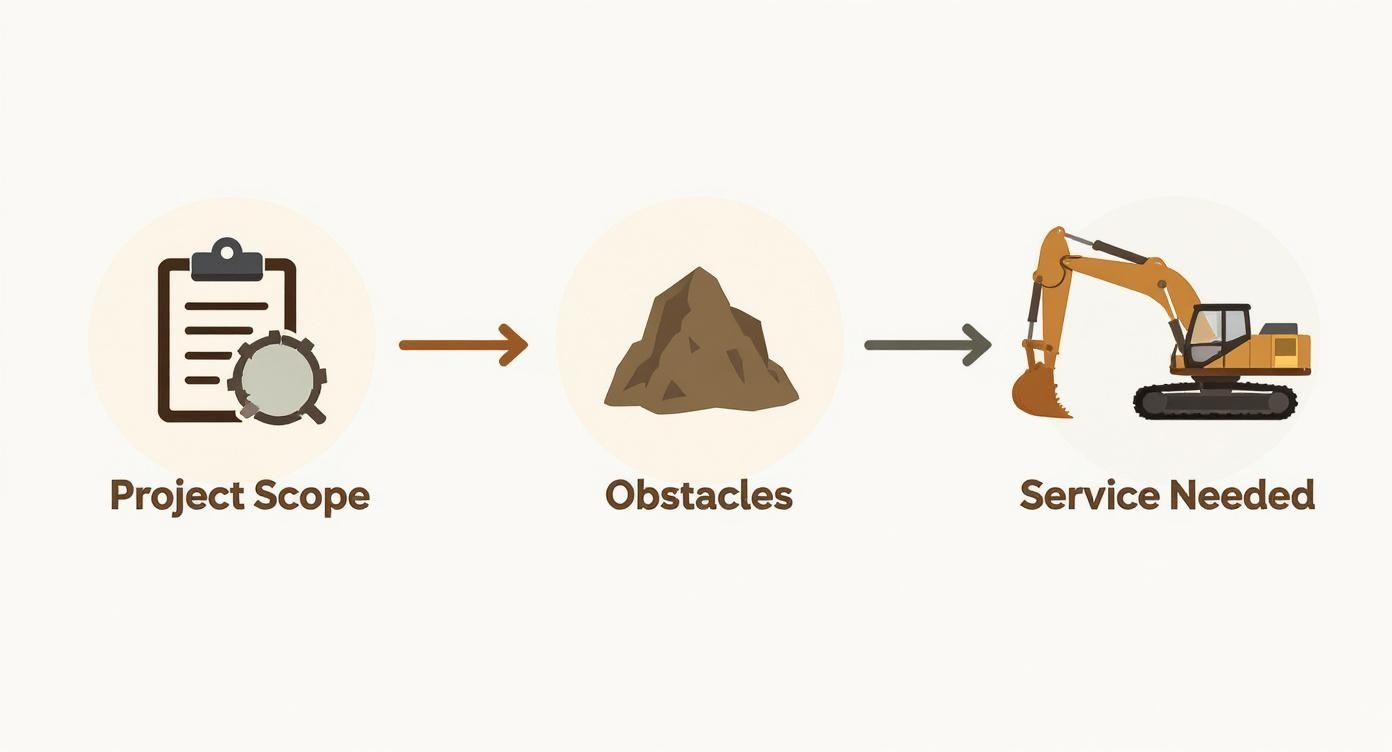
As you can see, figuring out what you need and what’s in the way directly points to the right gear and expertise for the job. Often, it’s crucial to think about the broader construction project context as well.
For a deeper dive into this initial planning phase, our guide to professional property clearing services offers some great insights. Having this information ready before you make the first call will make the entire process run a whole lot smoother.
Navigating Central Coast Council Regulations
Before a single piece of machinery even thinks about starting up, the most critical step in any land clearing project is figuring out what you’re legally allowed to do. We can’t stress this enough. Getting this wrong can lead to eye-watering fines from your local council and stop-work orders from SafeWork NSW. It’s a non-negotiable part of the process that protects you, your investment, and our incredible local environment.
Every council has its own rulebook, and what’s perfectly fine in a rural part of the Hunter Valley might be strictly forbidden on a suburban block in Newcastle. The Central Coast Council, for instance, has very specific guidelines designed to protect our unique coastal environment. Trying to clear land without checking these rules first is a gamble you simply don’t want to take.
Understanding Key Council Controls
When you start digging into council regulations, a few key terms will pop up again and again. You’ll almost certainly encounter Tree Preservation Orders (TPOs), which protect significant trees, and things like Biodiversity Overlays, which flag areas with sensitive ecological value. These overlays can seriously restrict what you can and can’t remove.
Let’s imagine you’ve bought a block in a coastal suburb like Macmasters Beach or Avoca Beach. These areas are often under tight controls because of their fragile ecosystems. What looks like a “simple” clearing job might actually need a formal Development Application (DA) and a supporting arborist report just to get off the ground. This isn’t just red tape for the sake of it; it’s about managing our land responsibly.
A common mistake we see is property owners assuming that because a tree is on their land, they have an automatic right to remove it. In most cases, especially with native species over a certain size, this is simply not true. Always, always check with your council first.
When Is a Development Application Required?
So, how do you know if you need to lodge a DA? It usually boils down to the scale and nature of your project. Minor clearing of invasive weeds or a few non-native shrubs might fall under ‘exempt development’, which means you can go ahead without formal approval.
However, you will almost certainly need council permission if your project involves:
- Removing native trees above a certain height or trunk diameter.
- Clearing land that sits within a designated environmental zone or is close to a waterway.
- Working on a property that is subject to a biodiversity or heritage overlay.
Navigating this paperwork can be a real headache, which is why working with an experienced local contractor is so valuable. A professional who offers land clearing services near me should be familiar with the specific rules of the Central Coast Council or Newcastle Council. They can help you figure out what’s needed, ensuring everything is done by the book and saving you from a major compliance nightmare down the track.
For more details on the practical steps involved, our guide on residential land clearing essentials has some great information. Ultimately, getting the approvals right isn’t just the first step—it’s the foundation for getting the entire project right.
What Happens When The Crew Arrives? Your On-Site Land Clearing Explained
So, what should you expect when the machinery actually rolls onto your property? A professional land clearing operation is a far cry from just knocking everything over with a dozer. It’s a carefully choreographed process, planned from start to finish to be safe, efficient, and fully compliant with every regulation.
Frankly, no two jobs are the same. Every project has its own quirks and demands a specific approach based on the unique conditions of your site.
The real work starts long before an engine ever turns over. Any contractor worth their salt will kick things off with a detailed on-site assessment and the creation of a Safe Work Method Statement (SWMS). This isn’t just a piece of paper for us at Booms Up Civil; it’s a non-negotiable part of our process. It identifies every potential hazard—from overhead powerlines to hidden pipes—and lays out the exact steps we’ll take to manage those risks. The goal is simple: keep everyone on and near the site safe.
Choosing the Right Tools for the Job
Once the safety plan is locked in, we figure out the smartest way to tackle your project. A sloped, bushy block in the Hunter Valley needs a completely different strategy than a flat, sandy patch near Lake Macquarie. Getting the machinery selection right is absolutely critical, and it all comes down to the type of vegetation, the lay of the land, and what you plan to do with the property afterwards.
Let’s say your main goal is to get rid of dense scrub and small trees. In that case, forestry mulching might be the perfect fit. This technique uses a specialised machine that shreds vegetation right where it stands, turning it into a protective layer of mulch. This is a brilliant, low-impact option that returns nutrients to the soil and helps stop erosion, especially when you don’t need to dig out the root systems.
On the other hand, if you’re getting ready to pour a concrete slab or lay foundations, a more traditional ‘cut and grind’ approach is essential. This involves felling trees, grinding the stumps well below ground level, and pulling out all the root balls. Why? Because leftover roots will eventually rot, creating voids in the ground that can lead to subsidence issues down the line. It’s a vital part of proper site preparation and excavation.
Cleaning Up: Debris Management and Site Remediation
Modern land clearing places a huge emphasis on responsible waste management. The old days of just pushing everything into a pile to burn or rot are long gone—and for good reason. It’s often illegal and always bad practice.
A professional crew will have a clear plan for sorting and dealing with all the debris. This might involve chipping the green waste so it can be recycled or hauling away larger logs to be repurposed.
Historically, land clearing was a fundamental part of Australia’s agricultural development, particularly in New South Wales where vast areas were cleared for farming between 1892 and 1921. Today, our understanding of environmental impacts means we approach the task with much greater care and responsibility.
The final step is site remediation. This is where we make sure the land is left in a stable condition. On sloped sites or near waterways, this often means putting in erosion controls like silt fences or sediment basins to prevent soil runoff. The end goal is to hand you back a clean, stable, and ready-to-use site, perfectly prepped for whatever you have planned next.
If you want to dig deeper into the actual methods and steps, this practical guide on how to clear land offers some great insights.
Minimising Environmental Impact Responsibly
Land clearing is about more than just making space; it’s about reshaping a piece of the local environment. As property owners, we have a shared responsibility to manage this process thoughtfully, moving beyond simple council compliance to embrace genuine environmental stewardship. The decisions we make during clearing have real, lasting consequences.
Poorly managed projects can lead to significant soil erosion, especially on the sloping blocks we see so often around the Central Coast. This runoff doesn’t just stay on-site; it can pollute nearby waterways and sensitive catchments, affecting the entire local ecosystem.
It’s not just about the soil, either. The scale of land clearing in Australia has severe ecological consequences. For every 100 hectares cleared, countless birds, reptiles, and mammals are lost through habitat destruction. You can discover more about land clearing’s impact on wildlife from Bush Heritage Australia.
Modern Techniques for Sustainable Clearing
Fortunately, modern methods allow us to achieve your development goals without causing unnecessary harm. It’s all about working smarter, not harder. A professional operator’s first step should always be to identify and protect significant flora and fauna habitats, not just clear everything in sight.
One of the most effective techniques we use is selective clearing. Instead of a blanket removal, we strategically retain important native vegetation. This simple approach helps maintain biodiversity, provides natural shade, and preserves the unique character of your property. For example, on a large block in the Hunter Valley, we might clear for the house pad and access road but leave mature gum trees and understorey corridors for local wildlife to continue using.
Another key method is forestry mulching. This process grinds up vegetation on-site and spreads it back over the soil. This creates a natural blanket that stabilises the ground, prevents erosion, and returns valuable nutrients to the earth. It also avoids the need for costly and disruptive debris removal. After all, what you do with the waste is just as important as the clearing itself. We’ve put together a guide with helpful advice on how to dispose of soil and green waste responsibly.
The goal isn’t just to clear land; it’s to leave behind a stable, healthy, and resilient environment that’s ready for its next chapter. Proper planning prevents long-term problems like soil degradation and invasive weed growth.
By partnering with a contractor who prioritises these sustainable practices, you’re not just preparing your site for construction. You’re making a conscious choice to protect the local environment, ensuring your project contributes positively to the area for years to come.
How to Choose the Right Land Clearing Contractor
Finding the right land clearing contractor is easily the most critical decision you’ll make for your entire project. Get this right, and the whole process feels smoother, safer, and far more efficient. It’s about going deeper than a quick check for a licence and insurance—you need to partner with a true professional who understands the local landscape and won’t cut corners.
When you start looking for land clearing services, you need someone with proven, relevant experience. A contractor who mainly handles large-scale rural clearing might not be the best choice for a tricky, tight-access job on a dense Sydney block. Don’t be shy about asking for specific examples of their previous work on projects that look a lot like yours.
What to Ask Before You Hire
A professional operator will welcome your questions and have clear, confident answers ready. Think of it as a job interview—because it is. Here’s a practical checklist to help you sort the experts from the amateurs:
- Safety and Compliance: Ask to see their Safe Work Method Statement (SWMS) for a similar job. How do they actually manage risks on-site? Are they up to speed with SafeWork NSW requirements?
- Council Knowledge: Do they have a solid grasp of the specific rules for your area, whether it’s the Central Coast Council or Newcastle Council? A top-tier contractor knows the local regulations like the back of their hand.
- Waste Disposal: What’s the plan for all the green waste and debris? A responsible operator has a clear, environmentally sound strategy, not just a vague promise to “push it into a pile.”
This vetting process is more important than ever. Recent data reveals a significant spike in land clearing across New South Wales, with much of it affecting vital habitats. You can read the full NSW land clearing data report to see the scale of the issue yourself. Choosing a contractor who respects these environmental sensitivities is just good practice.
Understanding Your Quote
A vague, one-line quote is a massive red flag. A detailed, professional quote should break everything down so you know exactly where your money is going.
Your quote is more than just a price; it’s a reflection of the contractor’s professionalism and transparency. A detailed breakdown shows they’ve thought through every aspect of your project, from the initial cut to the final cleanup.
A proper quote should clearly outline the scope of works, list the specific machinery they plan to use, break down labour costs, and give you a realistic project timeline. It absolutely must detail how waste will be removed and flag any potential extra costs, like rock breaking or traffic control. By comparing these detailed quotes, you can make a smart choice based on value and expertise, not just the rock-bottom price.
For more guidance, our article on finding the right earthmoving contractors near me dives deeper into tips that are just as relevant for land clearing projects.
Your Land Clearing Questions Answered
When you’re searching for “land clearing services near me,” a lot of questions pop up. It’s completely normal. We talk to homeowners and developers every day who are trying to figure out the costs, timelines, and council rules for their projects.
Here are some clear, straightforward answers to the questions we hear most often from our clients across the Central Coast, Newcastle, and Sydney.

How Much Does Land Clearing Cost On The Central Coast?
This is always the first question, but the truth is, there’s no simple, off-the-shelf price. The cost of clearing a block is never a one-size-fits-all deal because every single property is different. The final figure really hinges on the size of your block, how dense the vegetation is, and how tricky the terrain is to navigate.
For instance, clearing a flat, half-acre lot with just some light scrub will be a world away, cost-wise, from tackling a steep, rocky site covered in mature gum trees and stubborn stumps. Even the soil type—whether it’s sandy coastal soil or heavy inland clay—plays a part, as it determines the machinery we need to bring in.
Your best bet is to get a few detailed, written quotes from reputable local contractors. This lets you compare not just the bottom line, but the entire scope of what’s included. Be very wary of any quote that seems too good to be true—it almost always is and probably hides costs that will pop up later.
Do I Always Need Council Approval For Land Clearing?
Not always, but it’s absolutely critical that you check before a single tree is touched. You can’t just assume it’s fine. Minor work, like getting rid of a few non-native shrubs or clearing out some invasive weeds, might fall under what your local council calls ‘exempt development’, which means no formal application is needed.
However, the moment your plans involve removing native trees, clearing land near a waterway, or working on a block with an environmental overlay, you will almost certainly need a permit or even a full Development Application (DA). The safest first step is always to ring your local council or chat with an experienced contractor who knows their specific regulations inside and out.
How Long Does A Typical Land Clearing Project Take?
The timeline for a clearing project can vary dramatically. A small, straightforward residential block with light vegetation might only take a professional crew a day or two to wrap up. On the other hand, a large, multi-hectare property with dense forest and difficult access could stretch out over several weeks.
A few key things can influence the schedule. Weather is a big one; heavy rain can bring everything to a halt. The type of machinery required and the logistics of getting all the green waste off-site also play a big role. Any professional contractor worth their salt will give you a realistic and transparent timeline as part of their initial quote.
It’s worth remembering that the on-site work is often the quickest part of the whole process. It’s the prep work, especially getting council approvals sorted, that can really take time, so factor that into your overall schedule.
What Happens To The Cleared Trees and Green Waste?
Any responsible contractor will have a clear, sustainable plan for managing the green waste. The old days of just pushing everything into a big pile and setting it alight are long gone—and in most places, it’s illegal.
Modern, professional crews have a few great options:
- Forestry Mulching: This is a fantastic method where all the vegetation is shredded on-site and spread back over the ground. It creates a protective layer of mulch that’s great for the soil.
- Chipping: Green waste can be fed through a massive chipper, and the resulting woodchips are then hauled away to a recycling facility.
- Repurposing: If there are larger logs, they might be cut and sent off to a sawmill or repurposed for things like firewood.
Make sure you ask your contractor about their disposal plan. It’s a key sign that you’re dealing with a professional, conscientious operator who handles waste legally and with respect for the environment.
Got more questions or want to talk through a specific project on the Central Coast, in Sydney, or up in the Hunter Valley? The team at Booms Up Civil is here to offer expert advice and a clear, no-obligation quote to get your project started on the right foot.