

Imagine trying to build a house on a block of land that’s all lumps and slopes. It’s a common problem, especially on the Central Coast, but there’s a smart solution: cut and fill excavation. Think of it as sculpting the earth on your property. We simply ‘cut’ away the high spots and use that very same soil to ‘fill’ the low spots.
The ultimate goal is to create a 'balanced site'—a perfectly level and stable platform ready for whatever you’re building, whether it's a new home, a shed, or a commercial carpark. It's the most efficient way to turn a challenging block into a valuable asset.
What is Cut and Fill Excavation?
At its core, cut and fill is about moving earth from where you don’t want it to where you do. It’s a fundamental technique that underpins almost every major construction project, from residential house pads on the Central Coast to massive commercial sites in Sydney's west.
By creating a balanced site, we tackle the two biggest—and most expensive—headaches in any earthworks job: paying to haul away excess dirt and then paying again to bring in new fill material. It’s an approach that works with the land, not against it, turning a challenging, sloped block into a valuable, buildable asset by using the resources you already have.
For a deeper dive into the initial phases of this work, check out our comprehensive guide on bulk earth works.
Cut vs Fill at a Glance
To really get your head around the process, it helps to see the two core actions side-by-side. While they happen on the same site, their goals and methods are distinct.
| Concept | Description | Goal | Material Handling |
|---|---|---|---|
| Cut | The process of excavating soil, rock, or other materials from high areas on a site. | To lower the ground level to the desired design elevation. | The excavated material, known as 'spoil', is removed from the cut area. |
| Fill | The process of placing and compacting that excavated material into low areas on a site. | To raise the ground level to the desired design elevation. | The 'spoil' is transported to the fill area and compacted in layers. |
Seeing it laid out like this makes it clear: cut and fill is a single, integrated system designed for maximum efficiency. It's a continuous cycle of removal and placement until the entire site is level.
Why Does This Matter for Your Project?
Getting to a balanced site isn't just about making things look tidy; it has huge practical and financial benefits. When the volume of material you ‘cut’ is roughly equal to the volume you need to ‘fill’, your project becomes incredibly cost-effective.
Let’s put it in a real-world context. Consider this scenario: you’re developing a property in the Hunter Valley. Without a proper cut and fill plan, you might dig out 500 cubic metres of soil. You could end up paying one contractor to truck all that spoil away, then paying another to bring in 500 cubic metres of clean fill for a different part of the block.
With a smart cut and fill strategy, you just move the soil from one side of the site to the other. This dramatically slashes your costs for transport, materials, and landfill disposal.
The biggest saving in cut and fill excavation comes from avoiding transport and landfill fees. These costs can often exceed the price of the excavation labour itself, making a balanced site plan the most financially sound approach.
This is exactly where professional planning pays for itself. An experienced contractor doesn't just start digging. We analyse the site's topography to map out a precise plan, ensuring every bucket of soil we move serves a purpose. It’s the key to preventing budget blowouts and frustrating project delays.
Whether it’s a tight residential block in Newcastle or a large-scale commercial pad, the goal is always the same: create a stable, level surface ready for construction, using nothing more than the ground beneath your feet.
The Cut and Fill Process Step by Step
A professional cut-and-fill job isn't about haphazardly moving dirt around. It’s a precise engineering process that unfolds in a series of critical phases, transforming an uneven block into a stable, construction-ready platform. Understanding this workflow helps you know what to expect when our machinery arrives on your Central Coast site.
This diagram shows the basic concept in action: moving soil from the high spots to fill the low spots, all to create a perfectly level area.
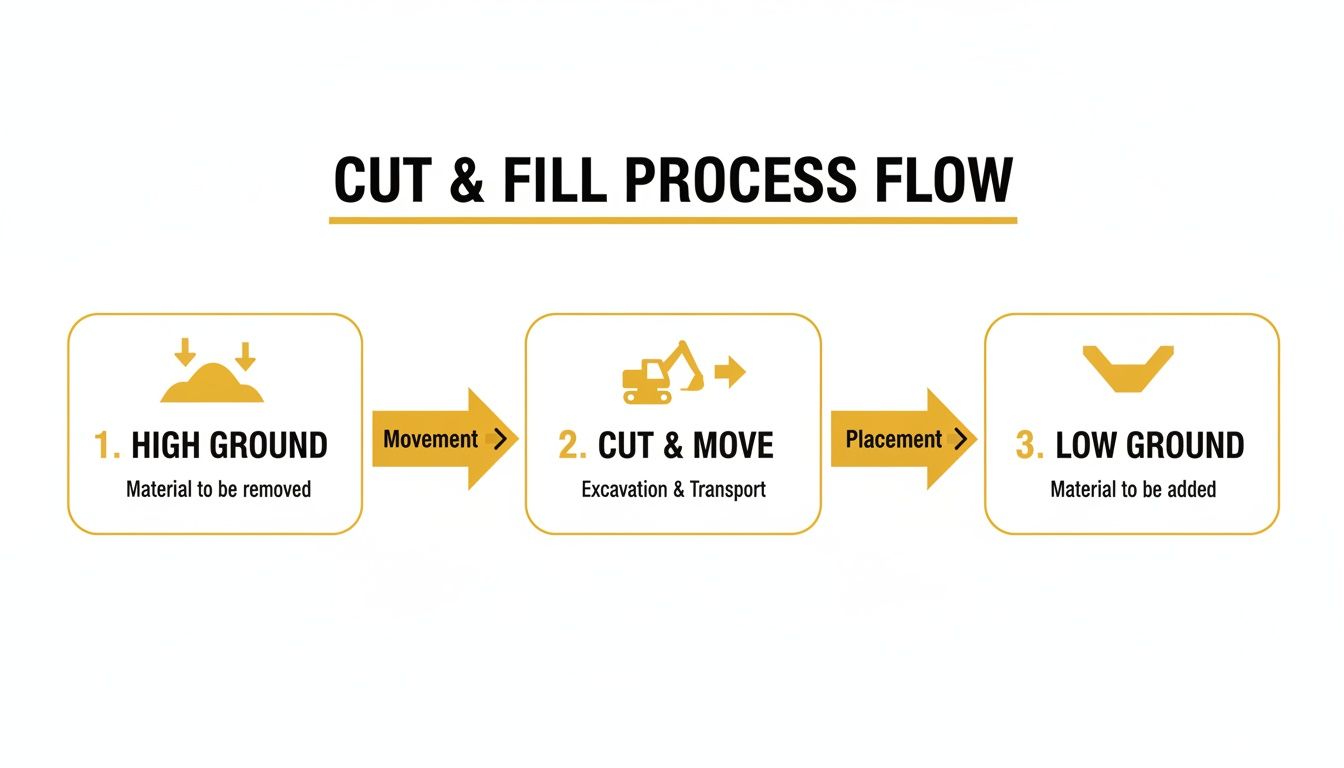
As you can see, it’s a cycle of removing, transporting, and re-placing earth until the site is perfectly balanced. Done right, this process massively minimises waste and imported material costs.
Site Investigation and Planning
Before a single bucket of soil is turned, we conduct a thorough site investigation. The first step is a detailed topographical survey to map out the land's high and low points. Just as crucial is the geotechnical analysis, where we take soil samples to understand exactly what we’re working with.
For instance, the reactive clay often found on a block in Wyong behaves completely differently from the sandy soils common around Terrigal. This data dictates everything that follows, from the type of machinery we’ll bring in to the specific compaction methods needed. Only then do we create a precise earthworks plan, mapping out exactly which areas are designated for ‘cut’ and which for ‘fill’.
Site Preparation and Excavation
With a solid plan locked in, we get the site ready for the main event. This involves clearing away any vegetation, carefully stripping the precious topsoil to be stockpiled for later use, and marking out the cut and fill zones with pegs and string lines, all guided by the engineering design.
Then, the heavy work begins. Using machinery like excavators and dozers, we start cutting into the designated high areas of the block. Once the material is cut, efficient transport is key. This excavated soil, or ‘spoil’, is moved to the fill areas, usually with tipper trucks. On larger sites, specialised equipment like conveyor trailers can be brought in to move huge volumes of soil and aggregates quickly and efficiently.
Material Placement and Compaction
This is, without a doubt, the most critical stage for the long-term stability of your entire project. The excavated soil isn't just dumped into the low spots. It's carefully placed in controlled, even layers—what we call 'lifts'—that are typically 150-300mm thick.
Each of these lifts is then compacted with heavy rollers. This process methodically squeezes out air pockets and dramatically increases the soil's density, creating a solid foundation that can support a concrete slab or driveway without sinking or shifting years down the track.
Proper compaction is non-negotiable. Failing to compact fill correctly in engineered lifts is the single biggest cause of future structural problems, like cracked slabs and subsiding foundations. Getting this right the first time is essential.
Final Grading and Drainage
Once all the fill is placed and compacted to engineering standards, we perform the final trim. Our expert operators use graders or excavators with specialised attachments to ensure the entire surface is perfectly level and precisely matches the design specifications.
At the same time, we shape the site’s drainage. This involves creating subtle slopes (or ‘falls’) to direct rainwater away from your future building foundations and towards stormwater systems or designated runoff areas. This final step is crucial; it prevents water from pooling and undermining the integrity of your new level ground, leaving you with a site that is not only level but also safe, compliant, and ready for whatever comes next.
How We Calculate Cut and Fill Volumes Accurately
So, how do we figure out exactly how much soil needs to be moved? It’s certainly not guesswork. Getting the numbers right is the single most important part of planning a successful project, preventing you from running out of fill material or ending up with a huge, expensive pile of excess soil. This is where precision and experience—like our 15+ years on the Central Coast—really make a difference.

The most common and trusted technique we use is the grid method. It’s a straightforward, proven approach that gives us a clear, detailed picture of your site’s earthmoving needs.
The Grid Method Explained
Imagine laying a virtual grid, like a giant piece of graph paper, over your site plan. At every point where the grid lines intersect, we record two key numbers: the existing ground level and the proposed final level from the engineering design.
The difference between these two numbers instantly tells us whether we need to cut soil away or fill it in at that specific spot. A positive result means it's a fill area; a negative result means a cut is needed. By doing this across the entire site, we build a complete 3D model of the work required.
This method is used all over Australia for its reliability, especially on large, open sites. It allows for incredibly efficient planning, sometimes even eliminating the need for imported materials altogether by balancing the site perfectly.
The Crucial Role of Swell and Compaction Factors
Now, calculating that initial volume is only half the story. The real expertise comes from understanding how soil behaves once you start moving it around. This is where two critical variables come into play: the swell factor and the compaction factor.
Soil is not a static material. When you dig it up, it expands. When you compact it, it shrinks. Failing to account for this is a classic rookie mistake that leads to massive budget blowouts.
Let's break it down:
- Swell Factor: When we excavate soil, we disturb its natural, compacted structure and introduce air pockets. This causes it to ‘swell’ and take up more space. For example, 10 cubic metres of dense clay in the ground might suddenly become 13 cubic metres once it’s loose in the back of a tipper.
- Compaction Factor: Conversely, when we place that soil as fill, we compact it down in layers. This process removes those air pockets to create a dense, stable foundation, which reduces its volume. That same soil might end up occupying only 9 cubic metres once it's fully compacted on the new level.
Different soil types have vastly different swell and compaction rates. The sandy soils of the Central Coast behave completely differently from the heavy clays you find in parts of the Hunter Valley or the rocky ground in areas around Sydney. Accurately predicting these changes is the key to achieving a truly balanced site and avoiding costly surprises down the track.
For those wanting to play with the numbers, our soil excavation volume calculator provides a useful starting point to see these principles in action.
Key Cost Factors in a Cut and Fill Project
When you get a quote for a cut and fill project, it helps to know what’s really behind the numbers. While the work is often priced per cubic metre, the final invoice tells a much bigger story that goes way beyond just digging. The decisions we make together in the planning phase have a massive ripple effect on your budget.
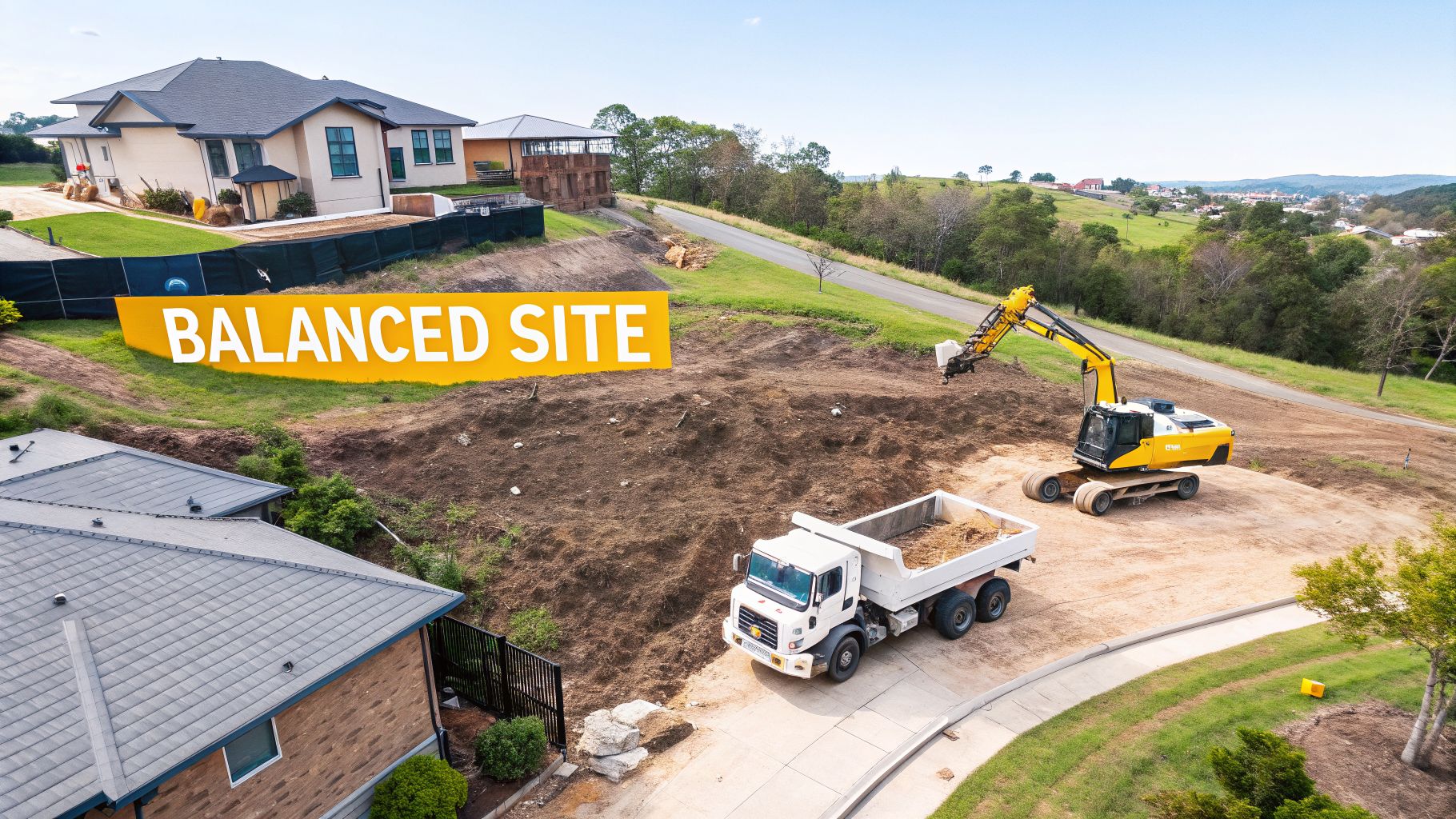
The single biggest opportunity for cost savings boils down to one simple goal: creating a ‘balanced site’. This is the sweet spot where the amount of soil we ‘cut’ is almost exactly what we need to ‘fill’. Nailing this is the absolute key to keeping your project on budget.
Spoil Disposal and Material Haulage
Without a doubt, the two biggest line items on almost any earthworks project are hauling away excess soil (spoil) and paying the hefty fees for its legal disposal at a licensed facility. The genius of a well-executed cut and fill project is that it can virtually eliminate both of these costs.
By reusing material excavated from high areas to build up the lower sections, we drastically slash the need to truck in expensive fill or, even more importantly, truck out excess spoil. Think about it: every single truckload of dirt that leaves your site is a triple-cost. You pay for the machine and operator to load it, the fuel and driver to transport it, and the landfill fees to dump it.
A balanced site design wipes all three of those costs off the board. You can see a full breakdown of these expenses in our guide to the cost of excavation per cubic metre.
Site Accessibility
A huge factor in the final cost is simply how easily we can get our machinery onto your property and to the work area. A wide-open, flat block in a new Hunter Valley estate is a dream scenario. We can bring in large, highly efficient excavators and trucks to get the job done quickly.
It’s a different story on a tight residential block in inner-city Newcastle or a steep, narrow property on the Sydney Northern Beaches. Limited access might force us to use smaller, less efficient machinery, which means the job naturally takes longer. In the toughest cases, restricted access can add significant manual labour costs or require specialised equipment just to move material from A to B.
The easier it is for our machines and trucks to get in and out, the faster and more cost-effective your project will be. This isn't just about the driveway; we have to consider things like overhead power lines, tight corners, neighbouring properties, and street parking for our tippers.
Soil and Ground Conditions
The type of ground we’re dealing with directly impacts the project's difficulty, timeline, and cost. You can't just use the same approach for every soil type; each one needs the right equipment and handling.
Here are some common conditions we work with across NSW:
- Sandy Soils: Common on Central Coast sites, sand is very easy to dig. The trade-off is that it can be unstable and needs careful management to stop trenches from collapsing. It also compacts very differently to clay.
- Clay Soils: Found in many areas inland from the coast, clay is heavy and can get incredibly sticky and slow when wet. The upside is that when it's managed correctly, it compacts to form an exceptionally stable and solid base.
- Rock: Hitting unexpected rock, like the sandstone bedrock found all over Sydney, is one of the biggest variables in excavation. You can't dig it with a standard bucket. It requires specialised hydraulic hammers or rock saws, adding significant machinery costs and time to the project.
The best way to avoid expensive surprises is with a professional geotechnical assessment before we even start. This lets us see what’s really under the surface, plan the job properly, and give you an accurate, transparent quote that reflects the reality on the ground.
Navigating Council and Environmental Rules in NSW
Before the first bucket of soil is ever moved on a cut and fill project, you're faced with a landscape of local and state regulations. Getting this right isn’t just about ticking boxes on a form; it's about making sure your project is legal, safe, and doesn't cause environmental headaches that lead to hefty fines and stop-work orders.
A professional contractor doesn't just dig dirt—they navigate this entire process for you, protecting you from the kind of long-term legal issues that can derail a project entirely.
The first stop is always your local council. Whether your project falls under the Central Coast Council, the City of Newcastle, or another council in Greater Sydney, any significant earthworks will almost certainly require a Development Application (DA).
This process is how the council ensures your plans align with local planning controls, from zoning rules to heritage and environmental protections. Trying to sneak work through without a DA is a fast track to disaster, often resulting in council-issued stop-work orders and serious financial penalties.
Protecting the Local Environment
A huge focus for both local councils and the NSW Environment Protection Authority (EPA) is managing what washes off your site when it rains. Every single earthworks site must have a solid sediment and erosion control plan in place. This is completely non-negotiable, especially in sensitive coastal areas like the Central Coast or near Newcastle's precious waterways.
This plan means installing measures like sediment fences (silt fences) and designated truck washout areas before any excavation starts. These simple controls stop soil, clay, and other muck from ending up in stormwater drains, which flow straight into our local creeks, rivers, and beaches. Failing to control site runoff can trigger substantial fines from the council or the EPA.
On-Site Safety and Compliance
Beyond the environmental rules, every construction site in NSW must follow strict workplace health and safety (WHS) regulations, which are overseen by SafeWork NSW. For a cut and fill job, this puts several key responsibilities squarely on your contractor:
- Managing Dust and Noise: This involves using water carts to keep dust down and sticking to council-approved work hours to keep noise disruption for your neighbours to a minimum.
- Ensuring Machinery Safety: All plant and machinery must be operated safely by certified operators, with clear exclusion zones marked out to keep people safely away from moving equipment.
- Managing Contaminated Materials: Your contractor is responsible for identifying and safely handling any contaminated materials, like asbestos-containing materials (ACM) or soil impacted by chemicals from past industrial use.
If any unexpected or suspicious materials are uncovered during excavation, work must stop immediately. The material has to be properly identified and a safe management plan put in place before anything else happens. This is a critical legal and safety requirement that can't be ignored.
An experienced contractor knows these obligations inside and out. They handle the paperwork, set up the necessary site controls, and make sure your project moves forward smoothly and in full compliance with NSW law. Correctly managing soil removal is a big piece of this puzzle; for more on that, you can learn about professional soil disposal methods in our guide.
Partnering with a compliant and experienced team like Booms Up Civil gives you complete peace of mind. It means you can focus on the vision for your project, knowing all the legal and environmental details are being managed correctly from day one.
Choosing the Right Cut and Fill Contractor
Choosing the team for your cut and fill excavation is, without a doubt, the most critical decision you'll make. The platform they create is literally the foundation your home or commercial building will sit on for decades to come. Get this choice right, and your project starts on solid ground; get it wrong, and you're inviting costly headaches down the track.
To protect your investment, you need to get comfortable asking direct, tough questions before you sign anything. A genuine, professional contractor won't just tolerate your questions—they'll welcome them. This is how you sort the real experts from the cowboys.
What to Ask Potential Contractors
Walking into a conversation armed with the right questions is the single best way to vet a potential contractor. Don't be shy about digging for details. Their answers (or lack thereof) will tell you everything you need to know about their experience, professionalism, and whether they're the right fit for your job.
Here are the non-negotiables you should ask every single contractor you talk to:
- Are you fully licensed and insured? This isn't just a box-ticking exercise; it's your financial protection. Ask to see their current public liability insurance and their NSW contractor licence. If they hesitate, walk away.
- Can you show me similar projects you’ve completed? Look for proof they've done this before. Ask for examples of jobs in places like Gosford, Wyong, or even Sydney's Northern Beaches if that’s where you are. This shows they know the local ground conditions and council quirks.
- How do you handle surprises, like hitting rock? Finding unexpected rock shouldn't be a crisis for an experienced crew. They should have a clear plan ready to go, including how they bring in gear like rock breakers and how they’ll communicate the costs with you.
- Will you provide a detailed, written quote? A vague, one-line quote is a massive red flag. Always insist on a comprehensive breakdown of costs that clearly states what’s included and, just as importantly, what’s not.
Understanding the Quote and Their Approach
A good quote is more than just a number—it’s a reflection of the contractor’s grasp of the project. It should lay out the plan for site prep, the estimated soil volumes, the compaction methods, and how they’ll manage any excess spoil. This is where you'll see our 15+ years of local experience and problem-solving mindset really come to the forefront.
When you're choosing a contractor, it's also worth checking that their approach to site safety is up to scratch. Understanding what good contractor management services look like ensures you're partnering with a team that takes compliance as seriously as you do. At the end of the day, it's about building a partnership you can trust.
We believe in getting the job done right, the first time. Our entire approach is built on transparent communication and a real-world understanding of local conditions, whether we're dealing with the sandy coastal soils of the Central Coast or the dense clays of the Hunter Valley.
Ultimately, you need to feel confident. Confident in their skills, confident in their communication, and confident that they can deliver a stable, properly engineered platform for your build. For a complete checklist and more tips, have a look at our guide to finding the best excavation contractors near you.
Common Questions About Cut and Fill Excavation
When you’re staring at an uneven block, it's only natural for questions to start piling up. After more than 15 years managing cut and fill projects across the Central Coast, Sydney, and Newcastle, we’ve pretty much heard them all. Here are the straight answers to the questions we get asked the most.
How Long Does a Typical Cut and Fill Project Take?
This is the big one, but the honest answer is: it depends entirely on your site. For a straightforward residential block, the site cut itself might take anywhere from a couple of days to a week.
However, the timeline can stretch. The size of the property is a major factor, as is the soil type—sandy soil is much quicker to move than heavy, wet clay. And then there’s the infamous NSW weather. A solid week of rain can put a stop to everything, turning a simple job into a much longer process. We always factor these realities into our quotes to give you a realistic timeline from day one.
Can All Excavated Soil Be Used as Fill?
In a perfect world, yes. In the real world, absolutely not. Only soil that meets engineering standards for ‘suitable material’ can be reused as fill. You can't just shift any old dirt from one part of your block to another and expect to build a house on it.
For instance, we always carefully strip the rich, organic topsoil and set it aside. It’s gold for your future garden beds, but it’s completely unsuitable for providing a stable building foundation.
Similarly, if our team hits contaminated soil or large quantities of rock, that material has to be handled separately. It can’t be used as fill and usually needs to be hauled off-site for specialised disposal, which is a critical part of meeting environmental regulations.
What Happens if We Find Rock on My Site?
Hitting rock is a very common scenario, especially around Sydney with its sandstone bedrock and in certain pockets of the Central Coast. It’s not a project-killer, but it definitely changes the game. A standard excavator bucket won't get through solid rock.
When we hit rock, we switch to specialised hydraulic attachments like rock breakers (hammers) or rock saws. This will naturally impact the project's timeline and budget, and it’s precisely why hiring a contractor with the right gear and experience is so crucial. A seasoned team will anticipate this possibility and have a clear plan to minimise delays and keep you informed about any extra costs.
A filled site is absolutely stable enough to build on—if the job is done correctly. When the fill material is placed in controlled layers (lifts) and compacted to strict engineering standards, the resulting ground is just as strong, stable, and reliable as undisturbed earth. It all comes down to professional execution.
Ready to get your project on solid ground? The team at Booms Up Civil Group has over 15 years of experience delivering professional cut and fill excavation services across the Central Coast, Sydney, and Newcastle. Contact us today for a free, no-obligation quote and expert advice.