
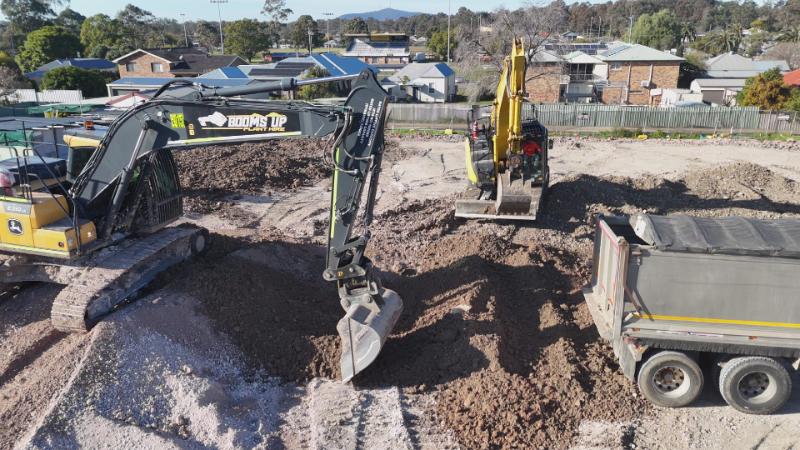
Use our FREE calculator to quickly estimate the volume of soil you need to excavate and the amount of spoil that needs to be removed from your site. Enter your excavation dimensions below to get an instant estimate in cubic metres (m³) and tonnes.
Soil Excavation Calculator
Estimate excavation volume, spoil weight & bulking
How to Use the Excavation Calculator
Getting an accurate estimate starts with knowing the shape and size of your excavation area. Select the shape that best matches your dig, whether it’s a rectangular trench, a circular pier hole, or a triangular section on an angled block. Then plug in your measurements in metres.
The calculator works out two key figures. First, the in-situ volume, which is how much soil is sitting in the ground undisturbed. Second, and this is the one that catches most people out, the bulked spoil volume. That’s the actual amount of material you’ll need to truck away once it’s been dug up and loosened.
If you’re unsure about exact measurements at this stage, even a rough estimate will give you a useful ballpark for budgeting purposes.
Why Bulking Factor Matters for Your Project
Here’s something that surprises a lot of property owners and even some builders. Once soil comes out of the ground, it doesn’t stay the same volume. It expands. The industry calls this “bulking” or “swell factor”, and it can add anywhere from 15% to 40% to the amount of material you need to deal with.
Let’s say you’re excavating for a new slab on a block in Gosford and you need to remove 50 cubic metres of clay. That 50m³ in the ground could easily become 65m³ once it’s sitting loose in the back of a truck. That’s a significant difference when you’re calculating haulage costs and tip fees.
The bulking factor varies depending on the soil type you’re working with.
Sand and gravel typically bulk by around 10 to 15%. These are loose, granular materials that don’t expand much when disturbed. You’ll find plenty of sandy soils along the Central Coast’s coastal suburbs from Terrigal through to Umina.
Topsoil and loam tend to swell by around 20 to 25%. This is common across much of the Hunter Valley and the western suburbs of Newcastle, particularly in areas with established gardens and vegetation.
Clay is where it gets significant, bulking by 25 to 40% depending on moisture content. Heavy clay soils are prevalent across Western Sydney, parts of the Central Coast’s inland areas like Ourimbah and Kulnura, and through much of the Maitland region.
Rock and shale can bulk by 40 to 60% or more once broken up. Anyone who’s excavated on Sydney’s North Shore or parts of the Central Coast’s sandstone shelf knows how quickly broken rock fills up a truck tray.
Understanding this factor before you start digging helps you plan accurately for the right number of truck loads and avoids those unwelcome budget surprises halfway through the project.
Soil Density: How It Affects Your Spoil Weight
Volume tells you how much space the soil takes up, but weight is what determines your haulage costs. Most tip facilities and haulage operators charge by the tonne, so knowing the approximate weight of your spoil is just as important as knowing the volume.
Different soil types have different densities, measured in tonnes per cubic metre (t/m³).
Topsoil is the lightest at around 1.1 to 1.4 t/m³. It’s less compacted and contains more organic material, making it lighter than subsoils.
Sand sits around 1.5 to 1.7 t/m³ depending on moisture. Wet sand from a coastal site in, say, Woy Woy or Swansea will weigh more than dry sand from an inland block.
Clay is heavier again at roughly 1.6 to 2.0 t/m³. Saturated clay from a site with poor drainage can be significantly heavier than dry clay, which directly impacts what your trucks can legally carry per load.
Gravel and crushed rock ranges from 1.8 to 2.2 t/m³, making it the heaviest common material you’ll encounter on most residential and commercial sites.
The calculator defaults to 1.5 t/m³ as a reasonable average, but you can adjust this based on what you know about your site conditions. If you’ve had a geotech report done, the soil density information will usually be included in the findings.
Common Excavation Scenarios in NSW
To give you a practical sense of how the numbers work, here are a few typical scenarios we see across our service areas.
Residential pool excavation on the Central Coast.
Imagine you’re installing a standard 8m x 4m pool with an average depth of 1.5m. That’s 48m³ of in-situ soil. If you’re digging through sandy clay (bulking factor around 25%), your loose spoil volume jumps to roughly 60m³. At around 1.5 t/m³, that’s approximately 72 tonnes of material to remove. You’d be looking at roughly five tandem tipper loads.
Site cut for a new build in Newcastle.
A typical house pad might require excavating an area of 15m x 12m to a depth of 600mm. That’s 108m³ in the ground. With a 20% bulking factor on the loamy soil common in suburbs like Lambton or Merewether, the loose volume hits around 130m³, requiring approximately 11 truck loads to clear.
Driveway excavation in the Hunter Valley.
A new driveway measuring 20m long x 3.5m wide excavated to 300mm gives you 21m³. Even with bulking, that’s a relatively straightforward two to three load job. But if you hit rock in the Hunter’s western reaches, the bulking factor and removal costs can escalate quickly.
These are estimates to help you plan. Every site is different, and factors like site access, soil contamination, and disposal facility requirements will all influence the final scope.
Planning Your Excavation: What to Consider Next
Once you’ve got a handle on the volumes and weights involved, there are a few practical steps worth thinking about before the machines arrive.
Check with your local council.
Depending on the scale of your excavation, you may need development approval or at the very least need to comply with conditions around sediment control, noise, and working hours. Council requirements vary across the Central Coast Council, City of Newcastle, Lake Macquarie City Council, and the various councils across Sydney and the Hunter.
Call Dial Before You Dig.
Before any excavation begins, it’s a legal requirement to identify underground services. This free service (call 1100 or visit their website) shows where water, gas, electrical, and telecommunications lines are buried on your property. Hitting an underground service isn’t just dangerous, it’s expensive and can shut your project down.
Think about where the spoil is going.
Disposal costs vary depending on the material type and the facility. Clean fill is cheaper to dispose of than contaminated soil, which must go to a licensed facility. If your site has any history of industrial use, a contamination assessment may be required before you can remove material.
Consider your site access. Narrow driveways, overhanging trees, or steep grades can all affect what size equipment can get in and out of your property. This in turn impacts the size of trucks that can be used for haulage and the overall cost and timeline of the job. Booms Up Civil Group specialises in tight access excavation. Contact us to learn more.
Need a More Accurate Quote?
This calculator gives you a solid starting point for planning and budgeting. But every excavation project has its own set of variables, from soil conditions and site access to council requirements and disposal logistics.
If you’d like a more accurate estimate tailored to your specific site, get in touch with the team at Booms Up Civil Group. We provide free, no-obligation quotes for excavation projects across the Central Coast, Sydney, Newcastle, and the Hunter Valley. With over 15 years of experience working across NSW, we’ll help you understand the full scope of your project before the first bucket hits the ground.
Call us on 0458 888 741 or request a free quote to discuss your project.