
Think of bulk earth works as the foundational sculpting of your construction project. Long before any slab is poured or frame is raised, the land itself must be perfectly shaped. It’s the essential first step that sets the stage for everything that follows, ensuring stability for decades to come.
What Are Bulk Earth Works Exactly?
At its core, bulk earth works is the process of moving massive quantities of soil, rock, and other materials from one part of a site to another. The goal is to create a perfectly level, stable, and correctly contoured base for construction.
Whether you're planning a new home in a Sydney suburb or a large commercial carpark in Newcastle, this initial stage is non-negotiable. The entire process really just boils down to two key actions: 'cut' and 'fill'.
- Cut is where we remove material from the high points on your land.
- Fill is where we add that material (or imported material) to the low points.
It’s a bit like preparing a canvas for a painting. Without a smooth, properly primed surface, the final masterpiece is guaranteed to have flaws. Getting this phase wrong can lead to a world of pain down the track, including drainage disasters, foundation movement, and incredibly costly structural damage. While the terms earthmoving and excavation are often thrown around interchangeably, it’s worth knowing that there are key differences. To get a clearer picture, it’s helpful to explore the distinctions between excavation and earthmoving.
The success of your entire build rests on the quality of the earth works. Getting it right the first time prevents future headaches, saves a fortune in rework, and ensures the long-term integrity of your structure.
In Australia's booming construction sector, bulk earth works form the absolute backbone of site preparation, especially here in New South Wales. This work is fundamental to major public projects, from sprawling new motorways to expanding urban developments.
According to Infrastructure Australia, the nation's Major Public Infrastructure Pipeline is sitting at a massive $213 billion over the five years from 2023–24 to 2027–28—a pipeline that relies almost entirely on effective, large-scale earthmoving. You can read the full Infrastructure Market Capacity Report for more detailed insights.
The Bulk Earth Works Process From Start To Finish
Every successful earth works project follows a clear, logical sequence. It’s a common misconception that it’s all about just shifting dirt around. In reality, it’s a highly calculated process designed to deliver a stable, compliant, and perfectly engineered foundation for whatever comes next.
It all kicks off with a thorough site assessment and survey. This is our chance to really get the lay of the land, figuring out its topography, soil composition, and any hidden challenges waiting for us. A detailed survey is absolutely critical, especially in a region as diverse as NSW. The sandy, free-draining soil you find near the Central Coast beaches behaves in a completely different way to the reactive clay common in the Hunter Valley, and that initial assessment dictates our entire approach.
Site Clearing and Grubbing
With a solid plan in place, the first physical step is site clearing and grubbing. This phase is all about removing every obstacle on the surface. We get in there and clear away trees, shrubs, large rocks, and any old debris or structures that might be in the way.
Next, we strip the topsoil and stockpile it somewhere safe on-site. You can't build on this organic-rich layer, but it's liquid gold for landscaping later on. Proper site clearing gives us a clean slate to work from and, crucially, stops any organic matter from decomposing under your future structure, which could cause major stability issues down the track. You can get a deeper look at this initial stage in our guide on the fundamentals of site preparation for excavation.
This simple diagram breaks down the flow of a cut and fill operation—the real heart of any bulk earth works project.
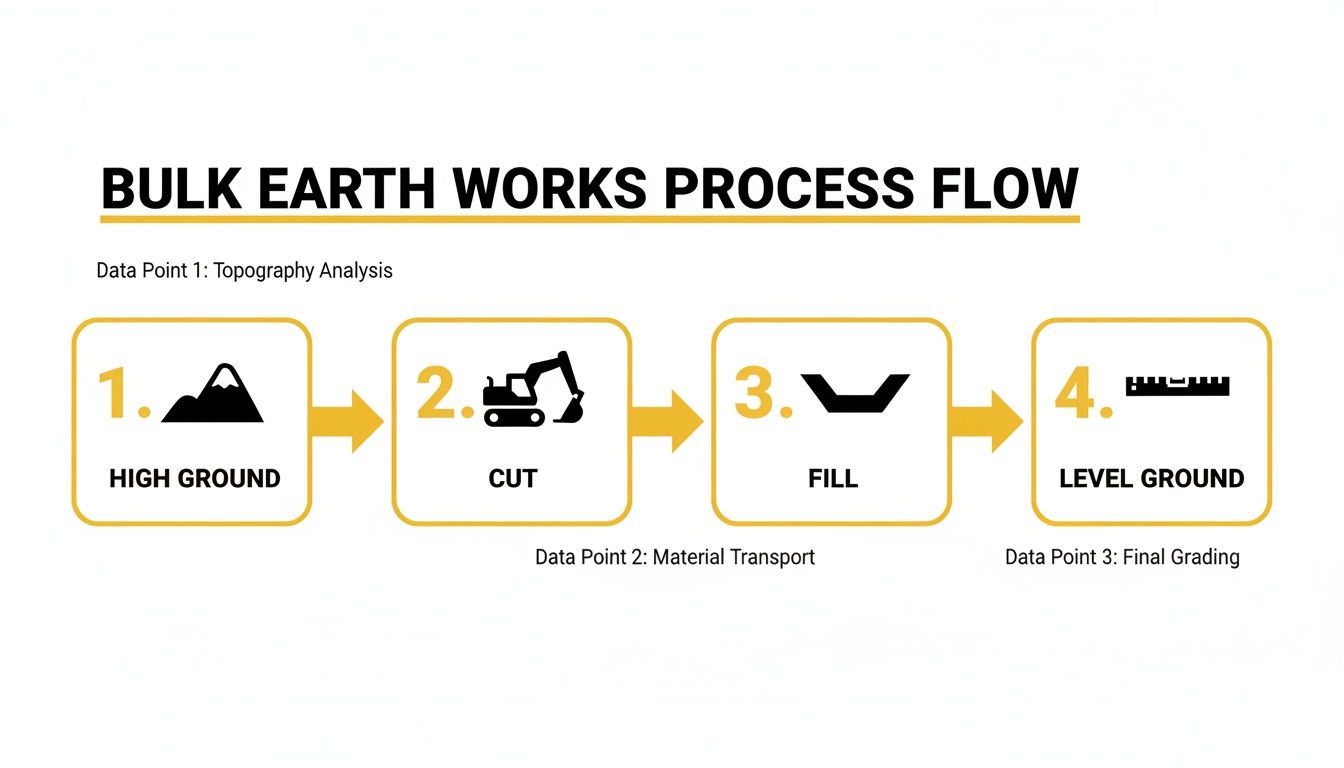
As you can see, the core idea is to strategically take soil from high points and use it to build up the low points, creating a perfectly engineered level.
The Cut and Fill Phase
Once the site is cleared, we move into the main event: the cut and fill phase. This is the essence of bulk earth works. Guided by the surveyor's plans and the engineer's specs, our skilled operators use heavy machinery like excavators and bulldozers to move earth with precision.
The 'cut' is exactly what it sounds like—digging out soil from areas that are too high. The 'fill' is where we place and compact that same soil in areas that are too low. Imagine you're building on a steep Terrigal block; we might cut into the hillside at the back of the property and use that material to build up the front, creating a level pad for the new home. The ultimate goal is to achieve a 'balanced site', using the land’s own material as much as possible to minimise the cost and hassle of hauling dirt away or bringing new fill in.
Compaction and Final Grading
The final steps are arguably the most critical for ensuring long-term stability: compaction and final grading. It’s not enough to just dump soil into place. It has to be compacted properly in layers, known as 'lifts', using specialised machines like rollers. This process squeezes out air pockets and dramatically increases the soil's density, creating a rock-solid base that won't sink or shift over time.
Once compaction is done, we carry out the final grade. This is the meticulous process of shaping the surface to the exact levels and slopes laid out in the plans. A proper final grade ensures water drains away correctly, preventing it from pooling around your future foundations. It’s a crucial finishing touch for any build, from a granny flat in a Gosford backyard to a massive commercial slab in Newcastle.
Essential Machinery for Effective Earthmoving
Having the right tool for the job is everything in bulk earth works. Using the wrong machine doesn’t just slow things down; it can compromise the quality of the final result and even create safety risks. Think of our fleet as a specialised toolkit where each piece of equipment has a specific, crucial role to play in sculpting your site to perfection.
When you partner with us, you get access to a modern, versatile fleet ready for any challenge. It’s not about just having the biggest machines, but the right machines. A project’s success often hinges on selecting the perfect equipment for the site’s unique conditions, whether it's navigating a tight residential block in Sydney or clearing a large commercial lot in the Hunter Valley.
The Workhorses Of The Site
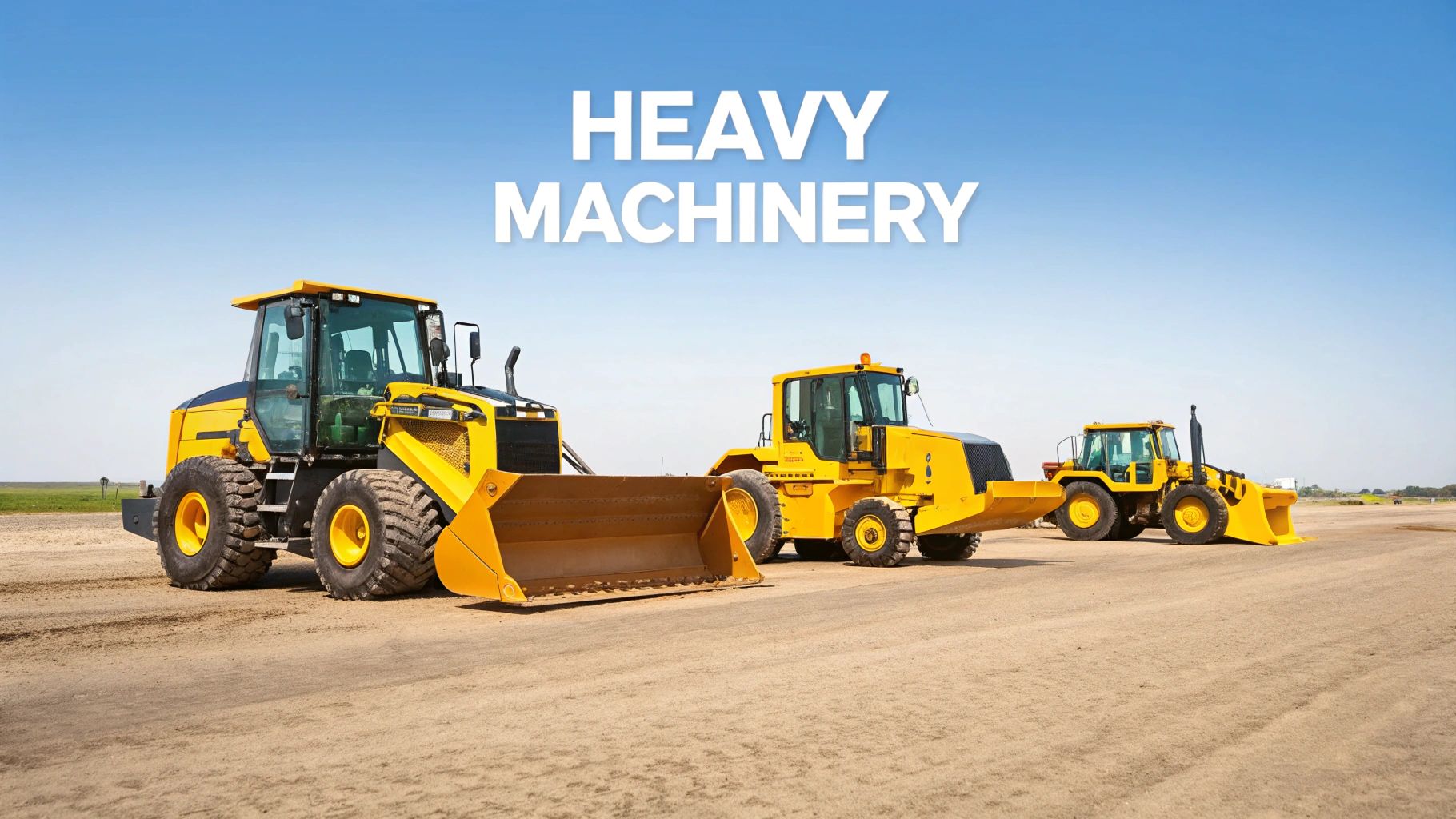
Every machine on-site has a distinct purpose. Understanding their roles helps you appreciate the skill and strategy that goes into an efficient earthmoving operation. Here are the key players you'll typically see on one of our projects.
-
Excavators are the versatile stars of the show. With their powerful hydraulic arms and buckets, they handle the precise digging required for foundations, trenches, and detailed shaping. Their ability to rotate 360 degrees allows them to dig and load material with incredible efficiency. By swapping out the bucket, their functionality expands even further, which you can read about in the complete guide to excavator attachments.
-
Bulldozers, or 'dozers', are the brute force of the fleet. These powerful tracked machines are unmatched for pushing enormous volumes of soil, rock, and other debris. We use them for large-scale land clearing, rough grading, and spreading fill material across a site, quickly establishing the basic contours of the project.
-
Loaders, including wheel loaders and compact track loaders (like a Posi-Track), are essential for material handling. After an excavator has dug a pile of soil, a loader scoops it up and efficiently transfers it into a truck for removal or relocates it to another part of the site for fill. A nimble Posi-Track is perfect for tight-access residential sites, like those often found in older Sydney suburbs.
A quick-reference guide is always handy to keep track of the common machinery used in bulk earth works and what each one is best suited for on a typical NSW construction site.
Key Earthmoving Equipment and Their Primary Roles
| Equipment Type | Primary Use | Ideal for Projects Like… |
|---|---|---|
| Excavator | Precision digging, trenching, detailed shaping, loading trucks | Foundation digging, utility trench installation, detailed batter shaping |
| Bulldozer | Pushing large volumes of soil, rock, land clearing, rough grading | Large-scale site clearing, creating haul roads, spreading bulk fill |
| Loader | Moving material around the site, loading trucks from stockpiles | Transferring soil to trucks, backfilling trenches, general site cleanup |
| Compactor/Roller | Densifying soil, creating stable ground for construction | Compacting sub-base for roads, foundations, and building pads |
Each piece of equipment is a specialist in its own right, and the success of the project depends on having the right machine in the right place at the right time.
The Finishing Specialists
While digging and moving get most of the attention, the job isn't finished until the ground is perfectly stable and prepared for construction. This is where the finishing specialists come in, ensuring the earth we’ve moved provides a solid foundation.
Compactors and rollers are the unsung heroes of bulk earth works. These machines apply immense weight and vibration to the soil, squeezing out air pockets and increasing its density. Proper compaction is absolutely critical to prevent the ground from sinking or shifting under the weight of a building.
Without this step, the entire structural integrity of the project would be at risk. This process is mandated by Australian Standards to ensure a safe, long-lasting build.
How Bulk Earth Works Costs Are Calculated
Figuring out the cost of bulk earth works isn’t as simple as getting a price per hour. While every project has its own unique character, the key factors that drive the final price tag are surprisingly consistent. Getting your head around these variables will help you make sense of any quote and see exactly where your money is going.
At its heart, the cost is a function of three things: volume, material, and logistics. The more earth we have to move, and the harder it is to dig up and haul away, the more labour and heavy machinery the job demands. It's why a quote for bulk earth works is always tailored specifically to your site.
The Core Cost Drivers on Any Project
First and foremost, the total volume of soil to be shifted is the biggest single factor. This is always measured in cubic metres (m³) and is calculated during the initial site survey and planning stages. The rule is simple: more volume means more time, more machine hours, and more truck movements. All of that adds up.
Next up is the type of material we’re dealing with. Digging through the sandy loam common on the Central Coast is a completely different ball game than excavating Sydney's notoriously stubborn sandstone bedrock. Hard rock or dense clay requires more powerful machinery, specialised attachments like rock breakers or hammers, and a whole lot more time—all of which gets reflected in the price.
Site accessibility also plays a massive role. A flat, open block in the Hunter Valley with wide street access is far simpler to work on than a steep, narrow site tucked away in a dense Sydney suburb. Tight access might mean we need smaller, more specialised machinery, which can sometimes increase the project's duration and complexity.
Spoil Removal and Material Import
So, what happens to all the earth once it's been dug up? The answer to that question will have a huge impact on your budget.
In a perfect world, we achieve what’s called a 'balanced site'—where the soil cut from one area is used as fill in another. This is easily the most cost-effective scenario, as it minimises transport and disposal costs.
Most projects, however, generate excess material, known as spoil, that needs to be transported off-site. The costs here aren't just about the digging; they also include:
- Trucking and haulage fees to move the spoil from your site to a disposal facility.
- Disposal or 'tipping' fees charged by the licensed facility that accepts the material.
- Testing and classification costs if there's any reason to suspect the soil might be contaminated.
On the flip side, if your site needs more fill than what's available from the cut, we’ll need to import clean fill. The cost of the material itself, plus the labour and transport to get it to your site, will be added to the project budget.
Compliance and Unexpected Costs
Finally, there are the essential costs of compliance and safety. These aren't optional extras; they are non-negotiable requirements to make sure the project is run safely, legally, and with minimal impact on the surrounding environment. This bucket includes things like implementing sediment control measures to protect local waterways, creating traffic management plans if we’re working near a road, and paying any council-specific inspection fees.
It's also worth keeping an eye on the broader economic climate. Recent years have seen significant price hikes right across the construction industry in NSW. According to Infrastructure Australia, heavy civil-engineering construction costs have jumped a staggering 51–53% since 2010–11, with a big chunk of that increase happening recently.
These market-wide shifts in material and labour costs inevitably find their way into project budgets. For a deeper dive into these trends, you can read the full 2024 Infrastructure Market Capacity Report.
Navigating Council Rules and Site Safety
Getting the ground shaped is just one part of the puzzle. The real foundation of a successful bulk earth works project is ensuring every single step is safe, compliant, and ticked off by the right authorities. In our world, safety and compliance aren't just buzzwords on a checklist; they're the absolute bedrock of everything we do. Without a rock-solid commitment here, a project is dead in the water before it even starts.
This means we’re not just following the regulations set by SafeWork NSW—we’re living by them. It also means working hand-in-glove with local councils, whether it's Central Coast Council, Newcastle Council, or any council in the greater Sydney region. Every local government area (LGA) has its own unique quirks, and knowing them inside and out is a massive part of our job. It's this local insight that keeps your project humming along, free from frustrating delays or nasty fines.
The Non-Negotiables Of Site Safety
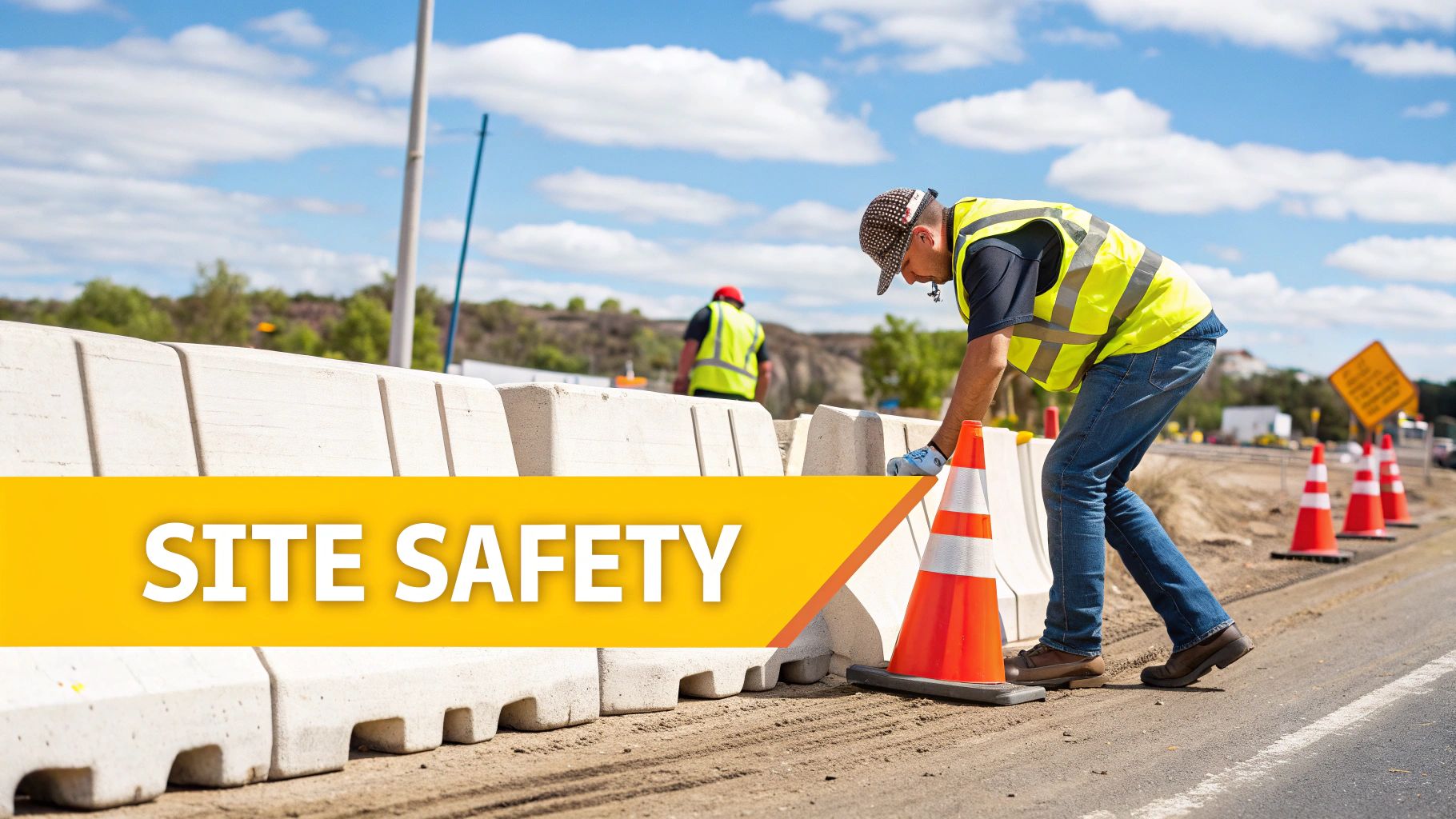
Let's be clear: a safe site is an efficient site. Before a single engine roars to life, we lock down a range of essential safety measures to protect our crew, your property, and the public. These aren't just gentle suggestions—they are mandatory procedures that form the backbone of our daily operations on the ground.
Our key safety protocols always include:
- Clear Exclusion Zones: We physically fence off areas where heavy machinery is operating. This isn’t just a line of cones; it’s a hard barrier ensuring no one can accidentally wander into harm’s way.
- Robust Traffic Management: For any project near roads or public spaces, a professional traffic management plan is non-negotiable. It’s about safely guiding vehicles and people around the work zone, not just slowing them down.
- Personal Protective Equipment (PPE): Our entire team is kitted out with the right gear and is required to use it—no exceptions. We're talking hard hats, high-visibility clothing, and steel-capped boots as a bare minimum.
These measures are fundamental. They are how we manage risk on any construction site, whether it's a small residential cut or a massive commercial development.
Meeting Council and Environmental Duties
Beyond the immediate physical safety of the site, we have a firm responsibility to the world around us. This means protecting the local environment and strictly adhering to every council requirement. The Development Application (DA) you get from the council isn't just a permission slip; it's a detailed rulebook spelling out the specific conditions we must follow for earthworks, drainage, and even retaining wall construction.
A critical first step for any excavation is lodging a Dial Before You Dig enquiry. This free national service provides detailed plans for all the underground utilities, helping us avoid catastrophic—and incredibly dangerous—damage to assets like gas pipes, water mains, and communication cables.
We also put robust erosion and sediment control plans into action. Imagine you're developing a block in a new estate near Warnervale. Without proper silt fences and sediment basins, the first big downpour could wash tonnes of loose soil into local storm drains, polluting waterways and flooding your new neighbours. These controls aren't just good practice; they're a legal requirement and a core part of being a responsible contractor. On top of that, understanding the specific safety needs for deep excavations is vital, and our guide on trenching and shoring best practices dives deeper into these critical procedures.
By choosing a contractor who puts safety and compliance at the top of the list, you're not just hiring a team to move dirt. You're gaining peace of mind, confident that your bulk earth works project is being done correctly, responsibly, and legally—protecting both your investment and the wider community.
How to Choose the Right Earth Works Contractor
Picking the right contractor for your bulk earth works is hands down one of the most critical decisions you'll make for the entire project. This isn't just about moving dirt; it's about laying the literal foundation for everything to come. Getting it right the first time isn't just important—it's non-negotiable.
You’re not just hiring someone with a machine. You're bringing on a partner, a team with the experience, integrity, and local know-how to see the job through properly.
A great contractor should be an open book from day one. Don't be shy about asking the tough questions. You'll want to verify their licences, check their public liability insurance, and ask about their safety record with SafeWork NSW. A professional outfit will have all this information ready and will be proud to share it.
Look for Proven Local Experience
Experience on jobs similar to yours is a massive green light. A contractor who has spent years tackling the unique challenges of our region—from the sandy soils on the Central Coast to the reactive clay in parts of the Hunter Valley—brings priceless insight to your project.
This kind of deep local knowledge, like our 15+ years working across the Central Coast, means we understand the nuances of different councils and can spot potential issues long before they turn into expensive problems.
It's also worth noting that a contractor's success in navigating the complex world of tenders often points to solid operational and project management skills. For more on this, check out this handy guide to winning building construction tenders in Australia.
Demand a Transparent and Detailed Quote
A vague, one-line quote is a huge red flag. You need a detailed, itemised quote that breaks down every anticipated cost: machine hire, labour, spoil removal, any imported materials, and compliance measures.
This level of detail protects you from nasty surprises down the track. More importantly, it shows the contractor has actually taken the time to properly assess your project's specific needs. Clear communication is everything; you need a partner who keeps you in the loop every step of the way.
Ultimately, choosing the right contractor boils down to two things: trust and proven capability. Do your homework, ask the right questions, and find a reliable partner you can count on. To make it easier, we've put together a detailed guide on what to look for when you're searching for earthmoving contractors near you.
Your Questions Answered: Bulk Earth Works FAQs
We get a lot of questions from homeowners and developers about bulk earth works. It's a big step in any project, so it's natural to want clear answers. Here are some of the most common queries we handle, designed to help you plan your next project with confidence.
How Long Does Bulk Earth Works Usually Take?
This really is the "how long is a piece of string?" question. The timeline is shaped by the project's size, the complexity of the site, and of course, the weather. A straightforward residential site cut for a new home in Wyong might only take a few days.
On the other hand, a large-scale commercial development in Newcastle could easily stretch over several weeks or even months. Unforeseen issues, like hitting a stubborn patch of rock or dealing with tricky site access, can also add time. We always build a realistic timeline into our proposals so you know exactly what to expect from day one.
Do I Need Council Approval for Earth Works?
In almost every case, the answer is yes. The vast majority of significant earth works projects require a Development Application (DA) to be lodged and approved by your local council, whether you're under Central Coast Council or dealing with a council in Sydney.
While some very minor jobs might fall under 'exempt development', it's always best to check first. Assuming you don't need approval is a risky and potentially expensive mistake. Helping clients navigate these local regulations is a core part of our service, and we can guide you through the compliance maze for your specific project.
What Happens to the Removed Soil?
Where the soil goes depends entirely on its quality and the overall site plan. The ideal scenario, and our first goal, is to achieve a 'balanced site'. This is where we strategically reuse soil cut from one part of the project as fill in another. It’s by far the most efficient and environmentally sound approach.
Any soil left over is known as 'spoil' and is trucked off-site to a licensed facility. If we uncover any contaminated material, it has to be managed and disposed of following strict EPA guidelines—there are no shortcuts. When choosing a contractor, it's worth looking into their business stability; understanding things like how site prep contractors get more leads can be a good indicator of their professionalism and long-term reliability in the industry.
Ready to get your project on solid ground? The team at Booms Up Civil Group has over 15 years of experience handling bulk earth works across the Central Coast, Sydney, and Newcastle. Call us today for a free, no-obligation assessment and quote. https://boomsupcivil.com.au