Before you can turn one block of land into two or more, you need a detailed roadmap. In NSW, this roadmap is the subdivision plan, an official document that legally redefines property boundaries to create new, separate land titles. It’s the foundational blueprint for a successful and compliant subdivision project.
Your Guide to Subdivision Plans in NSW
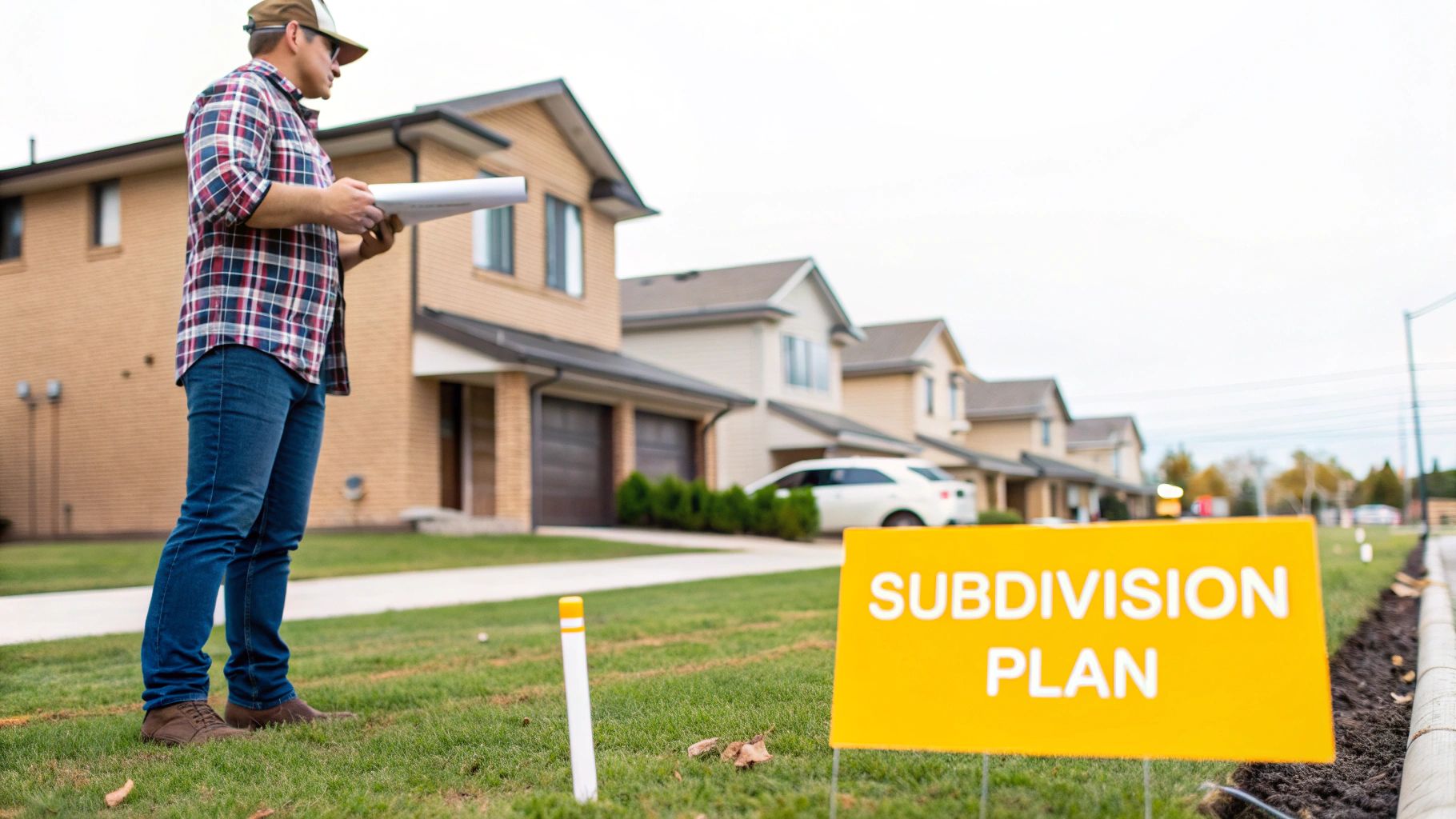
Think of a subdivision plan as an architectural drawing, but for your land. It's much more than just a few lines on a map showing where the new fence will go. A properly prepared plan is a comprehensive legal document, laying out every critical detail your local council and NSW Land Registry Services (LRS) need to see.
This document does a lot of heavy lifting. It clearly establishes access points, creates easements for essential services like water, power, and NBN, and designates any public spaces like new roads or footpaths. To get it over the line, the plan must be meticulously prepared by a registered surveyor.
Why Getting the Plan Right Matters
Getting this plan right from the very beginning is non-negotiable. An inaccurate or incomplete plan is a fast track to significant delays, budget blowouts, and even a flat-out rejection of your Development Application (DA). This can stop your project dead in its tracks before a single sod is turned.
Imagine you're planning a two-lot subdivision on a block in Kariong on the Central Coast. A well-drafted plan will not only show the new boundary line but will also detail the new stormwater drainage easement required to service the rear block. This ensures both new properties are fully compliant with Central Coast Council regulations. Miss that detail, and your application is going nowhere.
Key Takeaway: Your subdivision plan is the single most important document in your project. It’s the legal and practical foundation upon which everything else—from council approvals to civil works and finally, the creation of new land titles—is built.
Whether you're a homeowner looking to split your backyard or a developer planning a new estate near Newcastle, this document is your absolute starting point. It dictates the entire scope of the required civil works, from the initial land clearing right through to the final connection of services.
At Booms Up Civil, with over 15 years of hands-on experience across the Central Coast and Hunter regions, we’ve seen firsthand how a solid plan translates into a smooth project on the ground. It allows our team to accurately quote and execute the necessary earthworks, making sure the physical site perfectly matches the surveyor's vision and meets all regulatory standards. Getting it right on paper means we can get it right on site, the first time.
Understanding the Types of Subdivision in NSW
Not all subdivisions are created equal, and the right approach depends entirely on what you want to achieve with your property. When you start looking at subdivision plans in NSW, you’ll quickly find there are three main ways to divide land. Getting your head around these is the first, most crucial step in figuring out the best path forward.
Each type creates a completely different form of legal ownership and responsibility. The choice you make will affect everything from who owns the driveway to who pays for the upkeep of shared gardens. That’s why it’s so important to understand the differences before you even think about hiring a surveyor.
Torrens Title Subdivision
This is the most straightforward and common type of subdivision, especially for creating traditional, standalone blocks of land. Think of a typical new housing estate in the Hunter Valley where each home sits on its own distinct parcel.
With a Torrens Title, you have complete and independent ownership of the land and any buildings on it. No shared driveways, no common gardens, no legally binding ties to your neighbours’ property. This is the goal for most simple two-lot subdivisions, like splitting a large residential block in a suburb like Umina Beach on the Central Coast.
A Torrens Title subdivision gives you full autonomy. You are the sole owner of your defined block of land, responsible for everything within your boundaries, from the front lawn to the back fence.
Strata Title Subdivision
If your project involves units, apartments, or townhouses, you'll be dealing with a Strata Title. This model is designed specifically for properties where multiple dwellings share a single parcel of land and common infrastructure.
Under a Strata Title, you own the individual "lot"—which is usually the internal space of your unit or townhouse. Crucially, you also share ownership and financial responsibility for all the common property. This includes things like driveways, foyers, lifts, pools, gardens, and even the building's external walls and roof. All owners contribute to the upkeep of these areas through regular strata levies, which are managed by an owners corporation.
Community Title Subdivision
A Community Title scheme is often used for larger, master-planned estates that have significant shared facilities. It’s a bit like a larger-scale strata plan but offers a lot more flexibility, making it popular in modern developments across Sydney's growth corridors.
In this setup, a development is divided into separate Torrens Title lots for each house, but it also includes a shared "Community Property" lot. This shared property could be anything from private roads and a community clubhouse to tennis courts or parklands. Every property owner in the scheme is a member of the community association and chips in financially to maintain these shared facilities, ensuring they're well-kept for everyone to enjoy.
Comparing NSW Subdivision Types
Choosing the right title structure is fundamental to your project's success. Your surveyor and town planner can guide you, but understanding the basics helps you ask the right questions. Torrens Title is ideal for standalone properties, Strata is for shared buildings like unit blocks, and Community Title suits large estates with shared amenities.
Ultimately, the best choice depends on the nature of your development. A simple block split will almost certainly be a Torrens Title, while a block of units requires a Strata plan. For large estates with shared amenities, a Community Title offers the structure and flexibility you need. Understanding these distinctions is the first step in preparing your subdivision plans.
Navigating The Council Approval Process
Getting your subdivision from a sketch on paper to officially registered land titles is a journey. It’s a process that loops in surveyors, engineers, and, crucially, your local council. It can feel like a maze at first, but once you understand the roadmap, you can keep your project moving and sidestep those frustrating delays.
The whole thing kicks off when you or your planner lodges a Development Application (DA) with the local council, whether that's Central Coast Council, Newcastle Council, or another authority here in NSW. Think of the DA as your formal request to subdivide. It has to be backed up by a draft plan of subdivision drawn up by a registered surveyor.
The Key Stages Of Subdivision Approval
Once the DA is in, it enters the council's assessment phase. This is where they pore over your proposal, checking it against local planning controls, zoning rules, and environmental policies. If your plan needs new roads or drainage, a civil engineer will have to create detailed designs for that infrastructure, which also become part of your application.
After the council gives you the green light with a DA consent—often with a list of specific conditions you need to meet—the real work on the ground can finally start. This is the point where a team like us at Booms Up Civil steps in to handle the essential physical works, turning those approved plans into a reality. This stage is absolutely critical; every bit of work has to match the engineering designs perfectly to get the next round of approvals.
With all the required civil works successfully wrapped up, you’ll need to apply for a couple of key certificates. The first is a Subdivision Works Certificate (SWC), which confirms the construction was done exactly as the approved plans dictated. The final piece of the puzzle from the council is the Subdivision Certificate, their official stamp of approval saying all conditions of the DA have been ticked off.
The last leg of the journey is taking your signed subdivision plan and that all-important Subdivision Certificate to NSW Land Registry Services (LRS) for registration. Once it's registered, the new land titles are officially created. Your subdivision is legally complete.
This diagram breaks down the main types of subdivision, which will influence the specifics of your council application.
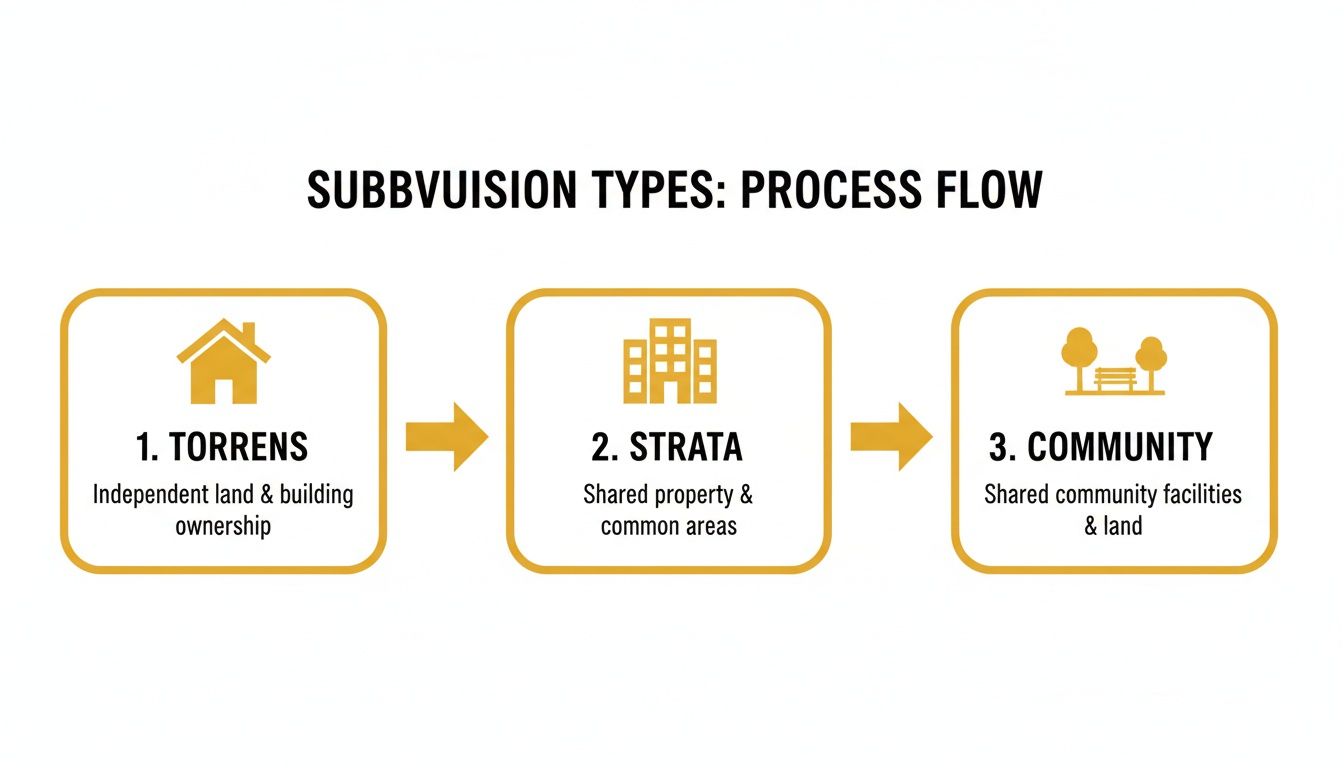
As you can see, it clearly separates Torrens Title for standalone lots, Strata for shared properties like units, and Community Title for estates with shared facilities. Knowing which one applies to your project helps you get on the right approval pathway from the start.
Step-By-Step Breakdown Of The Process
To make it even clearer, here’s the typical journey from application to registration. This structured process ensures every part of the development is compliant, safe, and built to last.
- Development Application (DA) Lodgement: This is your formal submission to the council. It includes the draft subdivision plan and all the supporting documents that spell out what you’re planning to do.
- DA Consent Issued: The council approves your application, but it usually comes with a list of "conditions of consent." These are things you must do, like building a new vehicle access crossing or connecting to the sewer main.
- Construction Certificate (CC) or Subdivision Works Certificate (SWC): Before a single shovel hits the dirt, you need approval for the construction plans. This certificate confirms that your detailed engineering designs meet Australian Standards and the council’s own requirements.
- Civil Works Construction: This is the hands-on phase. It’s when Booms Up Civil gets to work on site, handling everything from excavation and drainage installation to road construction and utility trenching, all precisely as specified in the approved plans.
- Obtain Final Subdivision Certificate: Once all the civil works are done and every DA condition is met, you apply for the final sign-off from the council. A certifier will inspect the site to make sure everything has been built according to the design.
- Lodge Plan at NSW LRS: The final step. You lodge the signed-off plan with the NSW Land Registry Services. This is the action that legally creates the new lots and issues their individual titles.
After you've navigated the subdivision approvals and finished any building work, understanding what is a Certificate of Occupancy often becomes the final hurdle. This is especially true if you’ve also constructed new homes as part of your subdivision, as it's the document that makes them legal to live in.
The Essential Civil Works for Subdivision
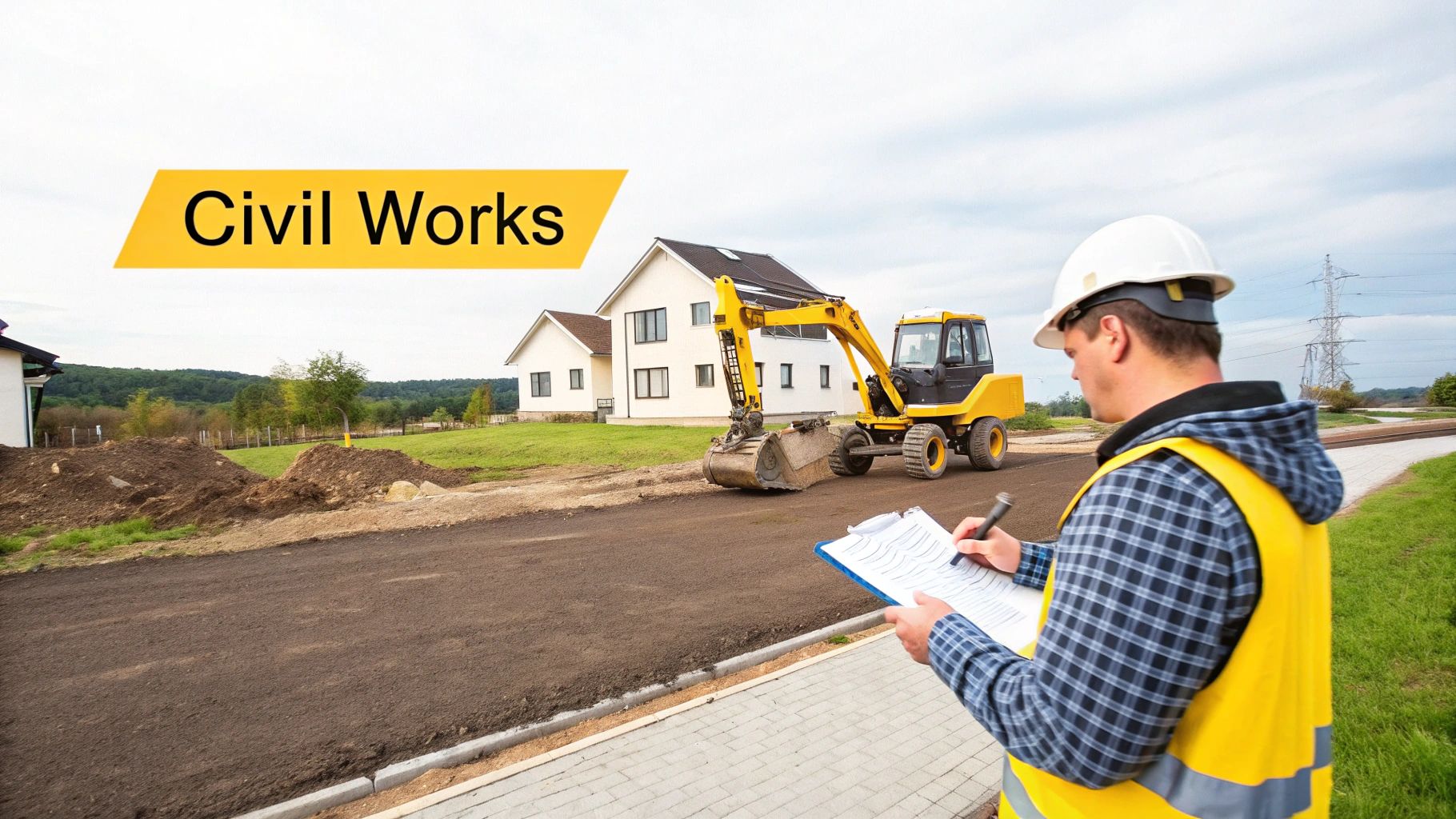
A subdivision plan is just lines on paper until the physical work transforms the land. This is the stage where your project truly comes to life, and where getting it right the first time is absolutely critical to avoiding costly delays and council rejections. The essential civil works are what turn a surveyor's vision into a compliant, functional, and valuable set of new lots.
This phase bridges the gap between council approval and the final registration of new land titles. It involves a sequence of carefully planned construction activities designed to prepare the site according to strict engineering and council standards. Without precise and compliant civil works, your Subdivision Certificate—the final piece of the puzzle—remains out of reach.
Initial Site Clearing and Grubbing
Before any earth can be moved, the site must be prepared. This first step is site clearing and grubbing, which involves the complete removal of trees, vegetation, stumps, rocks, and any old structures or debris. The goal is to create a clean slate, providing a safe and clear area for machinery to operate and for the new layout to take shape.
This process is more than just a quick clean-up. On the Central Coast, for example, this work must comply with Central Coast Council’s tree preservation orders and environmental protections. Professional contractors ensure all clearing is done in line with DA conditions, protecting significant vegetation where required and responsibly disposing of all green waste.
Shaping the Land With Bulk Earthworks
Once the site is cleared, the next major task is bulk earthworks. This is where we physically reshape the land to match the levels specified in the engineering designs. Using excavators, dozers, and graders, our operators cut and fill the site to create the approved landforms. You can explore the complexities of this phase in our guide to understanding bulk earth works.
Consider a sloping block in Terrigal or near Newcastle's hilly suburbs. Professional excavation is vital to create stable, usable building platforms for future homes. This might involve significant cutting into a hillside and constructing engineered retaining walls to ensure long-term stability and proper drainage, all while adhering to SafeWork NSW guidelines for working on gradients.
The growing demand for housing puts this stage under the spotlight. This signals a trend toward densification, increasing the need for expert civil contractors who can precisely prepare sites for new homes.
Installing Essential Underground Services
With the land shaped, the focus shifts to what lies beneath. Detailed excavation is required for installing essential services like sewer, water, and stormwater drainage. This involves digging precise trenches to the correct depth and gradient, laying pipes, and ensuring all connections meet the standards of local authorities like Hunter Water or Sydney Water.
This work is meticulous. Stormwater systems, for example, must be designed to manage runoff effectively, preventing erosion and flooding on the new lots and neighbouring properties. Every connection is inspected and tested before backfilling to guarantee it’s watertight and built to last.
Final Touches Roads and Access
The final stage of civil works involves constructing the infrastructure that makes the new lots accessible. This includes building road bases, pouring concrete for kerb and guttering, and constructing any new driveways or vehicle crossovers. The surface is then finished with asphalt or concrete, depending on the plan's specifications.
Getting It Right: The final grading of the site is crucial. It ensures that every lot drains correctly and that the finished levels perfectly match the approved subdivision plans, setting you up for a smooth final sign-off from the council certifier.
As part of these essential works, site management and safety are paramount. This often involves considering appropriate fencing for construction sites to secure the area and protect the public. At Booms Up Civil, our expertise ensures every physical element—from road bases to final grading—is completed to the highest standard, paving the way for your project's success.
Estimating Your Project Costs and Timelines
When it comes to subdivision, two questions always come first: "How much is this going to cost?" and, "How long will it take?" While no two projects are ever identical, getting a handle on the typical expenses and timeframes is absolutely essential for building a realistic budget and schedule. Getting this part right from day one is the best way to avoid nasty, expensive surprises down the track.
Forecasting these elements isn't just about tallying up the obvious construction work. It's a much bigger picture that involves professional fees, council charges, and service connection costs—all of which add up fast. Likewise, your timeline is often at the mercy of factors completely outside your control, with council processing times being the biggest wildcard of all.
Breaking Down the Key Project Costs
Pulling together a budget for your subdivision means getting granular. Missing even one key item can throw your project's financial viability into question. These costs generally fall into a few main buckets, covering everything from the initial paperwork to the final on-the-ground works.
Here’s a look at what you should be budgeting for:
- Professional Fees: This covers the experts you'll need on your team. Think payments to your registered surveyor for drawing up the subdivision plan, a town planner to handle the DA, and a civil engineer to design essential infrastructure like drainage and accessways.
- Council and Authority Fees: Get ready for a range of charges here. You'll have DA lodgement fees with your local council, inspection fees, and infrastructure contributions (often called Section 7.11 contributions). On top of that, there are fees payable to utility providers for hooking up the new services.
- Civil Works and Construction: This is almost always the biggest slice of the budget pie. It covers all the physical site work: land clearing, bulk earthworks, detailed excavation for services, retaining wall construction, drainage installation, and building new roads or driveways. You can get a better feel for how these jobs are priced in our guide on the cost of excavation per cubic metre.
- Contingency Fund: This is non-negotiable. It’s smart practice to set aside 10-15% of your total project cost for the unexpected. That buffer could be for anything from hitting unforeseen rock during excavation on a Sydney site to dealing with terrible soil conditions on the Central Coast.
What Influences Your Project Timeline
A subdivision timeline is a chain of dependent steps; a delay in one stage creates a domino effect that can stall the entire project. While a straightforward two-lot subdivision might be done and dusted in 6-12 months, more complex projects can easily stretch to 18 months or even longer.
The land market's volatility also plays a huge role in how developers time their work. The market can fluctuate quickly, putting pressure on developers and civil contractors to prepare sites efficiently to catch market upswings. You can read a report on land market trends from UDIA NSW.
A Realistic View: The single biggest factor that will dictate your timeline is almost always the council's DA assessment period. This can vary wildly, from a few months to well over a year, depending on how complex your application is and how swamped the council is.
Other major factors that shape your timeline include the time needed for detailed engineering design, the duration of the on-site civil works (which can be held up by weather), and the final administrative hurdles of getting your new plan registered with NSW Land Registry Services. Being mentally and financially prepared for these waiting periods is a massive part of successful project management.
How a Civil Contractor Brings Your Plan to Life

A successful subdivision hinges on a whole team of specialists, but when the time comes to turn paper plans into reality, the civil contractor is the linchpin. This is the crucial stage where approved subdivision plans stop being drawings and start becoming solid ground under your feet. At Booms Up Civil, we work hand-in-glove with surveyors, developers, and homeowners to manage this entire on-the-ground process.
Our role often kicks off with early site assessments, getting our boots on the ground to spot potential roadblocks before they cause delays. We’re sizing up the topography, checking the soil type, and looking at existing vegetation to map out the most efficient and compliant path forward. It’s this proactive thinking that helps us get it right the first time, saving you a world of stress and money down the line.
From Site Prep to Final Certification
Once the preliminary work is done, we get into the real heavy lifting of the construction phase. It all starts with methodical land clearing, removing any obstacles to create a clean slate for the new layout. From there, we move onto the bulk earthmoving, shaping the land to create compliant landforms that match the engineering designs down to the millimetre.
Next, we handle the precision excavation needed for laying essential services like sewer, stormwater, and water mains. Imagine a project on Sydney's North Shore where hitting unexpected sandstone bedrock is almost a guarantee; our experience means we have the right gear and techniques to handle it without blowing your budget. On the other hand, the sandy coastal soils of the Central Coast demand a completely different approach to ensure trench stability and proper compaction.
The Booms Up Civil Difference: Our deep local knowledge across the Central Coast, Sydney, and the Hunter Valley is your secret weapon. We’ve seen it all—from tricky clays to solid rock—and we understand the specific council requirements in each area, ensuring your site works aren’t just done, but done right for a smooth certification process.
Constructing access roads, driveways, and creating stable building pads are the final major steps in preparing the site. We work meticulously to make sure every level and gradient is perfect, because even tiny errors here can cause major headaches with council inspectors. Throughout every single stage, our team operates under strict SafeWork NSW guidelines, because the safety of our crew and your site is always our top priority.
We know you need a partner who sees the big picture. By coordinating all these crucial physical works, we make sure your project stays on schedule and is fully prepped for that final, all-important sign-off. For a deeper dive into this process, you can find more detail in our guide to choosing the right subdivision contractors. Our one and only goal is to make sure the finished site is a perfect real-world reflection of your approved plans.
Common Questions About Subdivision in NSW
Starting a subdivision project brings up a lot of questions. We get them every day from clients across the Central Coast, Sydney, and the Hunter region. To help cut through the confusion, we’ve put together some straight answers to the most common queries we hear.
Getting clear on the fundamentals is the first step toward creating solid subdivision plans and moving your project forward with confidence.
Do I Always Need Council Approval to Subdivide Land?
Yes, absolutely. In NSW, subdividing land almost always requires lodging a Development Application (DA) with your local council. This is a non-negotiable step.
The DA process is there to ensure your subdivision lines up with local planning rules, meets minimum lot sizes, fits the zoning requirements, and has proper servicing and access. Trying to sidestep this formal approval is a surefire way to run into serious legal and financial pain down the track. Your local council, whether it's Central Coast Council or Newcastle Council, has the final say in making sure all land division is done by the book.
How Long Does a Subdivision Take From Start to Finish?
The timeline for a subdivision can vary wildly depending on how complex the project is. A simple two-lot subdivision on a clear, level block might take anywhere from 6 to 12 months from the day you lodge the DA to the moment the new titles are registered with NSW Land Registry Services.
On the other hand, a more complicated, multi-lot development could easily stretch to 18 months or more. The biggest time sinks are almost always the council assessment period, the complexity of the engineering design, and any nasty surprises you find on site—like hitting rock or discovering poor soil—during the civil works phase.
Key Insight: Patience is a virtue in subdivision. The actual physical work might only take a few weeks or months, but it's the paperwork and approval stages that often chew up the bulk of the time.
Can I Do the Earthworks Myself to Save Money?
It’s tempting to think you can cut costs by hiring an excavator and tackling the site prep yourself, but managing the civil works for a subdivision is a highly specialised field. It demands licensed operators, heavy-duty machinery, and a deep understanding of both council standards and SafeWork NSW regulations.
For crucial jobs like excavation, installing drainage, and the final site grading, bringing in a professional civil contractor is non-negotiable. It’s the only way to guarantee the work is safe, fully compliant, and done right the first time—all of which are vital for getting that final certification from your council. Getting it wrong can lead to expensive rework and painful delays.
At Booms Up Civil Group, we're here to answer all your questions and help you navigate the entire subdivision process. If you’re ready to discuss your project, contact our team for a no-obligation consultation.