Before a single slab of concrete is poured or a single wall frame goes up, the entire success of your project rests on what happens first. Professional site preparation services are where the real work begins, turning a raw block of land into a solid, stable, and compliant platform ready for construction. This is the crucial groundwork that guarantees your project’s long-term safety and stability.
What Exactly Are Site Preparation Services?
Think of it like preparing a canvas before you start painting. If you don't sand and prime it properly, the final masterpiece is doomed to fail. It’s the same with construction; professional site preparation ensures the integrity of everything that comes after, whether it’s a simple driveway in Newcastle or a multi-storey commercial build in Sydney.
This essential first phase is so much more than just pushing dirt around.
At its heart, site preparation covers every activity needed to make a piece of land suitable and safe to build on. It's a methodical process that deals with everything from the type of soil under your feet to the slope of the land and any obstacles that need to be cleared away. It's arguably the most important investment you'll make in the entire lifecycle of your project.
The Scope of Site Preparation
Effective site preparation is a comprehensive job, covering several key services that have to be done in the right order to get the right result. These always include:
- Initial Assessment and Planning: Long before any machinery rolls onto the site, a thorough evaluation is a must. This means digging into soil reports, checking for underground services, and getting a real feel for the site's unique challenges. The sandy coastal soils on the Central Coast behave very differently from the hard sandstone you find all over Sydney, and your plan has to account for that.
- Land Clearing: This is usually the first physical step you'll see. It involves removing trees, stubborn shrubs, rocks, and any old structures or debris cluttering the site. Getting this right takes more than a bulldozer; it demands a strategic approach, which you can learn more about in our detailed guide to property clearing services.
- Grading and Levelling: This step is all about shaping the land to create a perfectly level building pad and, just as importantly, to ensure proper drainage. Good grading is absolutely vital to channel rainwater away from your future foundation, preventing the kind of costly water damage that can become a nightmare down the line.
The site preparation industry is massive, and that tells you just how critical it is to the construction sector. In fact, Australia's site preparation services market was valued at a huge $46.0 billion in 2024, which shows just how strong the demand from new construction projects really is.
While the market saw a bit of a contraction in 2025, the fundamental need for expert groundwork never changes. You can dive deeper into the market insights on IBISWorld. Getting this stage right with a team that truly understands the local ground conditions isn’t just a good idea—it’s non-negotiable.
The A to Z of a Site Preparation Project
So, how do you get from a rough, untouched block of land to a perfectly prepared, build-ready site? It’s a multi-stage journey, and every single step is a critical piece of the puzzle. Getting it right ensures a smooth workflow and a rock-solid foundation for whatever comes next.
Let's walk through the typical process, breaking down not just what we do, but why each phase is so crucial for your project’s long-term success.
This visual simplifies the flow from a raw site to a construction-ready platform.
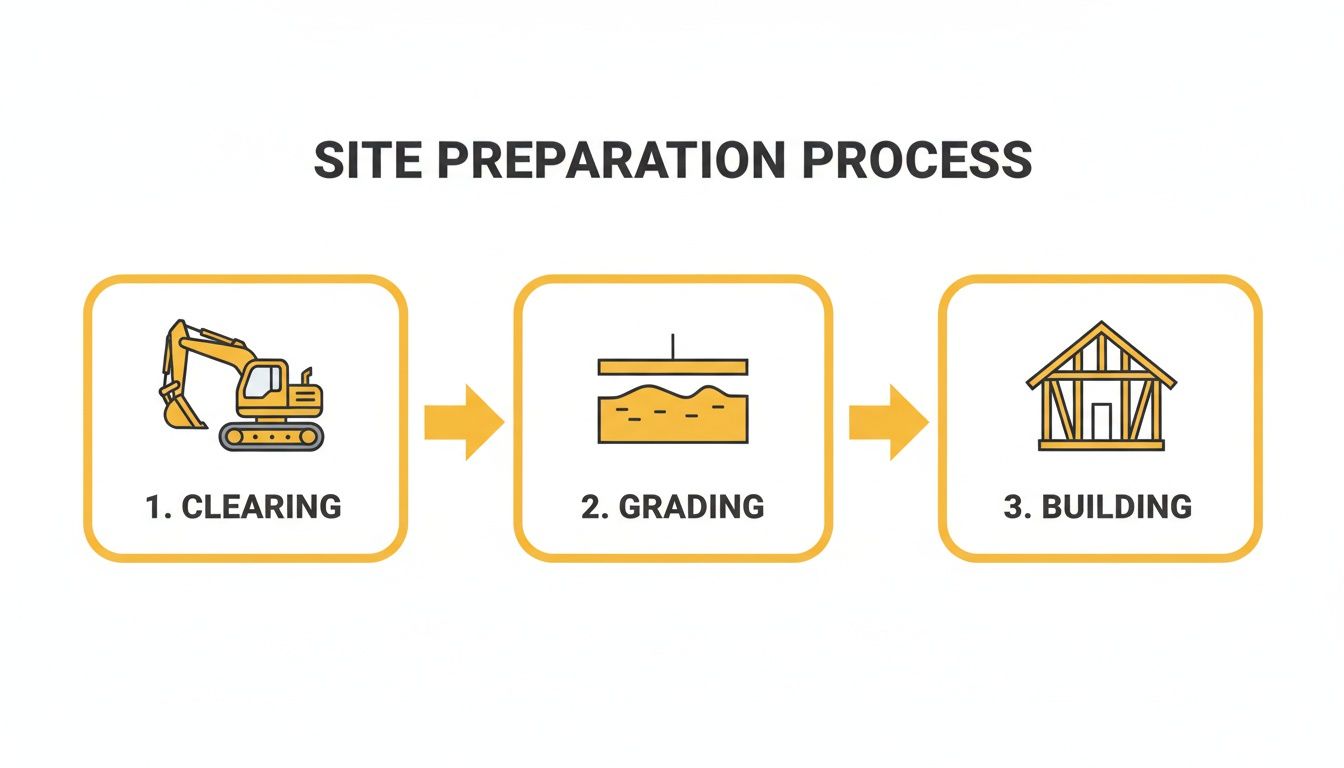
As you can see, it's a logical progression: clear the land, shape it correctly, and then hand over a solid base for the builders to begin their work.
Step 1: Initial Survey and Council Approvals
Before a single machine rumbles onto your property, the first job is always a thorough site survey and assessment. We need to know exactly what we’re working with—the slope of the land (the "fall"), the soil type, and the location of any underground services like water, gas, and power lines. This involves a lot more than just a quick look; we're diving into Dial Before You Dig plans and geotechnical reports to build a complete picture.
This initial planning phase is also where the conversation with your local council, whether it’s the Central Coast Council or Newcastle City Council, gets serious. Your Development Application (DA) needs to include detailed site plans that cover everything, including how you'll manage erosion and sediment runoff. Getting this right from the start is the single best way to prevent expensive delays down the track.
Step 2: Safe Land Clearing and Demolition
Once we have the green light, the physical work kicks off with clearing the site. This could be as simple as removing trees and vegetation, or it might involve breaking up old concrete paths or even demolishing an entire existing structure. Safety isn't just a buzzword here; it's paramount, especially when we're dealing with potential hazards.
Every action we take is guided by SafeWork NSW regulations. We secure the site and ensure all waste materials are handled and disposed of responsibly. For instance, if we're clearing a block in a leafy suburb like Kariong, we pay close attention to tree preservation orders to make sure only approved vegetation comes down.
The goal of land clearing isn’t just to create an empty space. It’s about creating a safe, clean, and accessible work area that sets the stage for precise excavation and construction.
Step 3: Bulk and Detailed Excavation
With a clear site, we can start digging. This part of the job is usually broken into two distinct stages: bulk excavation and detailed excavation. Think of bulk excavation as the heavy lifting—it’s where we move huge volumes of soil to create the basic shape for a building platform, basement, or swimming pool.
After the major earthmoving is done, we switch to detailed excavation. This is the finer, more precise digging needed for things like strip footings, trenches for services, and plumbing. For example, digging the foundation for a new build in Warnervale demands absolute precision to ensure the slab will sit on perfectly level and stable ground. You can get a better sense of the scale of these jobs in our guide to bulk earth works.
Site Preparation Workflow at a Glance
To give you a clearer picture of how these steps fit together, here’s a quick summary of a typical site prep project. Each phase has a distinct goal and specific things for property owners and developers to keep in mind.
| Phase | Primary Goal | Key Considerations |
|---|---|---|
| 1. Survey & Approvals | Understand the site and gain legal permission to start. | Geotechnical reports, council DA, Dial Before You Dig. |
| 2. Clearing & Demolition | Create a safe and accessible blank canvas for work. | Tree preservation orders, waste management, SafeWork NSW rules. |
| 3. Excavation | Shape the land to match architectural plans. | Differentiating between bulk (volume) and detailed (precision) work. |
| 4. Grading & Compaction | Ensure stability and proper water drainage. | Correct slope for runoff, soil density for foundation support. |
| 5. Utilities & Final Prep | Install essential services and finalise the building platform. | Trenching for pipes/conduits, final site inspection and handover. |
This table shows that site preparation is a systematic process, where the success of each phase depends on the one before it. Proper planning and execution at every stage are what create a truly build-ready site.
Step 4: Grading and Compaction
Once the digging is done, the land needs to be perfectly shaped, or 'graded'. Honestly, this is one of the most critical parts of any site preparation service. Proper grading is what ensures rainwater flows away from your future home's foundation, a non-negotiable in areas known for heavy coastal downpours.
With the site graded to the correct levels, the soil then has to be compacted. Using specialised machinery like heavy rollers, we compact the soil to create a dense, stable base. This is what stops the ground from shifting or subsiding over time, which could lead to catastrophic structural issues for your build. A poorly compacted base is a recipe for future foundation cracks and failures. It's as simple as that.
Step 5: Trenching for Utilities and Final Prep
The final major step before the builders arrive is digging the trenches for all those essential services. We create precise channels for electrical conduits, water pipes, sewer lines, and stormwater drainage. Every trench must be at the exact depth and location specified in your building plans.
With all the groundwork finally complete, the site gets a final check to make sure it meets every single specification. What's left is a clean, stable, and perfectly prepared platform, ready for the concreters and builders to roll in and start the next exciting phase of your project.
Decoding the Costs of Site Preparation
Let's get straight to it. One of the first questions on just about everyone's mind is, "How much is this going to set me back?" It’s a fair question, but giving a single, fixed price for site prep without seeing the block is impossible. What we can do is break down what drives the cost, helping you budget properly and understand the difference between a quality quote and one that’s just cheap.
The final price for site preparation services isn't a single number; it's a sum of many different parts. No two blocks of land are ever the same, which is why a one-size-fits-all price just doesn't exist. The quote will always come down to the unique challenges and needs of your specific property.
Site Size and Accessibility
This one's pretty obvious, but the bigger the area, the more time, machinery, and labour it’s going to take. Prepping a large commercial pad for a new estate out near Warnervale is a completely different beast to clearing a small backyard for a granny flat in Gosford.
Accessibility is another massive factor. How easily can we get our gear in? A site with wide, clear street access is a dream. We can roll in a tip truck and a 14-tonne excavator without a problem. But a steep, narrow block tucked away in Terrigal? That might mean bringing in specialised tight-access machinery. Limited access often means more hands-on labour and smaller machines, which can stretch out the timeline and, naturally, the cost.
Ground Conditions and Soil Type
What’s lurking under the topsoil has a huge say in the final price. The type of ground we’re digging into dictates the machinery we’ll need and how long the job is going to take. It's the great unknown that can make or break a budget.
- Sandy Coastal Soils: Super common on the Central Coast. Sand is usually easy to dig, but it’s unstable. It can require extra shoring and careful management to stop everything from collapsing.
- Reactive Clay: Head further inland towards the Hunter Valley and you'll hit this stuff. Reactive clay swells when it's wet and shrinks when it's dry, which can mean digging deeper foundations and getting engineers involved.
- Sydney Sandstone: Hitting solid rock is a regular occurrence across many Sydney suburbs. This isn’t a job for a standard bucket. It calls for heavy-duty hydraulic hammers and rock saws—specialised gear that adds a significant cost to the excavation phase.
A geotechnical report is the only way to know for sure what you're up against. It’s a small investment upfront that can save you from massive, costly surprises down the track.
Slope of the Land
Working on a flat block is straightforward. Working on a slope? That's a whole other level of complexity. A steep site needs meticulous planning to create level building pads. This is usually done with a "cut and fill" process, where we dig out soil from the high side (the cut) and use it to build up the low side (the fill).
This process almost always requires building retaining walls to hold all that earth in place, which is a major additional cost. For a closer look at the numbers behind digging, you might find our guide on the cost of excavation per cubic metre helpful.
Vegetation Clearing and Waste Removal
The amount and type of green stuff on your block will also shape the quote. Clearing some light scrub is a relatively quick task. Taking out large, established trees, however, is a much bigger deal that requires certified arborists and specialised equipment.
Then, you've got to think about where everything goes. All that excavated soil, rock, and green waste has to be taken away. The cost of "haulage"—loading it up and trucking it to a licensed disposal facility—is a key part of the budget. Tip fees can be eye-watering, especially for contaminated soil, so this should be a clearly itemised part of any detailed quote. If you're trying to map out a wider project budget, a landscaping cost estimator can be a handy tool for getting a feel for the different expenses involved.
Navigating NSW Council Rules and Compliance
Getting the groundwork right is about more than just moving dirt—it’s about satisfying all the legal requirements that govern your project. Think of compliance not as red tape, but as the essential framework that keeps your build safe, legal, and environmentally sound. It’s what protects you from hefty fines and project-killing stop-work orders.Navigating the rules set by local government bodies like the Central Coast Council or Newcastle City Council can feel like you’re trying to find your way through a maze. This is where an experienced contractor comes in. We don’t just do the physical work; we guide you through this process, making sure every part of your site prep meets or exceeds all the relevant Australian Standards.
The Role of Your Local Council
Before a single bucket of soil is moved for major site preparation, you almost always need a green light from your local council. This comes in the form of a Development Application (DA), which is your formal request for permission to get your project off the ground. A DA is a detailed document that needs to show the council exactly what you plan to do and how you'll do it by the book.
A comprehensive site plan is the heart of your application. It needs to detail every aspect of the work, from the precise location of your excavation to how you’ll manage stormwater runoff. For instance, if you're building a new home with a driveway, the council will want to see detailed plans for the vehicle crossing. Getting these specifics right from the start can make all the difference, which we cover in our guide on designing compliant vehicle access crossings.
Key Takeaway: A well-prepared DA is your golden ticket. Missing information or non-compliant plans are the number one cause of frustrating and expensive delays, often pushing project timelines back by months.
Erosion and Sediment Control: A Top Priority
One of the biggest concerns for councils, especially in coastal areas from Sydney up to the Hunter Valley, is managing runoff. When we clear and excavate land, the exposed soil can easily wash into stormwater drains and pollute our local waterways. This is a serious environmental issue, and councils are incredibly strict in enforcing the rules to prevent it.
An Erosion and Sediment Control Plan (ESCP) is a mandatory part of most DAs for this very reason. This plan spells out the specific measures we’ll put in place to keep soil on your site where it belongs. This usually means installing sediment fences (silt fences), creating a single stabilised entry/exit point to stop mud from being tracked onto the road, and protecting nearby stormwater pits.
Imagine we're working on a sloping block in Copacabana. The risk of runoff there is high. Our plan would have to include robust silt fencing along the low side of the property and maybe even a temporary sediment basin to capture water before it has a chance to leave the site. Failure to implement these controls properly can result in on-the-spot fines from council rangers.
SafeWork NSW and On-Site Safety
Beyond council rules, all professional site preparation services must comply with the strict health and safety regulations laid out by SafeWork NSW. This is completely non-negotiable. These regulations cover everything from machine operation and trench safety to managing potential hazards like underground services or contaminated soil.
For example, any excavation deeper than 1.5 metres requires specific safety measures like shoring or benching. These steps are designed to prevent trench collapse—a leading cause of serious injuries on construction sites. As your contractor, it’s our job to have a comprehensive safety plan in place that protects workers, visitors, and the public. We make sure our team is fully licensed, insured, and trained to manage all site risks effectively, giving you complete peace of mind.
From Earthworks to Excavation: The Core Services
The term "site preparation" gets thrown around a lot, but what does it actually cover? Think of it as the entire suite of specialised jobs that take a raw, untouched block of land and transform it into a perfectly engineered canvas, ready for construction.
Getting a handle on these core services helps you understand how everything fits together. It's a sequence, a process where each step builds on the last to create a solid, stable foundation for whatever comes next.
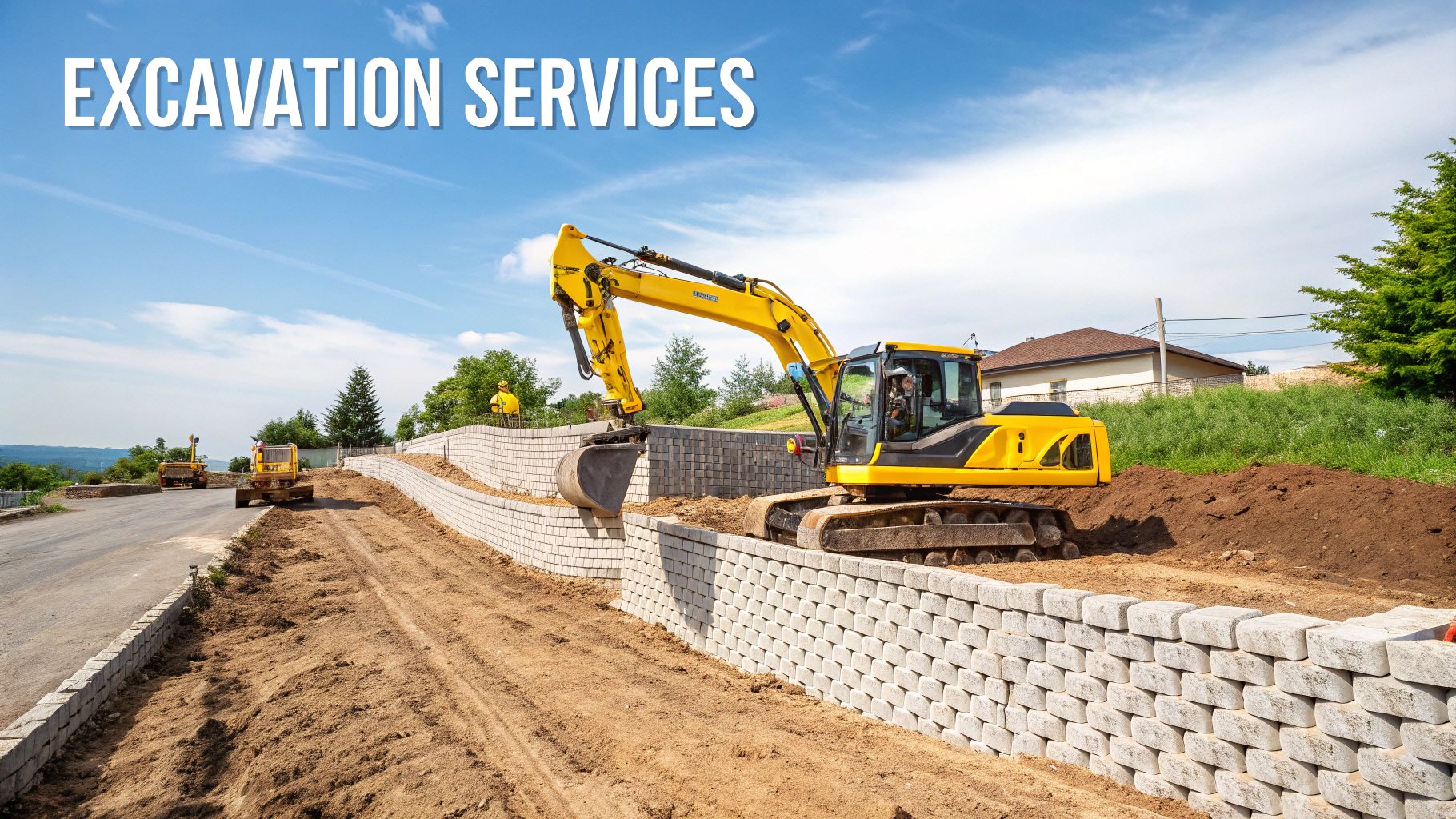
This kind of groundwork is the bedrock of the entire construction industry, not just here in NSW but globally. The market for site preparation contractors is massive, projected to hit $323.37 billion by 2025, according to The Business Research Company. That growth is fuelled by everything from new housing estates to major public infrastructure, all of which start with the same non-negotiable need: expert groundwork.
Bulk and Detailed Excavation
Excavation is often the first thing people picture when they think of site prep, but it’s far more nuanced than just digging holes. It really breaks down into two distinct phases: bulk excavation and detailed excavation.
Bulk excavation is the heavy lifting, the large-scale work. This is where we bring in the big machines to move massive quantities of soil, clay, and rock. The goal is to carve out the general shape for a building pad, a basement, or a sprawling carpark. It's like sculpting the land with a very big chisel.
Detailed excavation is where the precision comes in. Once the bulk work is done, we switch to a more meticulous approach for things like slab footings, trenches for plumbing and power, and shaping the exact profile for a new swimming pool. If you want to dive deeper into the specifics, check out our guide on the difference between excavation and earthmoving.
Land Clearing and Vegetation Management
Before any digging can start, we need a clean slate. That’s where land clearing comes in. It’s the methodical removal of trees, dense shrubs, boulders, and any old debris littering the site.
But this isn't just a matter of bulldozing everything flat. It demands careful planning, especially when it comes to respecting council tree preservation orders and managing green waste in an environmentally responsible way. Proper vegetation management makes the site safe to work on and stops tree roots from causing headaches with your foundations years down the track.
A common mistake is underestimating the scope of land clearing. It’s a strategic process that must align with council regulations and the final building footprint to avoid costly rework.
Grading, Compaction, and Concrete Preparation
With the site cleared and excavated to its rough levels, the focus shifts to grading and compaction. Grading is the art of shaping the ground to create the precise slopes needed for drainage and a perfectly level building area. Get this wrong, and you'll have water pooling against your foundation for years to come.
Next up is compaction. We use heavy rollers to densify the soil, squeezing out air pockets to create an incredibly stable, load-bearing surface. A properly compacted base is absolutely non-negotiable; it's what prevents the ground from subsiding and causing ugly structural cracks later on. The final step is preparing for the pour—setting up all the formwork for slabs, footings, and driveways so it's ready for concrete.
Structural Landscaping and Retaining Walls
Sloping blocks are just a fact of life across the Central Coast and many Sydney suburbs. This is where structural landscaping, particularly the construction of retaining walls, becomes an essential part of the site prep process. These walls aren't just decorative; they're engineered solutions to hold back tonnes of earth and create usable, level tiers of land.
Imagine trying to build on a steep block in Terrigal or a hilly site in the Hunter Valley. It would be impractical and downright unsafe without retaining walls. Sandstone retaining walls, for instance, are a fantastic solution. They are incredibly strong and long-lasting, plus they have a natural look that fits right in with the local landscape. They make the unbuildable, buildable.
How to Choose the Right Site Preparation Contractor
Picking the right partner for your site preparation is one of the most critical decisions you'll make for your entire project. The quality of their work is literally the foundation for everything that follows. This is definitely not the place to cut corners; chasing the cheapest quote often leads to the most expensive problems down the track. A contractor who delivers real value gets it right the first time.

When you're sizing up potential contractors, you’re looking for a lot more than just someone with an excavator. You need a team with proven experience, all the right insurances, and a deep understanding of local conditions.
Verify Licences and Insurance
First things first: check their credentials. Any reputable contractor in NSW must hold a current contractor licence for the work they do and be fully insured. It’s essential to ask for their certificates of currency for both Public Liability Insurance and Workers Compensation.
This is completely non-negotiable. It’s what protects you from serious financial risk if an accident happens on your property. Don't just take their word for it—ask to see the paperwork.
Check Their Local Knowledge and Past Projects
A contractor who knows the local landscape is worth their weight in gold. Ask them about their experience working with your local council, whether it's Central Coast Council, Newcastle Council, or another body.
Their familiarity with specific DA requirements and local ground conditions—from Sydney's tricky sandstone to the Hunter's reactive clay—can save you months of headaches and delays. Make sure to ask for a portfolio of similar projects they've completed. It’s the best way to get a real feel for the quality and scale of their work.
A cheap quote often hides what's missing—like proper compaction, adequate drainage, or correct waste disposal. A value-for-money quote is transparent and detailed, showing you exactly what’s included to ensure a lasting, compliant result.
Communication and a Detailed Quote
Clear and honest communication is everything. Your contractor should be able to explain the whole process in plain language and be easy to get hold of when you have questions.
This transparency must extend to their quote. It needs to be itemised, clearly outlining the scope of works, machinery costs, labour, haulage fees, and any provisional sums. A vague, one-line quote is a major red flag. To effectively choose a contractor, it helps to understand how they build their reputation and find work, which can include industry directories and powerful lead generation sites. A professional who invests in their own business is far more likely to invest in the success of your project.
Common Questions We Get About Site Preparation
Over the years, we've had plenty of chats with clients across the Central Coast, Sydney, and the Hunter Valley about the nuts and bolts of site prep. To help you get a clearer picture and plan your project with confidence, here are the answers to the questions that come up most often.
How Long Does Site Preparation Usually Take?
Honestly, it varies massively depending on the job. Clearing a straightforward, flat block in Woy Woy for a new driveway might only take us a couple of days. But then you have large commercial sites in Sydney needing major excavation and engineered retaining walls – those can easily stretch into several weeks, sometimes longer.
Things like weather can throw a spanner in the works (heavy rain stops all earthworks), as can unexpected council inspection hold-ups or hitting a surprise layer of sandstone nobody knew was there. We always build a realistic timeline upfront and make sure you’re kept in the loop every step of the way.
Do I Need to Organise Council Approval Myself?
While lodging the Development Application (DA) is ultimately the property owner's responsibility, a good site preparation contractor is your most valuable partner in getting it right. We're the ones who supply the crucial documentation that goes into your application, like detailed site plans, haulage routes, and solid erosion and sediment control plans.
We’ve spent years working with councils like Central Coast Council and Newcastle Council, so we know exactly what they’re looking for. This inside knowledge helps get your submission compliant from the get-go, which is the best way to dodge those frustrating and expensive delays.
What Happens if You Find Asbestos on My Site?
Finding something that looks like asbestos brings everything to an immediate halt. It’s a scenario that demands a strict, by-the-book response, guided by SafeWork NSW regulations. The moment we uncover anything suspicious, work in that area stops instantly.
From there, we call in the specialists: a qualified environmental consultant to test the material and a licensed asbestos removalist to assess the situation and safely remediate the site. Yes, this can add time and cost to a project, but when it comes to safety and legal duties, correct handling is absolutely non-negotiable.
Can You Work on a Site with Difficult Access?
Absolutely. In fact, tricky sites are our specialty. So many blocks across the Central Coast and in the tighter suburbs of Sydney come with steep slopes, narrow driveways, or boundaries right on top of each other.
That’s why our fleet includes modern compact excavators and mini-dumpers built specifically for this kind of tight-access work. More importantly, our operators are masters at navigating these challenging sites safely and efficiently. It means we can confidently say "yes" and deliver fantastic results where other contractors might have to walk away.
Ready to get your project started on solid ground? Booms Up Civil Group has the local expertise and modern machinery to handle any site preparation challenge. Call us today for a no-obligation chat and a free quote for your project. Learn more at https://boomsupcivil.com.au.