Before a single drop of concrete is poured or a single timber frame goes up, the ground itself has to be made perfect. This is where site cut excavation comes in – it’s the crucial first step of creating a stable, precisely-levelled canvas for your entire construction project. Honestly, getting this part right is the most important move you can make.
Understanding the Purpose of a Site Cut
Lots of people hear "excavation" and just picture a big hole in the ground. But a professional site cut is a far more technical and vital process. It’s all about shaping the land with precision, following an architect's or surveyor's plans to create a perfectly level and stable platform, which we call a building pad. This is what guarantees the foundation of your new structure will rest on solid, uniform ground.
Imagine you're building a new home on a sloping block in Terrigal on the Central Coast. You can't just build on an angle – it’s structurally impossible and unsafe. A site cut solves this by "cutting" into the high side of the slope and often using that excavated soil to "fill" the low side. This creates a flat, benched area, a process often called a "cut and fill."
Before we get into the nitty-gritty of the process, it’s helpful to understand the core goals. A professional site cut isn’t just about moving dirt; it’s about setting the stage for everything that follows.
Table: Key Goals of a Professional Site Cut
| Objective | Why It Matters For Your Project |
|---|---|
| Create a Level Platform | Ensures the concrete slab and frame are perfectly horizontal, preventing future structural stress. |
| Achieve Uniform Compaction | Guarantees the ground beneath the foundation has consistent density, eliminating soft spots that lead to cracking. |
| Establish Correct Drainage | Shapes the land to direct rainwater away from the foundation, preventing water damage and rising damp. |
| Prepare for Services | Creates the correct levels and access points for plumbing, electrical, and other underground utilities. |
| Define Site Boundaries | Clearly marks out the building footprint and setbacks according to the approved plans. |
As you can see, each step is about creating a predictable and safe environment for the rest of the build.
Why a Professional Site Cut is Non-Negotiable
Getting this stage right from the get-go prevents a whole cascade of expensive and downright dangerous problems down the track. A poorly executed site cut can lead to a world of pain:
- Structural Issues: If the ground isn't perfectly level and compacted, it can cause your concrete slab to crack. This isn't just a cosmetic issue; it can lead to long-term structural failure in your home or commercial building.
- Drainage Problems: Correctly shaping the land is absolutely vital for managing water flow. An improper cut can cause water to pool against your foundations, which is a recipe for moisture damage, mould, and rising damp.
- Costly Rework: Here’s the real kicker. If the levels are wrong, everything that follows will be out of alignment. The slab, the retaining walls, the driveways, even the landscaping – it all has to be redone, and that means eye-watering costs and frustrating delays.
Ultimately, a professional site cut is about creating certainty. It establishes the exact levels and solid ground needed for all the other trades to do their work correctly and safely. It truly is the foundation for the entire project's success, whether it's a new home build in a Newcastle suburb or a major commercial development in the Hunter Valley.
While it's a very specific discipline, it helps to understand the key differences between precision excavation and general earthmoving to appreciate the skill involved. For more great insights on related topics, you can find helpful information on various hardscape, drainage, and site foundation projects.
The Site Cut Excavation Process Step by Step
So, what actually happens on-site? A professional site cut isn’t just a few hours of digging; it’s a carefully choreographed process that transforms a raw piece of land into a build-ready platform. Let’s walk you through the entire journey, step by step, so you know exactly what to expect when our team arrives.
To make it real, let’s imagine we're tackling a challenging, sloping block in Kariong, a suburb on the Central Coast known for its varying terrain. The goal here is to create a perfectly level pad for a new home, complete with a driveway and a functional backyard area.
Initial Site Assessment and Surveying
Before a single bucket of soil is turned, the most critical work happens with plans and surveying equipment. This isn't just a quick look-around; it's a detailed investigation. We start by digging into your architectural plans and the geotechnical report, which is our roadmap to what’s under the surface—is it reactive clay, sand, or are we likely to hit sandstone?
Next up is the Dial Before You Dig search. This is a non-negotiable safety step that maps out all underground utilities like gas, water, electricity, and telecommunications cables. Hitting one of these is incredibly dangerous and causes massive disruptions, so we locate and mark them with absolute precision. Our surveyors then get to work pegging out the site, marking the exact boundaries, corners, and required levels (RLs) for the cut.
Site Clearing and Preparation
With the plan locked in, it’s time to prep the site for safe and efficient work. This phase involves clearing any vegetation, trees (with council approval, of course), rocks, and old debris from the work area. We also establish a solid, safe access point for our heavy machinery, like excavators and tipper trucks, to get in and out without wrecking council assets like kerbs and footpaths.
This diagram breaks down the core objectives we're aiming to achieve during every site cut.
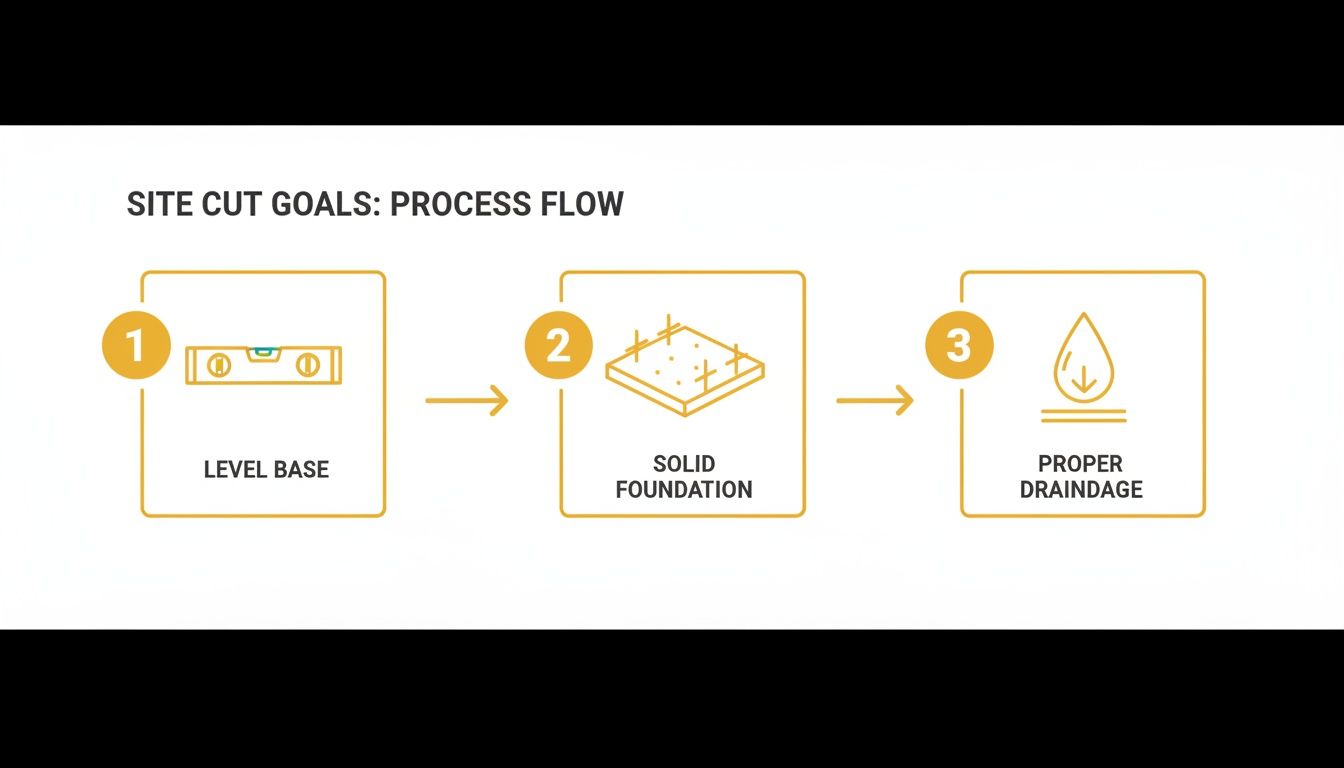
As you can see, the whole process is engineered to deliver a stable, level base that manages water effectively and provides a rock-solid foundation for the entire build.
The Cut and Fill Method
This is where the heavy lifting begins. On our sloped Kariong block, we’ll use the classic 'cut and fill' technique. Our excavator starts by 'cutting' into the high side of the slope, methodically removing soil to bring it down to the planned level.
But instead of just hauling all this soil away, we strategically move it to the lower side of the block. This 'fill' material is used to build up the ground, creating one single, continuous, and level platform. This method is incredibly efficient and cost-effective because it minimises the amount of new fill we need to bring in and slashes the amount of spoil that needs to be trucked away. To get any construction off the ground, it's vital to master land preparation for building with key steps, which covers everything from initial clearing to the final site cut.
Compaction and Final Grading
Just moving soil around isn't enough. The fill material has to be properly compacted to create a solid, stable base that won’t sink later. We lay the fill in layers, or 'lifts', typically around 300mm deep. After each layer is down, we bring in a padfoot roller or compactor to compress the soil, squeezing out air pockets and ensuring uniform density.
Why Compaction Matters: Without proper compaction, the ground can settle over time, leading to a cracked slab and serious structural problems down the line. We test the compaction levels to make sure they meet the strict engineering standards required for your foundation.
Once the levels are spot on and compaction is complete, we perform the final grade. Using a laser level for pinpoint accuracy, our operator skims the surface to create a smooth, precise finish, ready for the concreters to come in and do their thing. This stage is one of the most crucial parts of professional site preparation and excavation.
Spoil Removal and Site Tidy
Even with an efficient cut and fill, there's often some leftover soil, rock, or clay, known in the industry as 'spoil'. We load this into our tipper trucks and transport it to a licensed recycling facility. A clean site is a safe site, so we make sure all excess material is removed and the area is left tidy, giving the next team of tradies clear and safe access.
Safety and Compliance on NSW Construction Sites
When it comes to any kind of earthworks, especially something as detailed as a site cut, safety isn't just a priority—it's the entire foundation of a successful project. On any NSW construction site, whether it’s a residential block on the Central Coast or a major commercial development in Sydney, we operate under a strict framework of safety regulations. This isn't just about ticking boxes; it's about protecting our team, the public, and your project from completely preventable harm.
The risks involved in excavation are very real. An unsupported trench can collapse in an instant, and striking an underground gas or electrical line can have catastrophic consequences. This is precisely why a professional, licensed, and insured contractor isn't a luxury—it's a legal and moral necessity. We have a legal 'duty of care' under NSW law to ensure every possible measure is taken to make the worksite safe for everyone.
Key Safety Protocols on Site
To get ahead of these risks, we implement a robust safety plan before a single engine starts. This is a non-negotiable part of our process for every single job, whether it’s in a dense suburban spot like Gosford or a sprawling rural property in the Hunter Valley.
- A crucial first step is installing temporary site fencing. This secures the perimeter, preventing unauthorised access from the public—especially curious kids or pets. It clearly defines the work zone and is a basic requirement from both SafeWork NSW and local councils.
- We also establish clear exclusion zones around operating machinery. This ensures a safe distance is maintained at all times, preventing accidents before they have a chance to happen.
- For deeper excavations, like those for basements or deep footings, protecting against collapse is paramount. This involves using shoring or benching techniques to support the trench walls. You can read our detailed guide on trenching and shoring safety to see how these engineered systems prevent soil collapse and create a secure environment for workers.
Adhering to SafeWork NSW and Australian Standards
Every aspect of our work is governed by guidelines from SafeWork NSW and relevant Australian Standards (AS). These aren't just recommendations; they are legally enforceable rules that dictate exactly how excavation must be carried out. This covers everything from the safe operation of machinery to managing noise and dust to keep the neighbours happy.
The statistics really highlight why these rules are so critical. Across Australia, excavation work carries significant risk if it’s not managed correctly. Data from Safe Work Australia shows that land development and site preparation have tragically accounted for numerous fatalities in the construction industry over the years. In NSW specifically, a high percentage of machinery-related injuries involve equipment like excavators, which are central to every site cut. Discover more insights about these workplace safety statistics on worksafe.qld.gov.au.
This data isn't meant to scare you; it's meant to show why we are so uncompromising when it comes to compliance. A professional contractor who understands and follows these standards is your greatest asset in ensuring your project runs smoothly and, most importantly, safely from start to finish.
Ultimately, a compliant and safe site is an efficient site. By prioritising safety from day one, we prevent the kinds of incidents that cause costly delays, legal headaches, and potential harm. When you partner with us, you're not just hiring an operator with an excavator; you're bringing on a team that is fully committed to upholding the highest safety standards in the industry, protecting everyone involved in bringing your project to life.
The Right Equipment and Team for Your Site Cut
A successful site cut doesn't just happen. It’s a perfectly coordinated effort, a dance between powerful machinery and skilled operators who know exactly what they're doing. Having the right tools is only half the battle; knowing how and when to use them is what truly turns a set of plans into a solid, perfectly prepared building platform.
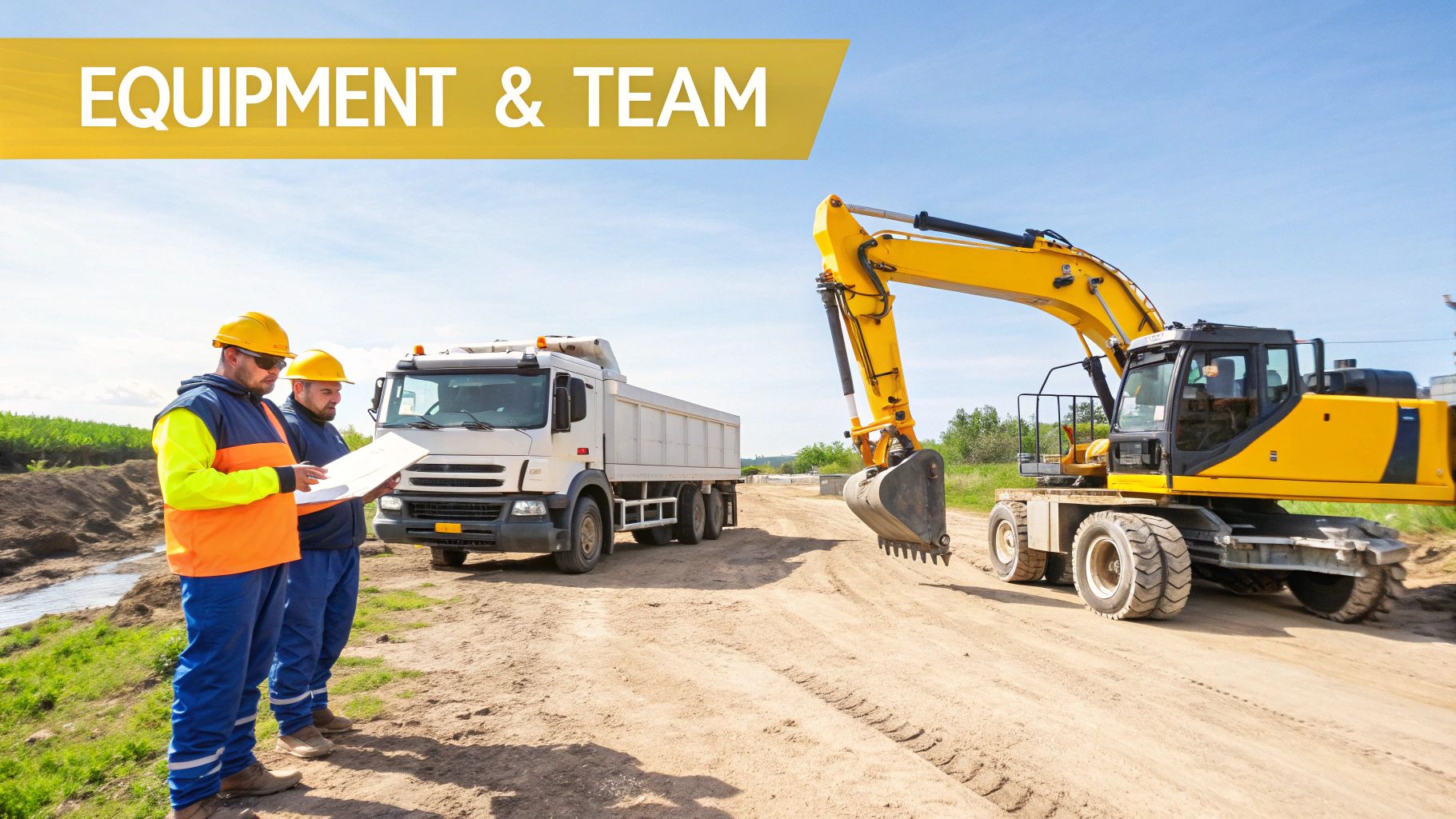
We always match our fleet to the specific demands of your project, because efficiency and precision are non-negotiable. A huge commercial site out in the Hunter Valley might need the sheer grunt of a 20-tonne excavator for bulk earthmoving. But for a tight residential block in a suburb like Copacabana, a smaller, more agile machine is the only way to go.
The Key Players in Our Fleet
Think of our machines as a specialist team, with each one playing a crucial role. Understanding what they do helps you see exactly how a site cut comes together.
- Excavators (5 to 30 Tonne): These are the undisputed workhorses of any site cut. They do the heavy lifting – digging into embankments, moving huge volumes of soil for the 'cut and fill' process, and loading up our tipper trucks. The size we bring depends entirely on your job's scale and how easy it is to get onto the site. You can get more details in our guide to excavator hire on the Central Coast.
- Posi-Tracks (Skid Steers): If excavators are the muscle, Posi-Tracks are the finishers. Their tracks give them fantastic stability and low ground pressure, making them perfect for the detailed work. They handle the final trimming, spread topsoil, and can get into confined spaces where a big excavator simply can't. They’re the ones that create that final, smooth finish on the building pad.
- Tipper Trucks: You can't have a clean site without these guys. Our tippers are constantly on the move, efficiently removing any excess soil, clay, or rock from your property. This is essential for managing spoil and keeping the site safe, clean, and ready for the next trade to come in.
The Human Element Behind the Machinery
Even the most advanced machine is just a lump of metal without a skilled operator at the controls. At Booms Up Civil, our people are our biggest asset, bringing years of hard-won, on-the-ground experience to every single project.
A Note on Expertise: An operator with 15+ years of experience on Central Coast soil knows how to 'feel' the ground. They understand that sandy coastal earth behaves completely differently from the reactive clay you find further inland, and they adjust their technique on the fly to get a perfect, stable finish.
Our on-site crew is a tightly coordinated unit. The Surveyor lays down the precise set-points and levels that act as our roadmap. The Machine Operator then takes those marks and uses their skill to cut to the exact millimetre required. Watching over it all is the Site Supervisor, making sure everything runs safely, on schedule, and in strict accordance with the project plan and SafeWork NSW regulations. It's this teamwork that lets us get the job done right, the first time.
Understanding Site Cut Costs and Timelines
When you're kicking off a build, two questions always jump to the top of the list: "How much will this cost?" and "How long is it going to take?" For a site cut excavation, there's no simple, off-the-shelf answer. The final price and schedule really depend on the unique personality of your block of land.
Getting your head around these variables is key to setting a realistic budget and project timeline. A small, flat residential cut on easy-to-work soil might be done and dusted in a couple of days. On the other hand, a huge commercial site with tricky access and a lot of rock could easily stretch into several weeks.
Key Factors That Influence Your Quote
Your quote for a site cut is much more than just an hourly rate for a machine. It’s a carefully calculated figure based on a few crucial elements that determine the labour, equipment, and time we need to get the job done right.
- Volume of Earth to be Moved: This one’s the most straightforward. The more cubic metres of soil we have to cut and shift, the longer it’s going to take and the more it will cost. We calculate this number directly from your architectural and engineering plans.
- Soil Type and Condition: What’s hiding under the topsoil makes a massive difference. Digging through the soft, sandy soils common on the Central Coast is a world away from battling the hard sandstone bedrock you find all over Sydney. If we hit unexpected rock, we’ll need to bring in specialised gear like hydraulic hammers, which adds both time and cost to the job.
- Site Accessibility: How easy is it for us to get our excavators and trucks onto your site? A wide-open block with street frontage is a dream. A narrow, steep driveway or a battle-axe block in a suburb like Gosford means we’ll be using smaller machines and more careful planning, which can stretch out the timeline.
- Complexity of the Design: A simple, flat building pad is far quicker to create than a complex, multi-level design with several benched areas and detailed batters. The more intricate the surveyor's plans, the more machine and operator time it takes to achieve that pinpoint precision.
Spoil Removal The Hidden Cost
One of the most significant costs in any site cut excavation is spoil disposal. "Spoil" is our industry's term for any excess soil, clay, or rock that has to be removed from the site after we’ve finished the cut and fill. This material has to be trucked to a licensed waste or recycling facility, and the tipping fees can be pretty steep.
The cost of disposal is worked out per tonne, and it changes depending on what we're hauling away. For example, clean fill is much cheaper to dispose of than contaminated soil or heavy rock. We always try to reuse as much material as possible on-site to minimise what needs to be carted off, which is a great way to save on costs. For a more detailed look at this, you might be interested in our guide on the cost of excavation per cubic metre.
The Site Preparation Services industry is a big part of Australian construction, and site cuts are a massive part of that. Wet hire—where you get the machine and the operator—drives a lot of the revenue. While the industry grew steadily for years, it hit a bit of a slump after 2022 as rising mortgage rates started to cool down new housing projects. You can discover more insights about these industry trends on ibisworld.com.
Common Excavation Challenges and How We Solve Them
Even the most meticulously planned site cut can throw a curveball. The true mark of an experienced excavation crew isn’t just their ability to follow a plan—it’s knowing exactly what to do when the ground beneath your feet doesn’t match the paperwork. With over 15 years of hands-on experience across the Central Coast, Sydney, and the Hunter Valley, we’ve seen pretty much everything and have the solutions ready to keep your project moving.
No two sites are the same, and anticipating these hidden challenges is the secret to staying on schedule and on budget. From surprise rock shelves to navigating tight suburban boundaries, our problem-solving mindset means we deliver results, no matter what hurdles pop up.
Hitting Unexpected Rock or Sandstone
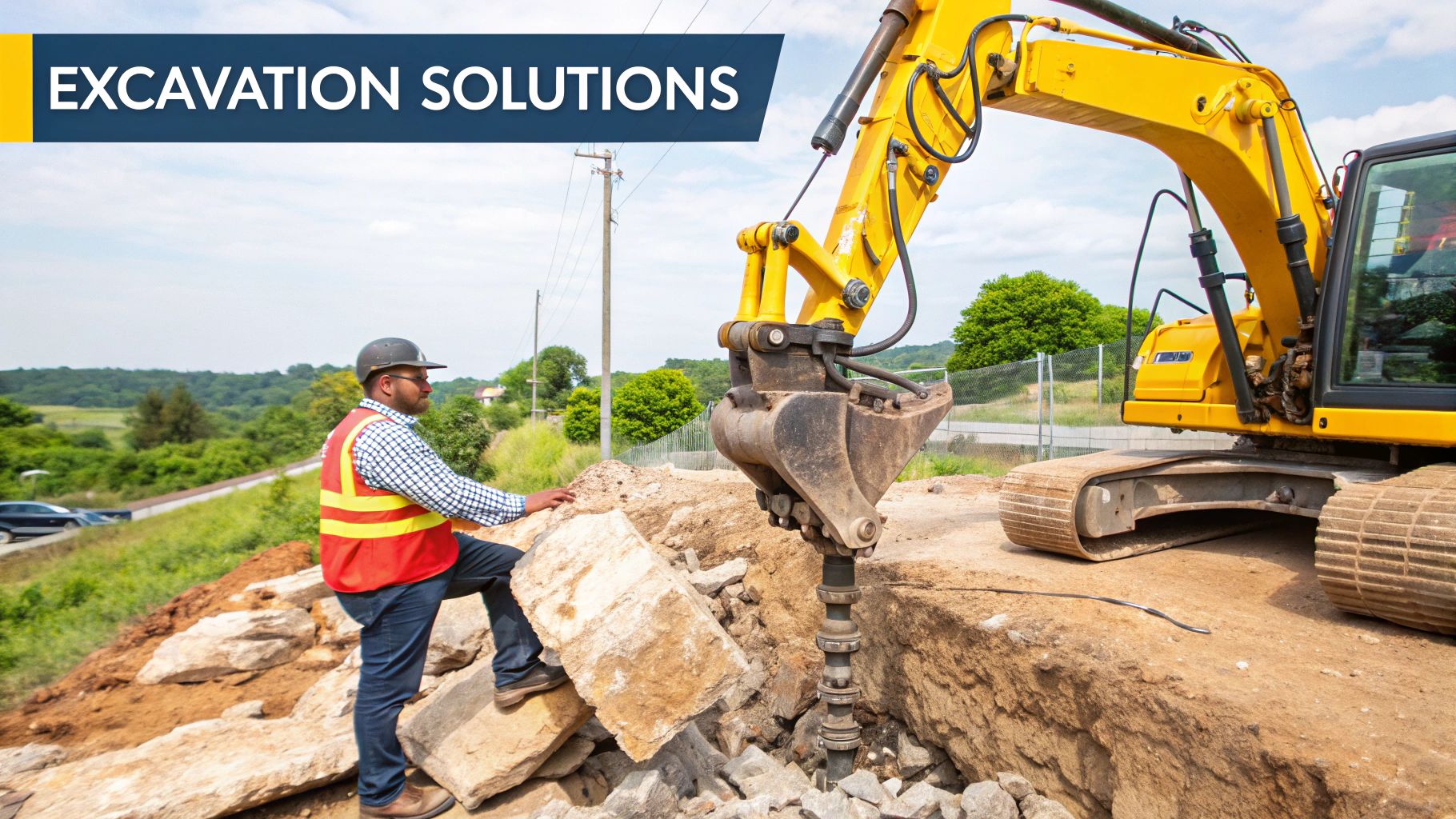
This is probably the most common challenge we run into, especially on projects throughout Sydney and certain parts of the Central Coast. You can be digging through what looks like standard clay soil, and then suddenly, the excavator bucket hits solid sandstone with a jarring thud. Without the right gear on standby, work grinds to a halt.
Our solution is to mobilise specialised attachments. We fit our excavators with powerful hydraulic hammers and rock grinders that can systematically break up even the toughest rock formations. This allows us to continue the site cut precisely to plan without causing excessive vibration or frustrating delays.
Managing Groundwater and Seepage
On coastal projects or after a period of heavy rain, groundwater can become a massive headache. As we dig deeper, water can start seeping into the cut, turning the site into a muddy pit and compromising the stability of the soil. This makes it impossible to achieve the level of compaction required for a solid building pad.
To get things under control, we implement dewatering techniques. This might involve digging sump pits and using pumps to actively draw water out of the excavation area, directing it safely away from the worksite. For more persistent issues, we can also install temporary drainage channels to manage the flow, keeping the ground stable and workable.
Working Near Boundaries and Neighbours
Excavating in established suburbs, like those around Newcastle or on Sydney's Northern Beaches, often means working right up against the neighbour's fence. This demands extreme care to avoid undermining fences, driveways, or even the foundations of an adjacent house. These deep site cuts near boundaries come with their own unique risks.
In Australia’s urban areas, these works often encroach on what’s known as the 'zone of influence', which can undermine adjacent properties. NSW regulations, similar to those in other states, mandate careful planning to prevent soil instability, with significant fines for non-compliance. You can read more about deep excavation safety alerts on vba.vic.gov.au.
To handle this, we stick religiously to the surveyor’s boundary pegs and often use shoring or careful battering techniques to support the excavated face. This ensures the integrity of the neighbouring land is fully protected throughout the project, which maintains safety and keeps the neighbours happy. Navigating these tricky situations is where our deep local experience really proves its worth.
Your Site Cut Questions, Answered
Got questions about site cut excavation? You're not alone. We get asked these all the time, so we've put together some straight-to-the-point answers to help you get your head around the essentials and plan your project with confidence.
Do I Really Need a Geotechnical Report Before a Site Cut?
Yes, you absolutely do. Think of a geotechnical report (or a soil report, as it's often called) as an x-ray of your block. It tells us exactly what we’re digging into – whether it’s soft sand, tricky reactive clay, or solid bedrock. This single document shapes our entire game plan, from the specific excavator we bring to site to whether we'll need specialised rock-breaking attachments.
More importantly, it’s not optional. Most councils across NSW, including the Central Coast Council and all Sydney councils, require a geotechnical report as a non-negotiable part of your development application (DA). It’s the only way to ensure the engineering for your foundations is perfectly matched to the ground conditions you're building on.
What's the Difference Between a Site Cut and General Earthmoving?
It all comes down to one word: precision.
A site cut excavation is a surgical, engineering-led process. We're working to shape a block of land to the exact levels (known as RLs) specified by a surveyor or architect. The goal isn't just to move dirt; it's to create a perfectly stable, level platform that your building's foundation will sit on for decades to come.
General earthmoving, on the other hand, is a much broader term. It covers bulk jobs like clearing large parcels of land, digging a dam, or just shifting huge volumes of soil from A to B where millimetre-perfect accuracy isn't the main goal. A site cut is about detailed shaping; earthmoving is often about bulk volume.
What Happens to All the Extra Soil After the Dig?
That pile of excess soil, clay, or rock is known in the industry as 'spoil'. In a smart 'cut and fill' site design, our first priority is to reuse as much of this spoil as possible. We use the 'cut' material to 'fill' and build up the lower areas of your block, which is a great way to save on costs.
Any spoil that’s left over has to be transported off-site to a certified facility for proper recycling or disposal. Managing this process responsibly, in line with NSW environmental regulations, is a big part of what we do. The cost of spoil disposal is always a significant line item in any excavation quote, and we handle it transparently.
Can I Just Hire a Dingo and Do a Small Site Cut Myself?
For your own safety and financial well-being, we strongly advise against it. Jumping on a piece of heavy machinery without the right licences, experience, and insurance isn't just illegal – it's incredibly dangerous.
You run a massive risk of hitting underground services like gas mains, water pipes, or power cables. A mistake like that can be catastrophic, not to mention astronomically expensive to fix. A professional contractor like us handles all the critical Dial Before You Dig checks, creates a safety plan for your specific site, and is covered by comprehensive insurance. It ensures the job is done right and safely the first time, protecting you from what could be a life-altering risk.
Ready to get your project started on solid ground? The team at Booms Up Civil Group has the local experience and modern fleet to handle your site cut excavation with precision and professionalism. Contact us today for a straightforward discussion about your project and a no-obligation quote.