Forestry mulching is a clever, single-step approach to clearing land. Instead of wrestling with multiple machines, burn piles, and haulage trucks, a single powerful unit moves through your property, grinding up trees, scrub, and undergrowth right where they stand. It’s all turned into a protective, nutrient-rich layer of mulch, which is a far smarter, faster, and more eco-friendly way to manage overgrown vegetation.
Your Guide to Forestry Mulching in NSW
If you own a block of land anywhere in NSW, from a bushy acreage on the Central Coast to a sprawling rural property in the Hunter Valley, you’ll know the constant battle of keeping vegetation in check. For years, the go-to methods were slow, expensive, and frankly, pretty tough on the land. They often left behind messy burn scars and bare, exposed soil.
Forestry mulching completely changes the game.
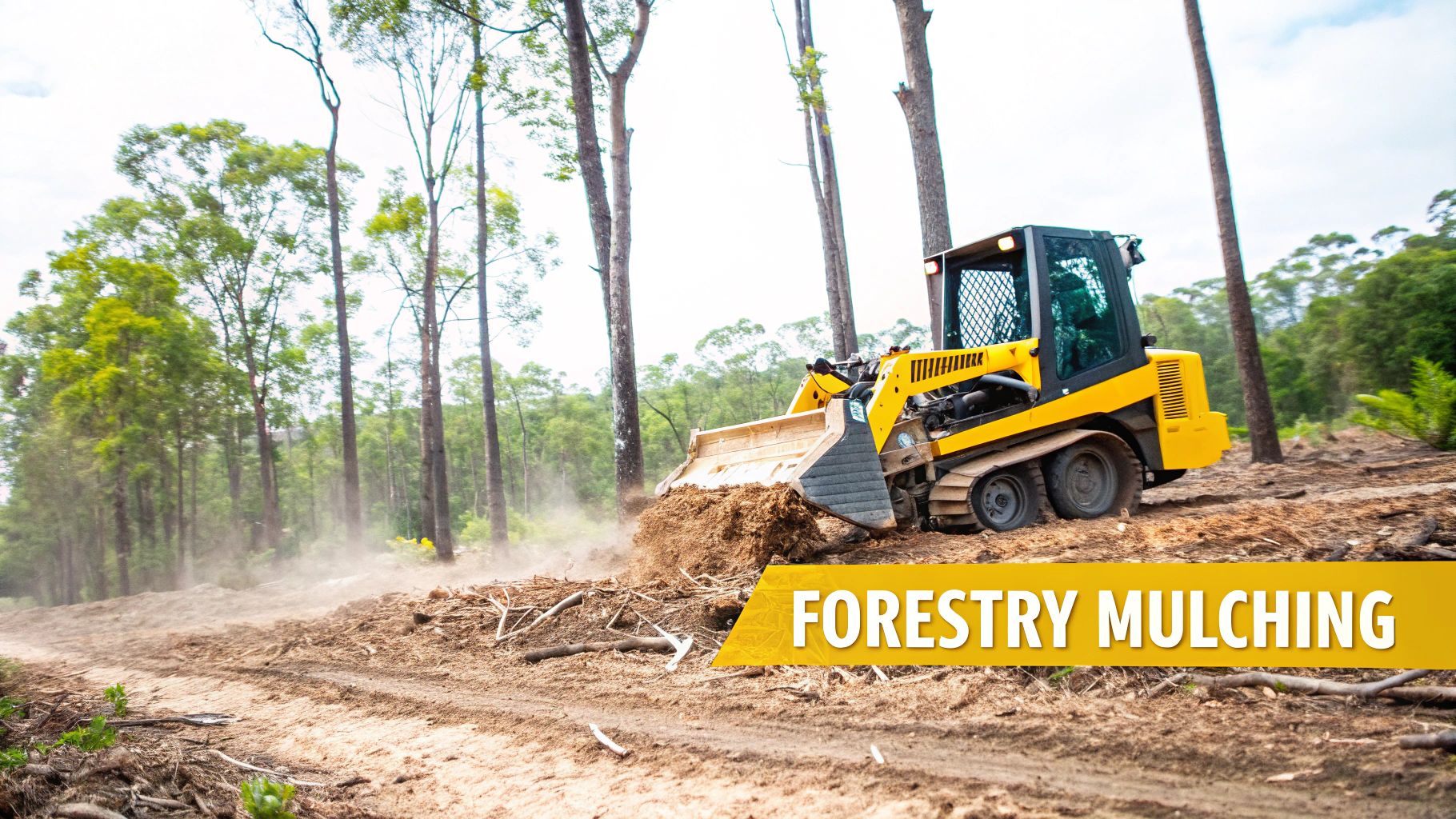
Think of it as an industrial-strength garden mulcher, built to handle your entire property. A single machine equipped with a specialised mulching head methodically works its way through the area, turning everything from saplings and dense scrub to small and medium-sized trees into a beneficial layer of organic mulch. It all happens in one pass, leaving your land clear, tidy, and protected.
The Mulching Process Explained
The heart of the process is a specialised mulching head, usually attached to a powerful excavator or a purpose-built tracked machine. This attachment uses a series of rotating, heavy-duty teeth to shred vegetation on contact, processing it on the spot and spreading it evenly across the ground.
This single-step method has become incredibly popular across NSW for a few key reasons. Firstly, there's no haulage or burning. Everything is dealt with on-site, which means no expensive trucks to haul away green waste. It also avoids the environmental headaches and safety risks of burn piles, which is a massive plus when dealing with local regulations from councils like Central Coast Council or Newcastle Council.
Secondly, it's great for your soil health and protection. That layer of mulch is like a natural blanket for your soil. It’s fantastic for preventing erosion, especially on the sloped blocks you see around Terrigal, and it helps the ground retain precious moisture during our dry spells. Over time, it breaks down and feeds the soil with organic matter.
And thirdly, you get immediate usability. As soon as we've finished, your land is ready to go. You can immediately use it for access tracks, put livestock on it, or move on to the next stage of your development.
At its heart, forestry mulching is about transforming a land clearing problem into an environmental solution. Instead of stripping the land, you're giving back to it, creating a healthier and more resilient landscape for the future.
Practical Applications on Your Property
Let’s talk real-world scenarios. Imagine you've bought a block near Lake Macquarie to build your dream home, but it's choked with dense bushland. Forestry mulching can carve out a clean building envelope and establish access, all while leaving the surrounding trees untouched and the soil structure intact.
Or maybe you’ve got a rural property out in the Hunter Valley. Forestry mulching is the perfect tool for creating and maintaining vital fire breaks. It’s an incredibly efficient way to reduce the fuel load around your home and assets, giving you much-needed peace of mind. As a method for land transformation, it’s a go-to for tasks like initial lot clearing services. The sheer versatility of this technique makes it a perfect fit for a huge range of residential, commercial, and agricultural jobs.
Key Benefits for Your Property and the Environment
When you choose forestry mulching, you're doing more than just clearing a block of land. You're making a smart investment in the long-term health of your property and the local environment. It's a method that works with nature, not against it, delivering a host of benefits that old-school land clearing methods just can't touch.
The most obvious advantage is how streamlined the whole process is. We roll up with one machine that clears and processes all the vegetation in a single pass. That means no separate crews for cutting, stacking, burning, or hauling away green waste. The savings in time and labour costs add up quickly.
A Healthier Landscape from the Ground Up
At its core, forestry mulching is simply better for your soil. The blanket of mulch it leaves behind acts like a natural shield, protecting the precious topsoil from getting washed away by a classic NSW downpour.
This is a game-changer on the sloped blocks you see all over the Central Coast and Sydney's Northern Beaches. By stopping erosion in its tracks, you’re helping to keep sediment out of our local creeks and rivers while holding your land together.
That same layer of mulch also acts like a giant sponge, helping the ground soak up and hold onto moisture. This is a huge win during the hot, dry summers we get here, easing water stress on your remaining trees and creating a far more resilient landscape.
Saving Time and Money
Let's get practical. Let's say you've got a five-acre lot near Cessnock that's choked with regrowth. Using traditional methods, you could be looking at weeks of work—felling trees, dragging everything into piles, and then either waiting for a burn permit or paying for truck after truck to haul it all away.
With forestry mulching, we can often knock over the same job in a fraction of the time. Because it's a one-machine, one-operator process, it’s just far more efficient. The flow-on savings in labour, machinery hire, and disposal fees are substantial.
The real economic win comes from everything you don't have to do. There's no paying tip fees, no juggling multiple contractors, and no waiting weeks for the site to be usable. The job gets done faster, and your land is ready for its next chapter, straight away.
Bushfire Mitigation and Property Safety
If you own property in a bushfire-prone area—which covers most of the Hunter Valley, Central Coast, and Sydney's outer suburbs—reducing the fuel load isn't just a good idea, it's a critical part of managing your land. Forestry mulching is one of the most effective tools we have for creating defensible space around your home and other assets.
It quickly chews through the flammable undergrowth, small trees, and shrubs that act as a ladder for fire to climb into the tree canopy. And unlike a prescribed burn, mulching gives us pinpoint control and can be done in a much wider range of weather conditions, without the risks of smoke or stray embers.
By turning potential fire fuel into a non-flammable, moisture-retaining ground cover, you're actively lowering your property’s bushfire risk. This doesn't just protect your family and home; it makes your land safer for firies to access if the worst should happen. When it comes to effective property clearing services, mulching is in a class of its own for its blend of speed, safety, and environmental stewardship.
The Machinery Behind the Mulch
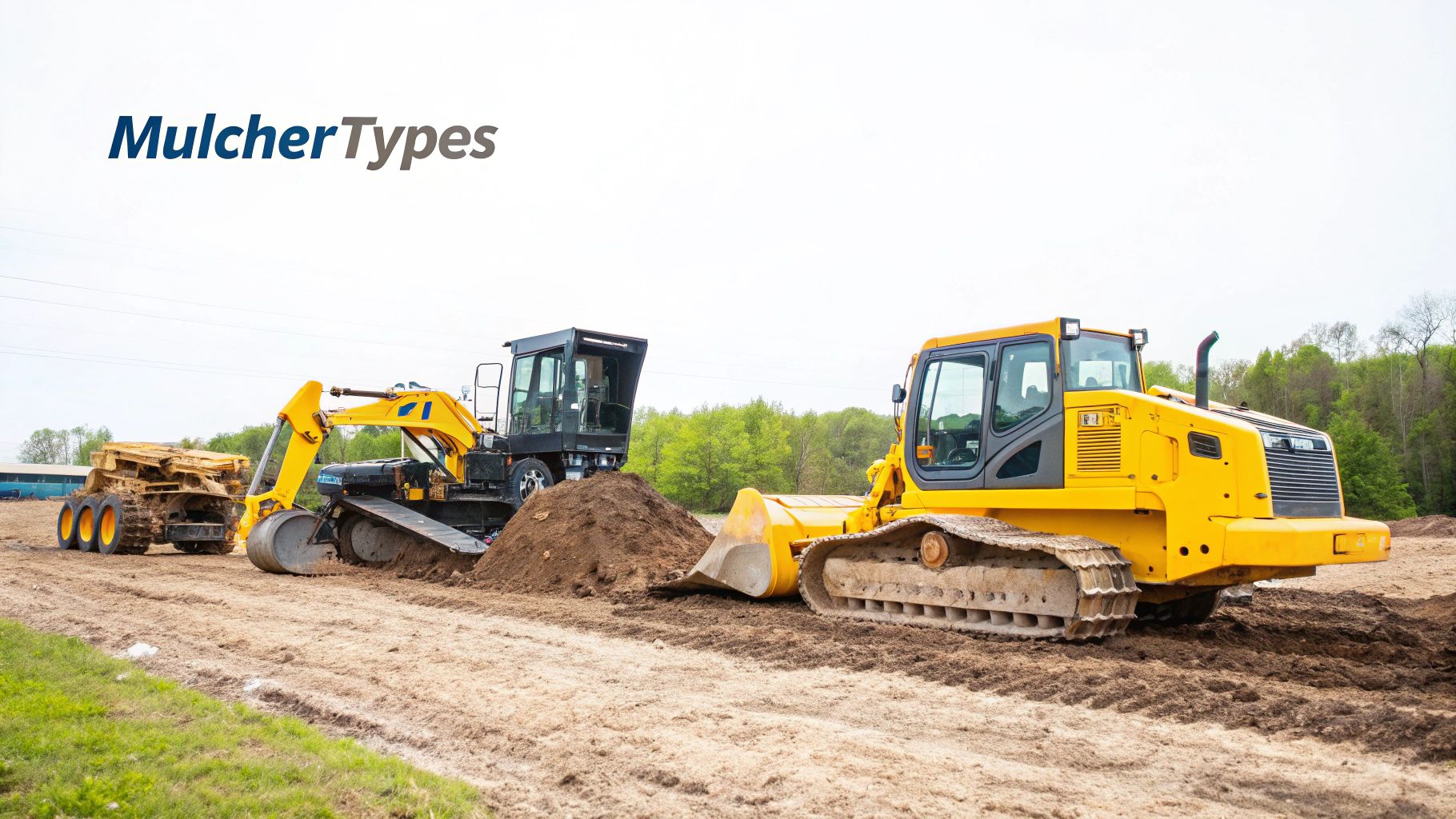
Let's pull back the curtain on the gear that makes forestry mulching possible. It's not a case of one-size-fits-all; the right machine is always hand-picked for your specific terrain and the type of vegetation we're dealing with. Getting this match right is where a contractor's experience really shines. It's the difference between a job done efficiently, safely, and a job that drags on.
At Booms Up Civil, we select from a fleet of specialised machines to ensure we bring the perfect tool for your project. This approach sidesteps common pitfalls, like using an underpowered machine that struggles and takes twice as long, or bringing in a beast that's too heavy and ends up compacting your soil. Our goal is always to get it right the first time.
The Heavy Hitters: Tracked Mulchers
For the big, tough jobs on rough or sprawling ground, dedicated tracked mulchers are the undisputed kings. Think of them as purpose-built tanks designed for one thing: turning dense bushland into mulch as fast as humanly possible.
These machines are built on their own track base, much like a bulldozer, which gives them incredible stability and low ground pressure. This allows them to work efficiently across vast rural properties in the Hunter Valley or clear large subdivisions without tearing up the ground. They are the go-to for clearing thick, woody regrowth or tackling many hectares of unwanted vegetation.
The Versatile All-Rounders: Excavator Attachments
For most residential and commercial projects around the Central Coast and Sydney, you’re more likely to see a forestry mulching head fitted to an excavator or skid steer. These attachments bring incredible versatility and precision to the table, letting us tackle jobs that dedicated mulchers simply can't get to.
An excavator with a mulching head, for instance, is the perfect setup for tricky, steep, or wet sites. The long reach of the excavator’s boom means we can safely clear vegetation on slopes, across ditches, or in sensitive areas without having to drive the machine directly over the ground. If you’ve got a challenging, sloped block in a suburb like Terrigal or Copacabana, this is the machine for the job. You can explore our complete guide to excavator attachments to see just how adaptable these machines truly are.
Drum Mulchers vs. Disc Mulchers
The business end of the machine—the mulching head itself—also comes in a couple of different flavours. The two main types you'll encounter are drum mulchers and disc mulchers, and the finish they leave is worlds apart.
A drum mulcher has a horizontal, spinning drum lined with fixed teeth. It grinds vegetation into a finer, more consistent mulch. This is ideal if you're after a clean, park-like finish, making it perfect for shredding undergrowth and smaller trees.
A disc mulcher is a different beast entirely, operating more like a giant, vertical saw blade with teeth around the edge. It's brutally aggressive and can take down and process larger trees much faster than a drum mulcher, but the mulch it leaves behind is coarser and chunkier.
So, which one is right? It all comes down to your end goal. For carving out fire breaks where speed is the top priority, a disc mulcher often gets the nod. But for preparing a tidy, clean building envelope for a new home, a drum mulcher will deliver a far superior aesthetic result.
Navigating Council Regulations in NSW
Before a single tooth on a mulching head even thinks about touching a tree, there's a critical step every landowner in NSW has to take: getting your head around the rules. You can't just fire up the machinery and start clearing vegetation. Making that mistake can lead to eye-watering fines and immediate stop-work orders from the council.
This is why understanding the local regulations isn't just a box-ticking exercise; it’s one of the most important parts of any forestry mulching project.
Every local government area, whether you’re under Central Coast Council, Hornsby Shire, or up in Newcastle, has its own unique playbook. These rules are laid out in their Local Environmental Plans (LEPs) and Development Control Plans (DCPs), which spell out exactly what you can clear, how much, and what approvals you’ll need. A seasoned contractor who works in your area day in and day out will know these documents like the back of their hand.
State Rules vs. Local Council Rules
It’s not just your local council you need to keep happy. Overarching state laws, like the Biodiversity Conservation Act 2016 and the Local Land Services Act 2013, set the ground rules for all vegetation management across NSW. These are complex pieces of legislation designed to protect our native flora, fauna, and sensitive ecosystems.
This is precisely why getting a straight "yes" or "no" on whether you can clear your land is rarely possible without a proper site assessment. A rural property near Cessnock, for example, will be governed by a completely different set of rules than a suburban block in Gosford, even if the trees and scrub look identical.
Important: Always work on the assumption you need approval. It is far, far cheaper and less stressful to check with your council and a qualified contractor before you start than it is to deal with the penalties for unauthorised clearing.
Understanding the RFS 10/50 Rule
One of the most common questions we get is about the Rural Fire Service (RFS) 10/50 Vegetation Clearing rule. It’s a well-known scheme that allows people in designated 10/50 entitlement areas to clear certain vegetation around their homes to reduce bushfire risk, often without needing a formal council Development Application (DA).
Here’s the breakdown: you can clear trees within 10 metres of your home, and you can clear underlying shrubs and groundcover (but not the trees) within 50 metres of your home.
Forestry mulching is a perfect match for this kind of work. It’s a fast, compliant way to reduce the fuel load and create a fantastic, low-risk defensible space. The mulch it leaves behind is non-flammable and great for the soil. But—and this is a big but—you must use the official RFS online tool to confirm your property is in a designated 10/50 area before any work begins. These boundaries can and do change.
Why Compliance Matters
Sticking to the regulations isn't just about dodging fines; it's about being a responsible land manager. Consider this scenario: you've just bought a block in a bushfire-prone spot bordering Ku-ring-gai Chase National Park. You’ll be trying to balance your family’s safety with the very strict environmental protections in place. This is where a knowledgeable contractor comes in.
They can help you map out a mulching plan that ticks all the boxes for RFS guidelines and satisfies council requirements, ensuring your project is safe, smart, and fully compliant from day one. Navigating the rules is a key part of our land clearing services, and it’s something we make sure to get right every time.
What Factors Influence Forestry Mulching Costs?
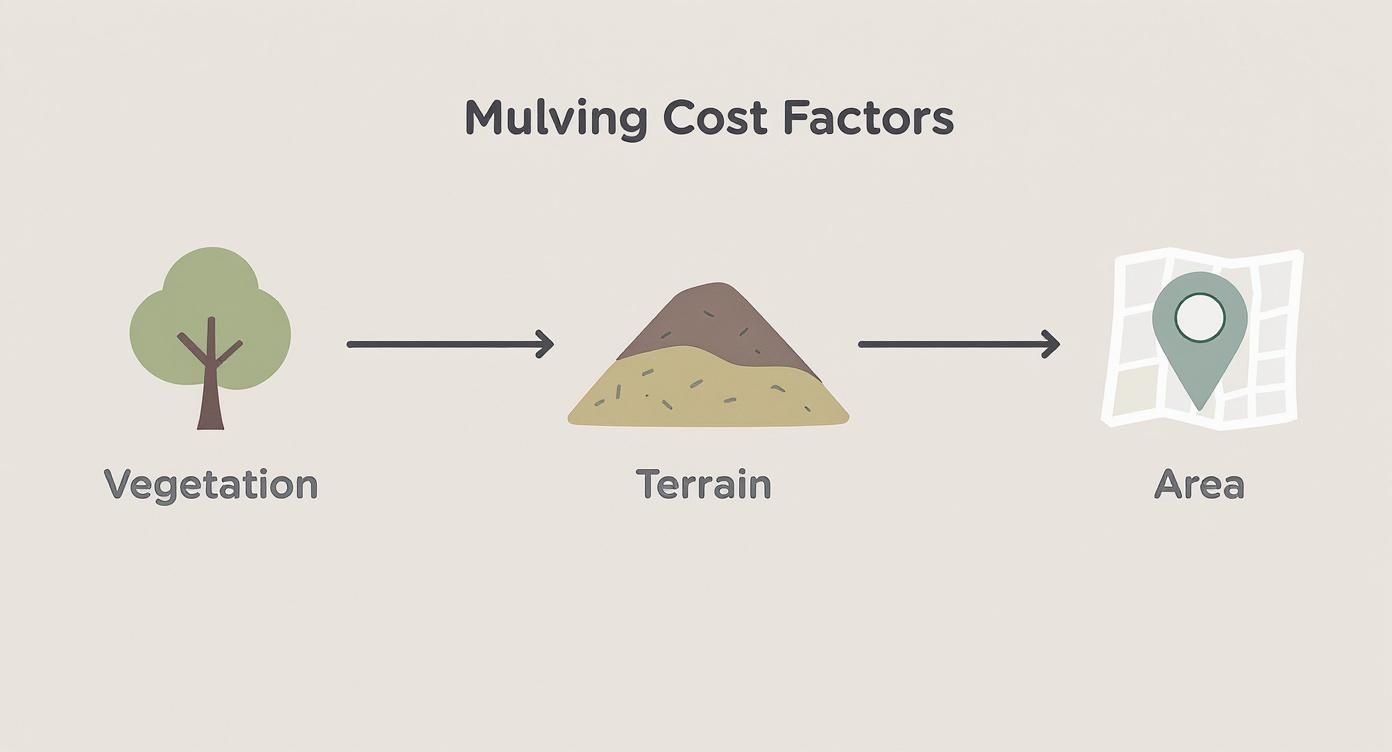
When you’re planning a project, the big question is always the same: "So, what's it going to cost?" With forestry mulching, there isn’t a simple square metre rate like there is for laying turf. The final price tag really comes down to a few key variables, and getting your head around them helps you see exactly where your money is going.
The single biggest cost driver is what we’re actually clearing. Think of it like this: mowing a tidy lawn is quick and easy, but tackling a paddock choked with waist-high weeds and gnarly thistles is a whole different ball game. It's the same for mulching.
Light scrub, lantana, and small saplings can be blitzed through very quickly, which keeps the job affordable. On the flip side, a site covered in dense, mature Wattle or stubborn regrowth Gum trees demands more power, more time, and more grunt from the machinery, and that’s naturally reflected in the cost.
Size, Terrain, and Access
The total size of the area is obviously a major factor, but it's not just about the hectares. The terrain itself plays a huge role in how the job unfolds. A flat, open block near Wyong is pretty straightforward work for our gear.
But take that same job to a steep, rocky site in Sydney's Hills district or a wet, boggy patch near the coast, and you’re looking at a much bigger challenge. These sites demand more careful machine operation and often specialised equipment, like an excavator fitted with a mulching head, just to get the job done safely and efficiently.
Accessibility is another piece of the puzzle. Can we get our machinery to the work area easily? Tight access points, winding tracks, or having to manoeuvre around existing sheds and fences all add time and complexity to the project.
The Finish You’re After
Finally, what do you want the place to look like when we pack up and leave? A rough initial clear for something like a fire trail is a much quicker process than creating a fine, park-like finish that you could almost run a mower over.
Achieving that smoother result means going over the area multiple times, grinding the mulch down into smaller and smaller pieces. A finer mulch breaks down into the soil much faster, but it also takes more machine time. When you ask for a quote, having a clear picture of your desired outcome helps us price the job with real accuracy.
When budgeting for land management, it's useful to think about all the variables that come into play, much like when you're analyzing project costs for outdoor improvements. The core principles of labour, the type of vegetation, and site complexity are universal.
The efficiency of forestry mulching has benefits that scale up significantly. The Forestry Corporation of New South Wales, for instance, uses methods like mulching to manage its vast forests, cutting down on labour and adding economic value to an industry that supports thousands of jobs. You can learn about the history of NSW forestry management to see how these practices work on a massive scale.
Best of all, the mulch we create stays on-site, enriching your soil. This completely eliminates removal costs, which is a major saving compared to traditional clearing where you have to figure out how to dispose of soil and green waste.
Is Forestry Mulching the Right Choice for You?
So, with all this talk about what forestry mulching can do, how do you figure out if it's the right call for your block? While it’s incredibly versatile, it’s not a silver-bullet solution for every single land clearing scenario. Knowing where it shines—and just as importantly, where other methods might be a better fit—is key to making a smart decision.
Let's get straight to it. This single-step process is a perfect match for a huge range of common projects across NSW, from residential blocks right through to large commercial sites.
When Forestry Mulching Is the Ideal Solution
We’ve found that forestry mulching really delivers the best results and value in a few key situations. It's ideal for preparing subdivisions, as it clears large tracts of land fast while leaving the soil structure intact and erosion-proof. Carving out a precise building envelope for a new home on a bushy block in suburbs like Kariong or Terrigal is a classic mulching job.
It's also the fastest, most effective way to cut fire breaks and create trails on rural properties throughout the Hunter Valley and Central Coast. Additionally, mulching is brilliant for tackling invasive pests like Lantana or Privet, turning a nightmare problem into beneficial ground cover.
This decision tree helps visualise how different project factors guide the approach.
As the graphic shows, when you start combining dense vegetation with difficult terrain and a large area, getting a professional assessment becomes critical to a successful outcome.
When You Might Need a Different Approach
Honesty is key, and forestry mulching isn't always the complete, final step. The biggest thing to think about is what needs to happen below the ground.
Picture this: you're getting ready to pour a concrete slab for a new house. Forestry mulching will clear the surface vegetation perfectly, but it leaves the stumps and root systems in the ground. To create a stable foundation, you’ll still need to bring in excavators to pull those roots out and prep the footings.
But flip that scenario. If you're creating a paddock for horses or a simple recreational area, leaving that root structure in place is a massive plus. It continues to hold the soil together, preventing erosion while the mulch layer breaks down and feeds the earth.
Ultimately, forestry mulching in Australia is part of a much bigger conversation about responsible land management. While traditional land clearing has significantly shaped our landscape, forestry mulching stands out as a far more sustainable technique. It’s been shown to minimise the soil erosion and carbon emissions that are common with older methods. Read the full research about forest management practices to get a deeper understanding of the broader context.
It's also generally not the right tool for felling large, mature hardwood trees or for sites where the ground must be completely bare and ready for immediate construction. Our goal is to give you balanced, practical advice so you can make a decision that genuinely works for your property and your specific goals.
Common Forestry Mulching Questions
When you're looking at a big job like forestry mulching, it's only natural to have a few questions. After more than 15 years on the tools across the Central Coast, Sydney, and the Hunter Valley, we've pretty much heard them all. Here are some straight-up answers to the queries we get most often from property owners just like you.
How Long Does the Mulch Last on the Ground?
The lifespan of that mulch layer really comes down to a few things: the type of timber we’ve mulched, how fine the chips are, and our local climate.
Here on the Central Coast, with our coastal humidity and decent rainfall, you can expect a good mulch layer to break down over two to four years. For the first year or two, it does a brilliant job of keeping weeds down and holding moisture in the soil. As it decomposes, it slowly feeds all that valuable organic matter back into your land, making for much healthier soil in the long run.
Can You Mulch in the Rain or on Wet Ground?
Look, our tracked machinery is built tough, but we are incredibly careful when it comes to wet ground. While we can often push through a bit of light rain without an issue, we draw the line at mulching on saturated soil.
Pushing on with wet ground just leads to deep ruts and serious soil compaction, which damages the ground structure and can cause drainage headaches down the track. Protecting your land is our top priority, so if the site is too wet, it’s always better to wait for things to dry out.
Do I Need a Permit for Forestry Mulching in NSW?
In almost every single case, yes, you will need some form of approval. Under NSW law, forestry mulching is classified as 'clearing', and that's something regulated by both your local council and state legislation. The exact permit you’ll need depends on your property’s zoning, the type of vegetation you’re removing, and any environmental overlays that might apply to your block.
Even with rules like the RFS 10/50 for creating bushfire-defensible space, you should never just assume you can go ahead without checking. We always tell our clients to have a chat with their local council—whether that’s Newcastle Council or Central Coast Council—before a single machine touches the property. It’s a simple phone call that can save you from a world of hurt and some hefty fines.
How Is Forestry Mulching Different from Land Clearing?
Think of forestry mulching as the smarter, more modern way of doing land clearing. Traditional land clearing is often a messy, multi-stage process. You’d have bulldozers knocking everything over, then that vegetation gets pushed into big piles for burning or carted off-site in trucks. It’s an approach that leaves behind bare, disturbed earth that’s just asking for erosion problems.
Forestry mulching, on the other hand, is a single-step process. One machine grinds all the vegetation right where it stands, turning it into a protective blanket of mulch in a single pass. It’s faster, far less disruptive to the soil, and it turns a waste product into a valuable resource for your land.
Ready to clear your land the smart way? The team at Booms Up Civil is here to help you navigate every step, from council compliance to a perfect finish. Contact us today for a free on-site assessment and quote.