
Hitting rock during an excavation can feel like a project-stopping nightmare. But for our experienced teams on the Central Coast, in Sydney, and the Hunter Valley, it’s just another day at the office.
Excavation in rock is a whole different ball game. It demands specific machinery and proven techniques to break and remove tough geological formations, whether you're up against the notorious Sydney sandstone or the challenging Hunter Valley shale.
Your Guide to Excavating Rock in NSW
Think of this guide as your practical walkthrough for tackling rock on your site. We're translating the complex world of civil earthworks into plain English, explaining why this work is so specialised and how you can plan for it without blowing your budget or timeline.
Whether you're a homeowner planning a site cut in Kariong or a developer mapping out a basement carpark in Newcastle, you'll walk away knowing exactly what's involved. We’ll cover everything from the crucial first step of ground investigation right through to the final site clean-up, giving you a clear picture of the equipment, processes, and critical safety and council requirements you need to be across.
What Happens Before You Break Ground
Before the first excavator bucket even thinks about touching the ground, the most critical part of any rock excavation project is already well underway. Think of proper planning not just as a good idea, but as the very foundation of a safe, efficient, and cost-effective job. Skipping this step is a bit like trying to drive from Sydney to Newcastle without a map—you might get there in the end, but it’ll be a stressful, expensive, and completely unpredictable journey.
This initial stage is all about figuring out exactly what’s lurking beneath the surface. You simply can't know what you're dealing with by just looking at the topsoil. This is where a thorough site assessment and ground investigation become non-negotiable.
The Role of Geotechnical Reports
A geotechnical report is your project's roadmap. It's prepared by a specialist engineer and gives us a detailed analysis of the ground conditions on your site. The process usually involves drilling boreholes to pull out soil and rock core samples, which then head off to a lab for testing.
This report tells us everything we need to know:
- The type of rock present: Are we dealing with the layered sandstone common across Sydney's North Shore, or the harder basalt we sometimes hit in parts of the Hunter Valley?
- The rock's hardness and strength: This is the big one. It determines its "rippability"—how easily it can be broken up by mechanical equipment. This single factor has the biggest impact on our choice of equipment and the project's timeline.
- The depth and layers: We find out where the soil stops and the rock starts, and whether we need to worry about different rock layers or "floaters" (large, loose boulders).
- Groundwater levels: Hitting water can seriously complicate excavation and might mean we need to plan for dewatering strategies.
Imagine you're planning a new build on a steep block in Terrigal on the Central Coast. A geotechnical report might show a top layer of sandy soil, followed by a solid shelf of sandstone at 1.5 metres. Knowing this lets us plan for the right gear from day one, which means no costly delays when a standard excavator suddenly hits refusal. We can then give you an accurate quote and a realistic schedule.
Without a proper geotechnical investigation, any quote for excavation in rock is essentially a guess. It’s a vital investment that prevents budget blowouts and unexpected project halts down the line.
Council Requirements and Initial Checks
Alongside the technical ground assessment, we also have to get across the local council requirements. Every council, whether it's Central Coast Council, Newcastle Council, or one in Sydney, has its own Development Control Plan (DCP) that can affect how excavation work is done.
These plans often lay down the law on things like working hours, noise limits, and, importantly, vibration control. If your project is close to neighbouring properties, a vibration monitoring plan might be a mandatory condition of your DA. This is to make sure the work doesn't cause any structural damage next door.
For a deeper dive into everything involved in getting a site ready, you can learn more about our professional site preparation services. This planning phase ensures every box is ticked—from safety compliance with SafeWork NSW to environmental protections—setting your project up for success before a single sod is turned.
Choosing the Right Rock Excavation Method
Once the ground investigation tells us what we’re up against, it’s time to choose the right tool for the job. There’s no single "best way" for excavation in rock; it’s all about matching the method to the specific rock type, the project's scale, and the site's unique constraints. Think of it like a chef picking the right knife—you wouldn’t grab a meat cleaver for a delicate garnish.
A whole range of factors come into play here. A tight-access residential block in Gosford with neighbours right on the fence line presents a completely different challenge to a sprawling commercial development out in the Hunter Valley. Noise, vibration, required precision, and project speed all have a say in figuring out the most effective—and responsible—approach. We have to weigh up the pros and cons of each technique to get the job done safely, on schedule, and with minimal fuss.
This flowchart gives a quick look at the initial assessment process, helping to steer the decision between methods suited for hard versus softer rock.
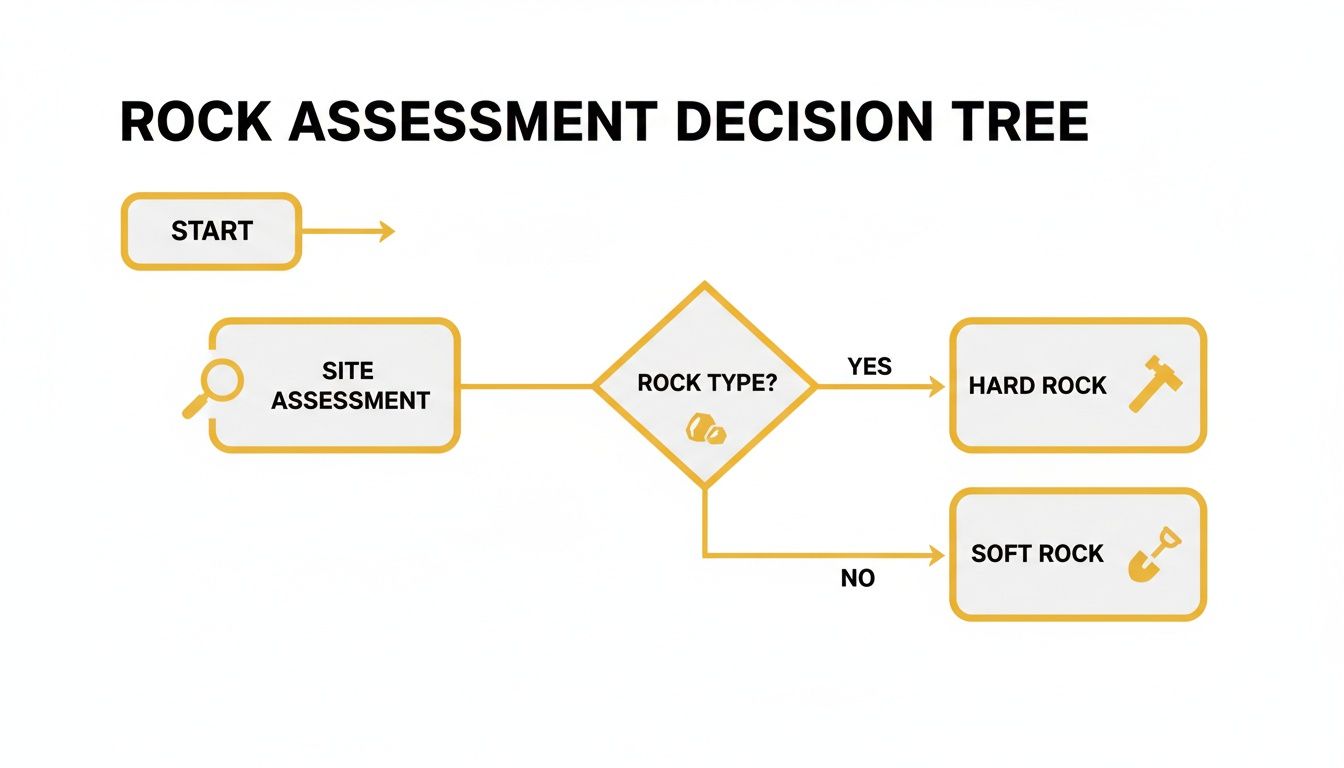
As you can see, the entire project strategy flows directly from understanding the rock's character, which then points us straight to the right equipment.
Here's a quick look at some of the most common methods we use, comparing their strengths and limitations.
Comparing Common Rock Excavation Methods
| Method | Best For | Speed and Efficiency | Precision | Common Constraints |
|---|---|---|---|---|
| Hydraulic Hammer | Detailed excavation in urban areas (pools, footings, basements). | Moderate speed, highly versatile. | High precision and control. | Noise and vibration can be a concern. |
| Ripping | Bulk earthworks on large sites with weathered or softer rock. | Very fast for bulk removal. | Low precision; not for detailed work. | Ineffective on very hard, solid rock. |
| Rock Sawing | Clean, precise cuts for trenches, boundaries, and foundations. | Slower, methodical process. | Extremely high precision. | Higher cost, can be noisy. |
| Chemical Splitting | Extremely sensitive sites where noise/vibration are forbidden. | Very slow (takes hours to expand). | High control over the break. | High cost, temperature-sensitive. |
Each of these techniques has its place, and often, the best solution for a complex site might involve a combination of methods to get the job done right.
Mechanical Breaking with Hydraulic Hammers
For the vast majority of residential and commercial projects in built-up areas like Sydney or the Central Coast, the hydraulic hammer is our go-to. Often just called a "rock breaker," this powerful attachment fits onto our excavators—everything from nimble 1.7-tonne machines for tight-access jobs up to the big 30-tonne excavators needed for bulk work.
The hammer works by smashing the rock surface with rapid, high-impact blows, fracturing it into smaller, manageable chunks that we can then easily scoop up and truck away. This method gives us fantastic control and precision, making it perfect for detailed work like swimming pools, house footings, and basement digs where you need to get right up to a boundary line without causing any damage.
Ripping for Bulk Earthworks
When we’re staring down large volumes of rippable or weathered rock, especially on bigger sites like new subdivisions or industrial estates, ripping is usually the most efficient way forward. This technique involves using a massive bulldozer (dozer) fitted with a single, giant steel tine known as a "ripper."
The dozer uses its immense weight and engine power to drag this tine through the ground, tearing the rock apart along its natural fracture lines and weaknesses. Ripping is seriously fast and effective for breaking up softer sandstones and shales, but it’s no use against very hard, massive rock formations where the tine simply can't get a grip. It’s a brute-force method designed for moving huge quantities of rock, not for fine-tuning the details.
Specialised Rock Sawing
But what happens when you need a perfectly clean, straight cut? That’s where rock sawing comes into its own. We attach a massive, diamond-tipped circular saw to an excavator, allowing us to slice through rock with incredible precision.
This method is the ideal choice for jobs like:
- Trenching: Creating neat, straight trenches for services like plumbing or electrical conduits without over-excavating. Our guide on trenching and excavation safety has more on this.
- Boundary Cuts: Slicing neatly along a property line before starting bulk excavation to prevent any disturbance to the neighbours.
- Foundations: Cutting the exact outlines for building foundations or lift shafts with millimetre accuracy.
While it's a slower and more expensive process than hammering or ripping, nothing beats rock sawing for its clean finish and minimal vibration.
Non-Explosive Chemical Splitting
In extremely sensitive environments where any vibration or noise is completely off-limits, we can turn to non-explosive chemical splitting. This clever method involves drilling a pattern of holes into the rock and then pouring in an expansive slurry, often called a "splitting agent."
Over several hours, the chemical mixture silently expands with incredible force—up to 18,000 PSI or more—creating cracks that break the rock apart from the inside out. It's a quiet, controlled, and totally vibration-free process, making it perfect for projects right next to heritage-listed buildings, hospitals, or sensitive infrastructure. It’s a great example of how modern techniques can solve tricky challenges in dense urban settings.
Understanding the True Cost of Excavating Rock
It’s the big question on everyone's mind: "So, what's it actually going to cost?" When you're dealing with excavation in rock, throwing out a simple square metre or cubic metre rate just isn't realistic without getting our boots on the ground first. The final price tag is a unique blend of factors specific to your site.
Think of it this way: digging through soft sand is one thing, but trying to get through a solid block of concrete is a different beast entirely. Rock is no different. The cost is directly tied to the difficulty of the job, which can shift dramatically from one property to the next, even within the same Central Coast suburb like Kariong or Terrigal.
Key Factors Driving Excavation Costs
The number one cost driver is, without a doubt, the rock itself. Hardness is everything. Soft, weathered sandstone that a dozer can easily rip through is worlds away from the extremely hard basalt or granite that needs relentless, intensive hammering. This resistance dictates how long the job will take and exactly what size and type of machinery we need to bring in.
Beyond the rock's personality, a few other critical elements will shape your quote:
- Volume of Material: Are we digging out a small section for pool footings, or are we carving out a basement for a new commercial building? The sheer amount of rock to be moved is a massive factor.
- Site Accessibility: Can we drive a large truck and a 20-tonne excavator straight onto your property? Or are we navigating a tight side passage in a dense Sydney suburb, which calls for mini-excavators and a lot more hands-on labour?
- Equipment Required: A job that needs a hydraulic hammer will naturally cost more per hour than one that just needs a bucket. If specialised gear like a rock saw is needed for precision cuts next to a boundary, that gets factored in too.
Getting a handle on these variables is the first step to building a realistic budget. To dive deeper, our guide offers more detail on the cost of excavation per cubic metre.
The Hidden Costs You Need to Know
The quote for just breaking the rock is only one piece of the puzzle. There are a few associated costs that often get overlooked but are absolutely essential for accurate budgeting. These aren't really "hidden" expenses—they're just a standard part of the process that needs to be on your radar from day one.
One of the biggest is haulage and disposal. All that broken rock has to go somewhere. This involves loading it onto trucks and carting it off to a licensed recycling facility or tip. The combination of these disposal fees and the trucking costs can add a substantial amount to the final bill.
Don't forget equipment float. This is industry speak for the cost of transporting heavy machinery to and from your site. Mobilising a 30-tonne excavator and all its attachments isn't a simple task; it requires specialised transport and is a necessary project expense.
Market Influences and Project Scale
Broader economic factors play their part as well. The demand for civil contracting services, especially in rock-heavy regions, can affect machinery availability and labour costs. For instance, recent data from the Australian Bureau of Statistics shows a big jump in mineral exploration expenditure, which almost always involves extensive rock excavation. This kind of activity, particularly in areas like the Hunter Valley, ramps up demand for the specialised gear and skilled operators we use. You can read more about these trends in the latest ABS mineral exploration report.
Finally, never underestimate compliance costs. Your local council or SafeWork NSW might require specific measures like vibration monitoring, dilapidation reports for the neighbours' properties, or special permits. Each of these comes with its own fee. A transparent, professional quote will always break these items down so you know exactly what you’re paying for, with no surprises.
Safety and Compliance: Getting It Right
When it comes to excavation in rock, safety and compliance aren’t just boxes to tick—they are the absolute bedrock of a successful project. The risks involved are much higher than with standard soil excavation, which means the regulations enforced by SafeWork NSW and local councils are significantly stricter.
Getting this wrong can lead to costly fines, project shutdowns, or worse, serious injuries.
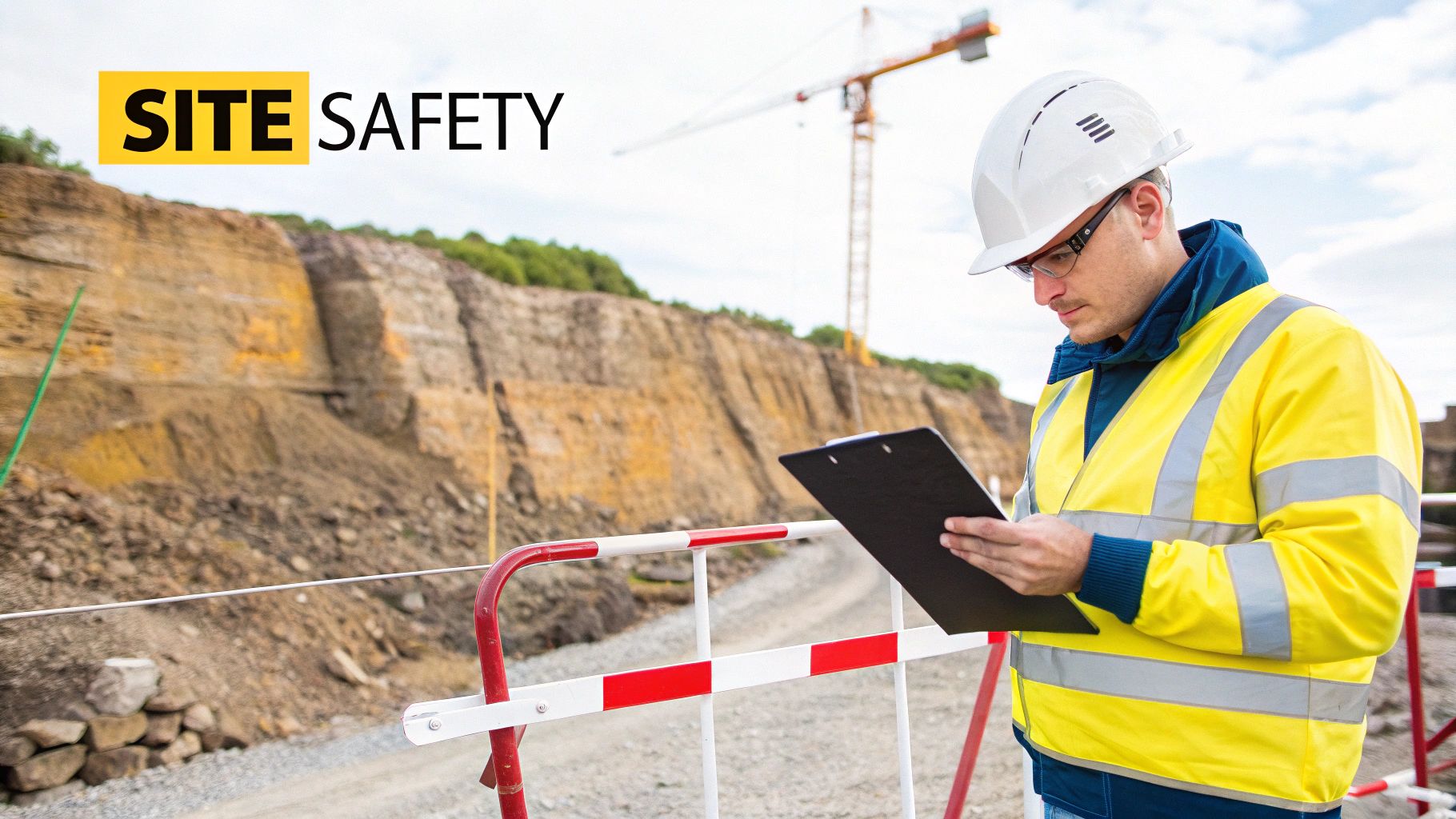
Breaking rock is a noisy, high-energy process. We're not just moving dirt; we're dealing with immense forces that can create flying debris, ground vibrations, and significant noise. That’s why our first priority is always establishing secure exclusion zones. These clearly marked areas keep everyone—workers, clients, and the public—a safe distance from the active work zone, ensuring nobody is at risk from rock fragments.
Managing On-Site Hazards
Beyond physical barriers, managing specific on-site hazards is crucial. Each risk requires a dedicated control measure to ensure the project runs smoothly and safely.
One of the most serious health risks, particularly when working with Sydney's prevalent sandstone, is exposure to respirable crystalline silica (RCS) dust. When sandstone is hammered or sawn, it releases fine silica particles into the air. If inhaled, this dust can cause permanent lung damage. To combat this, we use water suppression systems—spraying water directly onto the rock as it’s being broken—to keep dust levels to an absolute minimum and protect our team.
Noise and vibration are also major considerations. Prolonged exposure to the noise from a hydraulic hammer can damage hearing, so appropriate personal protective equipment (PPE) is mandatory for our operators. Furthermore, the vibrations can potentially affect neighbouring structures, which is why a professional approach is vital. It’s always good practice to review an essential construction site safety checklist to make sure every single base is covered.
The Importance of a Dilapidation Report
Before we even start making noise, one of the most important steps is commissioning a dilapidation report. This is a detailed inspection and photographic record of the condition of neighbouring properties before any high-vibration work begins.
A dilapidation report is your insurance policy against disputes. It provides a clear, independent baseline of any pre-existing cracks or issues, protecting both you and your neighbours by ensuring you’re only responsible for damage that can be directly attributed to your project.
Imagine you're excavating for a basement in a built-up Newcastle suburb. Without this report, a neighbour could claim that the work caused a crack that was actually there for years. The report eliminates ambiguity and is a crucial part of maintaining good community relations.
Working with Local Council Rules
Finally, every project must adhere to the specific Development Control Plans (DCPs) set by local councils, such as Central Coast Council or City of Sydney. These plans dictate critical aspects of the project, including:
- Permitted working hours (e.g., no rock hammering before 8:00 AM or on Sundays).
- Noise and vibration limits, which may require real-time monitoring.
- Traffic management plans if trucks need to access busy roads.
Navigating these regulations requires experience. It's about more than just having the right equipment; it's about understanding the local rules to keep your project compliant, safe, and on track from start to finish.
Why You Really Do Need a Specialist Rock Excavation Contractor
Look, anyone with a digger can move dirt. But when you hit rock, you're playing a completely different game. Excavation in rock isn't just a tougher version of soil excavation; it's a specialised discipline that demands unique experience, seriously heavy-duty machinery, and a problem-solving mindset forged over years of battling difficult geology.
Hiring a specialist isn't just a nice-to-have. It’s a critical investment in your project's timeline, budget, and overall success.
The real difference comes down to foresight. A general earthmover might only find out about a rock shelf when their bucket hits it with a jarring thud, bringing the entire project to a screeching halt. That’s an instant, expensive delay. A specialist, on the other hand, knows the local ground—we’ve dealt with the infamous Sydney sandstone countless times—and can see these challenges coming a mile away. This means you get a far more realistic schedule and budget from day one.
The Specialist Advantage
A true rock excavation contractor brings a few non-negotiable advantages to the table. First, we actually own and operate the right gear, like a fleet of excavators armed with powerful hydraulic hammers, rock saws, and splitters. We aren't just hiring it for the job. This means the machinery is always ready, properly maintained, and handled by a crew who knows its limits inside and out.
What’s more, our experience is your safety net for when things don't go to plan. What happens when a seam of rock turns out to be harder than the geotechnical report suggested? Or when groundwater starts pouring into the site? A specialist has been there, done that. We can adapt our methods on the fly without letting the project spiral out of control. We also know exactly how to manage the vibration, noise, and dust to keep the neighbours and local councils—like Central Coast or Newcastle—happy.
Insurance and Industry Expertise
When you're vetting a specialist, you need to look closely at their insurance. High-risk activities like rock breaking and blasting demand specific policies that go well beyond standard [general contractor insurance requirements](https://wexfordis.com/2025/06/27/general- contractor-insurance-requirements/). Your average earthmover simply won’t have this level of coverage.
The market for this kind of work is competitive, but it's also highly specialised. IBISWorld’s 2025 analysis shows there are 976 businesses in Australia's Rock, Limestone and Clay Mining industry, which tells you just how important it is to pick an operator with proven local knowledge and the right equipment.
Making the right choice isn't about finding the cheapest quote. It’s about mitigating massive financial and timeline risks and getting the job done right the first time. For a deeper dive into choosing the right team, check out our guide on finding the best excavation contractors near you.
Common Questions About Rock Excavation
We get asked about rock all the time. Here are a few of the most common questions we hear from clients across the Central Coast, Newcastle, and Sydney, along with some straight-up answers.
How Do I Know If I Have Rock on My Property Before I Start?
The only way to know for sure is to get a geotechnical investigation done. An engineer will come out, drill a few boreholes to take samples, and then put together a report that tells you everything—the type of rock, how hard it is, and exactly where it starts.
On smaller residential jobs, an experienced local contractor can often make a pretty good educated guess just by looking at the neighbouring properties and knowing the geological maps of the area. But at the end of the day, that formal report is the only guarantee and is almost always a council requirement for any significant development.
Can You Excavate Rock in a Tight Access Backyard?
Yes, absolutely. This is a classic challenge in built-up areas like Sydney and on smaller blocks all over the Central Coast. It’s something we deal with regularly.
We use specialised mini-excavators that are fitted with seriously powerful hydraulic hammers. These machines are compact enough to squeeze down narrow side paths. It's a slower process, and getting the broken rock out requires more careful planning, but it’s entirely doable with the right gear and a skilled operator who knows the ins and outs of working in confined spaces.
What Happens to All the Excavated Rock?
That really depends on the quality of the rock and what your project needs. A lot of the time, the rock can be crushed up and reused right there on-site. Think drainage material behind retaining walls, a solid sub-base for a new driveway, or even as clean fill.
This is always the best-case scenario—it's the most cost-effective and environmentally friendly option by far. If it can't be reused, the rock has to be trucked to a licensed disposal facility, which adds haulage and tipping fees to the job. We always look for ways to recycle on-site first to save you money and keep waste to a minimum.
Navigating the complexities of excavation in rock is a specialist game. If you're planning a project on the Central Coast, in Newcastle, or around Sydney, the team at Booms Up Civil is ready to help.