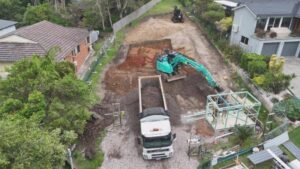

Before a single drop of concrete gets poured for that new slab, a temporary mould has to be built, and it has to be perfect. In a nutshell, that's concrete slab shuttering. It's the critical temporary structure that holds the liquid concrete in the exact shape and position you need until it cures and is strong enough to stand on its own. Getting this crucial first step right is the foundation of a successful build, and it's where our team's 15+ years of experience on the Central Coast really makes a difference.
What Is Concrete Slab Shuttering Anyway?

Think of shuttering—also called formwork—as the temporary mould that gives your concrete its final shape. It’s much more than just a simple box; it’s a precisely engineered structure designed to handle the immense outward pressure of wet concrete. Getting this step right is completely non-negotiable for the quality of your entire project.
Properly built shuttering is what separates a perfect foundation from a costly failure. It dictates the final quality of the slab, making sure it is perfectly level with clean, strong edges, and has the correct engineered thickness. This ensures the structural strength of your slab for decades to come.
The materials we use can vary a lot, depending on the job. Let's say you're building a custom-shaped patio in Terrigal with unique curves. For that, traditional timber shuttering gives us the flexibility we need for a bespoke finish. On the other hand, a huge commercial slab for a new warehouse in Tuggerah would be better suited to a modern steel or plastic formwork system for its speed and reusability.
Every material choice impacts the project’s timeline, budget, and the quality of the final finish. The complexity here is a big reason why finding the right team for your local concreting services is so important from the get-go.
The accuracy of your concrete slab shuttering directly translates to the quality and structural integrity of the final product. A few millimetres out at this stage can create significant problems for every trade that follows, from framers to tilers.
Ultimately, it doesn't matter if we're setting up for a simple granny flat slab in Wyong or a complex commercial foundation in Newcastle’s CBD—the principles are the same. The shuttering has to be strong, precise, and built to the exact specifications of the engineering plans. It sets the stage for everything that comes after.
Why Proper Shuttering is Crucial for Structural Strength
While perfectly neat edges are a great result of good shuttering, its real purpose runs much deeper. This temporary mould is the unseen foundation of your building's long-term safety and structural integrity. The quality of your formwork is directly linked to the strength and durability of the final slab, and getting it wrong can have serious, expensive consequences.
Imagine you're building a new home with a suspended slab in the Hunter Valley. This type of slab carries immense weight—not just from the tonnes of wet concrete during the pour, but from the entire structure built on top of it for decades to come. If the shuttering deflects, bows, or moves even slightly under that initial pressure, the resulting slab will be uneven, potentially thinner in some spots, and structurally compromised. This is the kind of mistake that leads to major headaches and costly rectification works down the track.
Precision is the Only Option
A professional's approach to formwork is all about applying engineering principles to a temporary structure. It’s not just about knocking a few boards together; it's a calculated process that must account for the immense hydrostatic pressure that wet concrete exerts. This pressure pushes outwards in all directions, and the formwork must be strong enough to resist it without any movement whatsoever.
The most critical aspect of concrete slab shuttering is its rigidity. Any movement during the pour becomes a permanent defect in the slab, affecting everything from floor levels to the overall stability of the building. Getting it right the first time is the only option.
This meticulous setup process is also fundamental to the slab's internal strength. For most structural slabs, steel reinforcement (rebar) is placed inside the formwork before the pour. The shuttering guarantees this steel cage is held in the perfect position, ensuring it has the right amount of concrete "cover" on all sides. This cover is vital for preventing moisture from reaching the steel and causing rust—a major cause of "concrete cancer," especially in the salty, corrosive air we see along the Central Coast.
The Foundation of a Growing Industry
The demand for high-quality concrete work is a cornerstone of Australia's construction landscape. In fact, the Australian concreting services industry has grown steadily, reaching an estimated $12.1 billion market size, driven largely by non-residential projects like warehouses, hospitals, and aged-care facilities. This growth, detailed on IBISWorld.com, highlights the ongoing need for precise foundation work where shuttering accuracy is paramount.
Ultimately, the shuttering does far more than just contain the concrete. It dictates the slab's final dimensions, thickness, and levelness, all of which are specified by a structural engineer. It also works in tandem with the initial ground preparation and foundation work. The precision required for the shuttering starts well before the first form is placed; it begins with accurate footings excavation and preparation. A solid, level base is essential for the formwork to sit correctly, ensuring the entire slab system works as designed.
Choosing the Right Materials: Timber vs. Steel Forms
When we're talking about concrete slab shuttering, the material we choose isn't just a matter of preference—it's about matching the right tool to the job. The decision has a direct knock-on effect on the project's timeline, budget, and the quality of the finished slab. Timber, steel, and modern plastic forms all have their place.
The two main players in the formwork game are traditional timber and modern engineered systems like steel or plastic. Getting your head around the pros and cons of each makes it pretty clear why we might recommend one over the other for your specific project on the Central Coast or in Sydney.
The Flexibility of Timber Formwork
Timber is the original, and still one of the most versatile, materials for shuttering. Its biggest advantage is its sheer adaptability. We can cut it, shape it, and nail it together on-site to create formwork for almost any design you can dream up.
This makes it the go-to for custom projects. Say you're building a unique home in Avoca Beach with curved retaining walls or a sunken lounge that needs fiddly steps and angles. Timber lets us build a completely bespoke mould that perfectly matches the architect's vision, something modular systems just can't do. Sure, it can be more labour-intensive, but for one-off or complex shapes, that flexibility is unbeatable.
The Efficiency of Steel and Plastic Systems
On the other side of the coin, you've got steel and plastic formwork. Made up of prefabricated panels, pins, and clips, these systems are built for three things: speed, strength, and reusability. For a massive commercial project, like a new warehouse slab in Tuggerah or a multi-level carpark in Newcastle, a modular steel system is miles more efficient.
The key benefits of steel and plastic shuttering are clear:
- Speed: Panels are quickly locked together, slashing setup and dismantling times compared to custom-building timber frames.
- Durability: Steel forms can be used hundreds of times, making them a more sustainable and cost-effective pick for large-scale or repetitive work.
- Precision: Engineered systems give you a perfectly smooth, consistent finish and are incredibly strong, minimising any risk of bulging or blowouts under the immense pressure of wet concrete.
The trade-off? Flexibility. These systems are best for straight lines and standard shapes, making them less practical for the custom curves you often see in residential projects. The upfront cost is higher too, but that's easily offset by its reusability across multiple jobs. The choice of materials for a slab is just one piece of the puzzle; similar thinking applies when you're trying to figure out the best type of concrete for your driveway.
The Shuttering Process: A Step-by-Step Guide
Understanding the theory is one thing, but seeing how concrete slab shuttering actually comes together on-site is where it all clicks. This process is a careful sequence of steps where precision is everything. We aren't just building a box; we're creating a perfectly engineered mould that has to perform under incredible pressure.
1. Site Preparation and Set-Out
The entire process kicks off long before the first formwork panel is even on site. It all starts with meticulous site preparation and excavation. We make sure the ground is perfectly compacted and levelled to the exact specifications the engineers have laid out. Only then can we accurately set out the slab’s footprint with pegs and string lines—this becomes our non-negotiable guide for the entire setup.
2. Formwork Installation and Checking Levels
Once the footprint is marked out, we get to work erecting the formwork panels. It doesn't matter if we're using custom-cut timber for a tricky residential job in Kariong or a modular steel system for a big commercial build in Somersby, the goal is exactly the same. Each panel must be perfectly plumb (that’s vertically straight) and set to the correct height.
We're constantly checking our heights with a laser level, making sure the top of the formwork is spot-on all the way around. It’s a common misconception that every slab should be perfectly level. For external slabs like driveways or alfresco areas, we must build a slight, calculated fall into the shuttering to ensure rainwater drains away from your home, preventing pooling and potential water damage.
3. Concrete Pour and Removal Timing
With the formwork braced and ready, the concrete pour can begin. During the pour, our team is constantly watching the shuttering for any signs of movement. After the concrete has cured enough to support itself, we begin the removal process, known as "striking". The timing for this is crucial. Formwork for a simple ground slab might stay in place for only a day or two, but for a suspended slab, it could be 7-14 days minimum, as specified by the engineer and Australian Standards (AS 3610).
This diagram shows how the project's scale often dictates whether we use adaptable timber or highly efficient steel formwork.
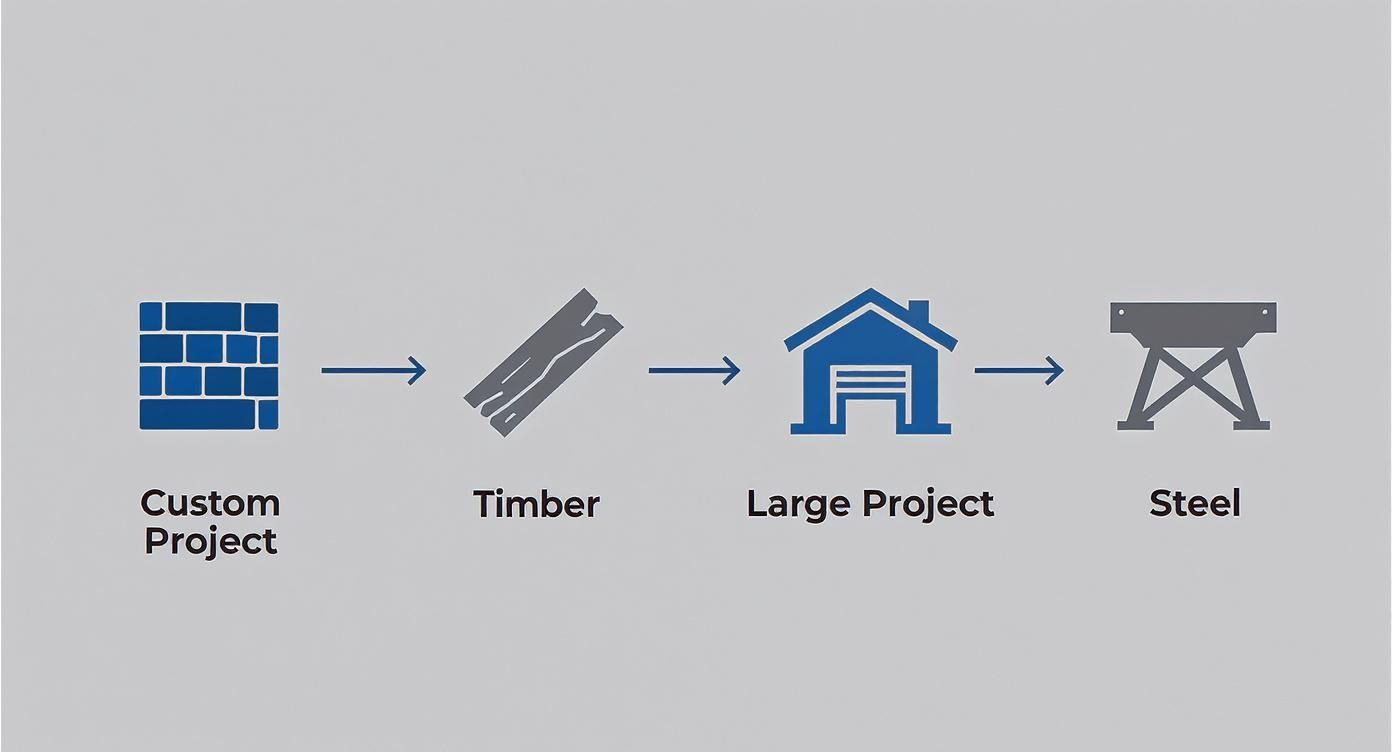
As you can see, while timber is fantastic for unique, smaller-scale designs, steel's reusability and strength make it the obvious choice for larger, more standardised construction projects.
The demand for this level of precision is growing right across Australia. The national concrete market, valued at USD 63,807.2 million, is projected to climb to USD 88,525.2 million, driven by major urban projects in cities like Sydney. This growth highlights the increasing reliance on advanced formwork systems to boost site efficiency and quality control, especially on constrained urban blocks.
Common Problems From Poor Shuttering (And How to Spot Them)

Even the most meticulously planned concrete pour can go sideways if the concrete slab shuttering isn't executed perfectly. Poorly built formwork is the root cause of everything from small cosmetic headaches to catastrophic failures that risk safety and demolish a project's budget. Knowing what can go wrong helps you spot the difference between a shoddy job and a professional setup on your own site.
Blowouts: A Costly Mess
The most dramatic shuttering failure is a blowout. This happens when the immense weight and pressure of wet concrete literally bursts a section of the formwork open. This is a clear sign the formwork was not braced strongly enough for the load, leaving you with a hazardous, expensive mess and a major project delay.
Uneven Slabs and Weak Edges
A far more common problem is an uneven or out-of-level slab. If the formwork moves or sags, the finished concrete surface will be a mess, creating a nightmare for every trade that follows. Tilers can't get floors to lay flat, and you’ll find water pooling in all the wrong spots. Weak edges that chip away easily are also the result of formwork moving or flexing during the pour.
How to Spot a Professional Setup
When hiring a contractor, it pays to know what proper shuttering should look like on your job site. A professionally braced shuttering setup should look almost over-the-top sturdy. You want to see plenty of external pegs and angled supports. There should be zero visible gaps between the panels, and the whole structure should feel rock-solid. This attention to detail prevents the common problems that stem from poor formwork.
The Importance of Safety and Timing When Striking Formwork
Getting the shuttering up is only half the battle; knowing exactly when to take it down is just as critical. This process, known as ‘striking’ the formwork, is a delicate dance governed by concrete strength and time—not the project schedule. Pull the forms too early, and you risk slumping, ugly cracking, or even a catastrophic collapse that compromises the entire slab.
The right time to strike depends entirely on the type of slab we’re dealing with. For a simple on-ground residential slab poured in a mild climate, we might be able to strip the edge forms after just 24-48 hours. But for a suspended slab that needs to support its own immense weight, that formwork has to stay put for much longer—typically a minimum of 7-14 days. The exact timing is dictated by structural engineering advice and the stringent requirements of Australian Standard AS 3610.
Safety and Compliance is Non-Negotiable
Striking formwork isn't just about yanking panels off. It requires a methodical, careful approach to ensure the safety of our team and protect the integrity of the fresh concrete. We follow a strict process, guided by SafeWork NSW principles, to dismantle the bracing and panels in a controlled, planned sequence.
This prevents any sudden load shifts that could damage the still-green concrete edges or, worse, cause injury from falling materials. Our commitment to comprehensive construction site safety guidelines is non-negotiable here. The job isn’t done until the last piece of shuttering is safely removed and the site is left clean and clear.
How Local Conditions Affect Curing Times
Weather plays a massive role in how quickly concrete cures and gains the necessary strength. A slab poured during a hot, humid Sydney summer will cure far faster than one laid on a cold, damp winter's day in the Hunter Valley.
That intense heat can accelerate the chemical reaction, but it can also cause surface cracking if the moisture evaporates too quickly. It's a balancing act we manage carefully to ensure a controlled, optimal cure. This kind of detailed management is also vital for other critical ground engineering tasks, as you can see in our guide on shoring for excavation projects.
The importance of skilled labour in shuttering can't be overstated. This commitment to best practices, for both timing and safety, ensures your project's foundation is rock-solid from pour day to final handover.
Got more questions or need a professional team for your project on the Central Coast, Sydney, or Newcastle? Give Booms Up Civil Group a call. We're here to help you get it right the first time.