

It’s easy to dismiss the humble concrete kerb as a simple finishing touch, but in civil and residential construction, it’s one of the hardest-working elements of your project. A professionally installed concrete kerb is one of the most important elements protecting your pavement, ensuring its structural integrity and long-term value.
Why a Concrete Kerb Is Your Project's Unsung Hero
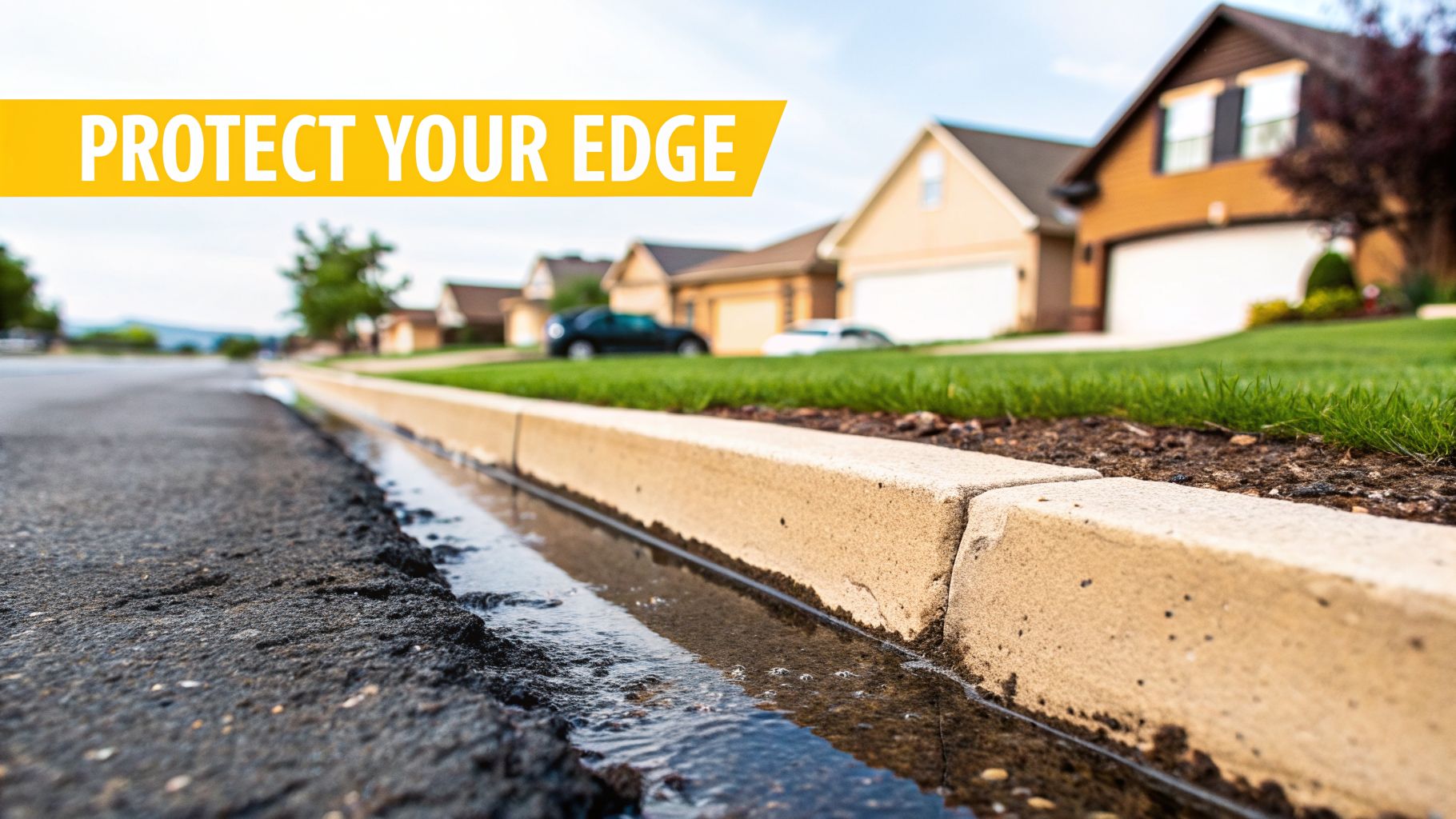
Most people don’t give a second thought to the concrete edge lining their street or carpark. But for any project, from a new driveway on a leafy Sydney block to a large commercial carpark on the Central Coast, the kerb serves two absolutely critical functions.
Understanding these roles is key to appreciating why getting your kerbing right the first time isn't just a good idea—it’s a non-negotiable part of quality construction.
The Dual Role of a Concrete Kerb
First and foremost, a concrete kerb provides structural support. We think of it as a rigid frame for your pavement, whether you’re working with asphalt or concrete. Without this solid edge, the sides of the pavement are exposed and incredibly vulnerable to crumbling and breaking apart under the weight of vehicles. This is especially true in heavy traffic areas where repeated pressure will quickly destroy an unsupported edge.
Its second major job is water management. A well-designed kerb and gutter system is the backbone of effective stormwater drainage. It works to capture rainfall and channel it toward designated drainage points like pits and outlets. This prevents water from pooling on the surface or, even worse, seeping underneath the pavement where it can erode and destabilise the sub-base—a common and costly problem in areas with heavy downpours like Newcastle and the Hunter Valley.
Think of it this way: A concrete kerb is to your driveway or carpark what a foundation is to your house. It provides the stability and protection needed to ensure the structure above it lasts for decades without failing.
More Than Just an Edge
Beyond its structural duties, a concrete kerb is also a vital tool for safety and organisation. It creates clear, physical boundaries for roadways, driveways, and parking bays, which helps guide both drivers and pedestrians. This is crucial for maintaining order and preventing accidents in busy environments. A properly built kerb can physically stop a car from rolling onto a footpath or into a garden bed.
With over 15 years of experience across the Central Coast and surrounding regions, our team at Booms Up Civil has seen the direct consequences of poorly installed or non-existent kerbing. It almost always leads to premature pavement failure, chronic drainage issues, and expensive repairs down the line. That’s why we insist on a professional approach that meets all relevant council specifications and Australian Standards, ensuring your project is built for longevity and compliance from the ground up.
Choosing the Right Kerb Profile for Your Project
Think all concrete kerbs are the same? Think again. The specific shape and size of a kerb—what we in the industry call its ‘profile’—is far more than just a cosmetic choice. It’s a crucial engineering decision.
Each profile is designed for a very specific job, whether that’s physically stopping a car from leaving the road or allowing a vehicle to roll over it smoothly. Getting this choice wrong from the outset can cause all sorts of headaches, from damaged tyres and poor water flow to failing to meet council requirements.
Quick Guide to Common Kerb Profiles and Their Uses
To help you match the right concrete kerb to your project, here’s a quick breakdown of the most common profiles you’ll see across the Central Coast, Newcastle, and Sydney.
| Kerb Profile | Ideal For | Key Feature |
|---|---|---|
| Barrier Kerb | Carparks, main roads, school zones | A high, steep face designed to stop vehicles. |
| Mountable Kerb | Residential driveways, access points | A low, sloped face for easy vehicle crossover. |
| Semi-Mountable | Collector roads, industrial areas | A moderate height that deters but allows access if needed. |
| Kerb and Gutter | New subdivisions, council roads | An integrated system for superior drainage and strength. |
This table is a starting point, but let’s dig into what makes each profile tick and where they perform best.
Barrier Kerbs for Control and Safety
The barrier kerb is the workhorse you’ll see lining busy roads and commercial carparks. These are intentionally tall, with a steep, almost vertical face. Their job is simple: to create a hard, unmissable boundary that physically prevents vehicles from mounting the kerb.
Imagine a bustling shopping centre carpark in Newcastle or a school zone in a suburb like Erina. A barrier kerb is absolutely non-negotiable here. It acts as a powerful visual and physical deterrent, protecting pedestrians, garden beds, and buildings from vehicle impacts. Safety and clear traffic separation are its top priorities.
Mountable Kerbs for Easy Access
At the other end of the spectrum is the mountable kerb, often called a roll kerb. This profile has a distinctive gentle, sloping face. It’s designed specifically to allow vehicles to drive over it at low speed without scraping their tyres or damaging their undercarriage.
This is the standard profile for residential driveway crossovers. If you’re building a new home in Terrigal or planning a new driveway for your property in Woy Woy, a mountable kerb is what you’ll need. It creates a seamless transition from the street to your land, ensuring easy access while meeting local council standards. For more on how a great driveway finish complements your kerb, check out our guide to concrete driveways.
The key difference is simple: a barrier kerb says "stop," while a mountable kerb says "cross here." Choosing the right one depends entirely on how you need vehicles to interact with the edge.
Semi-Mountable Kerbs and Integrated Kerb and Gutter
Sitting squarely in the middle is the semi-mountable kerb. It’s a hybrid, offering a face that’s steeper than a mountable kerb but not as aggressive as a full barrier profile. You’ll often find this design along collector roads where day-to-day traffic needs to be contained, but occasional access for service vehicles might be required.
Finally, we have the kerb and gutter system. This isn’t just a kerb; it’s a single, integrated unit where the kerb and the concrete water channel (the gutter) are formed and poured as one solid piece. This is the gold standard for most new subdivisions across the Hunter Valley and for virtually all council roadworks.
Why? Because it’s the most durable and effective solution for managing stormwater. The seamless design captures runoff efficiently and funnels it directly into the drainage system, preventing water from undermining the pavement and causing long-term damage.
The Professional Concrete Kerb Installation Process
Ever watched a kerbing crew at work and wondered how they get that perfect, continuous line of concrete? It’s a job that looks simple from a distance but relies on a huge amount of precision, the right gear, and a solid understanding of how the ground beneath it will behave.
A professional installation is much more than just pouring concrete into a shape. It's a carefully staged process, designed from the ground up to create a kerb that will hold its form and function for decades, whether it’s for a new subdivision in the Hunter Valley or a busy commercial carpark in Sydney.
Step 1: Site Preparation and Excavation
Before a single drop of concrete is even considered, the real work begins. This is, without a doubt, the most important stage of the entire job. The strength and lifespan of a concrete kerb are only as good as the ground it sits on.
The first call we make, every single time, is lodging a Dial Before You Dig enquiry. This isn't just good practice; it's a non-negotiable safety requirement to locate all underground utilities like water pipes, gas lines, and communications cables. Hitting one of these services can be disastrous and expensive, so no excavator bucket hits the soil until we have the all-clear.
Next, our team uses survey equipment to set out the exact line and level for the new kerbing. This ensures the finished product will direct water exactly where it needs to go—a critical detail on sloping sites or for large-scale stormwater systems required by councils like Central Coast Council. Only then do we start the excavation, digging a trench to the specified depth and width, and making sure the sub-base is solid, properly compacted, and ready for the next step.
Step 2: Formwork and Reinforcement
With the ground perfectly prepared, it's time to create the 'mould' for the concrete. For concrete kerbing, this is typically handled in one of two ways: with traditional formwork or, more commonly, with a specialised kerb extrusion machine.
Traditional methods involve building a frame from timber or steel to form the kerb profile. We often use this technique for shorter runs, custom one-off shapes, or in tight-access areas where a large machine simply won't fit. If you're interested in the finer points of how formwork is used to contain and shape concrete, you can find out more about how shuttering supports concrete structures in our guide to concrete slab shuttering.
For most of our commercial and civil projects, however, we use a kerb extrusion machine. This impressive piece of equipment has the form, or mould, built right into it. As the machine travels along the prepared path, it's fed concrete from a truck and extrudes it in a perfect, continuous profile. This method is incredibly fast and delivers a smooth, highly consistent finish that's hard to beat over long distances. For industrial jobs where the kerb might take a few knocks, we might also place steel reinforcing bars inside the formwork to give it extra tensile strength.
This visual guide shows how different kerb types are suited for specific functions, from stopping cars to allowing gentle access.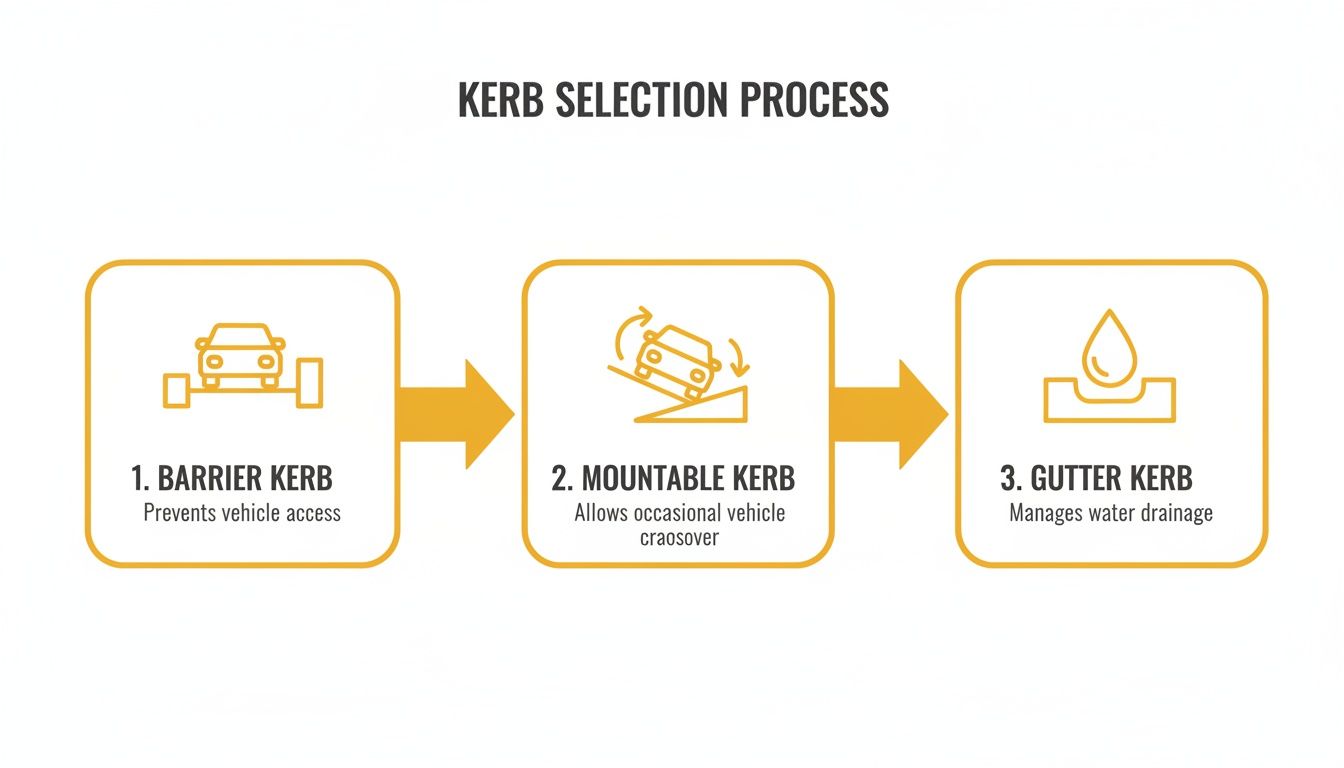
As the diagram shows, choosing between a barrier, mountable, or gutter kerb comes down to its primary job—whether that’s traffic control, vehicle access, or drainage management.
Step 3: The Concrete Pour and Finishing
With all the prep work done, it's time for the main event. A concrete agitator truck arrives on-site with a mix that’s been specifically designed for kerbing. It needs to have just the right consistency, or 'slump', to hold its shape perfectly as it emerges from the extrusion machine.
Our operator feeds the concrete into the machine and expertly guides it along the string lines we set out earlier. As it extrudes the concrete, the machine also compacts it, creating a dense and incredibly strong profile. This continuous pour is what gives the kerb its seamless appearance and structural integrity.
Immediately after the machine passes, our finishing crew gets to work. Using specialised trowels, they hand-finish the surface to get it perfectly smooth and clean. This is a real craft that takes a skilled hand to get a flawless, professional look.
Step 4: Curing and Control Joints
The final, and often most underestimated, stage is curing. Fresh concrete doesn’t just ‘dry’ out; it hardens through a chemical reaction called hydration. To reach its maximum design strength, the concrete needs to be protected from drying too fast, especially on a hot, windy day on the Central Coast. We typically apply a curing compound, which creates a thin membrane over the surface to lock in moisture.
Within 24 to 48 hours, we come back to saw-cut control joints at regular intervals along the new kerb. Concrete naturally expands and contracts with changes in temperature. These cuts create a planned weak point, encouraging any future cracking to happen neatly inside the joint, rather than randomly across the face of the kerb. It’s a small step, but it’s absolutely vital for the long-term looks and structural health of the entire job.
Understanding the Costs of Concrete Kerbing
It’s the first question on every client’s mind: "So, how much is my concrete kerb going to cost?" And while a simple price-per-metre would be ideal, the reality on the ground is that every project has its own unique set of challenges. A professional quote isn't just a number; it's a reflection of the specific conditions of your site.
Getting a handle on these variables is the key to creating a realistic budget and understanding exactly where your money is going. Let's dig into what really drives the cost of a professional kerbing job.
Length and Profile Are Just the Starting Point
Naturally, the total length of the kerb, measured in linear metres, is a major component of the price. A longer run means more materials and more labour hours. But that’s only scratching the surface.
The specific kerb profile you choose also plays a big role. A basic, mountable kerb uses less concrete and is often faster to form than a larger, more involved kerb and gutter system. More complex profiles require a higher degree of skill from both the machine operator and the finishing crew, and that’s reflected in the final cost.
Why Site Complexity Matters Most
Beyond the basic length and profile, the single biggest factor influencing the final price is site complexity. This is a catch-all term for everything from the state of the ground to how easily we can get our machinery into the work area. A simple job on a flat, clear block in a new estate will always be more affordable than a project on a steep, tight-access site.
A job on a steep, rocky block in a suburb like North Avoca will always require more intensive labour and specialised equipment than a flat, clear site in Warnervale. This preparation work is the foundation of a long-lasting kerb and is a crucial part of the overall cost.
Here are a few common scenarios that add complexity, labour, and cost to a project:
- Difficult Access: Can we get a concrete truck and the kerbing machine right up to the edge of the job? If the answer is no, we’re looking at using concrete pumps or even wheelbarrows to move the material, which dramatically increases labour time.
- Steep Slopes: Working on an incline isn’t just harder work for the crew. It demands a much more meticulous setup, careful planning for concrete flow, and more intensive finishing to get a perfect, uniform result.
- Poor Ground Conditions: If the subgrade is soft, unstable, or full of rock (like much of Sydney’s sandstone bedrock), extensive site preparation becomes non-negotiable. This could mean extra digging, importing and compacting new roadbase, and potentially bringing in specialised excavation machinery. For a deeper look at what drives these costs, check out the cost of excavation per cubic metre in our detailed guide.
- Removal of Old Kerbing: If there’s a failing concrete kerb that needs to go, the job now includes demolition, loading out the debris, and paying tip fees for disposal.
Ultimately, a proper quote from an experienced team like Booms Up Civil will account for all these factors. It gives you a transparent breakdown, ensuring there are no nasty surprises and that your investment results in a professional, compliant, and durable kerb that’s built to last.
Navigating Council Rules and Australian Standards
Getting your concrete kerb installed properly isn't just about achieving a neat finish—it's about making sure the project is safe, legal, and built to last. Across NSW, this means getting your head around a combination of local council rules and broader Australian Standards.
Getting this right is the difference between a successful project and a costly headache involving council fines or orders to rip it all out and start again. It’s easy to think a kerb is just a simple strip of concrete, but for councils, it’s a critical piece of public infrastructure that manages stormwater, defines boundaries, and keeps people safe. That’s why they have very specific requirements, and they can change dramatically from one council area to the next.
The Role of Australian Standards
At a national level, Australian Standards provide the technical backbone for quality construction. They set the non-negotiable minimums for materials, design, and workmanship, ensuring everything built is safe and durable.
For concrete kerbing, especially in commercial or public spaces, several standards come into play. The most common one we work with is AS 2890, which covers off-street parking facilities. If you're building a new carpark in Newcastle or Sydney, this standard dictates everything from the dimensions of parking bays to the specific kerb profile needed to safely control vehicle movement. Following these standards isn’t a choice; it’s a core part of any compliant build.
How Local Council Rules Differ
This is where things get really specific to your site. While Australian Standards set the framework, it’s your local council that dictates the exact rules for your suburb. A concrete kerb that’s perfectly fine in one area could be completely non-compliant just a few kilometres down the road.
For instance, the Central Coast Council has incredibly detailed specifications for residential driveway crossovers, which they call a "vehicular crossing." They specify the exact mountable kerb profile, the required concrete strength, and precise dimensions to ensure public footpaths aren't compromised. You can learn more about concrete crossovers in our dedicated guide for an in-depth look at these rules.
Move over to the Hunter Valley, and a developer working on a new subdivision will find that Newcastle Council’s main concern is how the new kerb and gutter system plugs into their broader stormwater management plan. They’ll have strict requirements for invert levels, water flow, and connection points to the public drainage network.
Key Takeaway: Never, ever assume the rules are the same everywhere. A contractor who suggests a "one-size-fits-all" approach to kerbing is waving a massive red flag. A true professional always checks the specific engineering drawings and local council specifications before a single tool comes out.
Do You Need a Development Application?
So, does this all require a full-blown Development Application (DA)? It depends.
For most minor residential kerb works, like repairing a section of your driveway crossover, you'll likely only need a permit from the council, not a full DA. However, for larger projects—new commercial carparks, subdivision roads, or any significant change to public infrastructure—a DA is almost always mandatory.
Your DA submission will need to have detailed plans showing the proposed kerb layout, profiles, levels, and how it all connects to existing infrastructure. This is where partnering with a contractor who is fluent in these local rules becomes absolutely essential. With over 15 years of experience working directly with councils across the Central Coast, Sydney, and Newcastle, we know exactly what they need to see for a smooth, fast approval.
How to Choose the Right Kerbing Contractor
When it comes to a concrete kerbing project, hiring the right team is the single most critical decision you'll make. The quality of the finish, its long-term durability, and whether it passes council inspection all come down to your contractor’s experience.
A great contractor anticipates and prevents problems before they start. A poor choice, on the other hand, can quickly lead to expensive rework, delays, and serious compliance headaches with your local council. Choosing the right partner isn’t about chasing the lowest price—it's about finding the best value and securing the right expertise for your job.
Verify Licences and Insurance First
Before you dive into the specifics of your project, the very first step is to check their credentials. Any professional, reputable contractor will have no issue providing current copies of their licences and insurance certificates. This is completely non-negotiable.
You need to ask for proof of three key documents:
- A current contractor's licence that is relevant to the type of work being done.
- Public Liability Insurance to cover any accidental damage to property during the project.
- Workers Compensation Insurance to protect you from any liability if a worker gets injured on your site.
Think of this as your first line of defence. If a contractor is hesitant or makes excuses about providing these documents, it’s a massive red flag. Walk away immediately.
General Concreter vs. Civil Kerbing Specialist
Not all concreters are created equal, and this is especially true when it comes to kerbing. A general concreter might be fantastic at pouring a residential slab, but they often don’t have the specialised machinery needed for high-quality, continuous kerbing.
A generalist might try to get by with hand-forming the kerb. This method is not only slow but almost always results in an uneven, inconsistent finish that won't stand up to scrutiny.
In contrast, a specialist civil contractor like Booms Up Civil owns and operates a kerb extrusion machine. This is the non-negotiable tool for the job. It produces a dense, perfectly uniform, and structurally sound concrete kerb that meets the strict specifications required for council roads, carparks, and subdivisions.
Ask a potential contractor one simple question: "Do you use a kerb extrusion machine for projects like this?" Their answer tells you everything you need to know about whether they're a true specialist or just a generalist trying to make it work.
Experience with Your Local Council Matters
Another crucial question to ask is about their direct experience with your specific local council’s engineering standards. As we’ve covered, the rules and required profiles can vary significantly between Central Coast Council, Newcastle Council, or the various councils across the Sydney basin.
A contractor who regularly works in your area already knows the required kerb profiles, drainage levels, and crossover designs inside and out. This local knowledge is invaluable. It streamlines the approval process and ensures your project is compliant from the get-go.
Ask to see photos or addresses of their previous jobs in your council area. A reputable contractor will be proud to show off their local work. When you're ready to select a contractor, reviewing their list of available professional concrete kerbing services can help ensure they meet your specific project requirements.
Making a confident hiring decision comes down to doing your due diligence. By verifying their credentials, confirming they have the right machinery, and gauging their local experience, you set your project up for success. To see how these principles apply to other concrete projects, check out our guide on finding concreting services near you.
Your Top Concrete Kerbing Questions Answered
To finish up, let's tackle some of the common questions we hear from clients across the Central Coast, Sydney, and Newcastle. Getting these final details clear can make all the difference when you're planning your project.
How Long Does a Concrete Kerb Need to Cure?
This is probably the most-asked question, and for good reason. A new concrete kerb needs time to cure and build its strength. As a general rule, you should keep light vehicles like cars off a new driveway crossover for at least 7 days.
While the concrete gains most of its structural integrity in that first week, it actually continues to harden and cure for 28 days or more. For council roads, high-traffic commercial zones, or areas that will see heavy vehicles, it’s always best to wait longer. Your contractor will give you specific advice for your site based on the concrete mix and the loads it will need to handle.
Can You Install a Concrete Kerb on a Slope?
Yes, and in many cases, you absolutely should. In fact, managing water on sloping sites is one of the most important jobs a concrete kerb has. Whether you're on a hilly block in Terrigal or inland, a properly installed kerb is critical for controlling water flow and stopping erosion in its tracks.
Putting a kerb on a slope is a specialist task. Our team uses survey equipment to get the levels and falls perfect, making sure every drop of water is channelled exactly where it needs to go – into the stormwater system and away from your property. Trying to eyeball this is a recipe for pooling water and bigger problems down the track.
What Happens If My Kerb Cracks Over Time?
It's a smart question, and the answer comes down to professional installation. A properly laid concrete kerb will always have control joints—those neat, straight cuts you see at regular intervals. They aren't a mistake; they're put there on purpose.
These joints are designed to give the concrete a predictable place to crack as it naturally expands and contracts with temperature changes.
Minor hairline cracks in these control joints are completely normal and don’t affect the kerb’s strength. But if you start seeing large, jagged cracks appearing elsewhere, it could signal a problem with the foundation underneath. If that happens, it’s worth getting it looked at by a professional.
Getting the job done right from day one is the best way to save yourself time and money. If you’ve got more questions or want some expert advice for your specific site, our team is always here to help.
For a professional assessment of your project on the Central Coast, Sydney, or Newcastle, get in touch with Booms Up Civil Group. We provide clear advice and detailed quotes to ensure your project is a success. Contact us today through our online form or give us a call.