If you’ve been searching for ‘retaining wall installation near me’, you already know this is a bigger job than just stacking a few blocks. It’s about finding a local expert who gets our unique ground conditions—from the sandy soils of the Central Coast to the reactive clays up in the Hunter Valley. This guide is your starting point for getting it done right.
Your Guide to Local Retaining Wall Installation
We’re going to walk you through the entire process from a practical, on-the-ground perspective, sharing the kind of advice we’ve given clients for over 15 years. This isn’t just theory from a textbook; it’s about making smart decisions now that will prevent major headaches down the track.
A well-built retaining wall does so much more than just hold back soil. It can completely transform a sloping block into usable, functional space, stop damaging soil erosion in its tracks, and seriously improve your property’s drainage and overall value. For a wider view of the building process, you might explore dedicated construction services to see how all the pieces fit together.
What This Guide Covers
Think of this guide as the essential briefing you need before any work begins. It’s all about making sure the job gets done right, the first time. We’ll be covering:
- Critical First Steps: We’ll show you how to assess your property’s specific needs, whether that’s taming a steep block in Terrigal or dealing with serious runoff in a Newcastle backyard.
- Navigating Council Regulations: We’ll demystify the process for dealing with Central Coast Council, Hornsby Shire Council, and others, so approvals don’t become a frustrating bottleneck.
- Choosing the Right Materials: From cost-effective timber to durable concrete sleepers and timeless sandstone, we’ll break down which materials suit different environments and budgets.
- Hiring the Right People: Understanding the difference between a general landscaper and a licensed structural wall builder is crucial. You can dive deeper into this by checking out our guide on finding the best retaining wall contractors near you.
This is your roadmap to a successful project. It’s designed to give you the confidence to ask the right questions and make informed choices from start to finish.
Navigating Council Rules and Site Realities First

Before a single shovel hits the dirt, the most critical work on any retaining wall project happens on paper and on-site. Getting this part wrong is the fastest way to face frustrating delays, spiralling costs, and even council-ordered tear-downs. It’s tempting to jump straight into choosing block colours and styles, but the real first step is understanding what your local council demands and what your property truly needs.
Nailing this planning stage is non-negotiable for the wall’s long-term safety and stability. In Australia, retaining wall failures are a serious concern, and they often stem from problems that should have been caught early. A shocking number of walls run into structural issues within their first five years, usually because of poor drainage, miscalculated loads, or shoddy installation—all things a solid plan addresses upfront.
Understanding Council Requirements
Here in NSW, a solid rule of thumb is that any retaining wall over one metre high will need council approval. The same goes for a wall of any height that’s propping up a significant load, like a driveway, building, or swimming pool. This isn’t just bureaucratic red tape; it’s a legal requirement to keep your property—and your neighbours’—safe.
Let’s imagine a common scenario: you’re planning a beautiful tiered garden on a sloping block in Gosford. Even if each individual wall is under a metre, the Central Coast Council might view the whole thing as a single, combined structure. This could easily trigger the need for a formal Development Application (DA) and a structural engineer’s design.
A quick phone call to your local council, whether it’s Newcastle City Council or Hornsby Shire Council, can clarify their specific rules. That single conversation can save you thousands in potential fines or the heartbreak of having to rebuild.
For a deeper dive, check out our guide on the essential retaining wall regulations in NSW, which breaks down the key planning policies you need to know.
The On-Site Assessment
Once you’ve got a handle on the paperwork, a thorough site assessment is the next critical step. This is where we look beyond the plans and get our boots on the ground to understand the unique conditions of your land. This isn’t just a quick glance; it’s a detailed analysis that shapes every decision, from the wall’s design and materials to the construction methods we’ll use.
Key factors we investigate include:
- Soil Type: The ground itself dictates so much of the design. Are we dealing with the sandy, easy-draining soil common along the Central Coast beaches, or the heavy, reactive clay you find further inland toward the Hunter? Each soil type demands a completely different approach to the footing depth and drainage system.
- Water Runoff: Where does water go when it pours down? We need to map the natural flow paths to engineer a drainage system that prevents hydrostatic pressure. This build-up of water behind the wall is the single biggest enemy of any retaining structure.
- Site Access: How are we getting machinery and materials in and out? A tight-access site in a dense Sydney suburb requires vastly different equipment and logistics compared to an open block out in the Hunter.
- Underground Services: The final, non-negotiable check is a call to Dial Before You Dig. This free national service gives us maps of all underground pipes and cables—water, gas, communications—ensuring our excavation work is done safely and avoids incredibly costly damage.
Choosing the Right Materials for Your Project
The material you choose for your retaining wall is easily one of the biggest decisions you’ll make. It’s a call that directly shapes the final look, the overall budget, and, most importantly, how long the wall will stand.
A material that’s perfect for a low, decorative garden wall in Newcastle just won’t cut it for a critical structural wall holding up a driveway on a steep Sydney block. Thinking through your options isn’t just about aesthetics; it’s a hard-nosed practical choice that ripples through the entire installation.
Let’s break down the common materials we work with every day across the Central Coast and surrounding regions, so you can make a call you’ll be happy with for years to come.
Treated Timber Sleepers
Treated timber sleepers are often the first thing people think of for DIY projects and smaller garden walls, mainly because they’re easy on the wallet and relatively simple to handle. They offer a rustic, natural vibe that blends nicely into a lot of backyard landscapes, especially for retaining walls under one metre high.
But you have to be realistic about their lifespan. Even quality treated pine has a use-by date, typically around 15-20 years, before rot or termites become a serious problem. For a property in a damp spot, like a coastal suburb such as Avalon Beach, you might see them start to fail even sooner, making them a poor choice for any long-term structural support.
Concrete Blocks and Sleepers
Engineered concrete blocks and sleepers have absolutely boomed in popularity, and for good reason. They’re strong, uniform, and offer a clean, modern aesthetic that suits a lot of new homes and commercial builds.
Because they’re manufactured, the design flexibility is huge—you’ve got a massive range of colours, textures, and finishes to choose from. The biggest plus, though, is their sheer durability. When we install them correctly with the proper steel reinforcement and concrete footings, these walls can last 40-60 years, or even longer. They are a rock-solid choice for taller walls or those needing to hold back a serious amount of soil. Their consistent shape also means the installation is faster and more predictable than working with natural stone.
Key Takeaway: The decision between timber, concrete, and sandstone isn’t just about the upfront cost. You need to weigh the material’s lifespan, maintenance needs, and how well it suits your property’s specific environmental conditions.
Natural Sandstone Blocks
For a truly timeless look that feels perfectly at home in the Australian landscape, nothing beats natural sandstone. From the iconic Hawkesbury sandstone you see all around Sydney to the beautiful tones we source for projects on the Central Coast, this material gives a wall unmatched character.
Each block is unique. It’s that organic, natural appearance you simply can’t fake with a manufactured product. The rich colours and textures add a premium feel to any property.
While the initial investment for sandstone is higher, its incredible lifespan makes it a smart long-term choice. A well-built sandstone retaining wall, complete with robust drainage, can easily last well over 100 years. It’s exceptionally tough and stands up to everything our climate can throw at it, including the harsh sun and coastal salt spray.
The sheer weight and size of sandstone blocks mean they require heavy machinery to place, making professional installation a must. But that mass is also its greatest strength, creating an incredibly stable gravity wall that isn’t going anywhere. If you’re interested in the nuts and bolts, our guide on sandstone retaining wall design dives deeper into how these beautiful structures come together.
To help you visualise the trade-offs, here’s a quick comparison of the materials we commonly use for retaining walls in the Central Coast, Sydney, and Newcastle.
Retaining Wall Material Comparison
| Material Type | Typical Lifespan | Aesthetic | Best Suited For |
|---|---|---|---|
| Treated Timber | 15-20 Years | Rustic, Natural | Low garden walls, non-structural decorative features, and DIY projects. |
| Concrete Blocks | 40-60+ Years | Modern, Uniform | Taller structural walls, engineered solutions, and contemporary home designs. |
| Natural Sandstone | 100+ Years | Timeless, Organic | Premium feature walls, heritage properties, and projects needing ultimate longevity. |
Ultimately, the right material balances your budget today with your vision for the property tomorrow.
Once you have a better feel for materials, it’s worth exploring the different types of retaining walls, their advantages, and disadvantages to see how these materials are used in various construction styles. This broader knowledge helps ensure you’re making the absolute best choice for your property’s needs and your long-term vision.
The Construction Process From Excavation to Backfill
Once your materials are locked in and the plans get the green light, the real work begins. A quality retaining wall build follows a strict sequence of events, and let me tell you, rushing any of these steps is a surefire recipe for disaster. We’ve all seen those sagging, bowing walls—that’s what happens when corners are cut. Over hundreds of projects on the Central Coast, we’ve dialled this process in to make sure every stage is done right the first time.
It all starts well below ground level, with the excavation. This is more than just digging a trench; it’s about crafting a perfectly level and rock-solid foundation for the entire structure.
Setting a Solid Foundation With Excavation
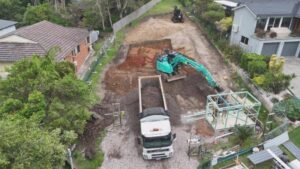
The footing is, without a doubt, the most critical part of the whole build. We begin by excavating a trench to the exact depth and width specified in the engineer’s design. This depth isn’t a suggestion—it’s non-negotiable and can change dramatically depending on the ground conditions at your site.
For instance, a job on a sloped block in Hornsby might mean digging into Sydney’s classic, solid sandstone bedrock, which gives us a fantastic natural base. But head up to the Hunter Valley, and we often hit reactive clay that expands and shrinks with every bit of moisture. On clay, we have to dig deeper and lay a much thicker, compacted road base to create a stable platform that won’t move. You can get a better sense of these challenges by reading about our local excavation services and how we adapt on the fly.
Why It Matters: An inadequate footing is like building a house on sand. If the base isn’t deep, wide, and compacted enough for your specific soil type, the wall you build on top of it will inevitably shift, settle, and fail. It’s just a matter of time.
Building the Wall Course by Course
With a solid footing prepared, it’s time to start building the wall itself. The technique obviously changes depending on the material you’ve chosen, but the core principles of precision and strength are always the same.
For a concrete sleeper wall, this means setting galvanised steel posts perfectly plumb and level in concrete footings. After the concrete cures, we carefully slide the heavy sleepers down into the channels, making sure every single one has a snug fit. If you’ve gone for a natural sandstone wall, our excavator operator becomes a master puzzle-solver, carefully lifting and placing each massive block to lock them together into an incredibly strong gravity wall.
Modern machinery has been a game-changer here, making the placement of these heavy materials not only safer but also much faster. This efficiency is what makes a professional job stand out. This infographic breaks down the key factors—cost, lifespan, and aesthetics—that go into choosing the right material for your wall.
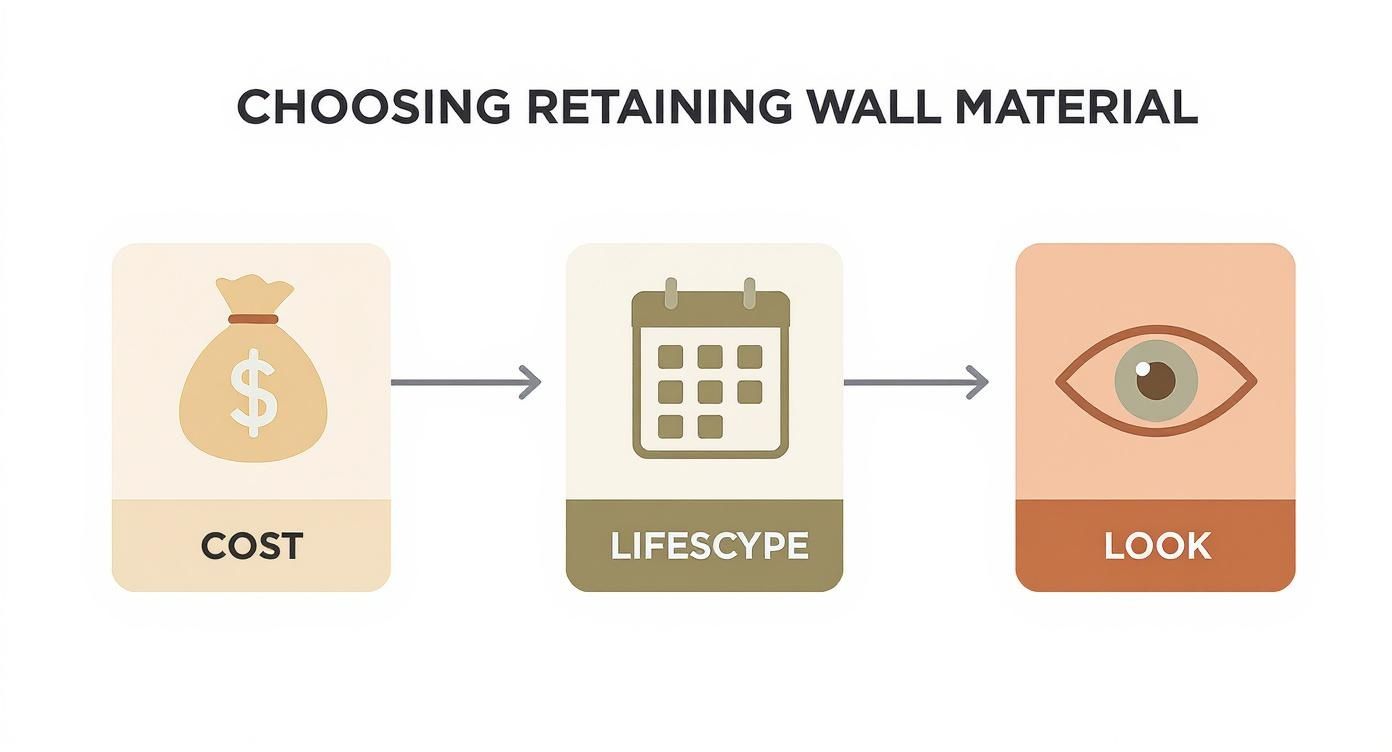
As you can see, materials like sandstone might have a higher upfront cost, but they deliver a far greater lifespan and a unique look that other options just can’t match.
The Critical Role of Drainage
Here’s a reality check that surprises a lot of homeowners: most retaining walls don’t fail because of the weight of the soil. They fail from the immense pressure of water trapped in that soil. This is called hydrostatic pressure, and it can push a wall over with incredible force.
Proper drainage is the only defence. Behind every single wall we construct, we install a purpose-built drainage system. This usually involves:
- An agricultural pipe (ag-pipe) running along the base of the wall to collect water.
- A layer of geofabric textile wrapped around the drainage material to stop silt and soil from clogging it all up.
- Free-draining aggregate, like blue metal gravel, which allows water to flow straight down to the pipe.
This combination creates a clear exit path for groundwater, relieving that dangerous pressure and guaranteeing the wall’s stability for the long haul. Honestly, skipping this step is the number one mistake we see in failed DIY walls.
Backfilling and Compaction
The final structural piece of the puzzle is the backfill. This involves carefully filling the space behind the new wall with the right material—it’s not just a matter of dumping all the excavated dirt back in.
We backfill in controlled layers, or ‘lifts’, usually about 200-300mm at a time. Each lift is then mechanically compacted to squeeze out any air pockets and ensure the soil becomes dense and stable. This crucial step prevents the ground from settling down the track, which would create voids and compromise the wall’s integrity.
Once the backfilling and compaction are done, we clean up the site, and the area is ready for whatever you have planned next—turf, gardens, or paving. Your new, solid retaining wall is officially ready to do its job for decades to come.
Understanding the Real Costs of a Retaining Wall
When you ask for a quote on a new retaining wall, the final figure you see is much more than just the wall’s length and height multiplied by a standard rate. A professional quote is a careful calculation of several key variables, and understanding them helps you see exactly what you’re paying for.
More importantly, it helps you spot a quote that seems too good to be true. Those almost always mean critical corners are being cut.
The final cost of a professional retaining wall installation is a sum of its parts, and every single one is crucial for a safe, long-lasting structure. Let’s break down exactly what goes into that number so you can compare quotes with confidence.
Material Costs and Choices
The biggest single variable is often the material you choose for the wall itself. Treated pine sleepers are the most budget-friendly option upfront, but their shorter lifespan means you’ll be looking at a replacement job sooner than you’d like.
At the other end of the scale, premium natural sandstone offers incredible longevity and a timeless, high-end look, but it comes with a higher initial investment. Concrete sleepers and blocks sit comfortably in the middle, providing a fantastic balance of durability, style, and cost.
For a really deep dive on this, our guide on sandstone retaining wall cost breaks down all the factors that influence the price of this premium material.
Labour and Site Access
Labour is the next major component, and it’s directly tied to the complexity and accessibility of your site. It’s all about efficiency.
Picture this: a wide-open, level block in the Hunter Valley allows us to bring in larger, more efficient machinery. We can get the job done faster with less manual handling, which helps keep the labour costs down.
Now, imagine a tight-access site in a dense Sydney suburb with narrow laneways and overhead powerlines. This kind of job might need specialised mini-excavators or even a lot of manual labour to move materials and soil. The degree of difficulty in getting our people and machines to the work area will always be reflected in the labour cost.
The Essential Hidden Costs
Beyond the obvious materials and labour, a professional quote includes several “hidden” costs that are absolutely essential for a quality job. These are the things that cheap quotes often conveniently leave out, which inevitably leads to problems down the track.
These critical components include:
- Engineering Plans: For any structural wall over one metre high, an engineer’s design is a non-negotiable requirement for council approval and, more importantly, for safety.
- Council Fees: Submitting a Development Application (DA) to your local council, like the Central Coast Council, comes with its own set of fees.
- Drainage Materials: This isn’t just a pipe. It’s the full system: ag-pipe, geofabric wrap, and tonnes of drainage aggregate (like blue metal) needed to prevent the immense force of hydrostatic pressure from pushing your wall over.
- Soil Removal (Spoil): Excavating for the footings creates a lot of excess soil. The cost to load and haul this spoil to a proper disposal facility is a real and necessary expense.
- Footings and Reinforcement: The cost of concrete for the footings and the galvanised steel posts for sleeper walls is a vital part of the wall’s structural integrity. Don’t let anyone tell you otherwise.
When you see a quote that is significantly lower than others, it’s often because one or more of these critical elements have been skipped. Industry data suggests professional installations can range from $300 to $1,000 per square metre—a wide range that reflects these very factors. Knowing this empowers you to ask the right questions and ensure you’re getting a wall that’s actually built to last.
Answering Your Top Retaining Wall Questions
Look, we get it. When you’re planning a retaining wall, the questions start piling up pretty quickly. After more than 15 years building these things all over the Central Coast, Sydney, and Newcastle, we’ve pretty much heard them all.
So, let’s get straight to it and answer some of the most common queries we get from property owners just like you.
How Long Will My New Retaining Wall Actually Last?
This is the big one, and the answer really boils down to two things: what it’s made of and—more importantly—how well it’s put together. A wall is only as strong as its foundation and drainage, full stop. The material is just the face of it.
A treated pine sleeper wall is often your budget-friendly, shorter-term option. You can realistically expect to get a solid 15-20 years out of it before you start worrying about rot or termites. But if you’re thinking long-term, a properly installed concrete sleeper or block wall is a serious investment in your property. These can easily last 40-60 years when done right.
Want something that will outlast you? Natural sandstone is in a league of its own. When we build a sandstone wall with a bulletproof drainage system behind it, that wall can stand for well over 100 years. The secret is always in preventing water from building up and pushing against the wall. That hydrostatic pressure is the number one killer of retaining walls.
Do I Really Need an Engineer for My Retaining Wall?
Not for every single wall, but in many cases, it’s not just a good idea—it’s the law.
Here in NSW, council regulations generally demand an engineer’s design for any retaining wall over one metre high. The same rule applies to any wall, no matter the height, if it’s holding up a serious load. Think driveways, carparks, or the ground supporting your house foundation.
Even if your project sneaks under those limits, getting an engineer involved is cheap insurance. What if you’re dealing with a tricky site? Maybe you have terrible soil, a seriously steep slope, or a heap of water runoff to manage. An engineer’s design ensures the wall is safe, compliant with Australian Standards (AS 4678), and built to handle the specific forces at play on your land. It’s about getting it right the first time and sleeping well at night.
Can I Build My Retaining Wall Right on the Boundary Line?
This comes up on almost every job. The short answer is: it depends entirely on your local council’s rules.
The main thing to remember is that the entire wall structure—including the underground footings and the all-important drainage gravel—cannot cross over onto your neighbour’s property. People often forget that the foundation is wider than the wall itself. If that footing pokes across the boundary, you could be in for a legal headache down the track.
Councils like the Central Coast Council or Newcastle Council have very specific setback rules. Before a shovel even hits the ground, you absolutely must check your council’s development control plan. Just as crucial? Go have a friendly chat with your neighbour. A bit of communication upfront can prevent a world of pain later on.
What’s the Difference Between a Landscaper and a Structural Builder?
This is a critical point that trips a lot of people up. A general landscaper is fantastic at making things look good. They might build a small, decorative garden bed wall that’s only holding back a bit of soil. Their work is primarily cosmetic.
A structural retaining wall, on the other hand, is an engineered structure. It’s designed to hold back immense pressure and prevent a landslip. A specialist who builds these holds the right credentials, like a structural landscaping licence in NSW. More importantly, they have years of experience with heavy machinery, a deep understanding of soil mechanics, and know exactly how to follow an engineer’s plan to the letter.
For any wall doing a structural job, using a qualified, licensed, and insured builder isn’t just a good idea—it’s essential for safety, compliance, and the longevity of your investment.
Planning a retaining wall has a lot of moving parts, but you don’t have to figure it all out on your own. If you’re on the Central Coast, in Sydney, or up in the Hunter Valley and need some expert advice, the team at Booms Up Civil is here to help. We specialise in strong, compliant, and great-looking retaining walls that are made to last.
Get a free, no-obligation quote for your retaining wall project today.