When you look at a retaining wall, you see a solid, unmoving structure. But the real enemy is invisible, working silently behind the scenes: hydrostatic pressure. This incredible force, created by trapped water, is the number one reason retaining walls fail. That’s why a proper drainage system isn't just a good idea—it's absolutely critical to the wall's safety and lifespan. We've seen first-hand over 15 years on the Central Coast how getting this right from the start is the only way to build a wall that lasts.
The Problem: How Water Pressure Breaks Retaining Walls
Think of the ground behind your retaining wall as a giant sponge. After a heavy downpour, like the ones we often get on the Central Coast, that sponge gets completely saturated. With nowhere to go, all that trapped water starts pushing with immense, relentless force against the back of your wall. This is what engineers call hydrostatic pressure.
This isn't a force that appears overnight; it builds with every single storm. A cubic metre of water-logged soil can easily weigh over 1,500 kilograms, and all of that weight is pushing outwards. At first, you might not notice a thing, but over time, that constant pressure will find the weakest point in your wall's construction.
What Happens When Pressure Builds
Without an escape route, the water just keeps accumulating, setting off a predictable and damaging chain of events. The sheer weight of the saturated soil starts to compromise the wall's structural integrity, causing it to lean, bow, or bulge outwards. You might start to see small vertical cracks appearing on the face of the wall—these are the classic tell-tale signs of a structure under extreme stress.
Imagine you're building on a steep Terrigal block, for example, where sandy coastal soils drain quickly but can still become waterlogged. A wall without proper drainage there isn't just a risk; it's a guaranteed failure waiting to happen. The ground at the base of the wall might become permanently soggy, and you could see chalky white stains, known as efflorescence, weeping through the wall itself.
Key Takeaway: Hydrostatic pressure isn't a minor issue; it is the single most destructive force acting on a retaining wall. An effective retaining wall drainage system is not an optional extra—it is the primary defence against this constant, invisible threat.
Ultimately, this ongoing pressure leads to a catastrophic failure. We see this all too often in older walls that were built before modern drainage standards were common practice. Understanding this force is essential for anyone building or maintaining a property, as there are many factors involved in constructing strong, long-lasting retaining walls in Newcastle and the surrounding region. A well-designed drainage system is your wall’s only real line of defence, ensuring it stands safe and stable for decades to come.
How Drainage Systems Work: Giving Water an Escape Route
So, how do you defeat the invisible force of hydrostatic pressure? It's surprisingly logical: you have to give the water an escape route. A properly designed and installed retaining wall drainage system is like a permanent release valve, stopping that pressure from ever building to a breaking point. It turns a destructive threat into a manageable flow.
Picture a typical Central Coast downpour hammering your property. Without a drainage system, all that water soaks into the soil and starts pushing relentlessly against your wall. But with one, it finds a much easier path. The rainwater filters down through a purpose-built vertical layer of gravel right behind the wall structure itself. This gravel zone is key—it ensures the soil immediately touching the wall can never become fully saturated and heavy.
The Journey of Water
Think of this gravel backfill as a superhighway for water. It channels every drop straight down to the base of your retaining wall. Waiting at the bottom is a special perforated pipe, often called an ‘ag line’ or agricultural drain. This pipe’s job is to collect all that filtered water and, using a carefully calculated slope, carry it safely away from the wall.
From there, the water is discharged into a designated stormwater connection, just as councils like Central Coast Council or Newcastle Council require. This simple but incredibly effective process stops hydrostatic pressure dead in its tracks, keeping your wall stable for the long haul.
This diagram shows exactly how unchecked rain leads to pressure build-up and, eventually, wall failure.
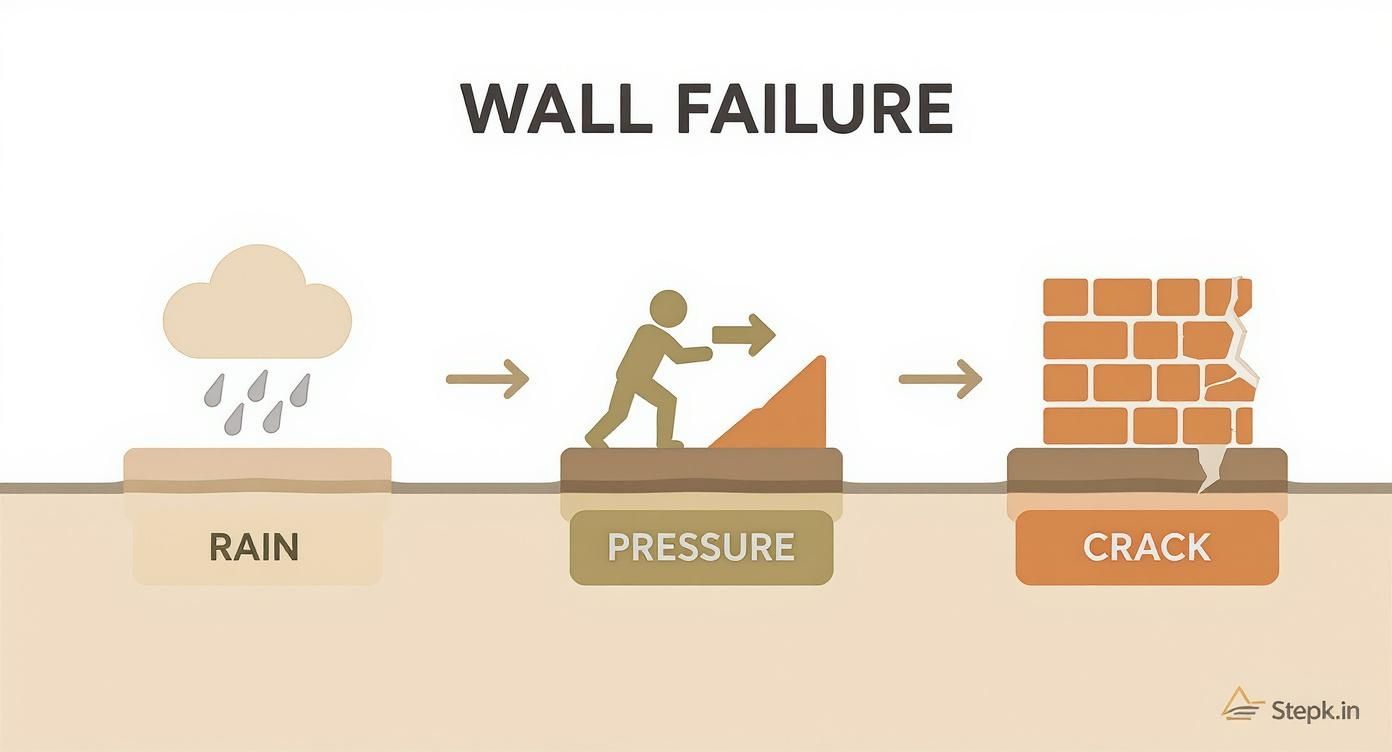
As you can see, interrupting this cycle by actively managing the water is the only way to prevent serious structural damage.
Why This Matters Across NSW
Getting this right isn't just a 'nice-to-have'; it’s a critical engineering principle recognised across Australia, especially in high-rainfall coastal areas of New South Wales. National infrastructure standards highlight just how vital this is. The Austroads Guide to Road Design states that proper drainage is fundamental to preventing the exact kind of hydrostatic pressure that causes walls to fail. In fact, the guide notes that in high-rainfall zones, a staggering up to 70% of retaining wall failures are directly caused by poor or blocked drainage systems.
A retaining wall drainage system isn’t just a collection of pipes and gravel. It's an engineered solution designed to protect one of your most valuable assets by actively managing the most powerful force on your property—water.
To properly deal with water pressure, a well-designed drainage system is non-negotiable. For a different perspective on managing water around structures, these foundation drainage and grading tips offer some helpful, universal principles. Ultimately, getting the drainage right from day one is the single best investment you can make in the longevity and safety of your retaining wall.
Key Components Explained: The Three Essential Parts of a Drainage System
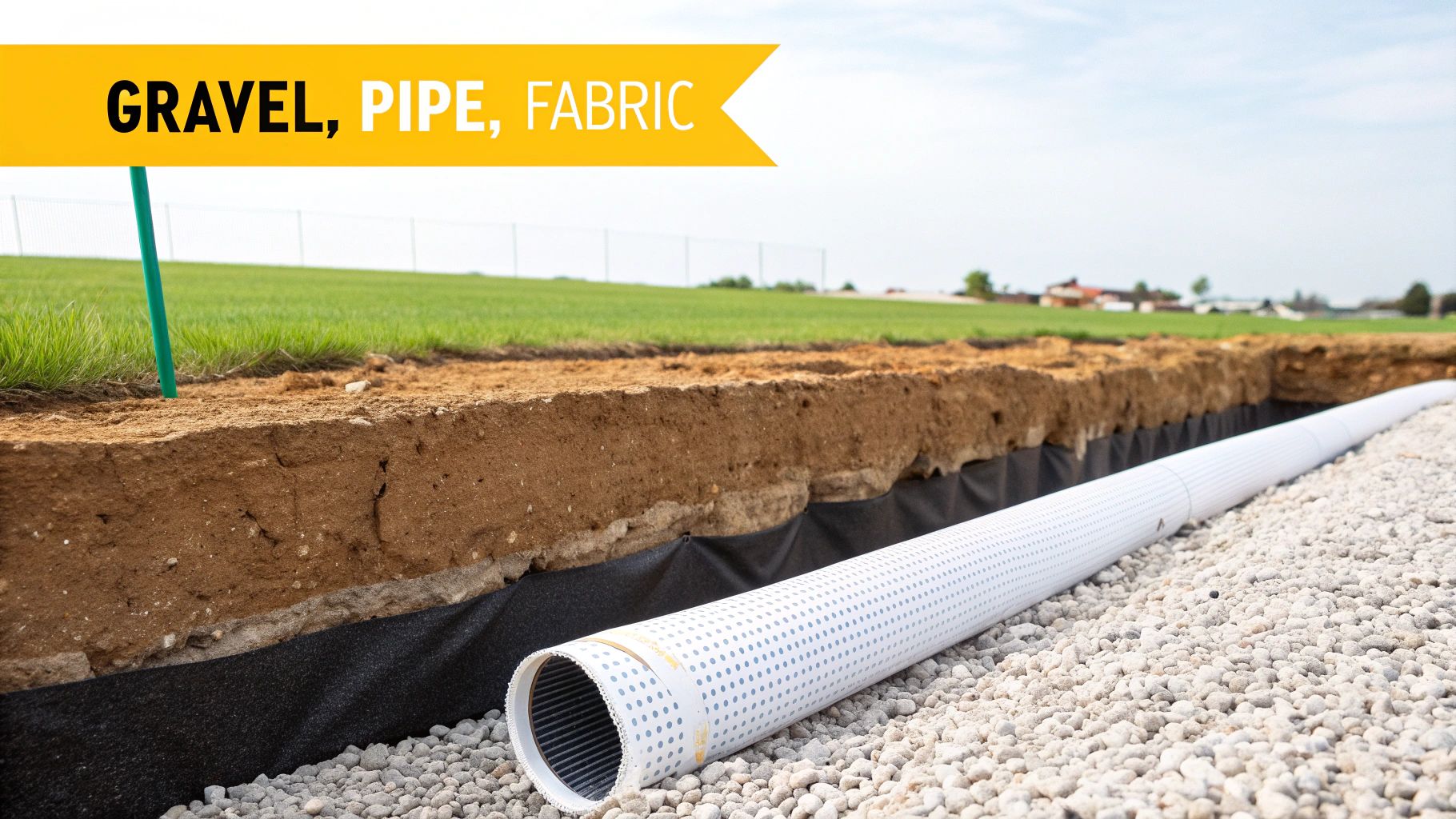
A truly effective retaining wall drainage system isn't just one component; it's a team of three parts working in perfect harmony. Each has a very specific job to do, and if you leave one out or get the installation wrong, the whole system is destined to fail. Understanding how they work together is key to seeing why a professional job is so non-negotiable.
1. Gravel Layers (Backfill): The Free-Draining Zone
First, and most importantly, you have the gravel backfill. This is a layer of clean, aggregate material—like blue metal or recycled concrete—that we place directly behind the retaining wall. It needs to be a decent width, typically at least 300mm. Its entire purpose is to create a super-permeable zone where water can travel downwards without a fight, instead of soaking into the soil and building up that dreaded pressure.
Think of it like trying to pour water through a bucket of clay versus a bucket of stones. The stones let it flow straight through, and that's exactly what the gravel layer does for your wall. This is especially critical in areas with reactive clay soils, which we see a lot of in the Hunter Valley or just inland from the Central Coast. Without a proper free-draining zone, these soils swell up massively when wet, putting an enormous strain on the wall.
2. Perforated Pipes (Ag Line): The Water Collector
At the very bottom of this gravel backfill sits the second key player: the perforated pipe, or 'ag line' as we call it on site. This is a flexible, corrugated pipe riddled with small slits or holes designed to collect all the water that filters down through the gravel.
It’s the main collection and transport system for all that groundwater. We lay the pipe with a slight but consistent fall (a gradient), which allows gravity to do the work of carrying the collected water towards a safe discharge point. Keeping up with modern stormwater system codes is vital here, as they've evolved to handle increased rainfall and ensure your system is both compliant and effective.
3. Filter Fabric (Geotextile): The Unsung Hero
The final piece of the puzzle is arguably the most critical for long-term success: the geotextile filter fabric. This non-woven material is the unsung hero of the entire drainage system. Think of it like the filter in your coffee machine; it lets the water pour through but holds back all the fine coffee grounds.
We wrap this fabric around the entire gravel backfill, separating it from the surrounding soil. This simple step is vital because it stops fine particles of silt, clay, and sand from washing into the gravel and clogging up the ag line over the years.
Without geotextile fabric, a drainage system can become completely choked with sediment in just a few years, rendering it totally useless. The wall is then left with no defence against hydrostatic pressure, leading to almost certain premature failure.
A properly wrapped system ensures the gravel stays clean and free-draining for the entire life of the wall. It’s a non-negotiable part of any professional installation and is mandated by Australian Standard AS 4678 for earth-retaining structures. Together, these three parts create a robust, reliable defence that protects your investment from the inside out. Get one wrong, and the entire system is compromised.
Signs of Drainage Problems: What to Look For
A retaining wall with a failing drainage system rarely gives up overnight. Long before a catastrophic collapse, your wall will start dropping hints that trouble is brewing behind it. Knowing how to spot these early warning signs can save you a fortune in complex repairs and, more importantly, keep your property safe.
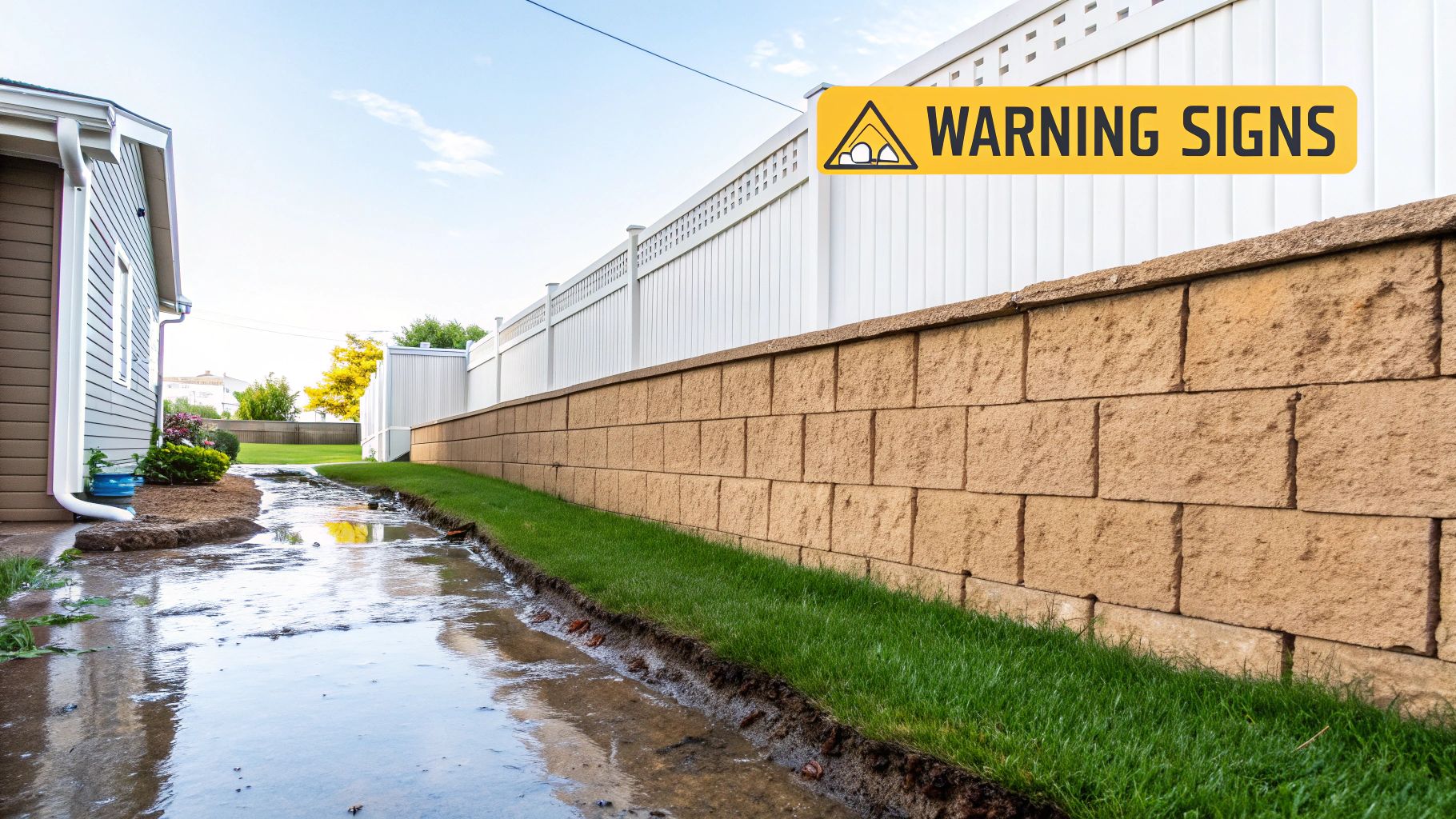
The most obvious and urgent red flag is any kind of movement. If you notice your wall is leaning, bulging, or bowing outwards, it’s a crystal-clear sign of immense hydrostatic pressure building up. This means the drainage isn't doing its job, and the sheer weight of waterlogged soil is physically pushing the structure towards its breaking point.
Water Stains and Cracks on the Wall's Surface
Another tell-tale sign is something called efflorescence. This looks like white, chalky, or crystalline stains spreading across the face of the wall. It’s caused by water slowly seeping through the wall material, dissolving natural salts along the way, and then evaporating, leaving the salt deposits behind. It's definitive proof that water is trapped and finding its own escape route.
You also need to keep a sharp eye out for cracks. While tiny hairline cracks can sometimes be nothing more than cosmetic, widening vertical or stepped cracks are a serious concern. These cracks are a symptom of significant structural stress, suggesting the wall is struggling to hold itself together.
Soggy Ground and Pooling Water
Don't just stare at the wall itself—look down. If the ground at the base of your retaining wall is constantly soggy, wet, or marshy, even days after rain, it’s a strong indicator that the ag line at the bottom is either blocked or was never installed correctly. The water has nowhere to go and is simply pooling at the lowest point.
This isn't a small-time problem; blocked drainage is incredibly common. Research from the Australian Road Research Board revealed that in urban areas like Sydney, up to 45% of drainage systems suffered blockages within just five years of installation, mostly from sediment and debris. You can read the full research about these drainage blockage findings to grasp the full scope of the issue.
Proactive Check: After the next heavy downpour, take a walk along your retaining wall. If you see water gushing from the face of the wall itself instead of exiting cleanly from the designated weep holes or a discharge pipe, your primary drainage system is compromised.
Spotting any of these signs means it's time to act. A failing drainage system will only get worse, and ignoring the problem puts both your property and your safety at risk.
Installation Basics: Why It Must Be Done During Construction
When it comes to retaining wall drainage, there’s one truth every seasoned tradesperson knows: you cannot effectively add it in later. A proper drainage system has to be designed and installed correctly from day one, as an integral part of the wall's construction. This isn't just friendly advice; it's a non-negotiable part of getting it right the first time.
Trying to retrofit a drainage system behind an existing wall is incredibly difficult, expensive, and often impossible without completely rebuilding the wall. This is why cutting corners on drainage during the initial build is a classic false economy that almost always ends in premature wall failure and much bigger bills down the track.
Compliance Isn't Optional
Building a retaining wall isn’t a weekend DIY project you can just wing. It’s a regulated construction process, governed by strict rules designed to keep everyone safe. Drainage sits right at the heart of these rules because it’s the key to the wall's long-term stability. The core guidelines are laid out in AS 4678-2002, the Australian Standard for earth-retaining structures. You can discover more insights about these structural standards on dot.gov to see the level of detail involved.
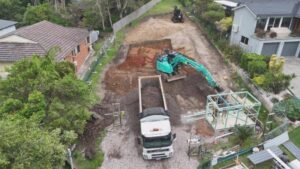
On top of the national standards, local councils have their own specific demands. Here on the coast, both Central Coast Council and Newcastle Council have stringent rules about stormwater management. Your drainage system can't just dump water wherever you feel like it; it has to connect to a legal discharge point. Professional installation starts right from the initial earthworks, as the integrity of your drainage is directly tied to the quality of the excavation. For a closer look at this crucial first step, check out our guide on site preparation and excavation.
Getting drainage right isn’t just about chucking a pipe behind a wall. It's about engineering a complete system that respects local conditions, adheres strictly to Australian Standards, and is built to last for decades—not just a few storm seasons.
Maintenance Tips for Homeowners
Once your wall is built and the drainage system is working, a little bit of maintenance goes a long way. The good news is that a professionally installed system is largely self-sufficient, but there are a few simple things you can do to ensure it stays that way for decades.
The most important task is to regularly check the drainage outlet point. This is where the ag line discharges the water it has collected. Over time, this outlet can get blocked by leaves, overgrown grass, mulch, or dirt. If this exit point is blocked, the entire system will back up, rendering it useless when the next big storm hits.
We recommend you check this outlet at least twice a year, especially before the start of the summer storm season. Simply clear away any debris to ensure water can flow freely away from the wall's foundation. This one simple check is the most effective piece of maintenance you can do to protect your investment.
Why Professional Installation Is Your Best Investment
While the theory behind retaining wall drainage might seem straightforward, the reality of installing it is a complex job that should always be left to experienced professionals. This is one of those jobs where experience truly makes all the difference. Knowing how the sandy loam on a Terrigal block drains versus the heavy, reactive clay you’ll find in Cessnock is absolutely crucial.
The Dangers of a DIY Approach
Trying to install a retaining wall drainage system without the right know-how and equipment can lead to serious, expensive problems down the track. You need precise grading to make sure water flows where you want it to, and even a tiny error in the pipe’s gradient can cause water to pool instead of drain away, completely defeating the purpose of the system.
On top of that, a professional team has the right plant and equipment, like excavators and compactors, to get the job done safely and efficiently. Handling tonnes of soil and gravel is physically demanding and potentially dangerous work if you don’t have the proper training and aren’t following SafeWork NSW guidelines.
An improperly installed drainage system is often worse than no system at all. It can create a false sense of security while hidden problems develop, leading to an unexpected and catastrophic failure years later.
Hiring a professional contractor is an investment in your property's future value and, most importantly, its safety. It’s about the peace of mind that comes from knowing the job was done correctly the first time, in full compliance with Australian Standards and local council regulations. For anyone thinking about a new wall, you can find more detail in our guide on what to look for when choosing retaining wall builders near you.
Ultimately, getting it right from day one is always the most cost-effective decision you can make.
Common Questions About Retaining Wall Drainage
To wrap things up, let's tackle some of the most common questions our team gets from property owners right across the Central Coast and Newcastle.
Can I Just Use Weep Holes Instead of a Full Drainage System?
This is a question we hear a lot, and the simple answer is a hard no. While weep holes—those small gaps or pipes you see in the face of a wall—can let a tiny bit of pressure out, they are absolutely no substitute for a proper, comprehensive drainage system. They are easily overwhelmed in a coastal storm and are notorious for clogging up. Think of them only as a secondary, backup feature to a full system with gravel backfill and an ag line.
What Is the Difference Between Ag Line and Regular PVC Pipe?
An agricultural line (ag line) is that flexible, corrugated pipe with small slits all over it. Its entire purpose is to collect water from the surrounding gravel backfill. A standard PVC stormwater pipe, on the other hand, is a solid, rigid pipe with no holes. Its job is to transport that collected water safely away from the wall's base. Your ag line will always connect to a solid stormwater pipe for final discharge.
Is My Retaining Wall Regulated by Council?
Yes, in almost every single case. Retaining walls, particularly those over a certain height (often 600mm) or built near a property boundary, are subject to strict council rules. These regulations cover engineering standards, safety requirements, and structural integrity. To make sure your project is compliant, it's essential to get familiar with the specific retaining wall regulations in NSW.
A properly designed and installed drainage system isn't just an add-on—it's the single most critical element protecting your investment. If you have any worries about an existing wall or you're planning a new one on the Central Coast, in Sydney, or across the Hunter Valley, getting expert advice is the right first step.
The team at Booms Up Civil Group has over 15 years of local experience getting these systems right the first time.