In NSW, retaining wall regulations are stricter than many people think. It’s a common trap to assume that if you’re only building a small wall, you’re automatically in the clear. The reality is that factors like height, how close it is to a boundary, and what you’re planning to build on top of it can completely change the game. We’ve seen it countless times over our 15+ years on the Central Coast – a simple backyard project can quickly become complex without the right advice upfront.
Your Guide to Retaining Wall Regulations NSW
Before you even think about turning a single shovel of dirt, getting your head around the rules for retaining walls in New South Wales is the single most important thing you can do. These regulations aren’t just bureaucratic red tape; they’re there to keep people safe, protect your property (and your neighbours’), and stop you from facing a costly structural failure down the track.
Getting this wrong is serious business. It can lead to everything from council fines and demolition orders to eye-watering repair bills. We believe in getting it right the first time, which means understanding the rules before a single sod is turned.
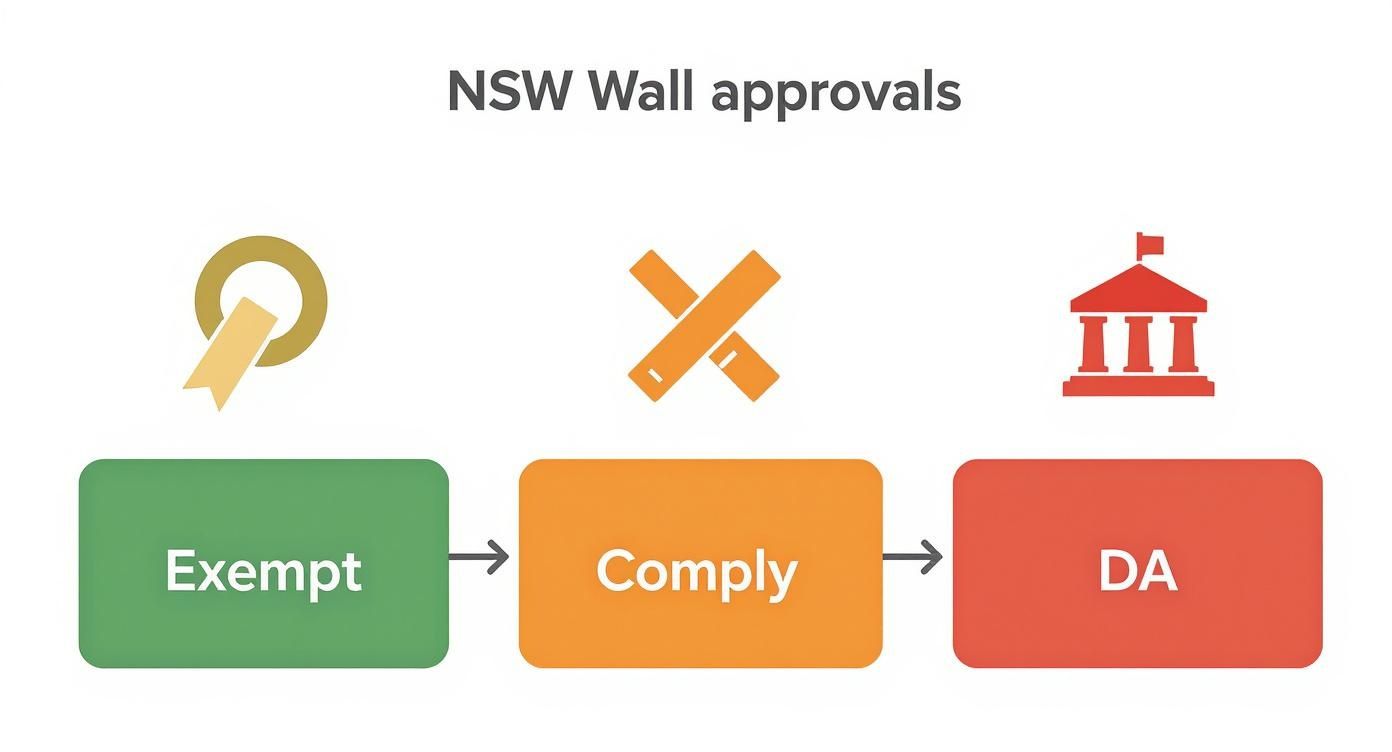
Think of the approval process like choosing a path up a mountain. There are three main routes, and the one your project takes will depend entirely on its size, where it is, and how complex it is.
- Exempt Development: This is the easy, flat path. It’s for minor, low-risk structures that meet a very strict set of criteria, mostly around height and distance from boundaries.
- Complying Development (CDC): This is a faster, more direct route for straightforward projects that tick all the boxes of a predetermined standard. You still need certification, but it cuts out the long council assessment.
- Development Application (DA): This is the full-blown expedition to the summit. It’s for larger, more complex walls or those in sensitive spots. A DA means a full assessment by your local council and almost always involves detailed plans from a structural engineer.
Let’s look at a classic example. Imagine you’re on a sloping block in Gosford on the Central Coast and you want to level out your backyard for a new lawn. The wall you need will be 800mm high. Right away, you’ve gone past the 600mm height limit for exempt development. That means you’re pushed into needing formal approval—most likely a full-blown DA. It’s a perfect illustration of how a seemingly simple job can quickly require serious planning to meet council rules.

NSW Retaining Wall Approval Pathways at a Glance
To help you quickly see where your project might fit, here’s a simple breakdown of the main approval routes for retaining walls in NSW.
| Approval Pathway | Typical Height Limit | Key Considerations | Professional Input Required |
|---|---|---|---|
| Exempt Development | Up to 600mm | Must be a set distance from boundaries & not support major structures. | Generally none, but a surveyor is recommended to confirm boundaries. |
| Complying Development (CDC) | Up to 1m | Must meet pre-set standards in the State Policy. Not all properties are eligible. | A private certifier is required. |
| Development Application (DA) | Over 1m (or if not exempt/CDC) | Required for complex designs, walls near sensitive areas, or load-bearing structures. | A structural engineer and often other consultants are needed for plans. |
This table is just a guide, of course. Every site has its own quirks, and local council rules can add another layer of complexity. The key takeaway is to know which path you’re on before you start spending money on construction.
Navigating these rules is a massive part of delivering effective structural landscaping solutions. Figuring out which pathway your project falls into from day one is what saves time, stops budgets from blowing out, and makes sure your wall is built to be safe and legal for decades to come. At Booms Up Civil, we walk clients through this maze every single day, ensuring every project starts on solid, compliant ground.
When Your Retaining Wall Needs Council Approval
So, what matters most for retaining walls in NSW? Get this one detail right and the rest of the process falls into place. Under the State Environmental Planning Policy (SEPP) for Exempt and Complying Development, any wall over 600mm high steps out of the Exempt Development category.
Council approval kicks in the moment your wall clears that 600mm mark. NSW takes a cautious stance compared to other states, so it pays to know the rule before you break ground. You can discover more about these NSW-specific regulations to see how they apply across the state.
Height Is Not The Only Trigger
It’s a common trap to assume that keeping your wall under 600mm is all you need. Councils look at more than height alone. Factors like boundary proximity, easements or even nearby parks can push you into a full Development Application (DA).
Take Warnervale on the Central Coast, for example. Let’s say you build a 500mm garden wall that sits closer than 900mm from your boundary. Suddenly, that “small” wall needs approval. Things that can trigger a DA include walls within 900mm of property boundaries, structures encroaching on easements or public land, or positioning in bushfire-protection zones.
How To Measure Wall Height Correctly
Getting your measurements wrong can land you in hot water. Councils aren’t interested in just the visible block height—they measure from the lowest natural ground point up to the highest top of the structure, fill included.
Crucial Point: Wall height is measured from the lowest natural ground level at the base of the wall to the highest point of the structure, which includes any fill behind it.
So, if you excavate 300mm and retain 400mm of soil above ground, that’s a total height of 700mm—and you’re firmly in DA territory. Both Central Coast Council and Newcastle Council will check that total level difference, not just what you can see above ground.
The Tiered Wall Loophole Myth
Some homeowners think two 500mm walls with a garden bed between them will slip under the radar. In reality, if those walls are within 2 metres of each other, councils treat them as a single, combined structure.
That means two 500mm tiers equate to one 1-metre wall. You’ll need a full DA and structural engineering sign-off just as you would for a single wall that height. This rule is especially critical for complex designs, like larger-scale sandstone retaining walls. For design tips and stability advice, check out our guide on sandstone retaining wall design.
Knowing these triggers up front lets you plan with confidence. You’ll see at a glance when you can crack on and when it’s time to pick up the phone and talk to your council.
Navigating The Development Application Process
Landing in the DA basket might sound daunting, but think of it as a detailed roadmap rather than a hurdle. It’s simply your council’s way of checking that a significant structure is safe, well-designed and respectful of the local landscape and neighbours.
The very first task in a DA journey is gathering your documentation. Each piece of paper you compile isn’t admin fluff—it’s a chapter in your project’s story, demonstrating to the council that you’ve done your homework.
Your Essential DA Toolkit
Treat your DA submission as if you’re pitching a project to a client. The council needs to see exactly what you intend to build, why it’s necessary, and how you’ll keep everything safe.
Your core documents include site plans outlining property boundaries and the wall’s location, structural engineering drawings detailing design specifications to Australian Standards, and a geotechnical (soil) report. This soil report is vital on tricky sites—whether you’re on reactive clay in the Hunter Valley or shifting sand on the Central Coast, this report informs a design that stands the test of time. To ensure nothing slips through the cracks, a quick reference to a a building permit checklist can save you hours of back-and-forth.
What Your Council Is Looking For
When a planner opens your DA, they’re hunting for evidence you’ve considered safety, environmental impact and neighbourly fairness.
Council’s Core Focus: Safety, environmental impact and fairness to neighbours.
Key assessment points include drainage management, visual impact on the streetscape, effects on adjoining properties like overshadowing, and a clear strategy for effective site preparation and excavation.
A Real-World DA Scenario
Imagine you want to build a 1.5-metre tiered retaining wall for a new pool on a waterfront block in Woy Woy. Suddenly, Central Coast Council flags that anything over 1 metre requires a DA. Proximity to water means erosion assessments may be needed, and nearby native trees may have legal protection zones.
Your DA needs to address all these angles—soil reports, coastal impact statements, tree management plans—turning a simple wall into a multi-layered project. Starting early and keeping the dialogue open with your council mitigates surprises. A thorough, well-documented application pre-emptively answers questions and smooths the path to approval.
Who Is Responsible for a Wall on a Boundary?
Boundary walls are a classic source of neighbourly friction here in NSW. When things go wrong, figuring out who pays isn’t always a simple 50/50 split.
Knowing who actually owns and is responsible for maintaining a boundary retaining wall is the first step to stopping a minor disagreement from blowing up into a major dispute.
Understanding the Core Principle of Ownership
Across Australia, and definitely here in NSW, the law generally points to one person: the owner of the land where the retaining wall physically sits is responsible for it. Simple, right? Not always. These situations get messy, as shown in a well-documented 2009 NSW court case involving encroachment, trespass, and nuisance where both neighbours ended up seeking court declarations. You can dig into the details of that ruling in this report.
The key principles usually boil down to this: the landowner on whose property the wall stands is typically responsible for its upkeep. However, the party who changed the natural ground level—by cutting or filling—often bears the responsibility for the costs involved.
Real-World Scenarios
Let’s make this real. Imagine you’re on a sloping block in Terrigal. Your neighbour decides to excavate their block to create a flat backyard, cutting into the slope that supports your property. They then build a retaining wall on their side of the boundary to hold up your land.
In this case, the “who benefits” principle kicks in. Because they did the excavation to benefit their property, they are responsible for that wall. Ownership follows benefit: the person who cuts into the hill must support the slope. When excavation is happening right on the boundary, understanding who is responsible for maintaining soil stability is critical. We’ve put together a detailed guide on excavation near neighbouring properties in NSW that covers this exact issue.
Now, consider a trickier situation in Copacabana where an old retaining wall straddles the boundary line, and nobody knows who originally did the earthworks. In these grey areas, councils will often push for a joint maintenance agreement or, in the worst cases, a court determination to sort it out.
| Scenario | Responsible Party |
|---|---|
| Lower lot excavates to retain higher land | Lower lot owner maintains the wall |
| Shared support with equal benefit | Maintenance is split unless a formal agreement exists |
| Wall is entirely on one property title | The title holder is responsible for repairs and inspections |
How to Prevent Boundary Disputes
Good fences make good neighbours, but clear surveys and written agreements make for even better ones. These are your best defences against a future conflict.
A professional boundary survey is the only way to know for sure where that wall sits. It removes all the guesswork. A simple, written agreement about maintenance can save you a world of legal headaches down the track. We recommend you hire a licenced surveyor, draft a straightforward maintenance agreement with your neighbour, and lodge a copy with your local council so it’s on record.
When the Council Steps In
If a boundary wall becomes unsafe, don’t be surprised if the council gets involved. Councils like Central Coast Council or Newcastle Council have the power to issue repair orders, and you could face penalties or have them fix it and send you the bill if you ignore their notices. If a retaining wall is flagged as a public safety risk, your local council can issue a formal notice requiring you to carry out repairs within a specific timeframe.
Failing to act on this can lead to hefty fines or the council stepping in to hire their own contractors to make the site safe—and passing the full cost on to you. Councils like Central Coast Council will often provide technical advice, but they won’t pay for repairs on private property. Always respond to any official notices promptly and keep a written record of all your communications.
By understanding the legal principles and being proactive with your neighbour and council, you can ensure your boundary walls are safe, compliant, and—just as importantly—that you stay on good terms with the people over the fence.
Essential Engineering And Safety Standards
Ticking the council’s boxes is only the start. The backbone of any retaining wall is sound engineering practice and an absolute commitment to safety. You can nail every regulation on paper, but what really counts is how your wall performs when soil and water push against it year after year.
Unpacking Australian Standard AS 4678
At the heart of Australian retaining wall design lies AS 4678 Earth-Retaining Structures. It might read like a technical tome, but its mission is simple: ensure your wall can handle every force acting upon it.
This standard covers everything from calculating lateral earth pressure—the sideways push from your soil—to specifying materials and build methods. It makes sure your design responds to local quirks, whether that’s the sandy, free-draining soils of the Central Coast or the heavy, reactive clay around the Hunter Valley.
The Critical Role Of Drainage
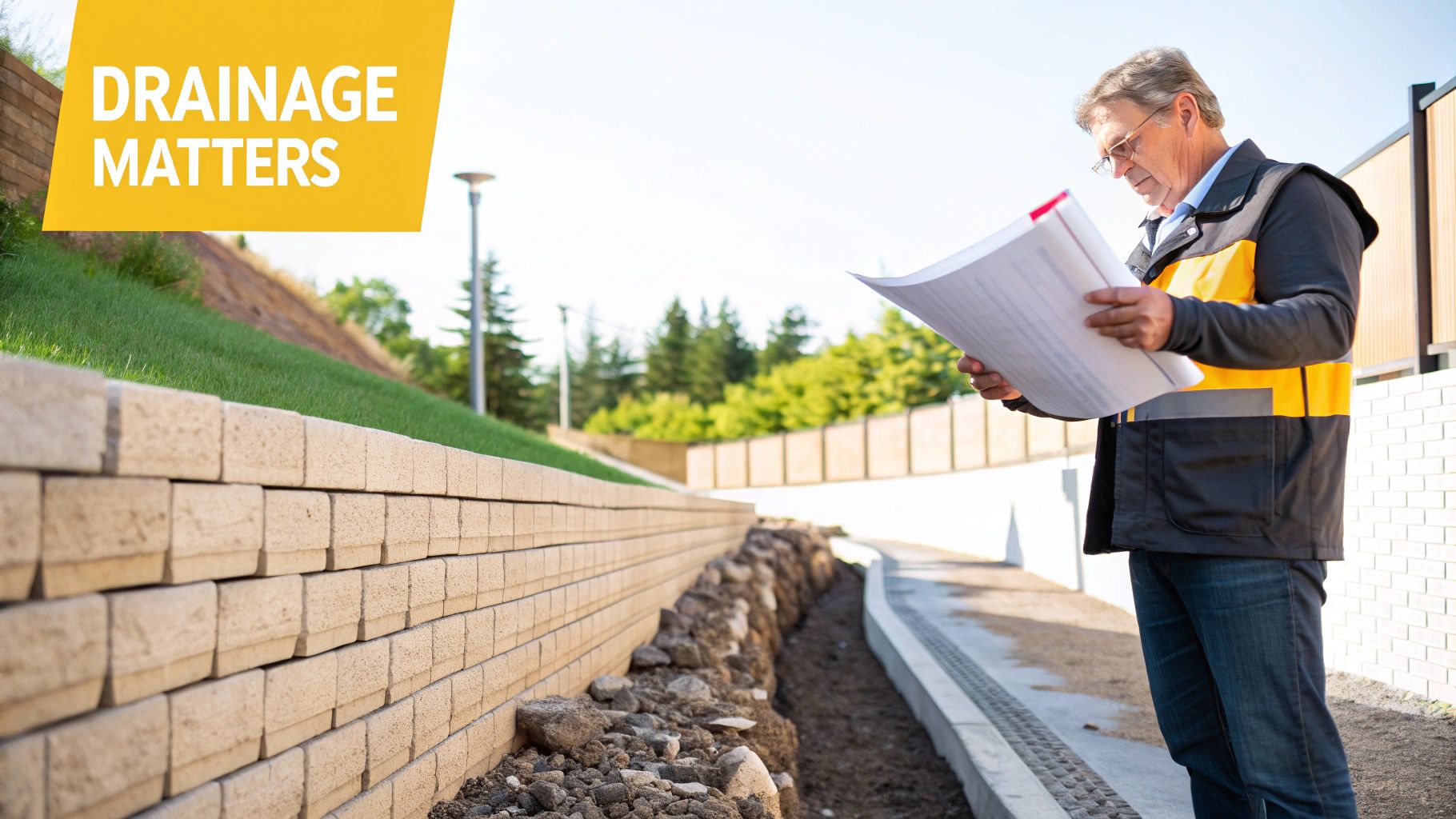
Almost every wall failure starts with poor drainage. When water has nowhere to go, it builds immense hydrostatic pressure behind the structure, and even the strongest wall can bow or crack under the load.
A retaining wall isn’t just holding back soil; it’s managing water. Proper drainage is the most critical element for its long-term stability and safety.
Drainage is not an optional extra but the lifeline of your wall. Effective systems include agricultural pipes (aggie pipes) laid at the base, a clean gravel backfill to guide water down to the pipes, and weep holes built into the wall face so trapped water can escape.
Why You Need A Structural Engineer
Any wall that needs a Development Application (DA) or sits on tricky ground demands a structural engineer. They take AS 4678’s principles and tailor them to your site conditions.
They’ll pore over the soil report, calculate loading, and produce certified drawings showing footing depths, reinforcement details and drainage layouts. That professional sign-off is your guarantee the design is both safe and robust.
SafeWork NSW And Excavation Safety
Building a retaining wall always begins with earthworks. That brings SafeWork NSW into the picture—site safety is a shared responsibility between you, the property owner, and us, your contractor.
Managing risks starts with careful planning for the excavation services needed to prepare the site. On tight-access blocks around Sydney or the Central Coast, this might mean shoring up trenches to prevent collapse or guiding machinery clear of boundaries and buried services. Adhering to SafeWork NSW guidelines ensures the project proceeds without incident, keeping workers, your family and your neighbours safe.
Common Retaining Wall Mistakes to Avoid
Getting your retaining wall right the first time saves you a world of stress, money, and time. With over 15 years of experience building walls across the Central Coast and Sydney, we’ve seen just about every common misstep that can turn a straightforward project into a costly headache. Think of this as your final checklist before you break ground.
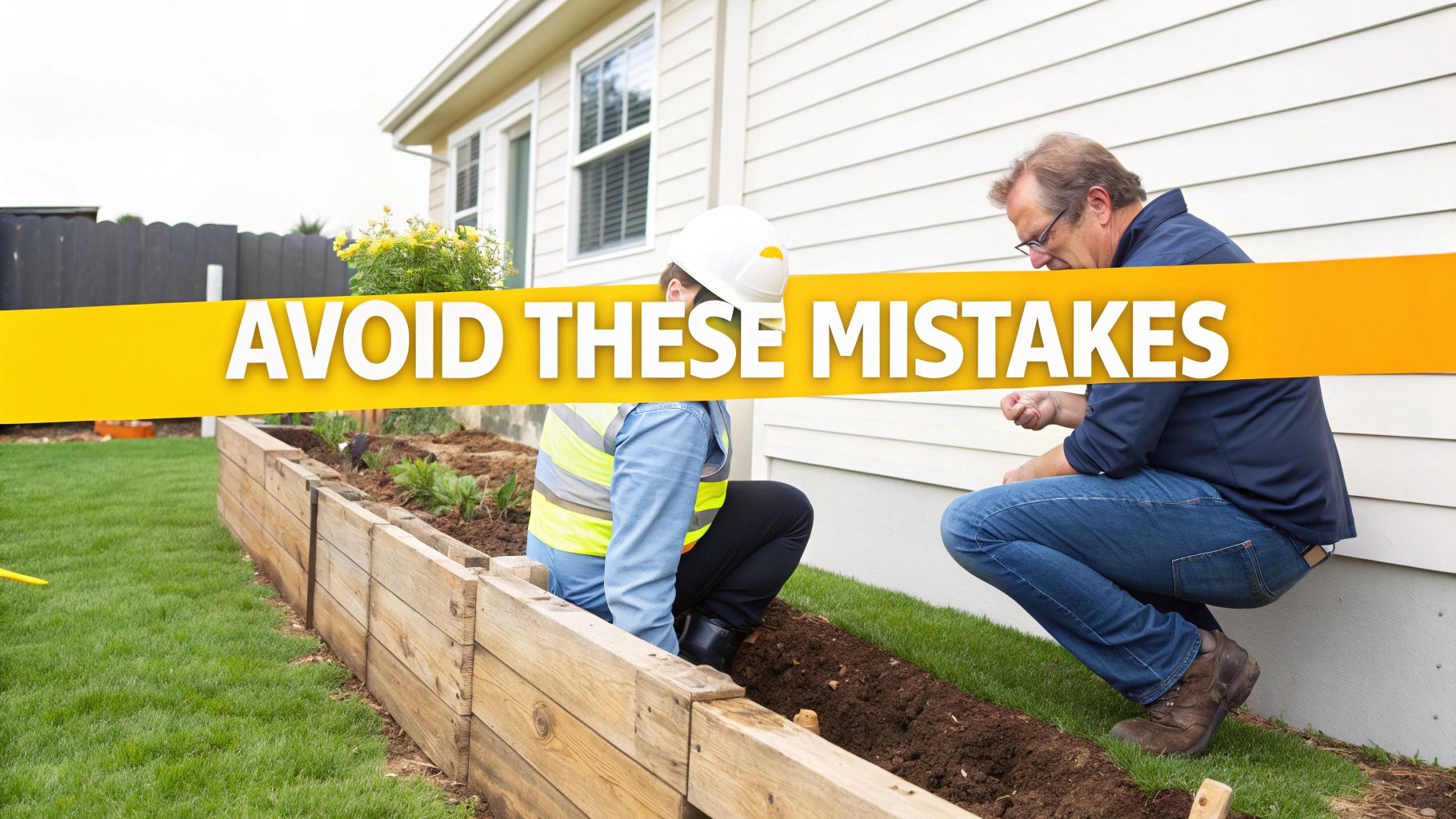
These mistakes are often simple oversights, but they can lead to major structural failures or serious compliance issues with your local council. By understanding them upfront, you can ensure your wall is built to be durable, safe, and completely legal.
Underestimating Drainage
This is the number one killer of retaining walls, without a doubt. We see it all the time: a beautifully constructed wall that has no way to relieve the immense water pressure that builds up behind it during a downpour.
Without proper drainage systems like agricultural pipes and a generous layer of gravel backfill, water gets trapped. This hydrostatic pressure can cause a wall to bow, crack, or even collapse entirely, no matter how strong it seems. It’s a silent force that you can’t ignore.
Choosing the Wrong Materials for the Job
Not all materials are created equal, especially when you factor in the local environment. Using untreated timber sleepers in termite-prone areas of the Central Coast is just asking for trouble. Likewise, using the wrong type of block for a site with reactive clay soil in the Hunter Valley can lead to premature cracking and movement.
Key Takeaway: Your material choice must be guided by your local environment. Factors like soil type, groundwater levels, and pest presence will determine what materials offer the best long-term durability.
Choosing materials based on looks alone, without considering their suitability for your specific conditions, is a mistake that will dramatically shorten the life of your wall.
Ignoring Boundary Setbacks and Surveys
Another common pitfall is just assuming you can build right up to your boundary line. Most councils, including Central Coast Council and Newcastle Council, have strict setback rules that dictate how far your wall must be from a neighbour’s property.
Building too close to or on a boundary without a formal agreement and a proper land survey can lead to nasty neighbourly disputes and council orders to demolish the structure. Always get a surveyor to confirm your boundaries before any work begins. It’s a small upfront cost that can save you a fortune down the line.
Attempting a DIY Build Beyond Your Scope
While a small garden edge might be a manageable weekend project, any retaining wall that’s structurally significant or needs council approval should be handled by a licensed professional. Retaining wall regulations in NSW are strict for a good reason.
Attempting to build a wall over 600mm high yourself not only risks structural failure but also leaves you without insurance coverage if something goes wrong. Licensed contractors ensure the work complies with Australian Standards and is built safely. This is more critical than ever; a report from the City of Randwick highlights that many public walls built in the 70s and 80s are nearing their end-of-life, reinforcing the need for new constructions to be built correctly from the get-go. You can read more about council asset management plans to see why councils take this long-term view so seriously.
Frequently Asked Questions
When it comes to building a retaining wall in NSW, it’s natural for specific questions to pop up. We get them all the time from property owners across the Central Coast and Sydney. Here are some of the most common queries, answered simply to help you get your project off the ground with confidence.
What Happens If I Build a Retaining Wall Without Council Approval?
Trying to get a retaining wall built without the proper council sign-off is a risky move that can backfire in some pretty serious ways. Your local council has the power to issue a ‘stop work’ order on the spot. Worse, they can follow that up with a notice to demolish the whole thing, leaving you to foot the bill. And that’s before we even talk about the hefty fines that come with breaching regulations.
But the headaches don’t stop there. An unapproved wall becomes a major problem when you try to sell your house, as it will lack the necessary compliance certificates. It’s also a red flag for your home insurer; if the wall fails and causes damage, they may not cover it. That would leave you personally liable for incredibly expensive repairs, not just to your property but potentially your neighbour’s as well.
Can I Build a Retaining Wall Directly on My Property Boundary?
In most cases, the answer is no. Councils across NSW, from Newcastle down to the Northern Beaches, usually require a setback from the boundary line. Just how far back you need to be depends on your local environmental plan (LEP) and, of course, the height of the wall.
Building right on the boundary isn’t impossible, but it complicates things significantly. It almost always requires the formal written consent of your neighbour and often involves creating a legal easement. It is absolutely essential to have a registered surveyor conduct a proper land survey before you lock in any plans. This is the only way to avoid accidentally building on your neighbour’s land and sparking a dispute down the track.
Do I Need an Engineer for a Wall Under 600mm?
Even though a wall under 600mm high often falls under Exempt Development and might not need a DA, bringing an engineer on board is still a very smart move in certain situations. Their expertise is invaluable for ensuring safety and long-term stability, especially if your property has tricky soil conditions. Think of the sandy coastal soils on the Central Coast or the reactive clay common in the Hunter Valley – these aren’t conditions you want to gamble with.
An engineer’s advice is also crucial if the wall is built on a steep slope or needs to support a heavy load like a driveway, carport, or pool. At the end of the day, getting it designed properly from the start is always going to be cheaper than fixing a collapsed wall later on.
At Booms Up Civil Group, we’re firm believers in getting the job done right the first time. If you’ve got questions about your retaining wall project or need a hand navigating the council approval maze, our experienced team is ready to help.
Get in touch with us for a free, no-obligation consultation today.