When you type "earthmoving contractors near me" into Google, the sheer number of options can feel pretty overwhelming. The key is to look beyond a simple search and build a strong shortlist of genuine, local professionals.
Think of a contractor's website as your first checkpoint. Is it professional? Can you easily find their ABN, licence numbers, and a clear gallery of completed work in your area? These are the initial signs of a legitimate business. We believe getting the groundwork right, both literally and figuratively, sets you up for a successful project from day one.
How To Start Your Search For The Right Earthmoving Contractor

Before you even think about picking up the phone, you need a crystal-clear picture of what your project involves. Defining your scope is without a doubt the most critical first step. Getting this right from the start helps you filter out the wrong contractors and ensures every conversation you have is with a relevant, qualified expert.
There’s a world of difference between jobs. For instance, a simple driveway excavation in a Newcastle suburb like Adamstown has completely different requirements than a complex site cut on a sloping block in Terrigal. The first might just need a small excavator and a tipper truck. The second? That could demand specialised machinery, shoring, and extensive soil analysis. Knowing this distinction is vital.
This initial planning also arms you with the right questions. Instead of just asking for a price, you can get into the nitty-gritty:
- Are there any access limitations on your site?
- What type of soil are we dealing with (e.g., Central Coast's sandy coastal soil vs. inland clay)?
- What are the local council requirements for sediment control?
This industry is a massive part of Australia's economy, with the construction machinery market valued in the billions. That scale means there are a lot of operators out there, making your vetting process even more important. You can find more details in this report on the Australian construction machinery market.
Once your scope is clear, you can begin the real search for quality earthmoving solutions. Go beyond the search engines. Check your local council’s DA registers to see who’s working nearby, or better yet, ask for recommendations from builders and landscape architects you trust.
The principles of vetting and due diligence apply right across the building industry. For a broader perspective, it can be helpful to read a guide on finding the best construction consultants, as many of the core ideas are the same.
Vetting Your Shortlist: What to Ask and Verify
You’ve got a few names on your list. Now the real work begins. This is where you separate the genuine professionals from the cowboys, and it all comes down to asking the right questions.
Don't be shy. A quality contractor expects and welcomes this kind of detailed vetting—it shows you’re serious about getting the job done right. We find that the best clients are the ones who ask tough questions, because it means we're all on the same page.
Your first line of questioning should always be about compliance and safety. Start by asking for a copy of their Certificate of Currency for Public Liability Insurance. This isn't just a piece of paper; it’s your primary protection if something goes wrong on your property. Next, ask about their licences. Any reputable operator in NSW should be able to provide their licence details without hesitation, which you can then verify with SafeWork NSW.
Digging Deeper Than the Basics
Once the paperwork checks out, you need to be sure their real-world experience matches your project's specific needs. This is particularly important if you’re looking for local earthmoving contractors in geologically diverse areas.
For example, get specific with your questions:
- Have you worked with the reactive clay soils common in parts of the Hunter Valley?
- What’s your experience with Sydney's challenging sandstone bedrock?
- Can you show me a project you’ve done that’s similar to my site cut on a sloping block on the Central Coast?
Their answers will quickly reveal if they have genuine local knowledge or just a general, one-size-fits-all skillset. You can get a better handle on these regional challenges by reading up on topics like excavation in Newcastle NSW, where the soil and site access can change dramatically from one suburb to the next.
Pro Tip: When you're checking their references, don't just ask, "Were you happy with the work?" Go deeper. Ask targeted questions like, "How did they handle unexpected issues?" and "Was their communication clear and consistent throughout the project?" This will give you a much better feel for their problem-solving skills and overall professionalism.
How to Understand and Compare Earthmoving Quotes

Getting a few quotes is a great start, but comparing them isn’t always as simple as picking the lowest number. A suspiciously cheap quote is often a huge red flag. It usually means crucial details have been left out, leaving you exposed to some nasty, costly surprises down the track.
Learning to read between the lines is the best way to protect your budget and keep your project on schedule. A quote from a reputable contractor should be a detailed, transparent document that clearly lays out every part of the job.
What a Good Quote Looks Like
A solid quote will break everything down so there’s absolutely no confusion about what you’re paying for. It’s much more than just a final price; it's a clear plan of action.
You’ll want to see these specific items:
- Detailed Scope of Works: This is non-negotiable. It needs to clearly describe every task, from preparing site access right through to the final cleanup. If your project involves clearing vegetation before the digging starts, you can learn more about what that involves in our guide to professional property clearing services.
- Itemised Costs: A professional quote will separate the costs for machine hire, labour rates (per hour or per day), and any materials.
- Spoil Removal Fees: The quote must specify the cost for removing and disposing of excavated material. This is often priced per tonne or per truckload.
Decoding Your Earthmoving Quote
Spotting the difference between a thorough quote and a vague one is crucial. A detailed breakdown empowers you to make an informed decision, while a single-line item can hide a mountain of potential extra costs.
| Quote Component | What a Good Quote Includes | Red Flag to Watch For |
|---|---|---|
| Scope of Works | A point-by-point list of every task, from site prep to final grading. | A single line like "Site preparation for Gosford property." |
| Costs | Itemised breakdown of machine hire, labour, and materials. | A single, all-inclusive price with no detail. |
| Spoil Removal | Clearly stated cost per tonne or truckload for removing excavated soil. | Vague terms like "spoil removal extra" or no mention at all. |
| Exclusions | A specific list of what is not covered (e.g., unexpected rock breaking). | No mention of exclusions, leaving you to assume everything is included. |
| Provisional Sums | Clearly defined estimates for unknown costs (e.g., potential rock). | Hidden or unexplained allowances that could blow out. |
A vague quote might look cheaper upfront, but it’s the detailed, transparent one that gives you true peace of mind and budget certainty.
Understanding Exclusions and Provisional Sums
Hidden costs often lurk in the "exclusions" section. This is where a contractor lists what is not included in the price. Common exclusions are things like rock breaking if unexpected rock is found, or extra costs for dealing with contaminated soil. It pays to read this part carefully.
A "Provisional Sum" (or PS) is an estimated amount included for a specific task where the final cost can't be known yet. For instance, a PS might be allocated for rock breaking. Be aware that if more labour or machinery is needed than estimated, this cost will go up.
A vague quote, maybe from a less experienced operator, might just say "Site preparation for Gosford property" with a single price. This leaves you completely vulnerable. A detailed quote, on the other hand, empowers you to compare based on true value and transparency, not just the lowest initial figure.
Finalising the Contract and Preparing for Work
With your contractor chosen, it’s tempting to think you can get the machines rolling straight away. But hold on—the most critical step is next. Before a single bucket of dirt is moved, you need to lock in the paperwork. A handshake or a verbal agreement simply won’t cut it; you absolutely need a formal, written contract to protect both yourself and your contractor. Think of this document as the single source of truth for your entire project.
So, what makes a good contract? It needs to clearly spell out the full scope of works, lay down a fair, staged payment schedule, and set realistic project timelines. Crucially, it must also have a plan for the unexpected. What happens if the crew uncovers asbestos or hits a massive sheet of sandstone—a classic surprise on Sydney sites? A solid contract will define the process for these discoveries, preventing arguments and costly delays down the track.
Preparing Your Site for a Smooth Start
Once the ink is dry on the contract, the focus shifts to getting your property ready for action. Your role as the owner is vital here to ensure everything kicks off without a hitch. For most residential jobs, this means making sure there’s clear and safe access for heavy machinery. This might sound obvious, but it’s a major logistical hurdle, especially in tightly packed suburbs.
Before any work begins, it's a legal requirement to lodge a free Dial Before You Dig enquiry. This service provides plans showing the location of underground pipes and cables, preventing costly and dangerous damage. Professional earthmoving contractors will insist on this.
It's also a good idea to give your neighbours a heads-up about the upcoming work as a courtesy. Taking these simple, proactive steps is a fundamental part of good site preparation and excavation, and it goes a long way in minimising delays. With the Australian construction market growing, driven by major projects, getting these fundamentals right is more important than ever. You can read more about the industry's forecast and growth to see just how busy things are getting.
Navigating Safety Compliance and Council Requirements
On any professional earthmoving site, safety and compliance aren’t just boxes to tick—they're completely non-negotiable. As the property owner, you actually share a degree of responsibility for what happens on your land. This makes your contractor’s adherence to SafeWork NSW regulations incredibly important for your own liability.
A professional crew will arrive with clear safety protocols in place from day one. You should expect to see Safe Work Method Statements (SWMS) for any high-risk activities, correct site fencing to secure the area, and robust erosion and sediment controls.
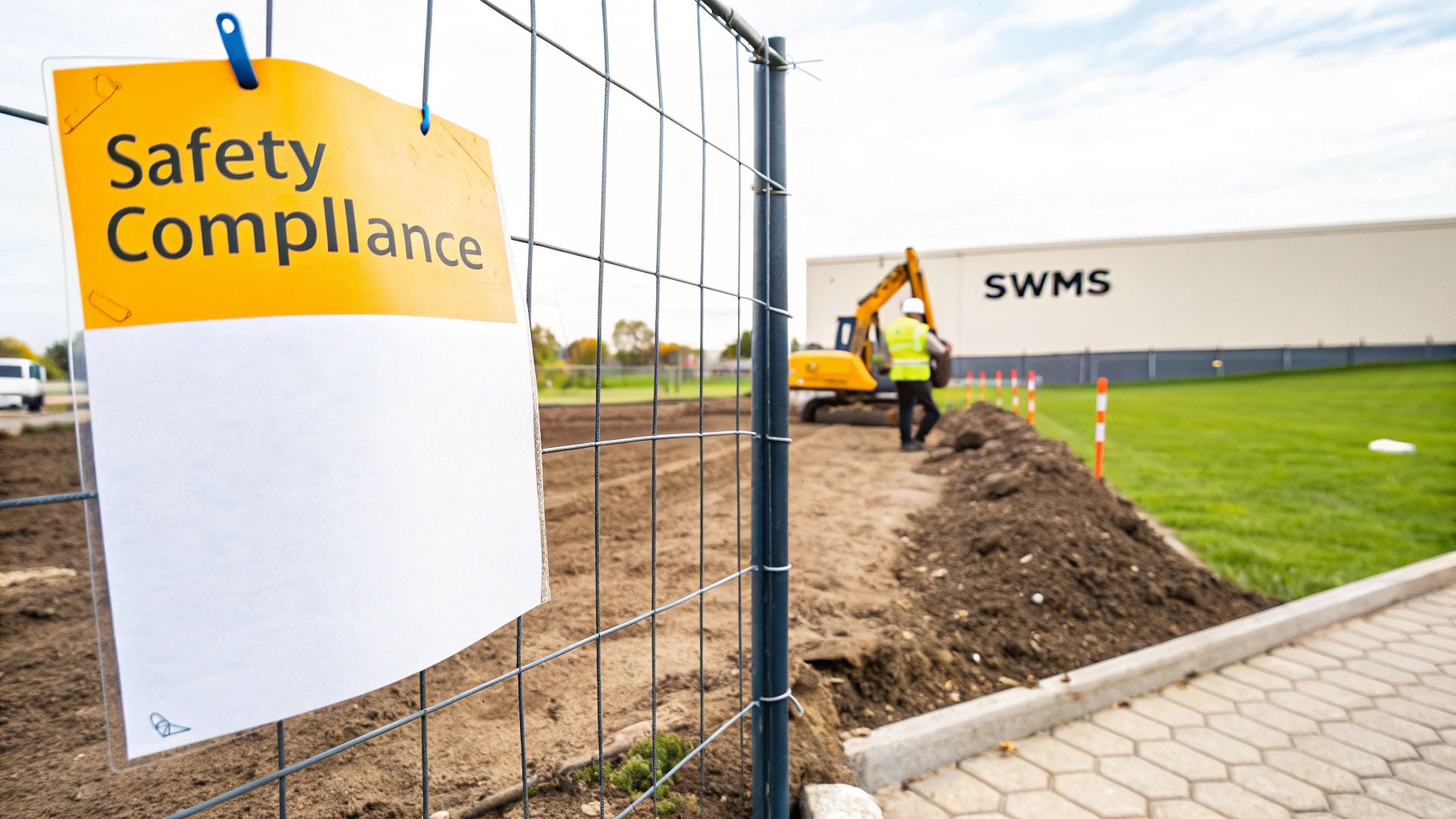
Those controls are especially vital in coastal areas like the Central Coast to protect our sensitive waterways from construction runoff.
Understanding Local Council Rules
Beyond state-level safety, your project absolutely must meet local council requirements. These can differ significantly; what Central Coast Council demands for a new build might be entirely different from the conditions set by Newcastle Council for a similar project.
A good local contractor is fluent in these nuances. They understand the specific Development Application (DA) conditions for your area and can implement the required measures without needing to be told. This local knowledge is precisely what helps your project move forward smoothly, avoiding costly fines or frustrating stop-work orders.
When working on sites that might contain rock or concrete, it's also critical that contractors are aware of the risks and prevention of respirable crystalline silica. As the earthmoving machinery market grows, driven by infrastructure projects, sticking to these standards becomes even more critical for everyone's health and safety.
Got Questions About Hiring an Earthmoving Contractor? We've Got Answers.
Here are a few of the most common questions we hear from homeowners and builders just like you. Getting these sorted out early on can make the whole process a lot smoother and help you move forward with confidence.
The Big One: How Much Does Earthmoving Actually Cost?
This is always the first question, and the honest answer is: it completely depends. The cost of hiring an earthmoving contractor is tied directly to the size and complexity of your job.
Think of it this way: digging out a simple driveway on a flat block is a world away from a major site cut on a steep, rocky slope in the Blue Mountains. The two jobs just aren't in the same league.
A few key things will always drive the price:
- The Machinery: Is it a nimble 5-tonne excavator for a tight spot, or do we need to bring in a 20-tonne beast?
- The Crew: How many operators and labourers does the job need to be done safely and efficiently?
- Spoil Removal: What are we digging up? The amount of soil, clay, or rock that needs to be hauled away—and the tip fees that go with it—is a major factor.
- Site Complexity: Steep slopes, tricky access, or hitting hard rock are the kinds of challenges that will naturally add to the cost.
Always insist on a detailed, itemised quote. A single lump-sum figure doesn't tell you the full story of where your money is going.
How Long is This Going to Take?
Just like cost, the timeline can vary wildly. Clearing a residential block might only take a day or two. But if we're preparing a large commercial site, we could be looking at several weeks.
A good, experienced contractor will give you a realistic schedule in their quote. They'll even factor in potential hold-ups like bad weather, which is always a possibility on the Central Coast, especially during the wetter months.
It’s also important to remember that surprises happen. Hitting a massive shelf of sandstone or digging up old building footings you never knew were there can definitely extend the timeline. A solid contract will always have a clause explaining how these kinds of discoveries are handled to keep things moving.
What Happens If You Hit Rock or Find Asbestos?
This is a very real concern, especially on older properties or in areas known for having rock shelves, which is common in many Sydney suburbs.
If there's even a hint of asbestos, a professional crew will stop work immediately. No questions asked. They'll then follow the strict protocols set out by SafeWork NSW to handle the situation safely.
Hitting unexpected rock is a bit different. The job will pause while everyone figures out the best way forward. This usually means bringing in specialised gear like a hydraulic hammer or a rock saw. This will be an extra cost, but it should have been mentioned as a potential variation in your contract from the get-go.
Ready to get clear, honest answers for your specific project? The team at Booms Up Civil has over 15 years of experience navigating the unique challenges of sites across the Central Coast, Newcastle, and Sydney. We provide transparent quotes and expert advice to get your project started on the right foot.