
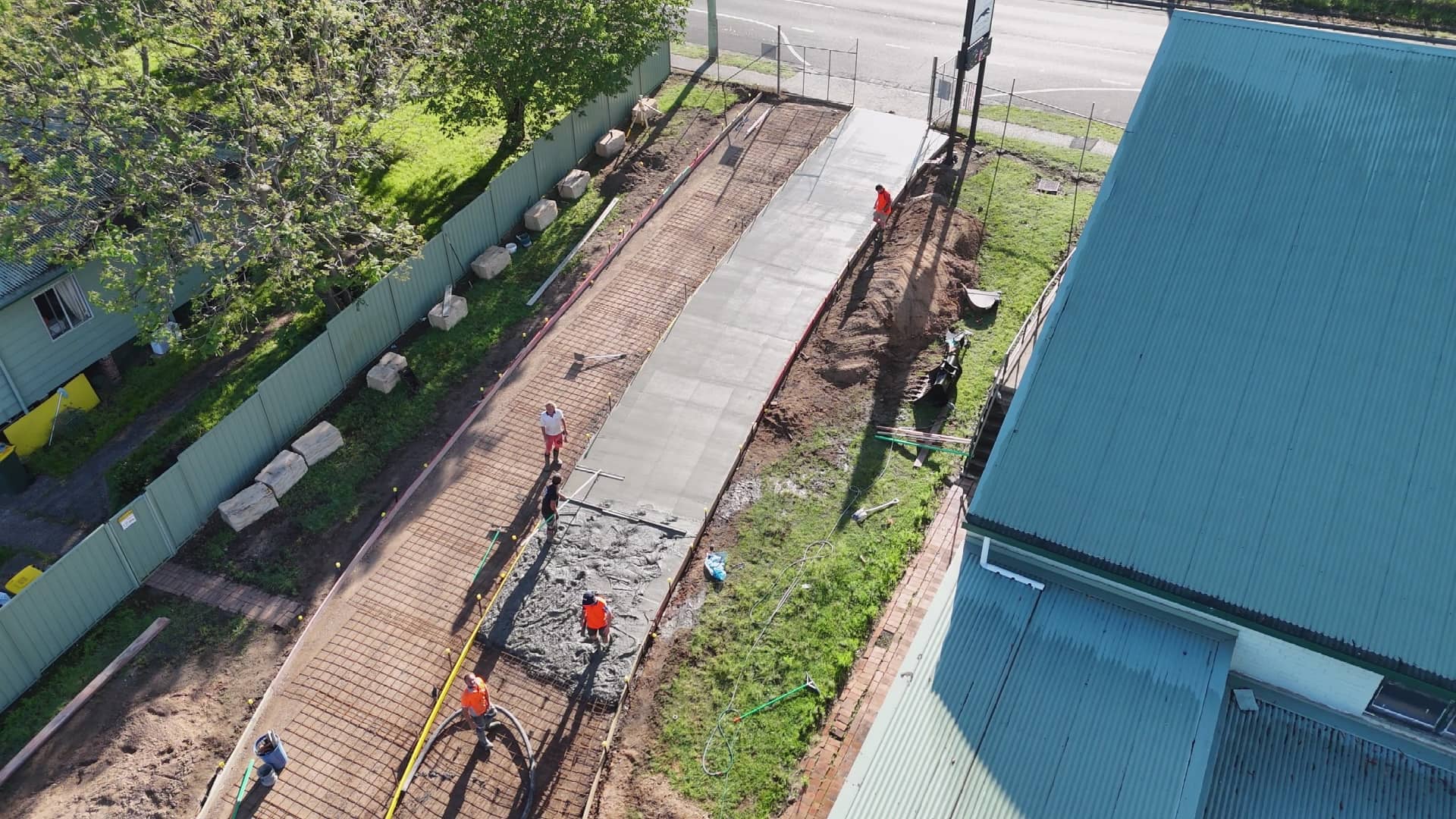
Whether you’re pouring a house slab, setting post holes for a pergola, or laying a concrete driveway, one question always comes first: how much concrete do I actually need? Get it wrong and you’re either short on pour day, one of the most stressful situations on a job site, or you’ve paid for material that’s sitting leftover in a skip bin.
This free calculator takes the guesswork out. Plug in your dimensions, select your pour type, and it gives you your volume in cubic metres, total weight in tonnes, and the number of 20 kg premix bags you’d need if you’re mixing yourself. Use it to get a ballpark before you call a ready-mix supplier, or before you get a quote from a concreting contractor.
Concrete Volume Calculator
Estimate concrete volume, weight & premix bags
How to Use This Calculator
Start by selecting the type of pour from the five options at the top. Each one changes the input fields to match exactly what that shape needs.
- Slab / Wall — for house slabs, driveway pads, paths, and retaining wall panels. Enter length, width, and thickness in millimetres.
- Square Footing — for pad footings under posts or columns. Enter the side length and depth.
- Round Column — for pier footings, post holes, and cylindrical columns. Enter the diameter and depth.
- Circular Slab — for round pads, tank bases, or circular aprons. Enter the diameter and thickness.
- Steps — for a full flight of solid concrete stairs. Enter the width, rise (height of each step), run (depth of each tread), and number of steps.
The Waste Allowance field adds a buffer on top of your calculated volume. Ten percent is a reasonable standard for most pours. You might drop this to 5% on a clean column job where you’re pumping straight into formwork, or push it to 15% on uneven ground where the sub-base has dips and high spots.
The Quantity field is handy when you have multiple identical pours — say, 8 post holes for a pergola all the same size. Enter the dimensions once and adjust the quantity rather than running the calculator multiple times.
Understanding Your Results
Net Volume vs. Total Volume
The net volume is the pure mathematical result — the exact space your pour needs to fill. The total volume adds your waste allowance on top of that. When you’re ordering concrete, always order to the total volume figure, not the net.
The Premix Bag Count
The bag count is calculated based on standard 20 kg bags, which yield approximately 0.01 m³ of mixed concrete each. This figure is most useful for small jobs — post holes, small footings, and garden projects. As a general rule, once your total volume goes past 0.5 m³, you’re better off ordering a ready-mix truck. Mixing that volume by hand is time-consuming, the batches won’t be consistent, and the cost of bags quickly overtakes a ready-mix delivery.
Weight
Concrete weighs approximately 2.4 tonnes per cubic metre once cured. The weight figure in the results is based on this standard density. It’s useful if you’re working out structural loads, or if your site has access restrictions and you need to know what a concrete pump truck will be dealing with.
Concrete Volume Reference: Common Pour Types
| Pour Type | Typical Thickness | Notes |
|---|---|---|
| Residential house slab | 100 mm | 85–100 mm is standard for most residential builds |
| Driveway / hardstand | 100–125 mm | 125 mm for heavier vehicle loads |
| Footpath / path | 75–100 mm | 75 mm fine for foot traffic only |
| Pad footing | 300–450 mm deep | Depends on engineer spec and load |
| Post hole (round) | To engineer spec | Typically 300–400 mm diameter |
| Concrete steps | 150–180 mm rise | 240–300 mm run per tread is standard |
Real-World Examples: How the Numbers Stack Up
Residential driveway on the Central Coast
A standard double driveway measuring 6 m wide by 8 m long, poured at 100 mm thick, gives you 4.8 m³ net. Add a 10% waste allowance and you’re ordering 5.28 m³ — so a 5.5 m³ ready-mix delivery is a sensible call. At 2.4 t/m³, that’s around 12.7 tonnes of concrete. You’d need 528 bags to do it by hand, which is why nobody does it that way.
Post holes for a pergola in Newcastle
Eight post holes, each 350 mm diameter and 800 mm deep, works out to 0.077 m³ per hole, or 0.62 m³ total before waste. With a 5% waste allowance that’s 0.65 m³. That sits right on the boundary where a small ready-mix delivery or a concrete mixer hire starts to make more sense than hand mixing 65 bags — especially in summer.
House slab in the Hunter Valley
A 15 m x 10 m slab at 100 mm thick is 15 m³ net. With a 10% waste allowance you’re ordering 16.5 m³. That’s a single concrete truck delivery — most standard agitator trucks carry 7–8 m³, so you’d be looking at two loads. At 2.4 t/m³, that’s roughly 39.6 tonnes of concrete going into the ground.
When Should You Use Premix Bags vs. a Ready-Mix Truck?
This is a question we get asked a lot, and the honest answer comes down to volume and time.
Premix bags from a hardware store make sense when your pour is under 0.3–0.5 m³, you have easy access to water and a mixer, and you’re not under time pressure. They’re perfectly fine for post holes, small footings, and garden projects.
A ready-mix truck makes sense for anything over 0.5 m³, any structural pour, and any job where consistency matters. Concrete that’s mixed in batches over a long period can have varying water-to-cement ratios, which affects strength. A ready-mix load is batched to spec at the plant and delivered in one consistent mix.
For reference, most ready-mix suppliers in the Newcastle and Central Coast region have a minimum order of around 0.5–1 m³, and pricing is typically per cubic metre with a delivery fee on top. It’s worth getting at least two quotes, as pricing and minimum loads vary between suppliers.
A Note on Slab Thickness
One of the most common mistakes on residential concrete jobs is under-specifying thickness to save money on volume. A 75 mm slab instead of 100 mm saves about 25% on concrete, but it also significantly reduces your load-bearing capacity and makes the slab more prone to cracking, especially in areas with reactive clay soils, which are common across the Hunter Valley and parts of the Central Coast.
If your job requires a slab that vehicles will drive on, or if it’s a structural element like a house pad, always work to your engineer’s specification rather than the minimum. The cost of repouring a failed slab far outweighs any savings made at the ordering stage.
Need a Concreting Quote on the Central Coast, Newcastle or Hunter Valley?
These numbers give you a solid starting point for budgeting, but every site is different. Soil conditions, access, reinforcement requirements, and finishing options all affect the final scope and cost of a concrete pour.
If you’ve got a project coming up, whether it’s a house slab, driveway, retaining wall footing, or something more complex, get in touch with the team at Booms Up Civil. We handle excavation, site prep, and concrete work across Newcastle, the Central Coast, and the Hunter Valley, and we can give you a proper site-specific quote.
These calculations are estimates only. Always consult a licensed contractor or structural engineer for specification on structural concrete pours. Concrete volume requirements may vary depending on sub-base conditions, formwork tolerances, and site-specific factors.